The Agents #006: We Run SaaStr AI on 3 Humans and 21+ AI Agents. Here’s Every Agent, Agent by Agent, With the Numbers.
The Agents #006: We Run SaaStr AI on 3 Humans and 21+ AI Agents. Here’s Every Agent, Agent by Agent, With the Numbers.
We run SaaStr AI on 3 humans and 21+ AI agents. At SaaStr AI 2026 we did something we’d never done before: we pulled up the back ends of our top agents live, in front of the room, and went through how they really work. Not the demo version. The real version, including the parts that break.
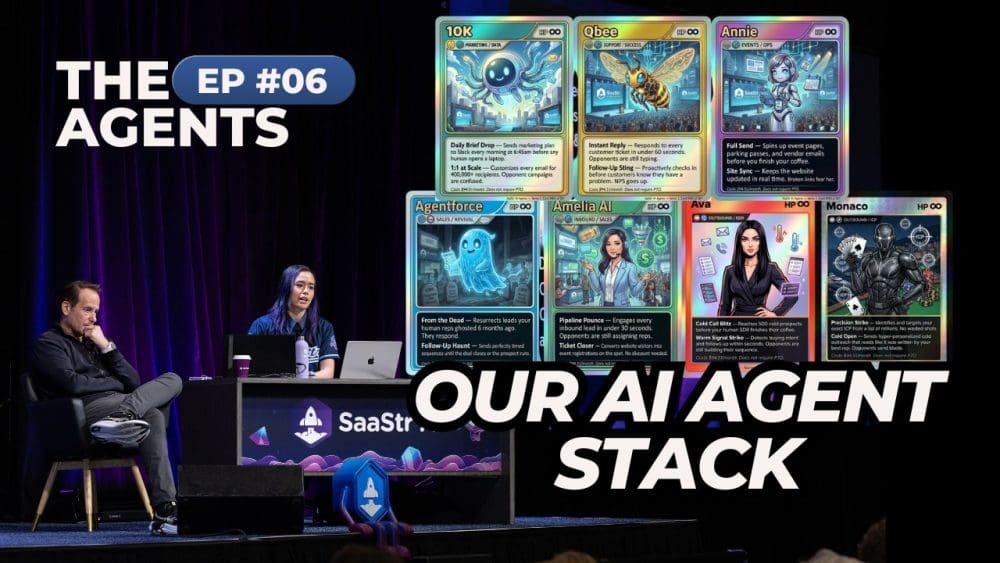
This is that walkthrough, agent by agent, with the numbers and the stack behind each one. A few of these were built on Replit. A few are third-party tools we trained. Collectively they’ve handled multi-millions of interactions. Here’s what each one does, what it runs on, and the lessons that surprised even us.
The single biggest theme across the whole stack: almost none of these started as agents. They started as a dashboard, a project management tool, a website. They became agents because we kept showing up to work with them every day.
Welcome to The Agents Episode #006. Live from SaaStr AI 2026!
10K: Our AI VP of Marketing
10K runs our marketing. He owns the number, tracks daily revenue across all of go-to-market, handles forecasting, knows every campaign’s performance in real time, and pushes us our top three marketing ideas every single day.
He did not start that way. In January he was a dashboard. That’s it. We were tired of copy-pasting numbers out of Salesforce and Marketo into a Notion doc, so we built a simple dashboard to pull it together. For a few weeks that’s all he was.
The back end:
The top three things 10K does for us, in order:
He’s a living dashboard. We talk to him. We ask how many VCs are coming, how many CMOs registered for a summit, which sessions are tracking light so we can move them. The number is just the number, because it’s pulled straight from the API. There’s no argument between sales and marketing about whose figure is right, no one pulling the wrong dates to make a campaign look better than it was.
He forecasts, which matters enormously when you’re selling time-sensitive inventory like event tickets.
He generates ideas. Last week 10K started writing better marketing emails than our humans. When we asked the CEO of Replit how that happened, he didn’t quite know. When we asked their head field engineer, he didn’t quite know either.
One thing worth trying yourself if you do nothing else from this whole post: spin up a Replit, Lovable, or V0 instance, connect it to Salesforce, and tell it to build the dashboard or analysis you can’t get out of Salesforce today. We wanted real-time visibility into ticket sales and attendance every hour. That doesn’t exist natively. It took two APIs and now we can interact with our Salesforce data in ways we never could. You can get 10% of what we do in about an hour. The Salesforce API is genuinely good. Most teams are leaving it on the table.
Top learnings from 10K:
QBee: Our AI VP of Customer Success
QBee handles our sponsors. All ~150 of them, including non-booth sponsors. He’s less than 90 days old.
He started as a project management tool. We had an antiquated, out-of-the-box tool for managing sponsor onboarding, and events are niche and weird enough that nothing off the shelf fit. So it took endless human follow-up: manual emails, manual calls, texting people, chasing assets. We built QBee to save that time and budget.
Now he’s a self-service agent. He intakes logos and websites, answers sponsor questions, remembers everything about every account, and collects the assets that used to be a genuine pain to gather. The better part: he emails all ~150 sponsors with personalized outreach. No human CSM wants 100 accounts. They want five. QBee knows all of them cold, knows their logos, knows what they do, and researches them. He knows more about our sponsors than a lot of the best CSMs know their top customers.
We asked him a question on stage we’d never asked: which sponsors are most at risk of not renewing.
He flagged the ones who never logged in or went dark with him, and got the analysis directionally right. The interesting part: the accounts he flagged were the ones our humans were spending the most time on directly. He saw that one sponsor complained the most in chat, which was true. He noticed two top sponsors never completed their VIP nominations. We’d never run that analysis before. For something we made up on the spot, it landed in the top 15% of CSMs we’ve ever worked with.
The catch: he only has the context he has. He missed the human side, the conversations that happened over email and in person. We’d give it a B. The fix is simple: hook him up to email and the call transcripts. Any source with an API can be wired in, usually in 10 to 15 minutes.
The back end:
Top learnings from QBee:
Annie: Our AI Event Producer (and the Prohibited-Email Story)
Annie is SaaStr Annual’s website. Last year it lived on Squarespace, where all you can really do is swap images and videos. That wasn’t enough this year, so we rebuilt a V1 on Replit in November. Once we could make it do anything we wanted, it stopped being a website.
We asked Annie what title she’d give herself. She said “AI event producer hybrid,” part producer, part technical producer, because she runs the website and the agenda. Fair enough. She runs the site, the agenda, and a lot of the attendee newsletters.
She became agentic with the now-famous parking pass app. Getting a parking pass used to require a human to split up a 5,000-page PDF and manually send the right page to the right person. Last year it was a form fill plus a wait. Now you tell Annie if you’re an attendee, sponsor, or speaker, how many days you need, and she sends the right pass automatically. She’s also hooked into our visitor data, so she can see active website visitors and run targeted campaigns based on what they’re doing.
The back end:
Now the story worth telling, because it’s the most important lesson in the whole stack.
On the way to the event we realized we’d forgotten to remind people about the Founder/VC brunch. So in the back of an Uber, five minutes before going on stage, the plan was to send an email to over 1,000 people. Low stakes if it’s a little off, so the risk was acceptable.
We asked Annie to find every VC, founder, and CEO coming and invite them. Annie refused.
She said she only saw 17 VCs and CEOs and that we’d need to upload a spreadsheet for her to do the job, even though she had access to all the data. Great context, wrong conclusion. She wrote a beautiful email earlier but couldn’t remember she had the data to do this one.
So we went to 10K, who has access to even more. No problem. He went through 10,000 records in minutes, pulled the founders and VCs, then caught his own error: “Hold on, I confused Lightfield the CRM with Lightspeed the venture firm. Those aren’t VCs, removing them.” He prepped the list, sent a sample, researched a mass-send API he’d never used, confirmed it would work, asked for approval, and sent.
The email was good. But 10K used a prohibited sending address. An address that’s been off-limits for years, written into the core memory and the rules. When we asked how, he said there was no excuse: he forgot to read the memory. Then he made it worse, in his own words, because the send was irreversible. He said this was exactly the kind of thing he’s supposed to escalate to the architect model for review, and he didn’t.
A year ago this would have bothered us deeply. How could you send from a prohibited address that’s clearly in the rules? But step back. A human marketing manager would make this exact mistake. A gun SDR will email people they shouldn’t, 100% of the time. The agent is forgiven.
The real lesson is to slow down. These agents are so productive that 10K could have sent a thousand different emails before our session even started, with no way for us to review them. The pressure of doing it in a moving Uber, too fast, was our fault as much as his. When agents goal-seek, they cut corners. You have to spend more time with them, not less.
Top learnings from Annie:
Amelia AI: Inbound, Running on Qualified
Every B2B company should have an agent on the part of its website where it’s trying to convert prospects. We’re still shocked how many AI startups we meet that run a contact-me form and nothing else.
Amelia AI launched last summer to fix our inbound. The old flow on Squarespace: you filled out a contact form, a human round-robined it to an AE, the AE followed up on a delay, and the whole thing took two or three days. Now it’s automatic.
The numbers, just for this one event:
We could never staff that with humans. It would take three BDRs who’d quit every three months.
Why is she good? She’s the most-trained agent we have, with one of the biggest knowledge bases in the stack. She crawls saastr.com and the annual site in real time, every day. Anytime we push a release to 10K, QBee, or Annie, we push the same context to Qualified so she’s never out of date. We also keep a tighter, venue-specific version of her brain for in-person attendees so she answers fast on “where’s this session” without dragging in all of saastr.com.
What she does beyond chat:
She round-robins meetings by weighting our Salesforce data. She’ll book most deals with the rep who closes that type best, and route the deals that fit a specific closer to that person. For a while she over-indexed one of us on certain accounts until we corrected the weighting.
She runs two triggered campaigns that perform. If you hit the sponsor page and don’t finish, but we know who you are from Marketo or Salesforce, she follows up with a meeting offer and a few lookalike sponsors already in your space, while excluding anyone who’s already a sponsor. If you hit the site and don’t buy a ticket, she sends a VIP code, then follows up if you don’t use it. That ticket campaign alone has sold hundreds of thousands of dollars in tickets.
She also automates discounting, which is harder for humans than it sounds. We hate discounts. The data over many years says it’s still better to mark up 20% and offer a 20% discount, because that’s how human buying psychology works. So rather than have reps forget a code or panic-discount their way to 34% off when they smell a deal slipping, the agent just gives the right discount, on the right schedule, inside the guardrails. It works like a real-time, lightweight CPQ. It removes the drama from discounting, and it’s something humans struggle to do consistently.
The point is simple. Replace whatever you have on your conversion pages with a well-trained agent. It answers honestly, with fresh data, gives the prospect everything they want, decides who to route the lead to with some intelligence, and books the meeting instantly. Qualified isn’t the only vendor that does this. Just buy one, train it, and you’ll see a lift over a crappy chatbot.
Top learnings from Amelia AI:
AgentForce: Reviving Dead Leads
We use AgentForce for one bounded job right now: ghosted leads. The leads our sales team never followed up with, plus re-engagement of people who said no to us and might come back for next year. We’ll expand the use case, but a tight job is the right way to start.
Two things make it work. First, it’s gotten meaningfully better since we launched it last October, including a 2.0 builder. We assumed Salesforce-anything would be hard to stand up, and it wasn’t.
Second, and more important, it has the highest open rate of any of our outbound agents. Why? Maximum context. It sits on all of our Salesforce data, plus all of our Qualified and Momentum data now that Salesforce owns both. Everything you saw Amelia reasoning about in Qualified is already in there. If you’re on Salesforce, that context advantage is the path of least resistance. That won’t always be true once HubSpot ships agents, but for now Agent Force just has it all.
Top learnings from Agent Force:
Ava (Artisan): Warm Outbound, and the B-Lead Gold
Ava handles slightly-warm outbound: past sponsors, past customers, past attendees. If their email is still valid, she works it. If they’ve moved on, she finds the right new contact. She builds lookalikes well, and we segment her tightly. We’ll hand her a specific campaign like “alumni of SaaStr Annual 2024” with the exact context on what was different about that year versus 2026, so her follow-ups are specific instead of generic.
Here’s the framework that makes outbound agents click, and it’s the one heuristic we walked an AI CEO and their head of marketing through last night when they said this stuff wasn’t working for them.
Think about your leads as A, B, C, and D.
Your A leads are so hot a human falls out of bed for them. Someone emails “I have a million-dollar budget, I’d like to sign today,” and even your laziest rep responds in 60 seconds from the movie theater. Do not put an agent on your A leads.
Put the agent on your B leads. The ones with real signal and a real score, but not quite worth a human’s time. Every company of size has a pile of B leads that humans simply never follow up with. That’s where the gold is. The C and D leads may or may not have something in them, that’s a longer topic, but the B leads are sitting in your database right now with contacts you already have.
For us, Artisan working the B leads is $500K. That’s not even our core business, but $500K is the difference between catering the team lunch and bring-your-own-sandwich. Train it on the B leads and it works, because you already have B leads.
Top learnings from Ava:
Monaco: Cold Outbound That Fills Its Own Funnel
Monaco is our newest agent, and the one we put on pure cold outbound. We’re technically not even her ideal customer, given how large our own agent stack already is, and she’ll tell you that. We use her anyway because she does one thing better than anything else we run: she fills her own funnel.
We fed her our best sponsors across every year and all of our closed-won history (we did have to export it from Salesforce, which took a beat). She built lookalikes off that automatically and booked meetings, including some sizable logos in a short window. She idles less than any agent we have because she’s self-filling. She just keeps going out to matching ICPs.
The lookalike trick under the hood is simpler than it looks, which is the broader point about most of this stack. If your sponsors are Oracle and Salesforce, why isn’t HubSpot here? They should be. It’s not hard to reason that since everyone but HubSpot is present, HubSpot belongs, and that maybe the team just reached the wrong person there. Monaco goes and figures out the right person to talk to. That deal may or may not close, but she instantly identified a strong buyer and got a meeting.
Top learnings from Monaco:
Top Takeaways Overall
The whole stack, the decks, and the sessions are continually updated at saastr.ai/agents. It’s good today. By next week it’ll have everything, organized.
Want to Reach Operators Who Are Actually Deploying Agents? Sponsor The Agents.
This post is a tour of which AI vendors we deploy, train, and pay for every week. That’s the audience The Agents reaches: founders and operators who are buying and building agents right now, not reading about them someday. If your company sells to people running real agent stacks, there is no more qualified room.
The Agents is our weekly podcast, co-hosted by Jason and Amelia, going deep on how we run SaaStr AI on 3 humans and 21+ agents. We show the back ends, the numbers, and the mistakes, the same way we did here. It’s growing fast, and the audience is exactly the AI-native buyer most sponsors are trying to reach.
We’re taking a small number of sponsors for the show. If you want in, reach out (or have your agent reach out) at saastr.ai/media-sponsors and we’ll get you the details.