
New research: Customer service team evolution
We analyzed 166 interviews with support leaders, managers, and frontline specialists to understand what changed once AI Agents like Fin became part of everyday work.
There’s anecdotal evidence that customer service teams are undergoing significant change, both as a result of companies implementing AI tools to support their work and due to broader technological shifts that are redefining their responsibilities. However, the scale and prevalence of these changes remain unclear.
Here’s what we gleaned from the data.
TL;DR: What’s changing
Research methodology
The goal of this research is to understand how many customer service teams have changed their roles, responsibilities and ways of working due to adopting AI agents, as well as understanding how these changes manifest within their organizations.
For this study, the data chosen consists of interviews conducted by the research team, either with Intercom customers or prospects. This data was chosen because the focus of the interviews revolved around the individual experience of the participant, which gives a higher chance of information related to role changes to be present.
The data was collected using Snowflake by pulling all interviews stored in gong conducted by a member of the research team from 01-01-2025 to 14-10-2025.
After the data was pulled, a python script was used to clean the conversation corpus for each conversation retrieved. Common English stopwords (e.g. “and”, “very”, “with”, etc.) were removed, as well as all the text associated with a speaker in the conversation that was not the interview participant(s). This was done to reduce the computational power required for the conversation coding, avoid API timeouts and reduce costs.
After the corpus was cleaned, the OpenAI API was employed, alongside a prompt, to code each conversation using closed codes defined in a closed codebook.
The codes used were:
Data analysis
166 conversations were retrieved. More than 90% of all conversations report some sort of change either in their role, team, or processes due to implementing Fin, or a similar AI product, with only 13 participants reporting no changes.
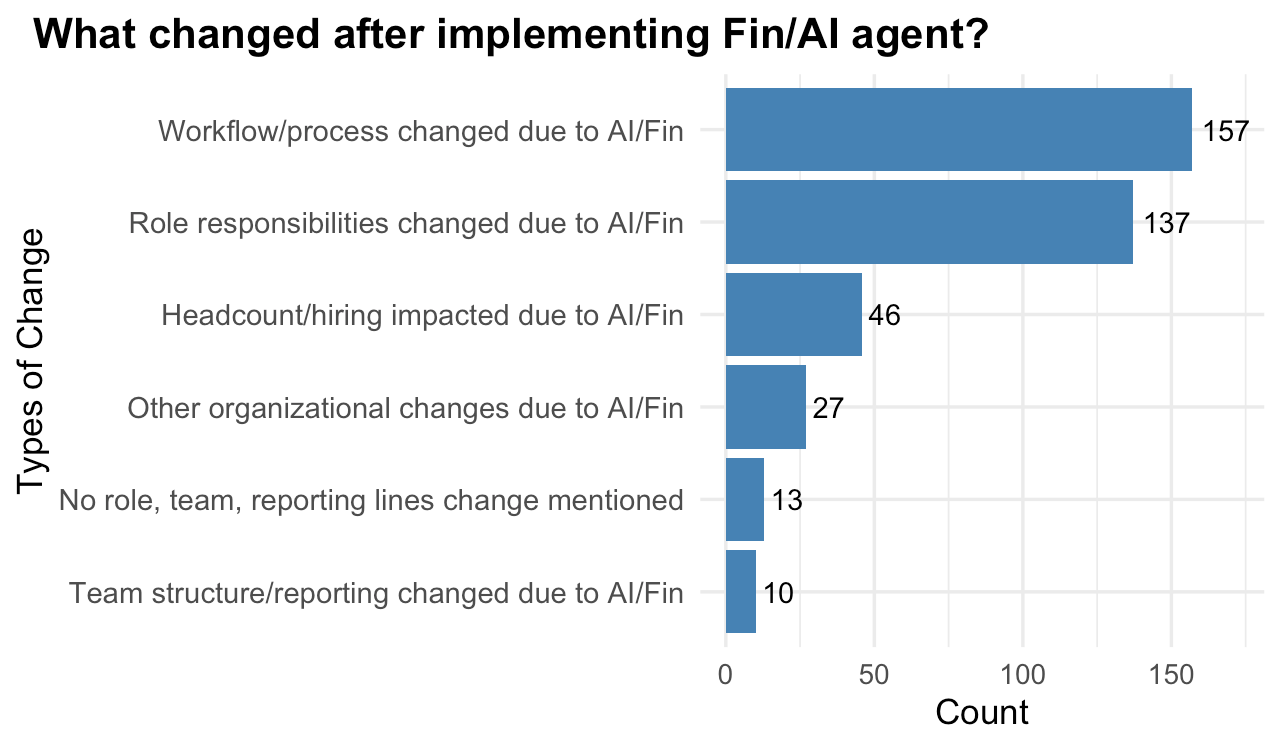
Fig 1: Types of changes due to Fin/AI agent implementation. Each conversation can have more than one type of change code associated with it (M = 2.35, Med = 2, Min = 1, Max = 4, N = 166).
More specifically, after implementing Fin or a similar AI product:
Additionally, 16.27% participants reported a change for a different reason from the ones highlighted above (“Other organizational changes due to AI/Fin”).
Sample representativeness
The sample is representative with a confidence level of 90% and a margin of error of ±6.4% (accounting for an overall unknown population size). The individual confidence intervals for each type of change are shown in the table below.
Thematic analysis
Across the dataset, here are the core themes that emerged.
1. Automation and AI integration replacing manual steps (94.58%)
Participants overwhelmingly describe automation and AI integration transforming support workflows. This highlights the disruptive and transformative power of AI in CS:
In short, AI is embedded across every step of the customer service pipeline, creating hybrid human–machine workflows and removing a large amount of repetitive manual work.
2. Humans shift to oversight, AI handles execution (82.53%)
Roles have become more strategic and supervisory, while AI absorbed much of the execution work:
Overall, AI made roles broader and more analytical, demanding less manual interaction and more responsibility for optimization, configuration, and strategy.
3. Reductions or slower growth due to efficiency gains (27.71%)
Headcount effects were mixed but mostly downwards or stabilized thanks to automation:
In short, Fin/AI is enabling companies to maintain or reduce staff while handling greater volumes of work.
4. New AI teams, flatter orgs, fewer escalation layers (6.02%)
Structural changes were smaller in volume but notable in nature:
Overall, team design is becoming more modular and data-driven, with AI-focused units and fewer siloed escalation paths.
5. Broader digital transformation and operational modernization (16.27%)
These reflect broader organizational and strategic shifts:
Essentially, “other” captures AI-driven modernisation across culture, tools, and strategy – going beyond support into how the organization operates and learns.
How have customer service roles and responsibilities changed due to Fin/AI agent implementation?
Implementing Fin or a similar AI agent profoundly changes how an organization operates, with around 95% of participants reporting some level of change in their processes after implementation. These systems have significantly reshaped the workflows that customer service teams are used to. Tasks once performed manually, such as ticket triage, routing, repetitive responses, and translations are now handled by AI agents.
“This marks a clear transformation in how customer service agents work: moving away from directly resolving customer queries to focusing on more analytical and procedural work”
As a result, customer service agents’ responsibilities have shifted from performing manual tasks to monitoring and fine-tuning the AI agent whenever its output is inaccurate or incomplete. This marks a clear transformation in how customer service agents work: moving away from directly resolving customer queries to focusing on more analytical and procedural work, such as testing, QA, and performance analysis of AI outputs.
Human agents who still handle conversations tend to do so either because the AI agent cannot yet respond adequately, or because of an organizational choice to retain human involvement for sensitive or high-value interactions. Nevertheless, the need for such roles is diminishing. Around 28% of participants reported a reduction in Tier 1 staff or a hiring slowdown or a full hiring freeze, as AI agents increasingly manage simple requests and organizational attention shifts towards improving automation efficiency.
“In some cases, this has led to the creation of specialized AI teams, reorganizations around workflow complexity, or the merging and redefinition of existing roles”
However, this transformation is not uniform across companies. While some roles have disappeared (particularly escalation layers), others have emerged. Many organizations are reallocating existing staff to AI management or hiring new technical profiles such as automation engineers, implementation specialists, and AI leads. In some cases, this has led to the creation of specialized AI teams, reorganizations around workflow complexity, or the merging and redefinition of existing roles.
Around 83% of participants reported changes to their roles or responsibilities following the introduction of Fin or similar AI agents. Specifically:
These structural changes have also fostered cultural change. Participants observed a growing emphasis on experimentation, continuous improvement and modernization, with stronger collaboration between customer service, data, operations, and product or engineering teams.
Overall, a widespread transformation is occurring in how customer service agents and teams operate following AI agent implementation. Roles are evolving, responsibilities are diversifying and collaboration across functions is becoming the norm. Given how pervasive these changes already are – and the continuous improvement of AI technology – it is likely that this transformation will become even more pronounced over time.
This evolution raises two important questions
Firstly, do customer service agents possess the skills required to succeed in these new roles? While they are experts in customer interaction and company policy, their work now demands new competencies in data analysis (e.g. reporting AI agent performance and how it changes over time), quality assurance/debugging (e.g. Fin output testing and versioning), and cross-functional communication (e.g. if help from another team is required, drafting a business case to justify the resources required could be needed).
Secondly, what long-term strategies are companies adopting to support these evolving roles? Some are reorganizing entirely around automation, while others retain traditional structures. For those undergoing transformation, it remains unclear whether these changes are part of a deliberate strategic plan aimed at achieving specific performance outcomes, or the result of experimentation without defined goals.
Ultimately, Fin’s success – and of AI in customer service more broadly – depends not only on the technology itself but on the people and strategies that shape its use. Understanding and supporting these human and organizational factors will be critical to ensuring that the benefits of AI adoption are fully realized.