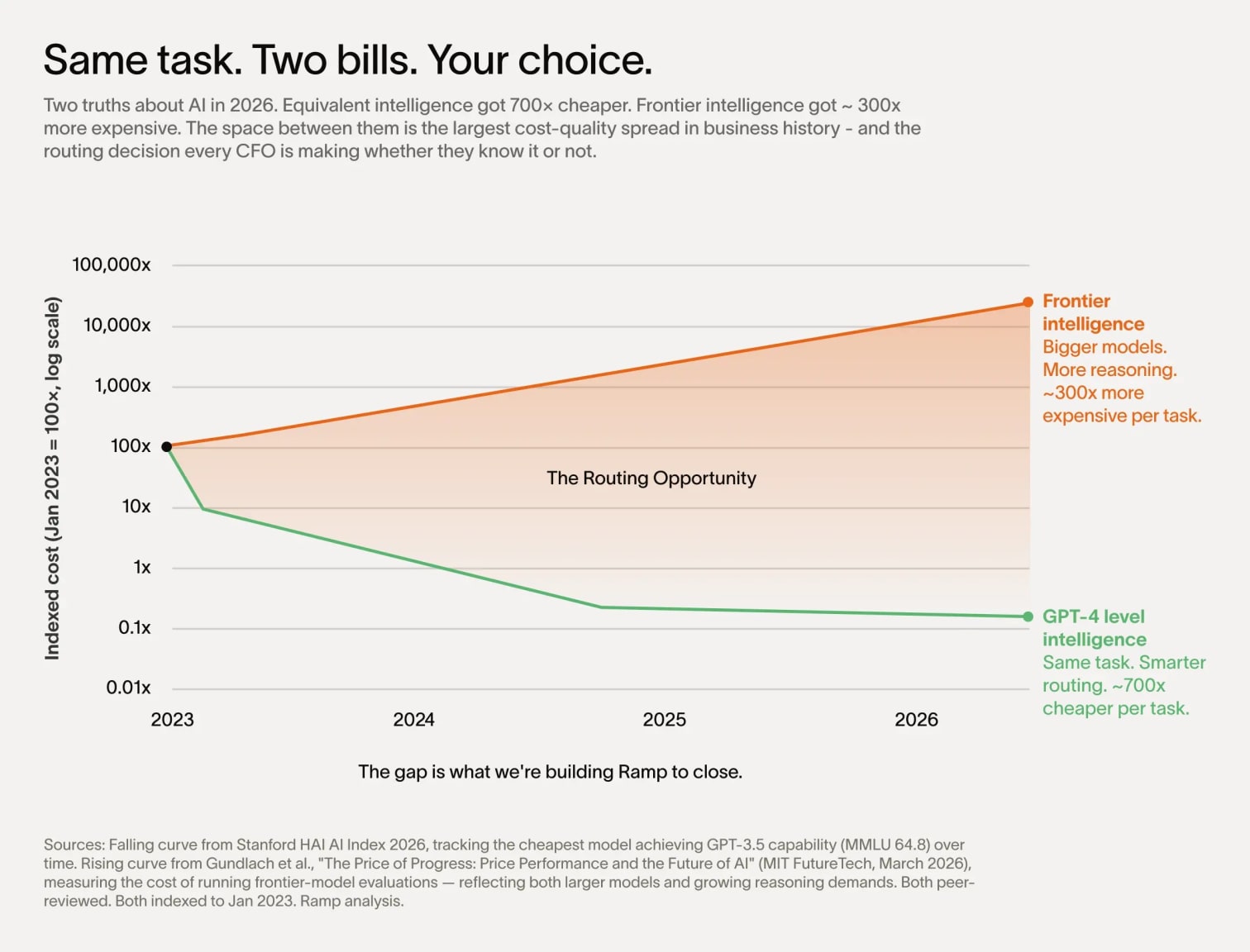
The Substitution Wave in AI
Three forces are reshaping the AI cost structure :
The natural response from AI buyers is substitution.
Coinbase6 :
At Coinbase we’re working hot on routing prompts to cheaper models where appropriate, & in some cases have been able to keep costs roughly flat, while token usage continues to grow exponentially.
Lindy7 :
Pulled the trigger today & switched 100% of Lindy traffic to DeepSeek v4, churning from Anthropic models. Saves us millions of $ & we’re actually seeing an increase in performance on many core use cases. Transformative for the business.
Harvey8 :
On a 100-task slice of our Legal Agent Benchmark (LAB), SFT moved Kimi 2.6’s all-pass rate from 11% to 15%, beating Opus’ 14%. But the cost gap was even more striking : $84 vs $954 across the same 100 tasks, or ~11x cheaper.
Cursor went further. They post-trained Kimi K2.5 into their own production model, Composer.9
Composer 2.5 is exceptionally intelligent & up to 10x more efficient than similarly capable models.
Coinbase’s quote shows where the savings go : costs flat, tokens exponential. Buyers don’t pocket the discount — they spend it on more intelligence.
Closed models are getting more expensive at the frontier; open models are getting cheaper at parity. The choice is which slope you want under your unit economics.