4a9cb03a07b1ecfb21c72835977aa831c821c524d904058e232cccfe49ad7e0f

Building a helpdesk is not hard.
It is, as our CEO Sylvain Perron puts it, "a pretty easy and well-known endeavor."
Ticketing, routing, a shared inbox, some analytics — this is solved software. It has been solved for twenty years.
What the major players in customer support haven't spent those twenty years solving is AI.
Zendesk launched in 2007. Freshdesk in 2010. Intercom in 2011. They are, by most measures, excellent ticketing systems. And when AI became something customers expected, they did what any mature software company does: they acquired, they integrated, they shipped a feature tier.
Their legacy architecture made it genuinely difficult to do the one thing that mattered: build AI that actually knows what it’s doing.
"They simply wrapped GPT in the simplest and dumbest way they can," says Perron, "because they don't understand the subtleties, and they don't have all the experience of building those kinds of AI agents at scale."
Botpress has spent the past decade building exactly that AI infrastructure.
Building the helpdesk was the natural next step.
An AI agent company that built a helpdesk — not the other way around
Botpress has been building AI agents since 2017 — before most support tools had an AI roadmap. We’ve shipped more than 750,000 AI agents across every industry and edge case imaginable.
What that distinction means in practice is hard to replicate: years of learning where AI fails, why it fails, and how to build the infrastructure that makes it stop failing.
Building a helpdesk on top of that core AI foundation is, frankly, the straightforward part.
What that depth of AI experience also makes clear is the structural problem at the center of every major helpdesk on the market: the AI and the human workspace are separate systems.
The traditional human-AI separation means every escalation is a cold handoff, i.e. a dead end. Typically the AI handles what it can, hits a wall, hands a ticket off to a human, and disappears. The human agent starts from scratch with no context, and the AI learns nothing from how they resolve it.
"If you don't own the support operations," Perron says, "and you just escalate — fire and forget — then you don't have a loop. It's virtually impossible for your agent to keep up and become better over time."
That is not something you can fix with a product update. It requires owning both sides of the operation in the same system, which is what Botpress now does.
AI and humans, working in the same room
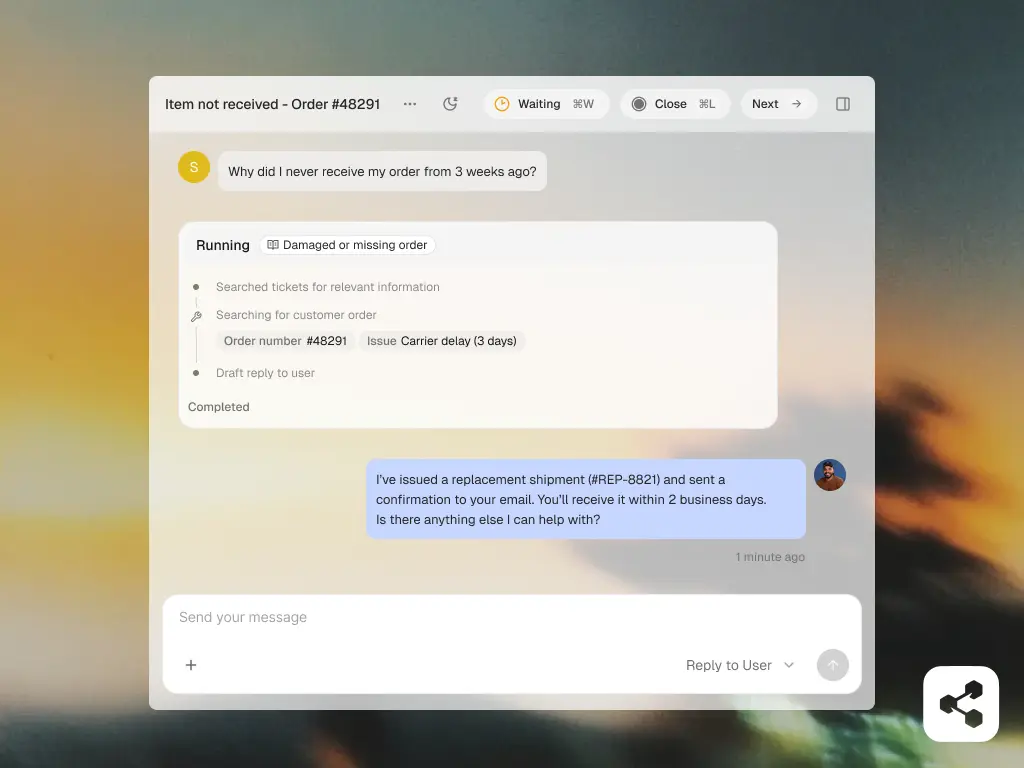
In Botpress’ new AI-native helpdesk, AI agents and human agents share the same environment and the same view of every conversation. When a ticket needs a human, the AI agent stays in the conversation — contributing what it can, passing full context, learning from how the human resolves it.
In practice, this means that by the time a human agent opens a complex ticket, the AI agent has already pulled logs, retrieved configurations, cross-referenced known issues, and written a findings report. The investigation that used to consume the first twenty to thirty minutes of a technical ticket has already happened.
"I get all the information I need and potential investigation avenues as soon as the AI agent hands off the conversation to me," says Ossama Elbannaoui, a Botpress support engineer who uses the product daily. "This has tremendously reduced time to resolution and leaves customers actually excited to reach out when new issues arise."
That resolution becomes the AI agent's answer the next time the same situation comes up. The more the team works, the better the AI gets. "An hour for support staff invested in Botpress," Perron explains, "is an hour that will compound and yield dividends many times over."
The most important vendor decision in customer support right now
There is a larger question here that the incumbents have a strong incentive to avoid: where is this all going?
"If there is one thing we're sure will happen in the future," Perron says, "it is that AI will keep doing more and humans will keep doing less."
AI is not a feature to be added to support software — it is the thing that will eventually run most of support operations, handling the complex tickets, the judgment calls, the multi-step workflows that currently require a human because no one wrote the rulebook for them.
This forward-looking view means the most important vendor decision a support team makes right now is not which ticketing system has the best UI. It’s who actually knows how to build AI.
"It is a far more obvious and smart decision," Perron says, "to focus on having a very strong vendor on the AI side — since that's going to be the bulk of where the productivity gains over the next couple of years will yield."
Buyers are beginning to feel this. Contract durations are getting shorter. Teams that locked into multi-year agreements with legacy vendors are negotiating their way out, keeping their options open, waiting to see who actually delivers.
"From my experience," Perron says, "I don't think legacy players will be able to move as quickly and as efficiently as the new AI-native players."
AI shouldn’t be priced as an add-on
This thinking also shapes how the Botpress AI-native helpdesk is priced – no per-seat cost, and free, unlimited AI usage.
The team avoided a per-seat cost because charging per seat for a platform where AI is doing an increasing share of the work creates exactly the wrong incentive — it penalizes growth and discourages AI usage.
AI is included in the product, not sold as an add-on, because AI isn’t a feature. It is the core of the helpdesk product.
What support operations look like when AI is actually good
Perron's picture of where a support team ends up, once it has real AI infrastructure underneath it, is not modest.
He compares it to what has already happened in software development: "If you take away Claude Code from a developer, that developer basically goes and does something else. Maybe they take a nap. It came to that point where, with no AI, it's almost not worth even working — you're not as leveraged as you could be, and it feels like a waste of time. It feels very primitive to go back to coding by hand."
Support operations are heading to the same place. The role of each person on the team shifts from handling tickets to directing and improving the AI that handles them. "The job of each person," Perron says, "is to basically train AI to make it better, correct course, and take decisions slightly better." The team's judgment becomes the thing that makes the AI exceptional, rather than the thing that substitutes for it.
Dominic Jodoin, Botpress's Head of Customer Engineering and one of the first people to run support operations on the product, puts it this way: "AI absorbs the busy work, the toil, the repetitive investigative tasks that drain agents' energy and time. What's left is the work that matters: the complex problems, the nuanced conversations, the situations that genuinely benefit from human judgment. Our agents aren't doing less. They're doing better."
Built for teams who can't afford to wait
"The best AI infrastructure in customer support shouldn't require a six-month implementation and an enterprise contract to access. Teams using the Botpress helpdesk are live in days.
"Once you try it and once you have those productivity gains," Perron says, "you're never going to go back to the primitive way."