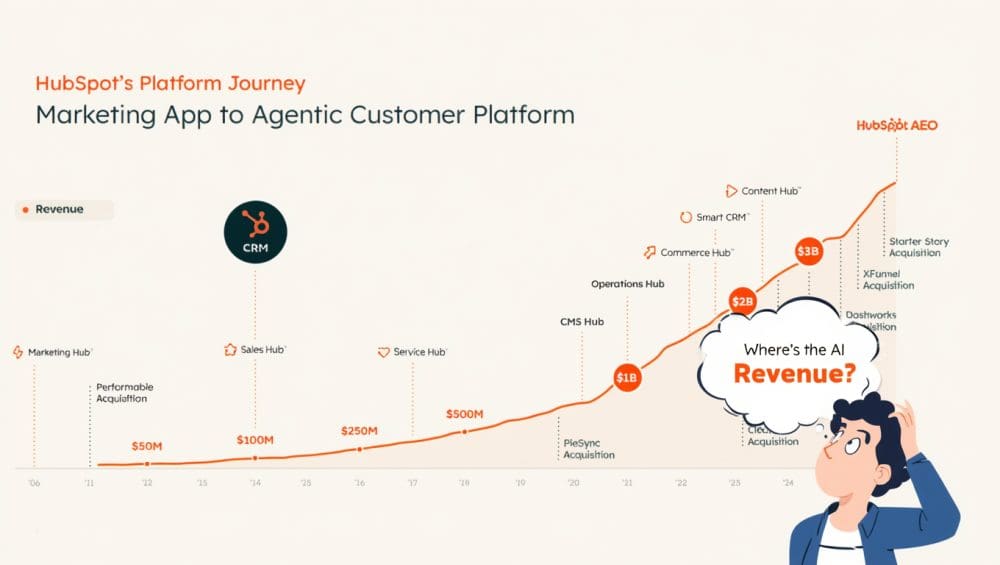
5 Interesting Learnings from HubSpot at $3.5B in ARR: 23% Reported Growth, $211M in Buybacks, and a 16% Stock Drop
HubSpot отчитался за Q1 2026 с выручкой $881M и ростом 23% в отчётной валюте, но в постоянной валюте рост составил лишь 18% и замедляется (гайд на Q2 — 16% CC). Несмотря на превышение консенсуса на $18M, расширение non-GAAP операционной маржи до 17,8% (+380 б.п.) и обратный выкуп акций на $211M, бумаги упали ~16% после закрытия. Главные причины: AI-выручка пока остаётся скорее историей, чем цифрой (Customer Agent — ~8 000 клиентов, Prospecting Agent — ~10 000, +57% QoQ), а CFO Кэтрин Бьюкер открыто говорит о «медленном старте Q2» из-за перехода на outcome-based pricing с 14 апреля 2026. Реальный двигатель роста — мультихабовая стратегия и движение в enterprise: 62% новых Pro+ клиентов берут несколько хабов, сделки >$10K MRR выросли на 41%. На контрасте за месяц Twilio ускорилась с 4% до 20%, Atlassian с 14% до 32%, Palantir с 70% до 85%, Cloudflare с 27% до 34% — а HubSpot замедляется, и рынок переоценивает её из «потенциального реускорителя» в «стабильного компаундера».
5 Interesting Learnings from HubSpot at $3.5B in ARR: 23% Reported Growth, $211M in Buybacks, and a 16% Stock Drop
by | 5 Interesting Things, Blog Posts, Scale
On paper, this was a strong quarter for HubSpot. Maybe not epic, but strong.
HubSpot reported Q1 ’26 with revenue of $881M, up 23% … as reported. Subscription revenue alone hit $862.3M, putting ARR run-rate around $3.45B. They beat consensus by $18M. Customer count crossed 299,458, up 16% YoY. Non-GAAP operating margin expanded 380 bps to 17.8%. Operating cash flow of $198.8M. They bought back $211M of stock in the quarter.
Then the stock dropped ~16% after hours.
Why?
Three weeks ago Twilio went from 4% growth to 20% growth in a single quarter and the CEO called it a “milestone quarter.” Atlassian went from 14% to 32%. Palantir went from 70% to 85%. Cloudflare ran from 27% to 34%. The market in May 2026 isn’t paying for “solid teens growth in constant currency.” It’s paying for visible reacceleration.
HubSpot’s quarter was the opposite: flat-to-decelerating constant currency growth, an AI revenue story that’s still mostly future tense, and a CFO openly flagging “a slow start to Q2.” Beat-and-raise wasn’t enough this time, because everyone else just showed what real reacceleration looks like.
Five things that matter:
1. The 23% Growth Is Mostly FX. The Real Number Is 18% CC, And It’s Flat-to-Decelerating
This is the most important thing in the print. Reported revenue growth was 23%. Constant currency growth was 18%. Five full points of the headline came from a weakening dollar.
Compare Q1 to the quarters before it like-for-like:
CFO Kathryn Bueker’s exact phrasing on the call: “Our updated guidance implies a step down in constant currency revenue growth to 16% in Q2 and then a modest acceleration for the remainder of the year.”
Step down. Not acceleration. Even the modest back-half “acceleration” only gets the full year to 17% CC, still below Q1’s 18%. HubSpot is growing in the high teens in real terms and decelerating, not accelerating. The reported number is a mirage that will keep flattering them as long as the dollar stays weak.
For B2B operators reporting in a weak-dollar regime, look at constant currency. That’s the actual underlying business.
2. AI Revenue Is Still Mostly a Story, Not a Number
Everyone wanted HubSpot’s print to be the proof point that AI is finally driving real B2B revenue. It’s not. Not yet.
What’s actually there:
More importantly, Bueker described core seats and credits as “emerging” growth levers. Not core. Emerging. She went out of her way to say AI monetization is “just one piece of the overall growth equation.” When pushed on NRR, she pointed to seat expansion, not AI consumption.
And here’s the part nobody is talking about: the AI pricing transition is hurting near-term sales execution. Bueker flagged a “slow start to Q2” tied to April retraining and go-to-market changes for the new pricing model. While reps learn how to sell outcome-based pricing, deals are slipping.
AI revenue at scale in B2B is taking longer than the narrative suggests. The companies talking the most about AI revenue are still mostly showing you activation counts, not contribution dollars. The contribution will come. Probably. But “promising AI traction” and “material AI revenue” are very different things in mid-2026.
3. The Real Growth Engine For Now Remains Multi-Hub, Not AI
If AI isn’t driving the 18% CC growth, what is? The same things that have been driving HubSpot for the last six quarters:
CEO Yamini Rangan was clear: “Our core growth levers of upmarket, multi-hub and platform consolidation, and pricing tailwinds remain solid. At the same time, our emerging AI monetization levers of core seats and credits are gaining traction.”
The order matters. Core levers are doing the work. AI is secondary.
Platform consolidation and upmarket motion remain the most reliable compounding mechanics in B2B. AI is an accelerant on those, not a replacement for them.
4. The Margin Story Is Real. The AI Dividend Is Showing Up On The Cost Side First
While AI revenue contribution is murky, AI-driven internal leverage is very clear:
Yamini’s framing: “We are investing aggressively in AI innovation while expanding operating margins at the same time.”
This is the actual AI revenue story for now, except inverted. It’s showing up as cost takeout. HubSpot’s own support org runs Customer Agent internally. Their go-to-market gets leverage from Breeze Assistant. The 380 bps of margin expansion is the AI dividend, just in the form of OpEx leverage instead of topline acceleration.
In 2026, the first place AI shows up in B2B financials is margin expansion, not revenue acceleration. Every operator should probably model AI as a margin lever first and a revenue lever second.
5. The Contrast With This Week’s Reaccelerators Is Brutal
This is what really crushed the stock. Look at what hit the tape over the last 30 days:
Now HubSpot Q1 2026: 18.2% CC → 18% CC → guided to 16% CC. Going the wrong way while the cohort goes the right way.
The market has decided that in mid-2026, the question isn’t “are you growing?” The question is “are you reaccelerating?” Twilio was a value trap for two years and just became a growth name. Palantir already broke the law of large numbers. Atlassian shook off the AI-coding-replaces-Jira fear in a single print.
HubSpot didn’t reaccelerate. It quietly decelerated and flagged a slow start to the next quarter, in the same week three peers showed the opposite pattern. The 16% drop is the market repricing HubSpot from “potential reaccelerator” to “steady compounder.” That’s not a small repricing in 2026. That’s a multiple compression event.
The bar has moved. Beat-and-raise was the bar in 2024. Reaccelerate-or-get-punished is the bar now.
And 4 More Quick Learnings:
HubSpot Has the Customer Base. Now It Needs to Deliver AI-Driven Growth.
It hasn’t yet. But it’s starting to. Wall Street won’t be happy until it really does.