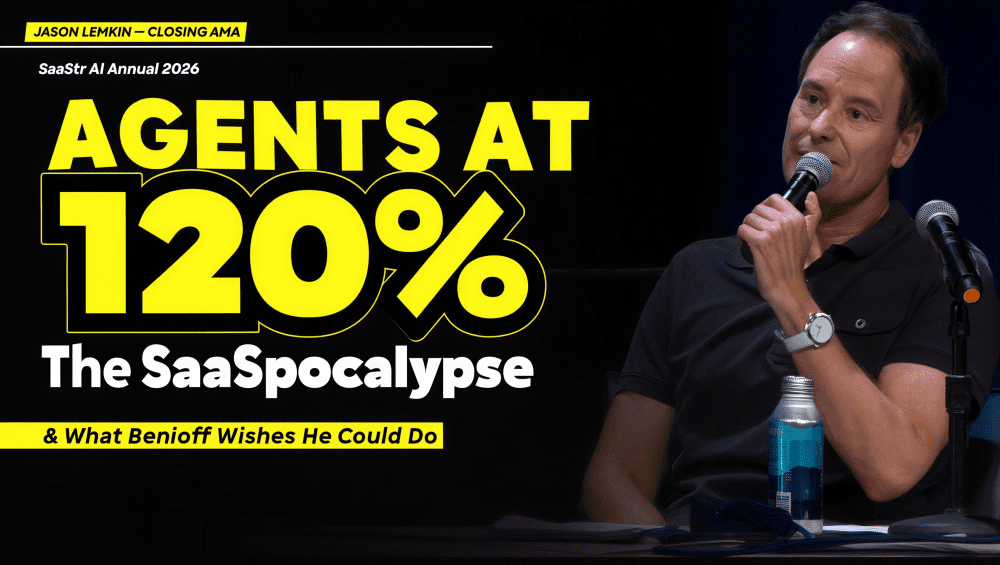
Schmoozing Is Dead, Agents Are Hitting 120% of Humans, and Growth Is the Only Thing That Matters: 10 Things From the Closing Q&A at SaaStr AI Annual 2026
Джейсон Лемкин подводит итоги SaaStr AI Annual 2026, собрав 10+ ключевых наблюдений из заключительной полуторачасовой сессии Q&A. Главные тезисы: эпоха «дружбана-продавца» закончилась — продавцы обязаны разбираться в продукте на уровне Forward Deployed Engineer (как Kody из Replit); даже Марк Бениофф признаёт, что мечтает запускать клиентов до подписания контракта. Соотношение «слоп-к-ценности» важнее самого факта слопа: сайт SaaStr на Replit вырос с 16 000 до 48 000 строк, а агент Monaco GTM окупился первой же встречей с Anthropic. Агенты уже бьют людей на 120% в инбаунде (Qualified — 682 встречи), социальной поддержке и ICP-аутбаунде. В венчуре 2026 года имеет значение только рост: чеки в Anthropic пишутся при оценке 950 млрд долларов за 48 часов, а планка для фандрейзинга поднялась с «10-to-20» до «5-to-30» и выше. У команды Лемкина теперь 21 агент в проде, 3 человека и более 1 млн долларов AI-выручки — всё без инженеров.
Schmoozing Is Dead, Agents Are Hitting 120% of Humans, and Growth Is the Only Thing That Matters: 10 Things From the Closing Q&A at SaaStr AI Annual 2026
Подлизы мертвы, агенты выдают 120% от людей, а рост — единственное, что имеет значение: 10 вещей с заключительной Q&A на SaaStr AI Annual 2026
by | Blog Posts, Featured Q&A, Q&A, Videos
автор: Jason Lemkin | Посты блога, Избранные Q&A, Q&A, Видео
We just wrapped SaaStr AI Annual 2026, and the closing Q&A on Day 3 ended up being one of the most engaged of the whole gathering. No script, no prepared deck, just an hour-and-a-half of questions from the audience on the topics most on their mind.
Мы только что закрыли SaaStr AI Annual 2026, и финальная Q&A на третий день оказалась одной из самых активных сессий всего ивента. Никакого сценария, никакой подготовленной презентации — просто полтора часа вопросов из зала на темы, которые сейчас волнуют людей больше всего.
We went off on a lot of tangents. Some of you were there. For those who weren’t, here are the 10 things that mattered most. Some of these I’ve been saying for a year. Some we figured out in real time on stage. A few I’m still chewing on.
Мы много раз уходили в сторону. Кто-то из вас был там. Для тех, кого не было, — вот 10 самых важных вещей. Часть из этого я повторяю уже год. Часть мы поняли прямо на сцене в реальном времени. А над парой пунктов я до сих пор думаю.
Let’s go.
Поехали.
1. Your Sales Team Needs to Be Product Experts. Schmoozing Is Officially Dead.
1. Ваша команда продаж должна быть экспертами по продукту. Подлизы официально мертвы.
There’s a guy at Replit, Kody, whose title is something like Head of Forward Deployed Engineering. When I first hit a wall using Replit, I talked to him briefly. The first call didn’t really help. The second call did. He sat down, explained exactly why I was having the issue, and walked me through how to get around it. That’s it. That’s the whole story. And that single interaction is why I’m a Replit super-fan today and have brought them millions of dollars in business.
В Replit есть парень по имени Kody, должность которого звучит как-то вроде Head of Forward Deployed Engineering. Когда я впервые упёрся в стену в Replit, я коротко поговорил с ним. Первый звонок реально не помог. Второй — да. Он сел, объяснил, почему у меня возникает эта проблема, и провёл меня через её обход. Вот и вся история. И именно из-за одного этого разговора я сегодня супер-фан Replit и принёс им миллионы долларов бизнеса.
Compare that to Marketo. I had a bug. They forced Amelia onto the phone for 4 hours, blamed her for the problem, and then told me they wouldn’t talk to me again unless she agreed to another 4 hours. They didn’t help. At all.
Сравните с Marketo. У меня был баг. Они силой посадили на телефон Amelia на 4 часа, обвинили её в проблеме, а потом заявили, что больше не будут разговаривать со мной, пока она не согласится на ещё 4 часа. Они вообще ничем не помогли.
That contrast is the whole game in 2026.
Этот контраст — вся суть игры в 2026 году.
In the age of AI, where every product is changing on a weekly basis, your sales team has to know the effing product cold. If they can’t answer a technical question the way Kody can, I’ll bypass them. I’ll buy from the competitor whose rep actually understands the product. And so will every other founder I know.
В эпоху AI, когда каждый продукт меняется еженедельно, ваша команда продаж обязана знать продукт до последней запятой. Если они не могут ответить на технический вопрос так, как это делает Kody, я обойду их стороной. Я куплю у конкурента, чей представитель действительно разбирается в продукте. И так же поступит любой знакомый мне фаундер.
The old model where the AE is a “people person” and the SE handles the technical questions is breaking. Not gone. But breaking. The reps who win now are the ones who know the product so well that customers can’t get rid of them, who hound them for months and years after the deal closes. That is the sign of a great rep. The customer keeps coming back, even after they’ve been handed off to someone else. The rep can’t escape them.
Старая модель, где AE — «душа компании», а SE отвечает на технические вопросы, разваливается. Ещё не исчезла. Но разваливается. Сегодня побеждают те представители, которые знают продукт настолько хорошо, что клиенты не могут от них отделаться, преследуют их месяцами и годами после закрытия сделки. Вот признак отличного представителя. Клиент возвращается снова и снова, даже после того как его передали кому-то другому. Представитель не может от него отвязаться.
If your rep can’t do that, they’re just not part of the discussion.
Если ваш представитель так не может — он просто вне обсуждения.
2. The Marc Benioff Unguarded Moment
2. Момент, когда Marc Benioff потерял бдительность
Last summer, Marc Benioff came on the 20VC podcast with me, Harry, and Rory. I asked him what he’d learned from Palantir. First he gave the line: that Palantir’s nine-figure deals show him he’s undercharging.
Прошлым летом Marc Benioff пришёл на подкаст 20VC ко мне, Harry и Rory. Я спросил его, чему он научился у Palantir. Сначала он выдал заготовленную фразу: что девятизначные сделки Palantir показывают ему, что он недозаряжает цены.
Then I caught him in an unguarded moment and asked what he thought about FDEs (Forward Deployed Engineers). He paused. And he said something I haven’t been able to stop thinking about:
А потом я поймал его в момент, когда он расслабился, и спросил, что он думает об FDE (Forward Deployed Engineers). Он сделал паузу. И сказал то, что я с тех пор не могу выкинуть из головы:
“I can’t do this, but I wish every single customer at Salesforce had an FDE and did not have to pay me until they were deployed.”
«Я не могу так делать, но я бы хотел, чтобы у каждого клиента Salesforce был FDE, и чтобы они не платили мне, пока не будут развёрнуты».
Read what he actually said. The CEO of the most successful B2B software company in history wishes every customer could go live before they signed a contract. Not after a 5-year deployment. Not after Accenture got it working. Before. The. Contract.
Вчитайтесь в то, что он сказал. CEO самой успешной B2B-софтверной компании в истории мечтает, чтобы каждый клиент мог запуститься в продакшен до подписания контракта. Не после пятилетнего внедрения. Не после того, как Accenture всё запустит. До. Контракта.
That’s the standard Benioff wants to hit in the agentic era. Of course it doesn’t work for Salesforce’s existing motion. But it’s what a great founder wants. The agent has to work when they go live. That’s the new bar.
Это та планка, на которую Benioff хочет выйти в агентной эпохе. Конечно, это не работает для существующей модели Salesforce. Но именно этого хочет великий фаундер. Агент должен работать в момент запуска. Это новая планка.
Whether you call them FDEs, SEs, SAs, or Forward Deployed Lawyers (like Harvey does with law firms, which I learned about from Anik at the CPO Summit), don’t over-index on the title. The mix is whatever it needs to be so that the agent already works on Day 30, not Year 3.
Называйте их FDE, SE, SA или Forward Deployed Lawyers (как делает Harvey с юрфирмами — об этом я узнал от Anik на CPO Summit), не зацикливайтесь на названии должности. Состав команды должен быть таким, чтобы агент уже работал на 30-й день, а не на 3-й год.
3. You Cannot Build a Real Relationship on Zoom
3. Невозможно построить настоящие отношения по Zoom
Every time a rep tells me they “have a great relationship” with a prospect, I ask one question: When did you meet them in person?
Каждый раз, когда представитель говорит мне, что у него «отличные отношения» с потенциальным клиентом, я задаю один вопрос: Когда вы встречались с ним лично?
Today the answer is almost always: never.
Сегодня ответ почти всегда: никогда.
Those relationships are fake. They are LinkedIn DMs and Zoom calls and a vague sense of familiarity. They are not relationships. And in a world where your buyer can replace you in 90 days with a better agentic vendor, fake-relationship inertia is not going to save you.
Эти отношения — фальшивка. Это LinkedIn-DM, Zoom-звонки и смутное ощущение знакомства. Это не отношения. И в мире, где ваш покупатель может заменить вас за 90 дней более качественным агентным вендором, инерция фальшивых отношений вас не спасёт.
Dinners. Events. Bring your customers together. That still works. Schmoozing on text does not. It hasn’t for a while. We just kept pretending.
Ужины. Ивенты. Сводите своих клиентов вместе. Это до сих пор работает. Подлизываться в текстиках — нет. И давно. Мы просто продолжали притворяться.
4. The Slop-to-Value Ratio Is the Only Frame That Matters
4. Соотношение «слоп к ценности» — единственный рабочий фрейм
A founder at the Q&A pushed back on me. She said the SaaStr AI Annual site has slop. Things break. The mobile app had bugs. A lot of these new products are sloppy.
Одна фаундерша на Q&A возразила мне. Она сказала, что на сайте SaaStr AI Annual есть слоп. Что-то ломается. В мобильном приложении были баги. Многие из этих новых продуктов — сырые.
She’s right.
Она права.
But she’s also looking at it wrong. The right frame isn’t is there slop. The right frame is what is the slop-to-value ratio, and which direction is it moving.
Но она смотрит на это неправильно. Правильный фрейм — не есть ли слоп. Правильный фрейм — каково соотношение слопа к ценности и в какую сторону оно движется.
I started working on the SaaStr AI Annual site in November on Replit. It was 16,000 lines of code by March. By the time Amelia took it over and we got to the event itself, it was 48,000. Somewhere in those 32,000 new lines, there’s slop. I’ll stipulate that. But this event we just ran could not have existed on Squarespace, which is what we were on for the last 4 years. The value to slop ratio for us is 50 to 1, and the slope of improvement is steep.
Я начал работать над сайтом SaaStr AI Annual в ноябре на Replit. К марту в нём было 16 000 строк кода. К моменту, когда Amelia взяла его на себя и мы доехали до самого ивента, стало 48 000. Где-то среди этих 32 000 новых строк есть слоп. Соглашусь. Но того ивента, что мы только что провели, не могло бы существовать на Squarespace, на котором мы сидели последние 4 года. Соотношение ценности к слопу у нас — 50 к 1, и наклон улучшения крутой.
The same is true for LinkedIn comments. Three months ago, automated LinkedIn comments were horrible. “Great job, team!” Garbage. Today the comments are getting really good. In 90 days they’ll be so good you’ll wonder if you should just have your AI talk to the slop AI and skip the humans. The slop quality is going up. (Whether that’s good for LinkedIn as a network is a different question. The value of those comments is still zero.)
То же самое с комментариями в LinkedIn. Три месяца назад автоматизированные комментарии в LinkedIn были чудовищны. «Great job, team!» Мусор. Сегодня комментарии становятся реально хорошими. Через 90 дней они будут такими хорошими, что вы задумаетесь, не пустить ли свой AI разговаривать со слоп-AI и пропустить людей. Качество слопа растёт. (Хорошо ли это для LinkedIn как сети — отдельный вопрос. Ценность таких комментариев всё ещё ноль.)
But for our products, for the agents we deploy, the value is 50 times the slop. I can prove it. Monaco GTM, which we launched two months ago, has some AI slop in it, not everything is perfect yet. Sam, the CEO, will tell you that himself. But the first day we went live, Monaco found the right person at Anthropic, figured out Anthropic was in our ICP, reached out, and set a meeting. Whatever slop is in Monaco, that one outcome paid for it 100x over.
Но для наших продуктов, для агентов, которых мы деплоим, ценность в 50 раз превышает слоп. Я могу это доказать. Monaco GTM, который мы запустили два месяца назад, содержит некоторое количество AI-слопа, не всё пока идеально. Sam, CEO, сам вам это скажет. Но в первый же день после запуска Monaco нашла нужного человека в Anthropic, поняла, что Anthropic подходит под наш ICP, написала им и поставила встречу. Какой бы слоп ни был внутри Monaco, этот один результат окупил его в 100 раз.
AI B2B software today is sometimes hacky, basic, primitive. It’s still early, despite the massive gains since just December. The AI inside it is sometimes better than the software itself. Both can be true. Give them a year.
AI B2B-софт сегодня местами хаковый, базовый, примитивный. Это всё ещё ранняя стадия, несмотря на огромный прогресс с декабря. AI внутри софта порой лучше, чем сам софт. И то и другое — правда. Дайте им год.
5. The First Time I Saw an Agent Beat a Human
5. Первый раз, когда я увидел, как агент обошёл человека
I had my real epiphany on this on-site at Annual, doing the Replit podcast with Kody. We were looking at the outbound emails 10K (our AI VP of Marketing, built on Replit) had written to get the right people to the event.
Настоящее озарение у меня случилось прямо на Annual, во время записи подкаста с Replit с Kody. Мы смотрели на исходящие письма, которые написал 10K (наш AI VP of Marketing, построенный на Replit), чтобы пригласить нужных людей на ивент.
The copy was good. Better than most humans I’ve worked with. But the copy wasn’t the point. The point was the analytics. The amount of work that went into identifying the top 40 people to invite, the personalization, the targeting, the prioritization. A human just couldn’t do that. Not in that time, not at that quality, not at that volume.
Тексты были хороши. Лучше, чем у большинства людей, с которыми я работал. Но дело было не в текстах. Дело было в аналитике. В объёме работы, которая ушла на выявление топ-40 людей для приглашения, на персонализацию, таргетинг, приоритизацию. Человек просто не смог бы такое сделать. Ни за это время, ни в таком качестве, ни в таком объёме.
That was the first time in a year of running 21 agents in production that I’d seen one clearly do something better than a human could. Not 80% as good. Not at parity. Better.
Это был первый раз за год эксплуатации 21 агента в продакшене, когда я увидел, что один из них явно делает что-то лучше человека. Не на 80%. Не на паритете. Лучше.
Once you see it once, you start looking for it everywhere.
Стоит увидеть это один раз — и ты начинаешь искать это везде.
6. Aiming for AI SDRs to Hit 80% of Your Best Rep. But In Some Parts of GTM, Agents Are Already at 120% of Humans.
6. Цельтесь, чтобы AI SDR работал на 80% от вашего лучшего представителя. Но в некоторых частях GTM агенты уже выдают 120% от людей.
Most founders building agents are anchored on “make it as good as 80% of our best human and then scale it.” That was the right frame a year ago. It’s the wrong frame now.
Большинство фаундеров, строящих агентов, привязаны к фрейму «сделай так же хорошо, как 80% нашего лучшего человека, а потом масштабируй». Год назад это был правильный фрейм. Сейчас — неправильный.
The new frame: find the slivers where an agent can be 120% of your best human, and start there.
Новый фрейм: найдите узкие участки, где агент может выдавать 120% от вашего лучшего человека, и начинайте оттуда.
A few examples from our stack:
Несколько примеров из нашего стека:
Inbound. Qualified (now owned by Salesforce) set up 682 strong meetings for us in the run-up to Annual. That is more meetings than any human BDR I’ve ever worked with could have set, at higher quality, with zero quota-driven sandbagging. Better than any human BDR. Full stop.
Инбаунд. Qualified (теперь принадлежит Salesforce) поставили нам 682 сильные встречи перед Annual. Это больше встреч, чем мог бы поставить любой человеческий BDR, с которым я работал, при более высоком качестве и без сэндбэггинга ради квоты. Лучше любого человеческого BDR. Точка.
Social selling. In 2021, people sold courses on social selling. The play was to manually monitor 100 prospects on LinkedIn, write “great job” when they posted, and pretend you were working. It mostly didn’t work. When someone I’ve never heard of writes “great job, Jason,” I don’t take a meeting.
Социальные продажи. В 2021 году люди продавали курсы по social selling. Замысел был такой: вручную мониторить 100 потенциальных клиентов в LinkedIn, писать «great job» под их постами и делать вид, что работаешь. По большей части это не работало. Когда мне пишет «great job, Jason» кто-то, о ком я никогда не слышал, я не назначаю встречу.
But now an agent can actually do this with value. Imagine I post “I love Replit but I had an issue getting OAuth working today.” An agent can read that, look at my account, identify the actual issue, and reply with a real answer. A human could never do that at scale. An agent can do real social help, not social selling. That is 120%.
Но теперь агент действительно может делать это с ценностью. Представьте, что я пишу: «Люблю Replit, но сегодня не смог настроить OAuth». Агент может это прочитать, посмотреть на мой аккаунт, идентифицировать реальную проблему и ответить настоящим решением. Человек никогда не смог бы делать это в масштабе. Агент может оказывать настоящую социальную помощь, а не социальные продажи. Это 120%.
Outbound for the right ICP. When a prospect says “I’m looking for an AI SDR that integrates with HubSpot and does X,” an agent can reply with “Here are 22 customers with that exact workflow. Payhawk uses this configuration. Want me to introduce you?” That is instant, specific value. A human rep saying “Want to grab coffee?” cannot compete.
Аутбаунд по правильному ICP. Когда потенциальный клиент пишет: «Я ищу AI SDR, который интегрируется с HubSpot и делает X», агент может ответить: «Вот 22 клиента с точно таким же воркфлоу. Payhawk использует такую конфигурацию. Хотите, я познакомлю?» Это мгновенная конкретная ценность. Человек-представитель с «не хотите ли выпить кофе?» здесь не конкурент.
Find your slivers. Aim for 120%, not 80%.
Найдите свои узкие участки. Цельтесь в 120%, а не в 80%.
7. The Worst Buying Experience in B2B Still Exists. AI Should Kill It Tomorrow.
7. Худший опыт покупки в B2B всё ещё существует. AI должен убить его уже завтра.
You go to a vendor’s website. You don’t want to talk to sales. But there’s no other option, so you click “Contact Sales.” You get on a call. It’s a kid named Jason who just graduated from San Mateo Community College. He’s there to qualify you to decide if you’re worth the time of an AE who might have a slot next week.
Вы заходите на сайт вендора. Вы не хотите говорить с продажником. Но другого варианта нет, поэтому вы кликаете «Contact Sales». Вы попадаете на звонок. Там парень по имени Jason, который только что окончил San Mateo Community College. Его задача — квалифицировать вас, чтобы решить, стоите ли вы времени AE, у которого, возможно, есть слот на следующей неделе.
He can’t answer any of your questions. You ask “Do you integrate with Replit?” He says, “I’ll have to ask Bob about that.”
Он не может ответить ни на один ваш вопрос. Вы спрашиваете: «У вас есть интеграция с Replit?» Он отвечает: «Мне нужно спросить Bob».
That role still exists at thousands of B2B companies. AI can do 110% of it today. That role should go extinct as soon as humanly possible. It’s actively destroying pipelines.
Эта роль до сих пор существует в тысячах B2B-компаний. AI уже сегодня может делать 110% этой работы. Эта роль должна вымереть как можно скорее. Она активно разрушает пайплайны.
8. If You’re Asking How to Get Your Leadership AI-Fluent, They’re Already Behind
8. Если вы спрашиваете, как сделать руководство AI-грамотным, оно уже отстало
Someone at the Q&A asked the best advice for leaders who aren’t in the loop on AI. My first reaction: if you have to ask the question, the org is by definition not AI-fluent.
Кто-то на Q&A спросил, какой лучший совет для лидеров, которые «не в теме» AI. Моя первая реакция: если вам приходится задавать этот вопрос, то ваша организация по определению не AI-грамотная.
You know when you are. You’re shipping code the way Andrew at Lovable is, where every product designer commits code. You’re not arguing with engineering about whether the tools work. The team isn’t telling you “these tools aren’t ready.” (Maybe they are. But if they’re saying that, you’re not fluent.)
Вы сами знаете, когда это так. Вы шипите код так, как это делает Andrew в Lovable, где каждый продуктовый дизайнер коммитит код. Вы не спорите с инжинирингом о том, работают ли инструменты. Команда не говорит вам «эти инструменты ещё не готовы». (Может, и не готовы. Но если они так говорят, вы не AI-грамотны.)
If you have to ask, here’s the only thing that works in my experience: bring your leadership into a room and show them the single most magical thing your team does with AI. Live. Not slides. Not a deck. The actual workflow. The actual agent doing the actual thing.
Если вам приходится спрашивать, по моему опыту работает только одно: соберите своё руководство в одной комнате и покажите им самую магическую вещь, которую делает ваша команда с AI. Вживую. Не слайды. Не презентация. Реальный воркфлоу. Реальный агент, делающий реальное дело.
If their jaws don’t drop, you’ve got a deeper problem. If they do drop, you’ve created the aha moment, and now they want to know how to bring it into the company. That’s how you drive change.
Если у них не отвиснет челюсть — у вас более глубокая проблема. Если отвиснет — вы создали момент «ага», и теперь они хотят знать, как принести это в компанию. Вот так и двигают изменения.
You can’t lecture people into AI fluency. You can only show them.
Нельзя начитать людям лекций про AI-грамотность. Можно только показать.
9. 2020-2021 Was an Aberration. Stop Trying to Apply Anything You Learned Then.
9. 2020-2021 был аномалией. Перестаньте применять уроки того времени.
I keep hearing people compare today to 2020-2021. They are not comparable. Not even close.
Я постоянно слышу, как люди сравнивают сегодняшний день с 2020-2021. Это несравнимо. Даже близко нет.
What actually happened in 2020-2021: a virus caused everyone to buy 20-year-old software like it was going out of fashion. There was no new technology. There was no platform shift. Demand spiked because budgets were temporarily infinite. And then it ended. Almost instantly.
Что на самом деле произошло в 2020-2021: вирус заставил всех скупать 20-летний софт как горячие пирожки. Не было никакой новой технологии. Не было никакого платформенного сдвига. Спрос подскочил, потому что бюджеты временно стали бесконечными. А потом всё кончилось. Почти мгновенно.
The clearest proof is Shopify. Shopify said in the summer of 2020 that it was already over. Their data, which is the pulse of e-commerce SMB, showed the spike ending in May/June 2020. The reason it looked like the boom lasted until Q1/Q2 2022 was long contract terms hiding a market that had already snapped back.
Самое наглядное доказательство — Shopify. Летом 2020-го Shopify сказал, что всё уже закончилось. Их данные, которые являются пульсом e-commerce SMB, показывали, что всплеск закончился в мае/июне 2020 года. Причина, по которой бум выглядел продолжавшимся до Q1/Q2 2022, — длинные сроки контрактов, скрывавшие рынок, который уже откатился.
Hopin raised at $6B running digital events. By September 2020, the demand was gone. They just kept showing ARR because customers had signed multi-year contracts. The net new was zero.
Hopin поднял раунд при оценке 6 млрд долларов, занимаясь цифровыми ивентами. К сентябрю 2020-го спрос исчез. Они просто продолжали показывать ARR, потому что клиенты подписали многолетние контракты. Net new был нулевым.
We learned nothing from that era because nothing real changed. Software didn’t get better. There was no AI. We don’t even work from home that much anymore. Half my friends in the Bay Area are grinding back in the office every day.
Мы ничему не научились в ту эпоху, потому что ничего реального не изменилось. Софт не стал лучше. Не было AI. Мы даже из дома уже почти не работаем. Половина моих знакомых в Bay Area каждый день пашут в офисе.
This time is fundamentally different. It is a platform shift. The products are changing weekly. The buyer behavior is changing. The org structures are changing. None of the 2021 playbook applies. Throw it out.
Это время принципиально другое. Это платформенный сдвиг. Продукты меняются еженедельно. Поведение покупателей меняется. Организационные структуры меняются. Ни один из плейбуков 2021 года не работает. Выкиньте их.
10. The Engineering Job Market: B-Tier Is Dead. S-Tier Is in an Arms Race.
10. Рынок труда для инженеров: B-уровень мёртв. S-уровень — в гонке вооружений.
Engineering hiring is up 20-30% from the lows. Engineers are in high demand. And it’s never been worse for B-tier developers.
Найм инженеров вырос на 20-30% от низов. Инженеры в высоком спросе. И для B-уровня разработчиков ещё никогда не было так плохо.
Both of those things are true. They’re not in conflict.
Обе эти вещи верны. Они не противоречат друг другу.
A simple example. My son is at Penn State, off the charts in math, doing real work in string theory and inner model theory. The labs find him. He has job offers.
Простой пример. Мой сын учится в Penn State, off-the-charts в математике, занимается реальной работой по теории струн и теории внутренних моделей. Лаборатории сами его находят. У него есть офферы.
None of his classmates in CS have a job. Zero. There is essentially no need for a B-tier, mid-grade CS engineer right now. It’s been devastating for that population. My daughter’s at Stanford. Nobody is going into CS anymore.
Ни у кого из его одногруппников по CS нет работы. Ноль. Сейчас фактически нет нужды в B-уровневом среднем CS-инженере. Для этой популяции это разрушительно. Моя дочь в Stanford. Никто больше не идёт в CS.
Why? Because in an agentic world, you can build basic software with way fewer engineers. So the bar has gone up. Replit and Lovable are in a death race, both at ~$500M in 18 months. Neither one can phone it in for a year. They have to ship harder than anyone has ever shipped. So they will hire any 10x or 100x engineer they can find. The arms race is at the top, not the bottom.
Почему? Потому что в агентном мире базовый софт можно строить гораздо меньшим числом инженеров. Поэтому планка поднялась. Replit и Lovable находятся в смертельной гонке, оба около 500 млн долларов за 18 месяцев. Ни один из них не может расслабиться даже на год. Они должны шипить жёстче, чем кто-либо когда-либо. Поэтому они наймут любого 10x или 100x инженера, какого только смогут найти. Гонка вооружений идёт наверху, а не внизу.
If the world were static, we could get by with fewer engineers. The world has never been less static. So great engineers have never been more valuable.
Если бы мир был статичен, мы бы обошлись меньшим количеством инженеров. Но мир никогда не был менее статичен. Поэтому великие инженеры никогда не были более ценными.
11. There’s No Land Grab in AI. There’s an Inertia Grab.
11. В AI нет гонки за землю. Есть гонка за инерцию.
This is a counterintuitive one. Everyone in venture is talking about the AI land grab. I don’t think it exists, at least not in the classic sense.
Это контринтуитивный тезис. Все в венчуре говорят об AI land grab. Я не думаю, что он существует — по крайней мере, в классическом смысле.
The reason is that customers know the products are changing weekly. They’re explicitly signing 1-year deals (not 3-year) and telling vendors “we will look again in 10 months.” So you can’t lock customers in the way you could in 2015.
Причина в том, что клиенты знают: продукты меняются еженедельно. Они осознанно подписывают годовые контракты (а не трёхлетние) и говорят вендорам: «Мы пересмотрим всё через 10 месяцев». Поэтому нельзя залочить клиентов так, как можно было в 2015-м.
What does exist is an inertia grab. The desire to switch is real. The cost to switch is lower than it used to be. But the cost of retraining, of building muscle on a new platform, of trusting a new vendor’s roadmap, is high. Once we’re trained on a platform, the new vendor has to be twice as good to make us switch. Not 10% better. Twice as good.
А вот что существует — это гонка за инерцию. Желание переключиться реально. Стоимость переключения ниже, чем была. Но стоимость переобучения, наработки мышечной памяти на новой платформе, доверия дорожной карте нового вендора — высока. Когда мы натренированы на платформе, новый вендор должен быть вдвое лучше, чтобы заставить нас переключиться. Не на 10% лучше. Вдвое лучше.
So if you’re a vendor: this is the moment to be in market. Customers are still picking their default platforms. The defaults that get set now will compound for years. And in B2B, especially in the agentic era, customers aren’t just buying your software today. They’re buying the next 24 months of your roadmap. They’re buying your trajectory. Which is exactly why founders have to be in front of customers right now. The CEO sells the journey.
Поэтому если вы вендор: сейчас момент быть на рынке. Клиенты всё ещё выбирают свои дефолтные платформы. Дефолты, которые установятся сейчас, будут накапливать эффект годами. И в B2B, особенно в агентной эпохе, клиенты покупают не просто ваш сегодняшний софт. Они покупают ваш роадмап на следующие 24 месяца. Они покупают вашу траекторию. Именно поэтому фаундеры обязаны быть перед клиентами прямо сейчас. CEO продаёт путь.
12. Venture in 2026: Growth Is the Only Thing That Matters. Full Stop.
12. Венчур в 2026: рост — единственное, что имеет значение. Точка.
Let me summarize all of venture capital today in one paragraph, because it’ll save you a lot of pitch meetings.
Позвольте мне резюмировать весь сегодняшний венчурный капитал в одном абзаце, потому что это сэкономит вам кучу питч-встреч.
In 2026, nothing matters but growth.
В 2026 году не имеет значения ничего, кроме роста.
Имеет ли значение валовая маржа? Нет. Имеет ли значение, повторяется ли выручка? Нет. Имеет ли значение, есть ли у вас многолетние контракты? Нет. Имеет ли значение NRR? Не особо. Имеет ли значение, что вы в регулируемой индустрии с сильными моатами? Ни капельки.
People are writing checks into Anthropic at $950B. They don’t get to talk to anybody. You don’t get to talk to anybody. You have 48 hours to decide if you’re investing at $950B or not.
Люди выписывают чеки в Anthropic при оценке 950 млрд долларов. Им не дают ни с кем поговорить. И вам не дают. У вас 48 часов, чтобы решить, инвестируете вы при 950 млрд или нет.
It is logical, even if it sounds like greed. The high end has no ceiling anymore. We’re going to see $3T+ IPOs in the coming months. The combined value of SpaceX, Anthropic, and OpenAI will exceed every tech IPO that has ever happened, combined. When the high end is that fat, no one cares about durability or quality of revenue. They care about growth.
Это логично, даже если звучит как жадность. У верхнего конца больше нет потолка. В ближайшие месяцы мы увидим IPO стоимостью более 3 трлн долларов. Совокупная стоимость SpaceX, Anthropic и OpenAI превысит все технологические IPO в истории, вместе взятые. Когда верхний конец настолько жирный, никого не волнует устойчивость или качество выручки. Их волнует рост.
The hard part: companies with very good growth that would have been easily funded 18 months ago won’t get funded today. 10-to-20 in a year used to be a slam dunk. With 120% NRR and durable, compounding revenue, you’d have term sheets in a week. The debate was whether next year was 36 or 42, not whether the company would exist.
Трудная часть: компании с очень хорошим ростом, которые 18 месяцев назад легко получили бы финансирование, сегодня финансирования не получат. Раньше «с 10 до 20 за год» был верняком. С NRR 120% и устойчивой, накапливающейся выручкой term sheet был у вас через неделю. Спор шёл о том, будет ли в следующем году 36 или 42, а не о том, выживет ли компания.
In the SaaSpocalypse, those sure things look unsure. So 10-to-20 isn’t enough anymore. You need 5-to-30. 3-to-50. Replit, 2-to-500. That’s the bar.
В SaaSpocalypse эти верные ставки выглядят неверными. Поэтому «с 10 до 20» больше недостаточно. Нужно «с 5 до 30». «С 3 до 50». Replit — «с 2 до 500». Вот планка.
If your growth isn’t in that zip code, you might take 100 beatings before you get a term sheet. That’s just the reality. Send me your growth. Maybe we’ll meet.
Если ваш рост не в этом диапазоне, вы можете получить 100 отказов прежде чем у вас будет term sheet. Это просто реальность. Присылайте мне ваш рост. Может, и встретимся.
What We Learned at SaaStr AI Annual 2026
Что мы поняли на SaaStr AI Annual 2026
One year ago, Amelia and I came out of SaaStr Annual with one pseudo-agent, a Delphi clone of me. This year, we have 21 agents in production, 3 humans on the team, and $1M+ in AI-driven closed revenue.
Год назад мы с Amelia вышли с SaaStr Annual с одним псевдо-агентом — клоном меня на Delphi. В этом году у нас 21 агент в продакшене, 3 человека в команде и более 1 млн долларов AI-driven закрытой выручки.
Next year? I don’t know. Will we have 441 agents? Will we have meta-autonomous agents that don’t even exist yet? Will composable software replace traditional software entirely? I genuinely don’t know.
В следующем году? Не знаю. Будет ли у нас 441 агент? Будут ли у нас мета-автономные агенты, которых ещё даже не существует? Заменит ли композируемый софт традиционный полностью? Я искренне не знаю.
What I do know: every single thing we built, Amelia and I built without an engineer. You can do it. You can probably do it better. That is the mission. I want everyone at this event to be better than us in a year. When you are, we’ll have won.
Что я знаю: каждую штуку, которую мы построили, мы с Amelia построили без инженера. Вы можете это сделать. Вы, скорее всего, сделаете лучше. В этом и есть миссия. Я хочу, чтобы каждый на этом ивенте через год был лучше нас. Когда вы такими станете — мы победили.
See you at SaaStr AI Annual 2027.
Увидимся на SaaStr AI Annual 2027.