
Labor market impacts of AI: A new measure and early evidence
Anthropic представила новую метрику воздействия AI на рынок труда — observed exposure, которая объединяет теоретические возможности LLM из работы Eloundou et al. (2023) с реальными данными использования из Anthropic Economic Index, придавая больший вес автоматизированным и рабочим сценариям. Авторы (Maxim Massenkoff и Peter McCrory) показывают, что фактическое покрытие задач AI пока далеко от теоретического потенциала: Claude покрывает лишь около 33% задач в категории Computer & Math. Наиболее подверженными оказались программисты (75% покрытия), специалисты по работе с клиентами и операторы ввода данных (67%); работники с высокой экспозицией чаще старше, женщины, образованнее и с более высокой зарплатой. BLS прогнозирует чуть более слабый рост занятости в подверженных профессиях: каждые 10 п.п. покрытия снижают прогноз на 0,6 п.п. С конца 2022 года систематического роста безработицы среди наиболее подверженных работников не обнаружено, однако есть слабые признаки замедления найма молодых работников (22–25 лет) в экспозированные профессии — снижение темпа найма примерно на 14%.
Влияние AI на рынок труда: новая метрика и первые свидетельства

Ключевые выводы
Мы вводим новую меру риска вытеснения работников из-за AI — observed exposure, которая объединяет теоретические возможности LLM и реальные данные использования, придавая больший вес автоматизированным (а не дополняющим) и связанным с работой сценариямAI пока далёк от достижения своего теоретического потенциала: фактическое покрытие остаётся лишь долей от возможногоПо прогнозам BLS, занятость в профессиях с более высокой observed exposure будет расти медленнее до 2034 годаРаботники в наиболее подверженных профессиях с большей вероятностью старше, женского пола, более образованные и с более высокой зарплатойМы не находим систематического роста безработицы среди сильно подверженных работников с конца 2022 года, однако есть косвенные свидетельства замедления найма молодых работников в подверженных профессиях
Введение
Быстрое распространение AI порождает волну исследований, измеряющих и прогнозирующих его влияние на рынок труда. Но опыт прошлых подходов даёт повод для скромности.
Например, одна заметная попытка измерить, какие рабочие места можно вынести за рубеж, отнесла примерно четверть рабочих мест в США к уязвимым, но десятилетие спустя в большинстве из них сохранился здоровый рост занятости. Государственные прогнозы роста занятости по профессиям, хотя и в целом верны по направлению, мало что добавили к линейной экстраполяции прошлых трендов в плане предсказательной силы. Даже задним числом влияние крупных экономических потрясений на рынок труда часто остаётся неясным. Исследования о влиянии промышленных роботов на занятость приходят к противоположным выводам, а масштаб потерь рабочих мест из-за торгового шока с Китаем по-прежнему остаётся предметом дискуссий.1
В этой работе мы представляем новую систему для понимания влияния AI на рынок труда и проверяем её на ранних данных, обнаруживая ограниченные свидетельства того, что AI к настоящему моменту повлиял на занятость. Наша цель — создать подход к измерению того, как AI влияет на занятость, и периодически возвращаться к этим анализам. Этот подход не охватит все каналы, через которые AI может изменить рынок труда, но, заложив этот фундамент сейчас, до того как проявятся значимые эффекты, мы надеемся, что будущие выводы будут надёжнее выявлять экономические потрясения, чем анализ постфактум.
Возможно, влияние AI окажется безошибочно очевидным. Эта система наиболее полезна тогда, когда эффекты неоднозначны, — и может помочь выявить наиболее уязвимые рабочие места ещё до того, как вытеснение станет заметным.
Контрфактуалы
Каузальный вывод проще, когда эффекты велики и внезапны. Пандемия COVID-19 и сопровождавшие её меры политики вызвали такие резкие экономические потрясения, что для многих вопросов сложные статистические подходы были не нужны. Например, безработица резко подскочила в первые недели пандемии, оставляя мало места для альтернативных объяснений.
Однако влияние AI может быть менее похоже на COVID и больше — на интернет или торговлю с Китаем. Эффекты могут быть не сразу видны по агрегированным данным о безработице; такие факторы, как торговая политика и бизнес-цикл, могут затруднять интерпретацию трендов.
Один распространённый подход — сравнивать результаты между работниками, фирмами или отраслями с большей или меньшей подверженностью AI, чтобы выделить эффект AI из других возможных факторов.2 Подверженность обычно определяется на уровне задач: AI может проверять домашние работы, но не управлять классом, например, поэтому учителя считаются менее подверженными, чем работники, чья работа полностью может выполняться удалённо.
Наша работа следует этому подходу, основанному на задачах, объединяя меры теоретических возможностей AI и реального использования, с последующим агрегированием до уровня профессий.3
Измерение подверженности
Наш подход объединяет данные из трёх источников.
База данных O*NET, в которой перечислены задачи примерно для 800 уникальных профессий в США.Наши собственные данные об использовании (измеренные в Anthropic Economic Index).Оценки подверженности на уровне задач из работы Eloundou et al. (2023), которые показывают, теоретически ли возможно для LLM ускорить выполнение задачи как минимум вдвое.
Метрика β из работы Eloundou et al. оценивает задачи по простой шкале: 1, если задачу можно ускорить вдвое одной только LLM; 0,5, если требуются дополнительные инструменты или ПО поверх LLM; и 0 в противном случае.4
Почему фактическое использование может отставать от теоретических возможностей? Некоторые теоретически возможные задачи могут не появляться в данных использования из-за ограничений модели. Другие могут медленно распространяться из-за юридических ограничений, требований к конкретному ПО, этапов человеческой проверки или других препятствий. Например, Eloundou et al. отмечают «Авторизация повторной выписки лекарств и предоставление информации о рецептах аптекам» как полностью подверженную (β=1). Мы не наблюдали, чтобы Claude выполнял такую задачу, хотя оценка кажется верной в том смысле, что теоретически её можно было бы ускорить с помощью LLM.
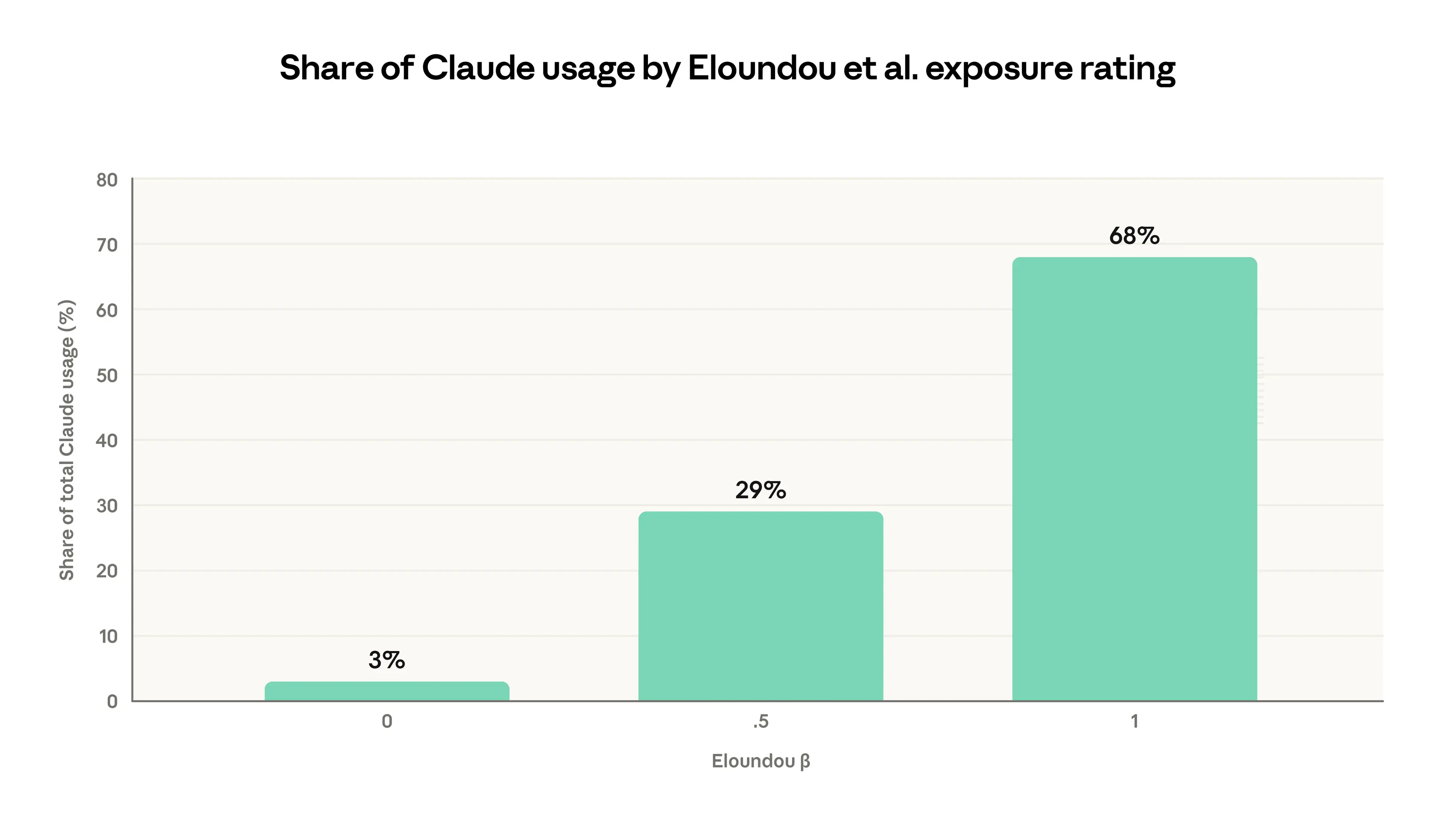
При этом меры теоретических возможностей и фактического использования сильно коррелируют. Как показано на Рисунке 1, 97% задач, наблюдаемых в четырёх предыдущих отчётах Economic Index, попадают в категории, оценённые Eloundou et al. как теоретически осуществимые (β=0,5 или β=1,0).
Новая мера подверженности на уровне профессий
Наша новая мера, observed exposure, призвана количественно оценить: из тех задач, которые LLM теоретически могли бы ускорить, какие действительно автоматизированно используются в профессиональных условиях? Теоретические возможности охватывают гораздо более широкий круг задач. Отслеживая, как этот разрыв сужается, observed exposure даёт представление об экономических изменениях по мере их появления.
Наша мера качественно фиксирует несколько аспектов использования AI, которые, как мы считаем, предсказывают влияние на рабочие места. Подверженность работы выше, если:
Её задачи теоретически возможны с AIЕё задачи имеют значительное использование в Anthropic Economic Index5Её задачи выполняются в рабочих контекстахУ неё относительно более высокая доля автоматизированных сценариев использования или применений API.Затронутые AI задачи составляют большую долю общей роли6
Математические детали приведены в Приложении. Мы считаем задачи, теоретически осуществимые с LLM, охваченными, если в трафике Claude они имели достаточное использование, связанное с работой. Затем мы корректируем на то, как именно выполняется задача: полностью автоматизированные сценарии получают полный вес, а дополняющее использование — половинный. Наконец, меры покрытия на уровне задач усредняются до уровня профессии с весом по доле времени, проводимого за каждой задачей.
Рисунок 2 показывает observed exposure (красным) в сравнении с β из Eloundou et al. (синим), иллюстрируя разницу между теоретическим и реальным использованием на нашей платформе, сгруппированную по широким категориям профессий. Мы рассчитываем это, сначала усредняя до уровня профессии с весом по нашей мере доли времени, а затем усредняя до категории профессий с весом по общей занятости. Например, мера β показывает потенциал для проникновения LLM в большинстве задач профессий Computer & Math (94%) и Office & Admin (90%).
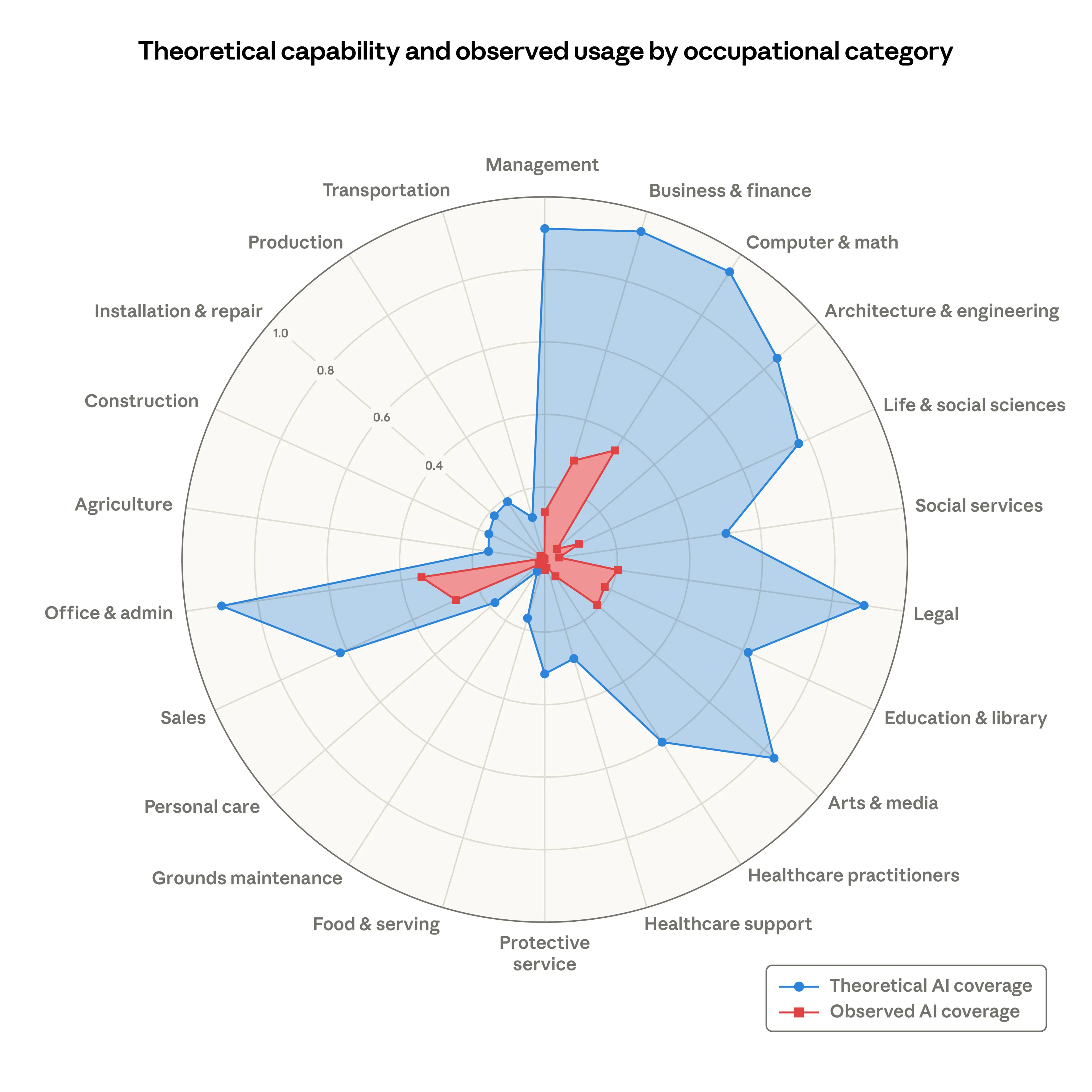
Красная область, отображающая использование LLM из Anthropic Economic Index, показывает, как люди используют Claude в профессиональной среде. Покрытие показывает, что AI пока далёк от достижения своих теоретических возможностей. Например, Claude в настоящее время охватывает лишь 33% всех задач в категории Computer & Math.
По мере того как развиваются возможности, распространяется внедрение и углубляется развёртывание, красная область будет расширяться, покрывая синюю. Также есть большая непокрытая область; многие задачи, конечно, остаются вне досягаемости AI — от физической сельскохозяйственной работы вроде обрезки деревьев и управления сельхозтехникой до юридических задач вроде представления клиентов в суде.
Рисунок 3 показывает десять профессий, наиболее подверженных по этой мере. В соответствии с другими данными о том, что Claude активно используется для программирования, Computer Programmers находятся на вершине с покрытием 75%, за ними следуют Customer Service Representatives, чьи основные задачи мы всё чаще наблюдаем в трафике first-party API. Наконец, Data Entry Keyers, чья основная задача — чтение исходных документов и ввод данных — в значительной мере автоматизируется, покрыты на 67%.
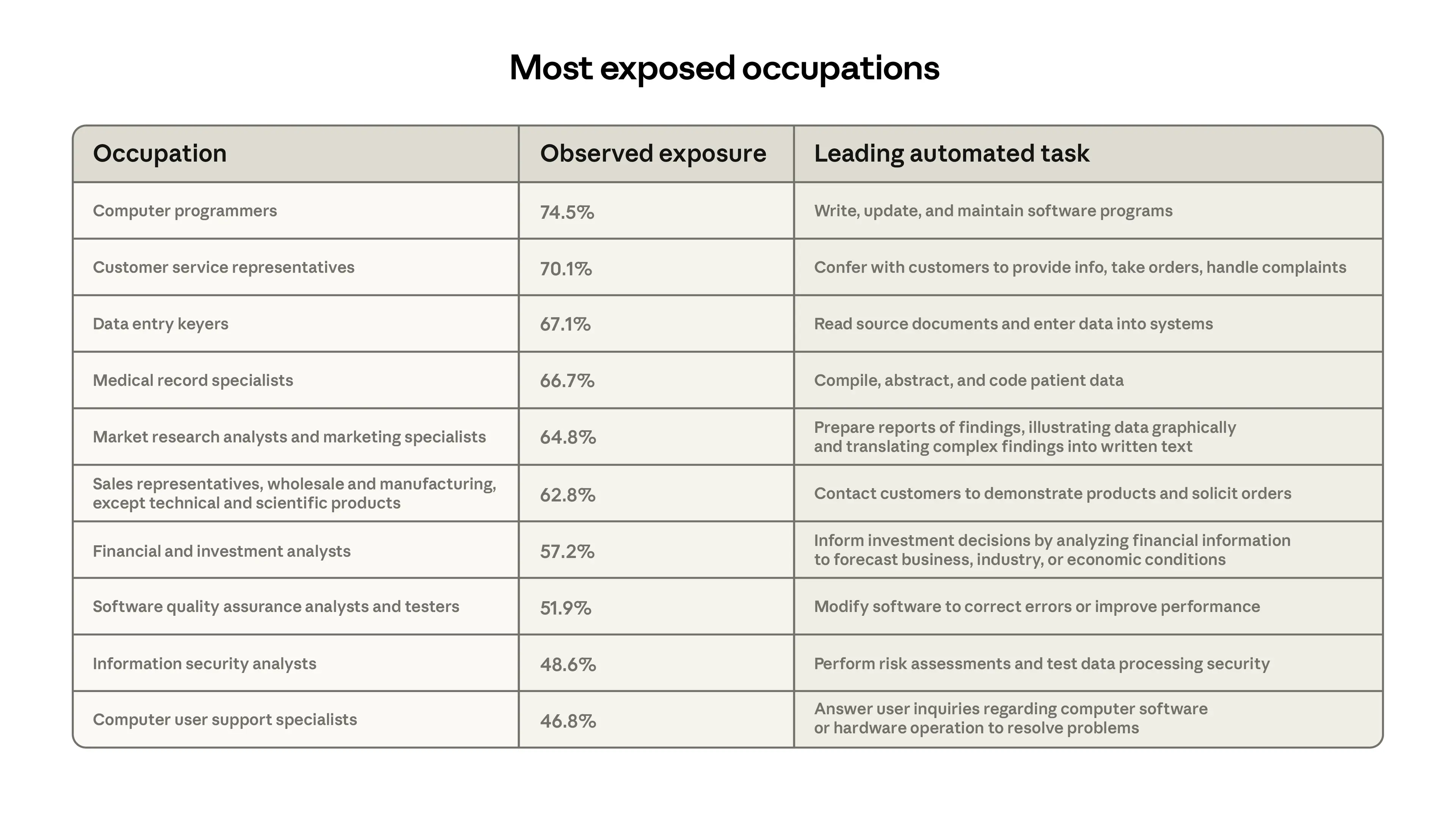
На нижнем конце 30% работников имеют нулевое покрытие, поскольку их задачи появлялись в наших данных слишком редко, чтобы преодолеть минимальный порог. В эту группу входят, например, повара, мотомеханики, спасатели, бармены, посудомойщики и работники гардеробов.
Как подверженность связана с прогнозируемым ростом занятости и характеристиками работников
Бюро статистики труда США (BLS) регулярно публикует прогнозы занятости, и последний набор, опубликованный в 2025 году, охватывает прогнозируемые изменения занятости для каждой профессии с 2024 по 2034 год. На Рисунке 4 мы сравниваем нашу меру покрытия на уровне профессий с их прогнозами.
Регрессия на уровне профессий с весом по текущей занятости показывает, что прогнозы роста несколько слабее для профессий с более высокой observed exposure. На каждые 10 процентных пунктов увеличения покрытия прогноз роста BLS снижается на 0,6 процентных пункта. Это даёт некоторое подтверждение тому, что наши меры согласуются с независимо полученными оценками аналитиков рынка труда, хотя связь и слабая. Интересно, что подобной корреляции для одной только меры Eloundou et al. нет.
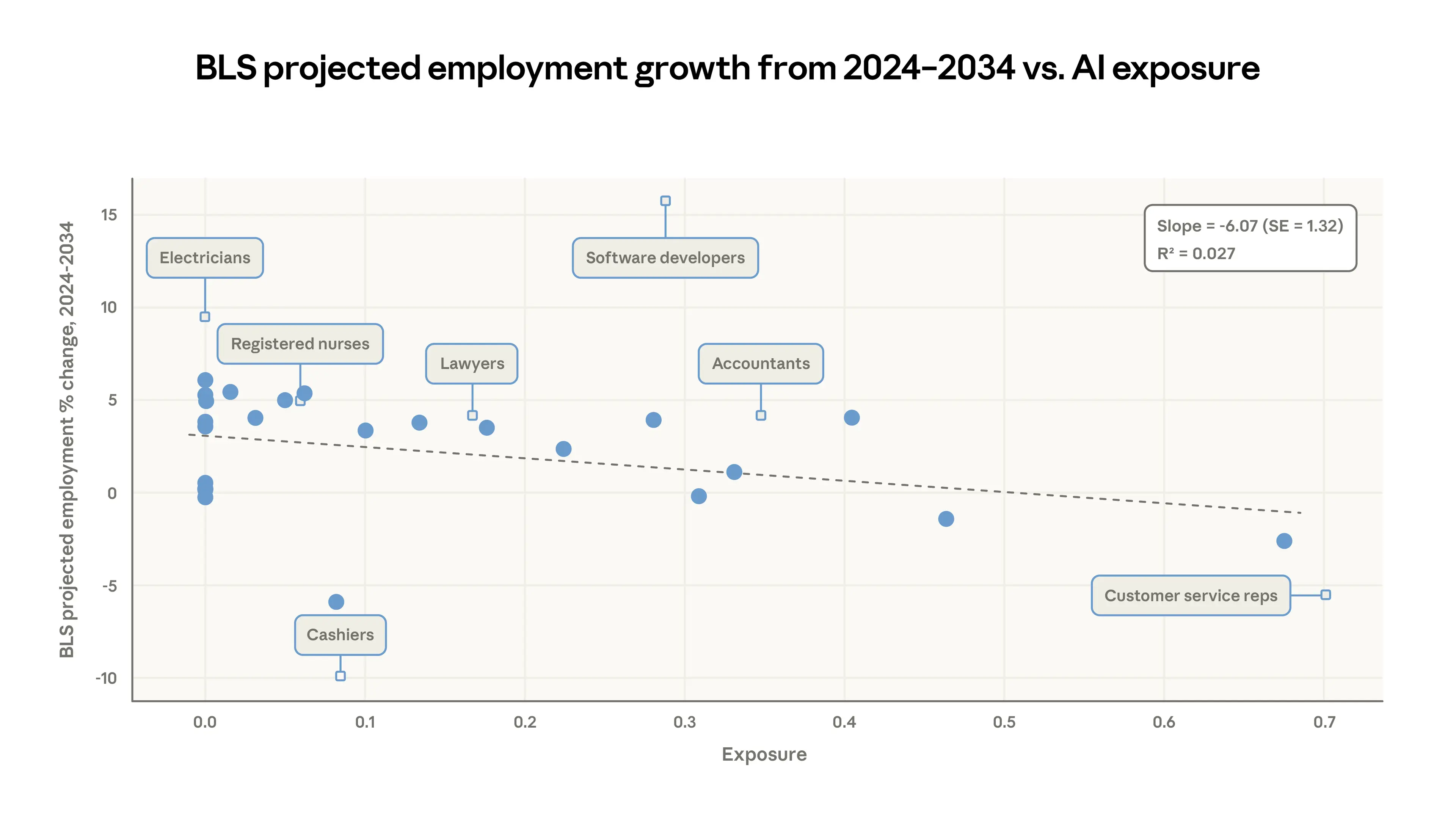
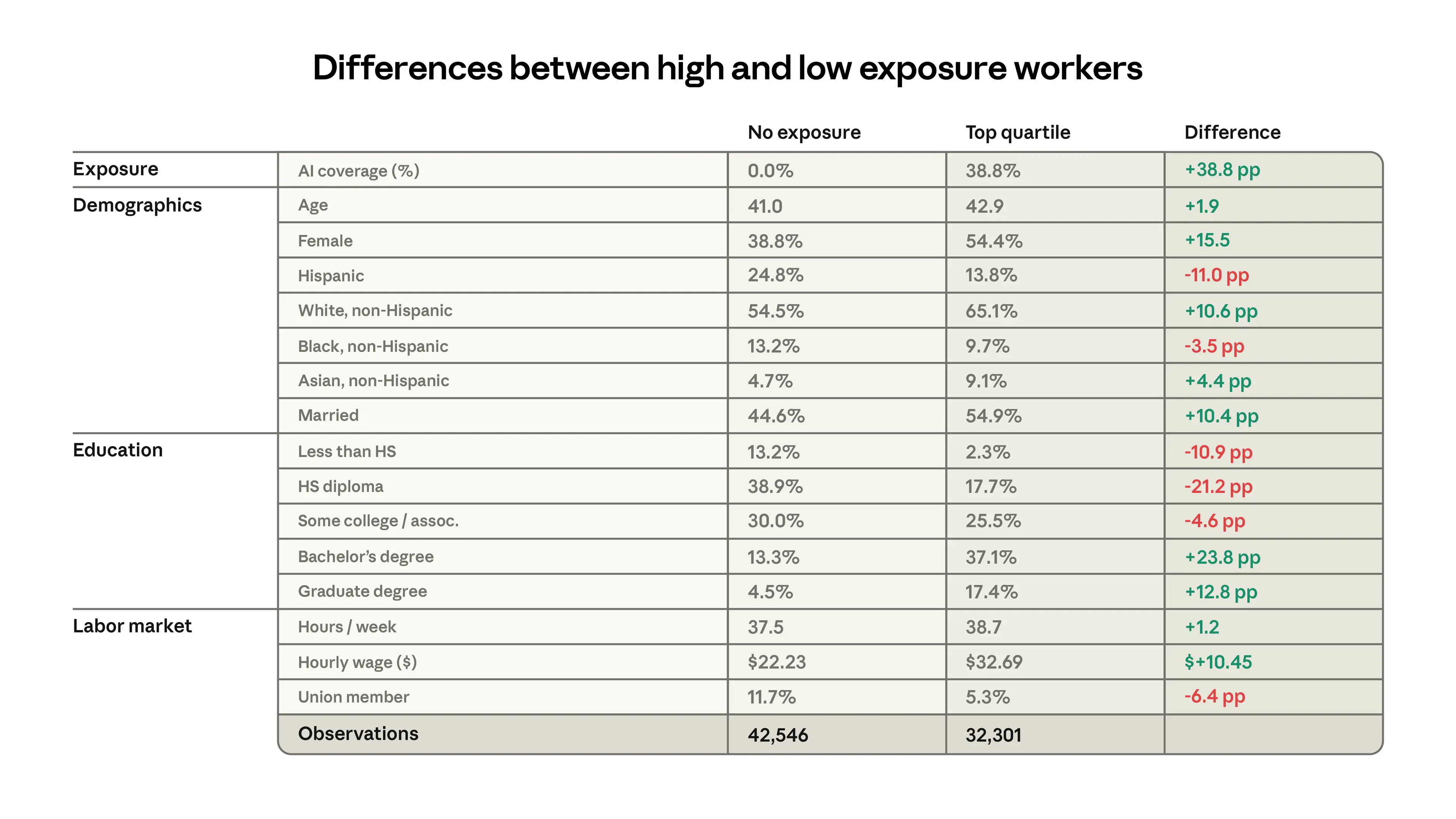
Рисунок 5 показывает характеристики работников в верхнем квартиле подверженности и 30% работников с нулевой подверженностью за три месяца до выпуска ChatGPT, с августа по октябрь 2022 года, на основе данных Current Population Survey.7 Эти группы очень различны. Более подверженная группа на 16 процентных пунктов чаще состоит из женщин, на 11 процентных пунктов чаще — из белых и почти вдвое чаще — из азиатов. Они зарабатывают в среднем на 47% больше и имеют более высокий уровень образования. Например, люди с учёной степенью составляют 4,5% неподверженной группы, но 17,4% наиболее подверженной — почти четырёхкратная разница.
Приоритизация результатов
Имея в руках эти меры подверженности, вопрос в том, на что смотреть. Исследователи использовали разные подходы. Например, Gimbel et al. (2025) отслеживают изменения в составе профессий с помощью Current Population Survey. Их аргумент в том, что любая значимая перестройка экономики из-за AI должна проявиться как изменения в распределении рабочих мест.¹ (Они обнаруживают, что пока изменения непримечательны.) Brynjolfsson et al. (2025) рассматривают уровень занятости в разбивке по возрастным группам с использованием данных компании по обработке зарплат ADP, тогда как Acemoglu et al. (2022) и Hampole et al. (2025) используют данные о вакансиях из Burning Glass (теперь Lightcast) и Revelio соответственно.
Мы фокусируемся на безработице как приоритетном показателе, поскольку она наиболее напрямую отражает потенциал экономического вреда: безработный человек хочет работу и пока её не нашёл. В этом случае вакансии и занятость не обязательно сигнализируют о необходимости политических реакций; снижение числа вакансий по сильно подверженной роли может компенсироваться увеличением вакансий в смежной. Большинство вредных для рынка труда последствий AI, вероятно, должно включать период повышенной безработицы, пока вытесненные работники ищут альтернативы. Current Population Survey хорошо подходит для отслеживания этого, поскольку безработные респонденты сообщают о своей предыдущей работе и отрасли.
Первые результаты
Далее мы изучаем тренды безработицы, сопоставляя наши меры на уровне профессий с респондентами Current Population Survey.
Ключевой вопрос при интерпретации нашей меры покрытия — каких работников считать «обработанными» воздействием? Следует ли ожидать изменений занятости уже при покрытии задач всего на 10%? Gans и Goldfarb (2025) показывают, что если профессии лучше описываются моделью O-ring, эффекты на занятость могут проявиться только тогда, когда все задачи имеют определённую степень проникновения AI. Hampole et al. (2025) утверждают, что средняя подверженность снижает спрос на труд, но концентрация подверженности только в определённых задачах может это компенсировать. А Autor и Thompson (2025) подчёркивают уровень экспертизы, требуемый для оставшихся задач.
Стремясь к простоте и отмечая, что нас больше всего волнуют крупные эффекты, мы строим анализ вокруг идеи о том, что воздействие должно ощущаться сильнее всего в группах с самой высокой средней подверженностью. Мы сравниваем работников в верхнем квартиле взвешенного по времени покрытия задач с работниками в нижнем. Если возможности AI растут быстро, покрытие задач может быть высоким и для более низких процентилей покрытия, и тогда более полезным может оказаться абсолютный порог. Но мы исходим из предположения, что воздействие должно затрагивать наиболее подверженных работников в первую очередь, и приводим результаты с варьированием порога, используемого для определения «обработанной» группы.
Верхняя панель Рисунка 6 показывает сырые тренды уровня безработицы с 2016 года для работников в верхнем квартиле подверженности и для неподверженной группы. Во время COVID менее подверженные AI работники — которые чаще имеют очную работу — испытали гораздо больший рост безработицы. С тех пор тренды между двумя группами были в основном похожи. Нижняя панель измеряет величину разрыва между наиболее и наименее подверженными работниками в рамках difference-in-differences, повторяя выводы из сырых данных. Среднее изменение разрыва с момента выпуска ChatGPT мало и незначимо, что указывает на то, что уровень безработицы более подверженной группы несколько вырос, но эффект неотличим от нуля.8
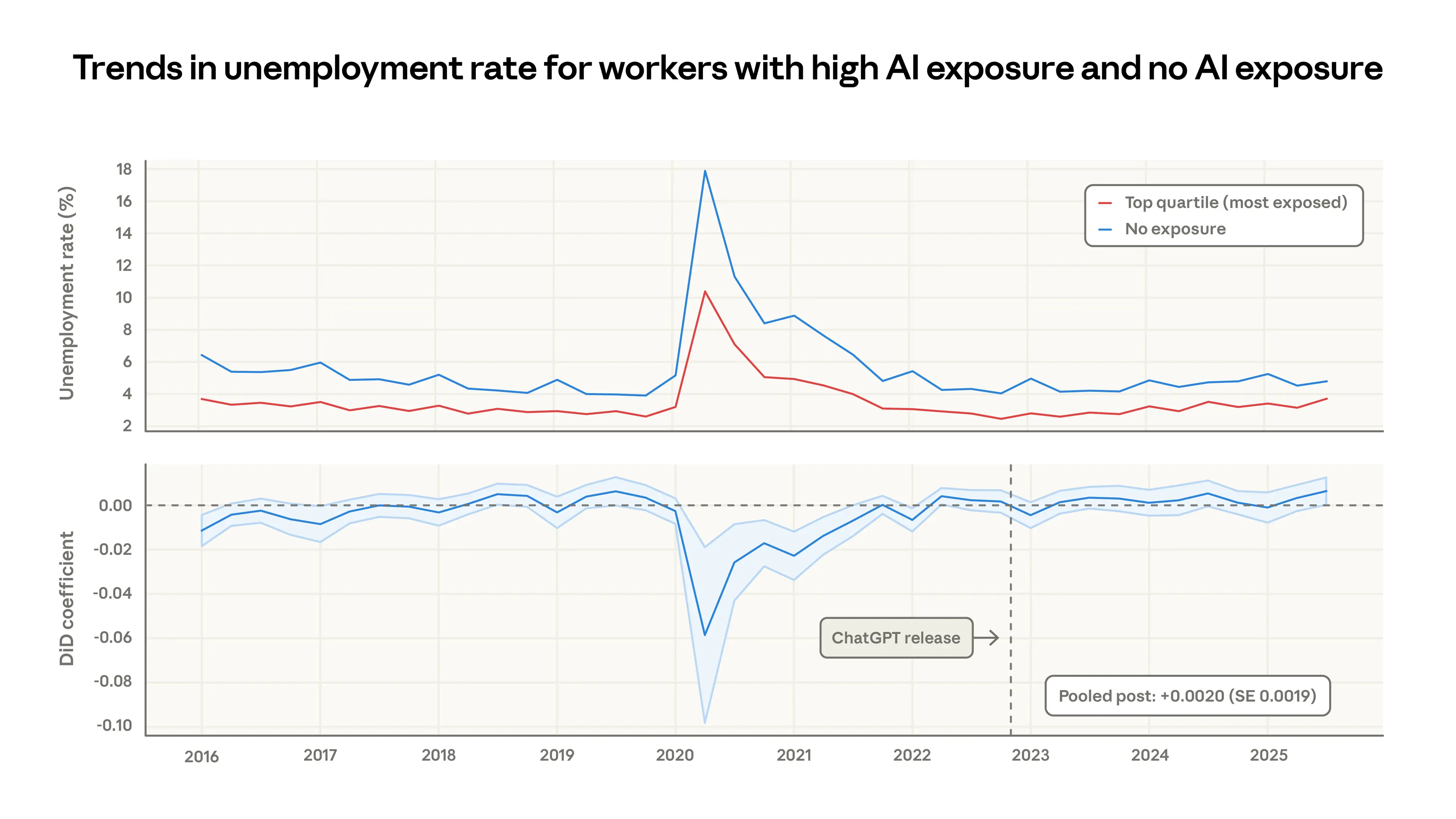
Какие сценарии может выявить эта система? Исходя из доверительного интервала объединённой оценки, дифференциальные приросты безработицы порядка 1 процентного пункта были бы заметны (это будет меняться по мере поступления новых данных, так что это лишь приблизительная оценка). Если бы все работники в верхних 10% были уволены, безработица внутри группы верхнего квартиля выросла бы с 3% до 43%, а агрегированная безработица — с 4% до 13%.
Меньшее, но всё же тревожное воздействие — это сценарий вроде «Великой рецессии для офисных работников». Во время Великой рецессии 2007–2009 годов уровень безработицы в США удвоился с 5% до 10%. Такое удвоение в верхнем квартиле подверженности подняло бы уровень безработицы в нём с 3% до 6%. Это также было бы видно в нашем анализе. Обратите внимание, что наша основная оценка основана на дифференциальных изменениях уровня безработицы в подверженной группе по сравнению с менее подверженной. Если бы безработица росла у всех работников параллельно, мы не приписывали бы это успехам AI, которые всё ещё не затрагивают многие задачи.
Одна особенно тревожная группа — молодые работники. Brynjolfsson et al. сообщают о падении занятости в подверженных профессиях на 6–16% среди работников 22–25 лет. Они связывают это снижение в основном с замедлением найма, а не ростом увольнений.9
Мы обнаруживаем, что уровень безработицы молодых работников в подверженных профессиях стабилен (см. Приложение). Но замедление найма не обязательно проявится как рост безработицы, поскольку многие молодые работники — это новички на рынке труда без указанной профессии в данных CPS, и они могут выйти из рабочей силы, не оказавшись в категории безработных. Чтобы напрямую обратиться к найму, мы используем панельное измерение CPS, считая процент молодых работников (22–25 лет), начинающих новую работу в более или менее подверженной профессии с течением времени. Рисунок 7 показывает месячный темп нахождения работы (то есть когда работник сообщает о работе, которой у него не было в предыдущем месяце) для молодых работников, в разбивке по тому, входят ли они в профессию с высокой или низкой подверженностью.
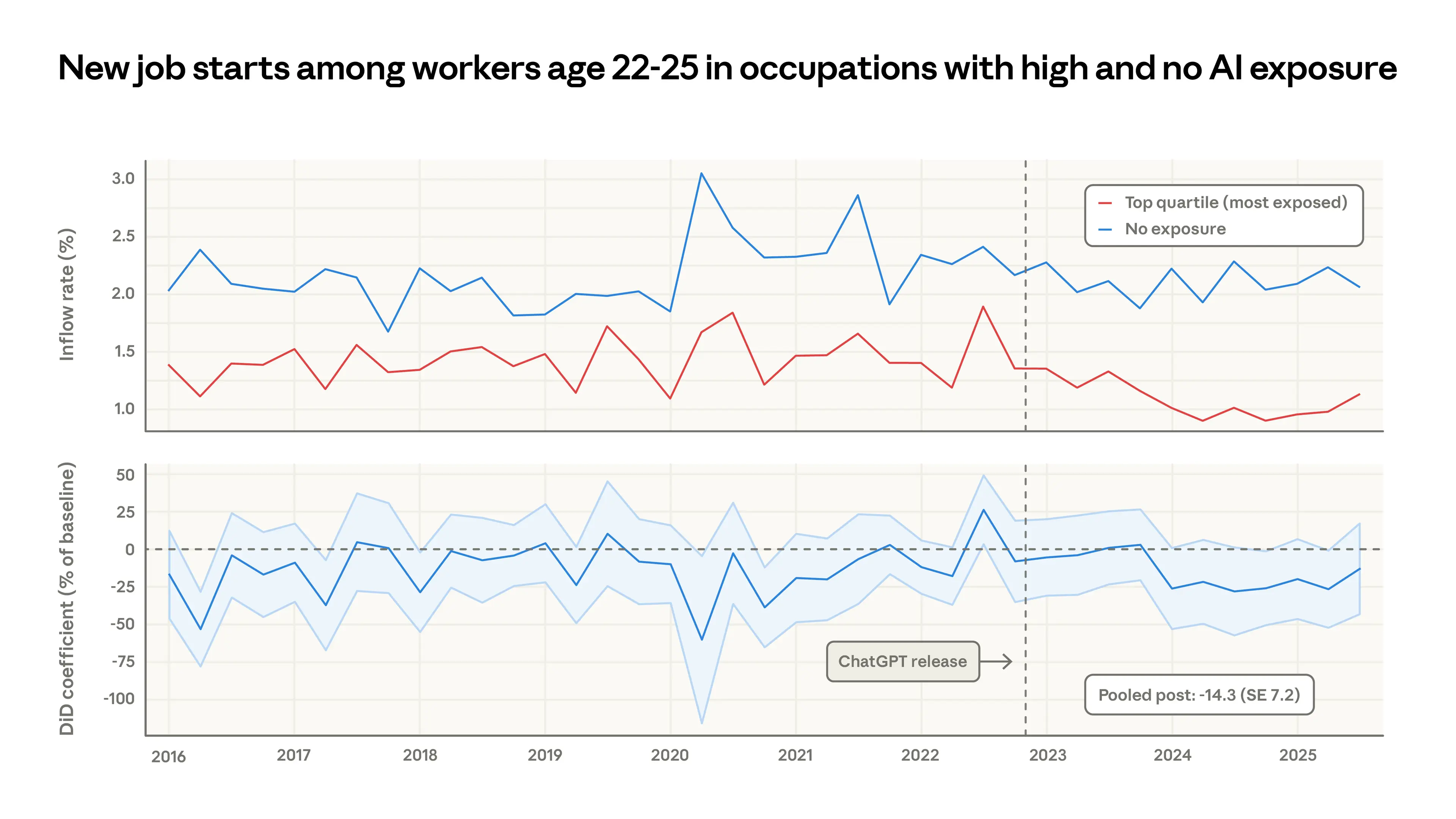
За исключением некоторых крупных колебаний в 2020–2021 годах, эти ряды визуально расходятся в 2024 году: молодые работники относительно реже устраиваются в подверженные профессии. Темпы найма в менее подверженных профессиях остаются стабильными на уровне 2% в месяц, тогда как вход в наиболее подверженные снижается примерно на полпроцентного пункта. Усреднённая оценка для эпохи после ChatGPT — снижение темпа нахождения работы на 14% по сравнению с 2022 годом в подверженных профессиях, хотя это лишь едва статистически значимо. (Для работников старше 25 лет такого снижения нет.)
Это может давать определённый сигнал о ранних эффектах AI на занятость и перекликается с выводами Brynjolfsson et al. Но есть несколько альтернативных интерпретаций. Молодые работники, которые не были наняты, могут оставаться на своих текущих работах, переходить на другие работы или возвращаться к учёбе. Дополнительная оговорка, связанная с данными, заключается в том, что переходы между работами могут быть более уязвимы к ошибкам измерения в опросах.10
Обсуждение
Этот отчёт вводит новую меру для понимания эффектов AI на рынок труда и изучает воздействие на безработицу и наём. Профессии тем более подвержены AI, чем больше их задач теоретически осуществимы с LLM и наблюдаются на наших платформах в автоматизированных, связанных с работой сценариях использования. Мы обнаруживаем, что компьютерные программисты, представители клиентской поддержки и финансовые аналитики оказываются среди наиболее подверженных. Используя данные опросов в США, мы не находим воздействия на уровни безработицы для работников в наиболее подверженных профессиях, хотя есть предварительные свидетельства того, что наём в эти профессии немного замедлился для работников 22–25 лет.
Наша работа — первый шаг к систематизации влияния AI на рынок труда. Мы надеемся, что аналитические шаги, предпринятые в этом отчёте, особенно в части покрытия и контрфактуалов, будут легко обновляемы по мере появления новых данных о занятости и использовании AI. Устоявшийся подход может помочь будущим наблюдателям отделять сигнал от шума.
В нынешней работе есть несколько улучшений, которые можно внести. Наши данные об использовании будут учитываться в будущих обновлениях, формируя развивающуюся картину покрытия задач и профессий в экономике. Метрика Eloundou et al. также может быть обновлена, поскольку она связана с возможностями LLM по состоянию на начало 2023 года. И, учитывая предварительные результаты по молодым работникам и новичкам на рынке труда, ключевым следующим шагом может быть изучение того, как недавние выпускники с образованием в подверженных областях ориентируются на рынке труда.
Приложение
Доступно здесь.
Благодарности
Авторы: Maxim Massenkoff и Peter McCrory.
С благодарностями: Ruth Appel, Tim Belonax, Keir Bradwell, Andy Braden, Dexter Callender III, Miriam Chaum, Madison Clark, Jake Eaton, Deep Ganguli, Kunal Handa, Ryan Heller, Lara Karadogan, Jennifer Martinez, Jared Mueller, Sarah Pollack, David Saunders, Carl De Torres, Kim Withee и Jack Clark.
Также благодарим Martha Gimbel, Anders Humlum, Evan Rose и Nathan Wilmers за отзывы на ранние версии этого отчёта.
Цитирование
@online{massenkoffmccrory2026labor, author = {Maxim Massenkoff and Peter McCrory}, title = {Labor market impacts of AI: A new measure and early evidence}, date = {2026-03-05}, year = {2026}, url = {https://www.anthropic.com/research/labor-market-impacts}, }
Ссылки
Acemoglu, Daron and Pascual Restrepo, "Robots and Jobs: Evidence from US Labor Markets," Journal of Political Economy, 2020, 128 (6), 2188–2244.
Acemoglu, Daron, David Autor, Jonathon Hazell, and Pascual Restrepo, "Artificial intelligence and jobs: Evidence from online vacancies," Journal of Labor Economics, 2022, 40 (S1), S293–S340.
Appel, Ruth, Maxim Massenkoff, Peter McCrory, Miles McCain, Ryan Heller, Tyler Neylon, and Alex Tamkin, "Anthropic Economic Index report: economic primitives," 2026.
Autor, David H, David Dorn, and Gordon H Hanson, "The China syndrome: Local labor market effects of import competition in the United States," American Economic Review, 2013, 103 (6), 2121–2168.
Autor, David H, & Thompson, N. (2025). Expertise. NBER Working Paper, (w33941).
Blinder, Alan S et al., "How many US jobs might be offshorable?," World Economics, 2009, 10 (2), 41.
Borusyak, Kirill, Peter Hull, and Xavier Jaravel, "Quasi-experimental shift-share research designs," The Review of Economic Studies, 2022, 89 (1), 181–213.
Brynjolfsson, Erik, Bharat Chandar, and Ruyu Chen, "Canaries in the coal mine? six facts about the recent employment effects of artificial intelligence," Digital Economy, 2025.
Eckhardt, Sarah and Nathan Goldschlag, "AI and Jobs: The Final Word (Until the Next One)," Economic Innovation Group (EIG), August 2025. Available at: https://eig.org/ai-and-jobs-the-final-word/
Eloundou, Tyna, Sam Manning, Pamela Mishkin, and Daniel Rock, "Gpts are gpts: An early look at the labor market impact potential of large language models," arXiv preprint arXiv:2303.10130, 2023, 10.
Fujita, S., Moscarini, G., & Postel-Vinay, F. (2024). Measuring employer-to-employer reallocation. American Economic Journal: Macroeconomics, 16(3), 1-51.
Gans, Joshua S. and Goldfarb, Avi, "O-Ring Automation," NBER Working Paper No. 34639, December 2025. Available at SSRN: https://ssrn.com/abstract=5962594
Gimbel, Martha, Molly Kinder, Joshua Kendall, and Maddie Lee, "Evaluating the Impact of AI on the Labor Market: Current State of Affairs," Research Report, The Budget Lab at Yale, New Haven, CT October 2025. Available at: https://budgetlab.yale.edu.
Graetz, Georg and Guy Michaels, "Robots at Work," Review of Economics and Statistics, 2018, 100 (5), 753–768.
Hampole, Menaka, Dimitris Papanikolaou, Lawrence DW Schmidt, and Bryan Seegmiller, "Artificial intelligence and the labor market," Technical Report, National Bureau of Economic Research 2025.
Handa, Kunal, Alex Tamkin, Miles McCain, Saffron Huang, Esin Durmus, Sarah Heck, Jared Mueller, Jerry Hong, Stuart Ritchie, Tim Belonax, Kevin K. Troy, Dario Amodei, Jared Kaplan, Jack Clark, and Deep Ganguli, "Which Economic Tasks are Performed with AI? Evidence from Millions of Claude Conversations," 2025.
Hui, Xiang, Oren Reshef, and Luofeng Zhou, "The short-term effects of generative artificial intelligence on employment: Evidence from an online labor market," Organization Science, 2024, 35 (6), 1977–1989.
Johnston, Andrew and Christos Makridis, "The labor market effects of generative AI: A difference-in-differences analysis of AI exposure," Available at SSRN 5375017, 2025.
Massenkoff, Maxim, "How predictable is job destruction? Evidence from the Occupational Outlook," 2025. Working Paper.
Ozimek, Adam, "Overboard on Offshore Fears," 2019. https://papers.ssrn.com/sol3/papers.cfm?abstract_id=3777307
Tamkin, Alex and Peter McCrory, "Estimating AI productivity gains from Claude conversations," 2025.
Tomlinson, K., Jaffe, S., Wang, W., Counts, S., & Suri, S. (2025). Working with AI: measuring the applicability of generative AI to occupations. arXiv preprint arXiv:2507.07935.
Сноски
Возможность вынесения рабочих мест за рубеж: Blinder et al. (2009) и Ozimek (2019); Государственные прогнозы роста: Massenkoff (2025); Роботы: Graetz и Michaels (2018) и Acemoglu и Restrepo (2020); Китайский шок: Autor et al. (2013) и Borusyak et al. (2022).Brynjolfsson et al. (2025) сравнивают тренды занятости работников в более и менее подверженных AI профессиях, используя меры подверженности задач из Eloundou et al. (2023) и данные о зарплатах от ADP. Johnston и Makridis (2025) проводят аналогичный анализ на основе задач с использованием административных данных США, но агрегируют воздействие до уровня отрасли. Hui et al. (2024) изучают, как фриланс-работы на Upwork отреагировали на выпуск ChatGPT и продвинутых инструментов генерации изображений, сравнивая работников в напрямую затронутых категориях с теми, кто не был затронут, до и после даты выпуска каждого инструмента. Hampole et al. (2025) используют инструментальную переменную для внедрения AI на уровне фирм, опирающуюся на исторические сети найма из университетов: фирмы, которые исторически набирали выпускников из университетов, чьи выпускники позже занимали роли, связанные с AI, сталкивались с более низкими издержками внедрения.Наши меры подверженности на уровне задач и профессий могут легко включать другие данные об использовании и распространяться на разные страны. Мы намерены применять эту методологию к новым контекстам со временем.В их системе «непосредственно подверженные» задачи — те, которые можно было выполнить вдвое быстрее с помощью LLM (с лимитом ввода 2000 слов и без доступа к недавним фактам). Задачи, «подверженные с инструментами», — те, которые подвергались такому же ускорению с LLM, имеющей доступ к ПО, например, для информационного поиска и обработки изображений. Задачи, которые не были подвержены, не могли быть сокращены по продолжительности на 50% или более с помощью LLM.Мы используем два предыдущих набора данных Anthropic Economic Index, охватывающих использование за август и ноябрь 2025 года. Для задач ONET, семантически очень близких друг к другу, мы делим счётчики между ними.На каждом шаге задействованы оценочные суждения. Должна ли мера Eloundou et al. (2023) входить как {0, 0,5, 1} или как-то иначе? Что определяет «значительное» использование? Как мы обращаемся с задачами, которые кажутся очень похожими на задачи с высоким использованием, но слишком редки, чтобы быть конкретно подхваченными в выборке для Economic Index? Насколько большее значение следует придавать сценариям автоматизации по сравнению с дополнением? Обнадёживающий вывод, на котором мы подробнее останавливаемся в Приложении, состоит в том, что корреляция Спирмена (по рангам) подверженности профессий при многих вариантах ответа на эти вопросы чрезвычайно высока.Чтобы сопоставить коды O*NET-SOC с кодами occ1990 в CPS, мы используем кросс-таблицу, предоставленную Eckhart and Goldschlag (2025).Мы исследуем это далее тремя способами в Приложении. Во-первых, мы спрашиваем, имеет ли значение процентильный порог, который мы используем для определения воздействия, варьируя его от медианы до 95-го процентиля. Во всех случаях эффект плоский или отрицательный (то есть безработица для подверженной группы снижается). Затем мы фокусируемся именно на молодых работниках, в возрасте 22–25 лет, как в Brynjolfsson et al. (2025). Наконец, мы используем данные о получателях пособий по безработице от Министерства труда для измерения безработицы вместо ответов на опрос CPS. Ни в одном расширении мы не находим явных эффектов на подверженные профессии.Этот диапазон широк, потому что авторы приводят оценки относительно нескольких контрфактуалов. Падение на 6 процентных пунктов сравнивается с контрфактуалом плоского роста занятости. Оценка в 16 процентных пунктов получена из дизайна, сравнивающего похожих работников в одной и той же фирме с разными профессиями.См. Fujita et al. (2024).
Исправления
Обновлено 8 марта 2026: Исправлен Рисунок 7, на котором ошибочно поменялись местами подписи между темпами притока для группы верхнего квартиля и группы с нулевой подверженностью.
Связанные материалы
2028: Два сценария глобального лидерства в AI
Наши взгляды на конкуренцию в области AI между США и Китаем.
Обучая Claude «почему»
Новое исследование о том, как мы снизили агентскую рассогласованность.
Natural Language Autoencoders: превращение мыслей Claude в текст
AI-модели вроде Claude говорят словами, но думают числами. В этом исследовании мы обучаем Claude переводить свои мысли в читаемый человеком текст.