[AINews] Codex Rises, Claude Meters Programmatic Usage
Latent Space фиксирует разворот настроений среди AI-инженеров в пользу Codex от OpenAI на фоне успехов GPT 5.5 и более щедрых лимитов. Anthropic меняет экономику подписок: к каждой платной подписке Claude теперь прилагается месячный кредит API-токенов на сумму, равную стоимости плана, для «программного» использования через claude-p, OpenClaw и сторонние SDK — что многие восприняли как «rug pull» после исторических скидок 70–90%. В тот же день OpenAI запустила enterprise-промо с двумя месяцами бесплатного Codex для переходящих клиентов. По данным Ramp за апрель, Anthropic впервые обошёл OpenAI по корпоративному внедрению (34,4% против 32,3%). Среди исследовательских новостей выделяются Token Superposition Training от Nous Research с 2–3× ускорением претрейна и NVIDIA Star Elastic с экономией в 360 раз против претрейна семейства. Figure показала 8-часовую автономную смену гуманоидов на Helix-02, а Recursive Ричарда Сошера запустилась как стартап рекурсивного самоулучшения ИИ.
[AINews] Codex Rises, Claude Meters Programmatic Usage
[AINews] Codex набирает обороты, Claude вводит счётчики для программного использования
a quiet day lets us report on a long trend of the major coding agents
тихий день даёт повод подвести длинный тренд по главным coding-агентам
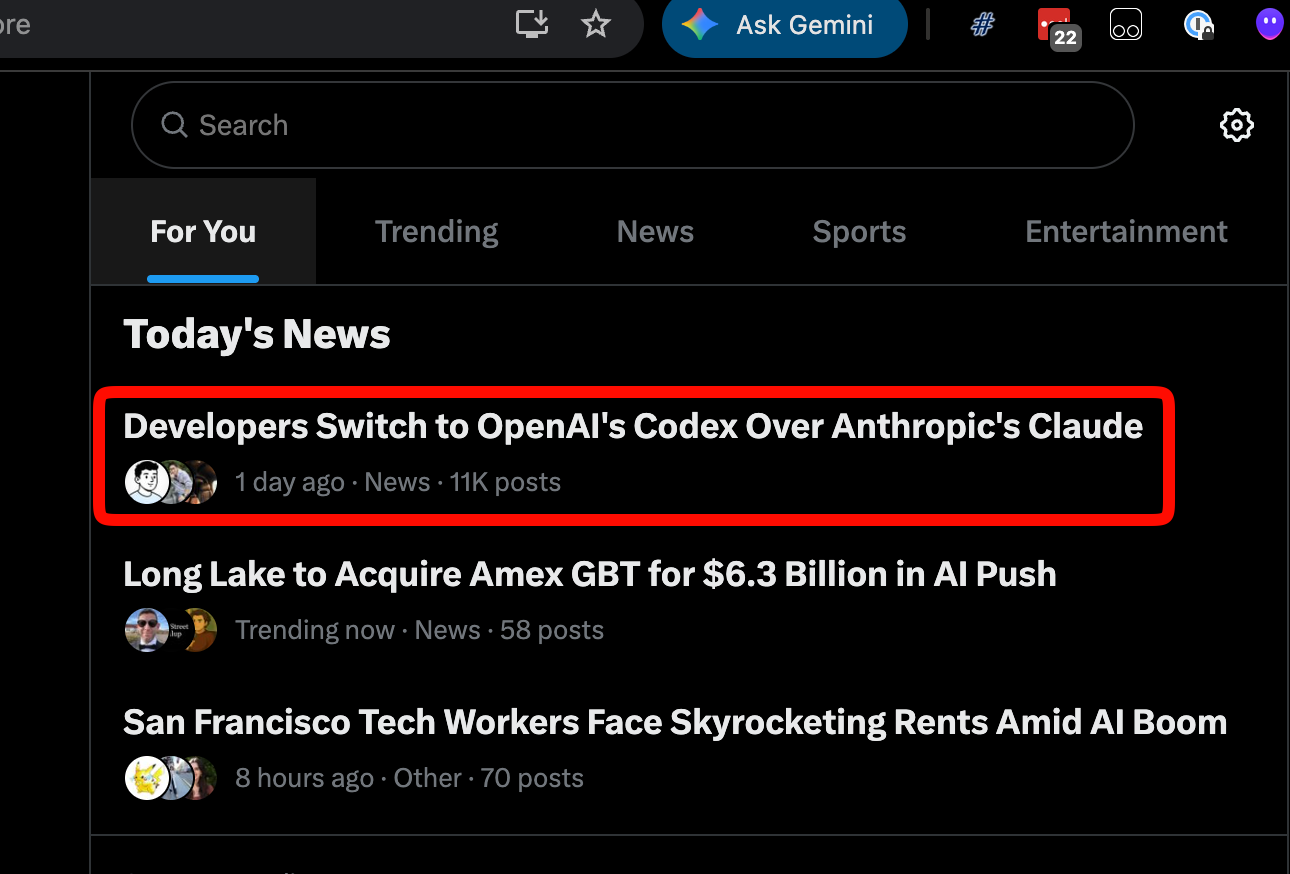
It has been a tale of two cities in the past 3 weeks since the launch of GPT 5.5; while the finance folks fall in love with Anthropic’s growth and CFO ahead of its likely October IPO, there has been a notable rise in pro-Codex sentiment among AI Engineers, likely a combination of GPT 5.5 being a really good (in some scenarios Mythos-tier) model, launch of Codex for Everything Else, and, a third thing, which is the trigger for today’s op-ed: more generous limits.
Последние 3 недели после запуска GPT 5.5 — это история двух городов: пока финансисты влюбляются в рост Anthropic и его CFO перед вероятным октябрьским IPO, среди AI-инженеров заметно растут про-Codex настроения. Это, вероятно, сочетание того, что GPT 5.5 — действительно хорошая (в некоторых сценариях уровня Mythos) модель, запуска Codex for Everything Else и третьего фактора, который и стал триггером сегодняшней колонки: более щедрых лимитов.
The messaging for Claude’s pricing change was generally pretty well done, it is simply not what uses of alternative harnesses wanted to hear: every Claude subscription now gets a monthly credit of API tokens equal to the dollar amount of the Claude subscription plan. So you pay $200, you get BOTH a Claude subscription with its own limits for using Claude on Anthropic-owned harnesses like Claude.ai and Claude Code (“interactive usage”), AND $200 worth of API credits for using Claude everywhere else including claude-p, OpenClaw and others (“programmatic usage”).
Коммуникация изменений в ценах Claude в целом сделана неплохо, просто это не то, что хотели услышать пользователи альтернативных harness'ей: теперь каждая подписка Claude получает месячный кредит API-токенов в долларовом эквиваленте плана. То есть вы платите $200 и получаете И подписку Claude со своими лимитами для использования Claude в фирменных harness'ах Anthropic вроде Claude.ai и Claude Code («интерактивное использование»), И $200 API-кредитов для использования Claude везде ещё, включая claude-p, OpenClaw и другие («программное использование»).
If things had worked this way from the start, it would have been viewed as a very good deal:
Если бы всё работало так с самого начала, это было бы воспринято как очень выгодное предложение:
However, because of the historical subsidy/pricing advantages (estimated between 70-90% discount from API pricing), people are viewing it as a “rug pull” of sorts — however it’s nice to have an official policy in place as opposed to the selective targeting of OpenClaw, OpenCode, and uncertain status of less popular harnesses.
Однако из-за исторических субсидий/ценовых преимуществ (по оценкам, скидка 70–90% относительно цен API) люди воспринимают это как своего рода «rug pull» — впрочем, приятно иметь официальную политику вместо избирательного таргетирования OpenClaw, OpenCode и неопределённого статуса менее популярных harness'ей.
That these headlines come on the same day as OpenAI launches their enterprise switch promo is an incredible coincidence:
То, что эти заголовки выходят в один день с enterprise switch-промо OpenAI, — невероятное совпадение:
At the end of the day, we would caution against reading too much into swings either way - both labs are doing very well, and these are in the grand scheme of things normal pricing shifts by people inventing the future of coding while figuring out optimal pricing as they shake up a decades-old industry. Anthropic was more liberal in the beginning, but now that Claude Code has a sustainable brand and clout as an agent harness, Anthropic is putting its most favorable pricing behind its own tools and metering everything else, whereas Codex as the challenger is being more liberal with everything.
В конечном счёте мы бы предостерегли от чрезмерных выводов из колебаний в любую сторону — обе лаборатории чувствуют себя очень хорошо, и в большой картине это нормальные ценовые сдвиги от людей, изобретающих будущее кодинга и нащупывающих оптимальное ценообразование, переворачивая многолетнюю индустрию. Anthropic был более либерален в начале, но теперь, когда у Claude Code есть устойчивый бренд и вес как agent harness, Anthropic ставит самые выгодные цены на свои собственные инструменты и метрирует всё остальное, тогда как Codex как претендент ведёт себя более либерально по всем фронтам.
Perhaps hardware is destiny, perhaps this is part of a longer 6 month alternating cycle of the “mandate equinox”:
Возможно, железо — это судьба, а возможно, это часть более длинного 6-месячного чередующегося цикла «mandate equinox»:
AI News for 5/12/2026-5/13/2026. We checked 12 subreddits, 544 Twitters and no further Discords. AINews’ website lets you search all past issues. As a reminder, AINews is now a section of Latent Space. You can opt in/out of email frequencies!
AI News за 12.05.2026–13.05.2026. Мы проверили 12 сабреддитов, 544 твиттер-аккаунта и больше никаких Discord. Сайт AINews позволяет искать по всем прошлым выпускам. Напоминаем, AINews теперь раздел Latent Space. Вы можете включать/отключать частоту email-рассылок!
AI Twitter Recap
AI Twitter Recap
Agent Infrastructure, Harnesses, and Developer Platforms
Инфраструктура агентов, harness'и и платформы для разработчиков
Cline, LangChain, Notion, and Cursor all pushed deeper into agent platform territory: Cline open-sourced a rebuilt Cline SDK and refreshed CLI with a TUI, agent teams, scheduled jobs, and connectors, positioning its harness as a reusable substrate for custom coding agents. LangChain shipped a large batch of agent lifecycle infrastructure at Interrupt: LangSmith Engine, SmithDB, Sandboxes, Managed Deep Agents, LLM Gateway, Context Hub, and Deep Agents 0.6. The most technically notable piece is SmithDB, a purpose-built observability database for nested, long-running traces with large payloads, reportedly yielding 12–15× faster access on key workloads; the team says it is built atop Apache DataFusion and Vortex. In parallel, Notion’s External Agents API lets third-party agents such as Claude, Codex, Cursor, Decagon, Warp, and Devin operate directly inside Notion as a shared, reviewable context layer rather than another silo. Cursor expanded cloud agents with fully configured development environments including cloned repos, dependencies, version history, rollback, scoped egress, and isolated secrets.
Agent UX is increasingly about long-running state, streaming, and orchestration rather than chat: Several launches converged on the same design direction. Duet Agent proposes a state-machine harness for jobs that last weeks or months, with parent/sub-agent coordination and memory replacing compaction. LangChain’s OSS updates added streaming typed projections, checkpoint storage, code interpreter, harness profiles, and model-specific tuning, all aimed at richer agent event streams than plain tokens. Tabracadabra moved from autocomplete to a context-aware assistant in any textbox, while VS Code introduced an Agents window and better multi-project task review. The architectural message across these releases is that production agents increasingly need durable execution, inspectable intermediate state, and tool-native UI surfaces rather than stateless prompt/response loops.
Cline, LangChain, Notion и Cursor — все углубились в территорию агентских платформ: Cline выложил в open source перестроенный Cline SDK и обновлённый CLI с TUI, агентскими командами, запланированными задачами и коннекторами, позиционируя свой harness как переиспользуемую подложку для кастомных coding-агентов. LangChain на Interrupt выкатил большую партию инфраструктуры для жизненного цикла агентов: LangSmith Engine, SmithDB, Sandboxes, Managed Deep Agents, LLM Gateway, Context Hub и Deep Agents 0.6. Самая технически примечательная часть — SmithDB, специально построенная база для наблюдаемости вложенных, долго работающих трейсов с большими пейлоадами, дающая, по сообщениям, 12–15× ускорение доступа на ключевых нагрузках; команда говорит, что она построена поверх Apache DataFusion и Vortex. Параллельно External Agents API от Notion позволяет сторонним агентам — Claude, Codex, Cursor, Decagon, Warp, Devin — работать прямо внутри Notion как общий, проверяемый слой контекста, а не очередной силос. Cursor расширил облачных агентов полностью настроенными средами разработки, включая клонированные репозитории, зависимости, историю версий, откаты, ограниченный egress и изолированные секреты.Agent UX всё больше про долгоиграющее состояние, стриминг и оркестрацию, а не про чат: несколько запусков сошлись в одном дизайнерском направлении. Duet Agent предлагает harness в виде конечного автомата для задач длиной в недели или месяцы, с координацией родительских/субагентов и памятью вместо компакции. OSS-обновления LangChain добавили стриминг типизированных проекций, хранение чекпойнтов, code interpreter, профили harness'ей и тюнинг под конкретные модели — всё ради более богатых событийных потоков агентов, чем простые токены. Tabracadabra ушёл от автокомплита к контекстно-зависимому ассистенту в любом текстовом поле, а VS Code представил окно Agents и улучшенный обзор задач между проектами. Архитектурное послание этих релизов: продакшен-агентам всё больше нужны долговечное исполнение, инспектируемое промежуточное состояние и tool-native UI-поверхности, а не stateless-циклы prompt/response.
Model Training, Architecture, and Data Efficiency
Обучение моделей, архитектура и эффективность данных
Pretraining efficiency and architectural experimentation were the strongest research throughline: Nous Research’s Token Superposition Training modifies the early phase of pretraining so the model reads/predicts contiguous bags of tokens before reverting to standard next-token prediction; they report 2–3× wall-clock speedup at matched FLOPs with no inference-time architecture change, validated from 270M to 3B dense and 10B-A1B MoE. Jonas Geiping et al. argued current message-based/chat training overly constrains agents to a single stream and released a multi-stream LLM paper claiming lower latency, cleaner separation of concerns, and more legible parallel reasoning/tool use; paper and code are linked here. δ-mem proposed an external online associative memory attached to a frozen full-attention backbone, with an 8×8 state reportedly improving average score by 1.10× and beating non-δ-mem baselines by 1.15×, with larger gains on memory-heavy benchmarks.
Post-training/compression and data curation also produced notable results: NVIDIA’s Star Elastic claims one post-training run can derive a family of reasoning model sizes, at 360× lower cost than pretraining a family and 7× better than SOTA compression. Datology’s VLM work, highlighted by Siddharth Joshi and Pratyush Maini, argues data curation alone can produce major multimodal gains: +11.7 points across 20 public VLM benchmarks at 2B, beating InternVL3.5-2B by roughly 10 points at about 17× less training compute, and near-frontier 4B performance with 3.3× lower response FLOPs than Qwen3-VL-4B. On the open data side, Percy Liang said the next Marin run already has 18T tokens in its mix and is still seeking more pretraining, mid-training, and SFT data, with a companion token viewer shared here.
Open evaluation and dataset work is maturing alongside model building: Kevin Li’s SWE-ZERO-12M-trajectories is positioned as the largest open agentic trace dataset: 112B tokens, 12M trajectories, 122K PRs, 3K repos, 16 languages. Victor Mustar flagged llama-eval as a step toward more comparable llama.cpp community evals. Meanwhile, Steve Rabinovich and Sayash Kapoor argued credible agent evaluation requires log analysis, not outcome-only metrics, because stronger agents expose hidden benchmark bugs and reward-hacking paths.
Эффективность претрейна и архитектурные эксперименты — самая яркая исследовательская линия: Token Superposition Training от Nous Research меняет раннюю фазу претрейна так, что модель читает/предсказывает смежные «мешки» токенов, прежде чем вернуться к стандартному next-token prediction; авторы сообщают о 2–3× ускорении по wall-clock при тех же FLOPs без изменения архитектуры на инференсе, проверенном от 270M до 3B dense и 10B-A1B MoE. Jonas Geiping и др. утверждают, что нынешнее message-based/чат-обучение чрезмерно ограничивает агентов одним потоком, и выпустили статью о multi-stream LLM, заявляя о меньшей задержке, более чистом разделении ответственности и более читаемом параллельном reasoning'е/использовании инструментов; статья и код по ссылке здесь. δ-mem предлагает внешнюю онлайн-ассоциативную память, прикреплённую к замороженному full-attention бэкбону: при состоянии 8×8 сообщается об улучшении среднего балла в 1,10× и о превосходстве над не-δ-mem базлайнами в 1,15×, с более крупным приростом на бенчмарках с высокой нагрузкой на память.Пост-трейнинг/сжатие и курирование данных тоже дали заметные результаты: Star Elastic от NVIDIA заявляет, что один прогон пост-трейнинга может породить семейство reasoning-моделей разных размеров, при в 360 раз меньшей стоимости, чем претрейн семейства и в 7 раз лучше SOTA-сжатия. Работа Datology по VLM, отмеченная Siddharth Joshi и Pratyush Maini, утверждает, что одно лишь курирование данных способно дать крупный мультимодальный прирост: +11,7 пункта по 20 публичным VLM-бенчмаркам на 2B, обгон InternVL3.5-2B примерно на 10 пунктов при примерно 17× меньшем тренировочном compute, и почти фронтирная 4B-производительность при в 3,3 раза меньшем response FLOPs, чем у Qwen3-VL-4B. Что до открытых данных, Percy Liang сообщил, что следующий прогон Marin уже содержит 18T токенов в смеси и по-прежнему ищет ещё данные для претрейна, mid-training и SFT; сопутствующий просмотрщик токенов здесь.Открытые evals и работа с датасетами созревают параллельно с построением моделей: SWE-ZERO-12M-trajectories от Kevin Li позиционируется как крупнейший открытый датасет агентских трасс: 112B токенов, 12M траекторий, 122K PR, 3K репозиториев, 16 языков. Victor Mustar отметил llama-eval как шаг к более сопоставимым community-eval'ам llama.cpp. Тем временем Steve Rabinovich и Sayash Kapoor доказывают, что заслуживающая доверия оценка агентов требует анализа логов, а не только метрик результата, потому что более сильные агенты вскрывают скрытые баги бенчмарков и пути reward-hacking.
Enterprise AI Pricing, Platform Competition, and Distribution
Ценообразование enterprise AI, конкуренция платформ и дистрибуция
Anthropic vs OpenAI competition sharpened around enterprise distribution and developer lock-in: Ramp data cited by Andrew Curran showed Anthropic at 34.4% of businesses vs OpenAI at 32.3% in April, the first apparent lead change in business adoption; The Rundown amplified the same figures. At the same time, Anthropic changed plan economics: ClaudeDevs announced that paid Claude plans will get a dedicated monthly credit for programmatic usage across the Agent SDK, claude -p, GitHub Actions, and third-party SDK apps. This was immediately read by power users as a major restriction on subscription-subsidized harnesses, with criticism from Theo, Jeremy Howard, Matt Pocock, and Omar Sanseviero. Anthropic partially offset that backlash with a separate 50% increase in Claude Code weekly limits through July 13, stacked on the previously announced 2× 5-hour limit increase.
OpenAI responded aggressively with Codex enterprise incentives: OpenAI Devs and Sam Altman offered two months of free Codex usage for enterprise customers switching in the next 30 days. OpenAI also published more technical platform detail, including a Windows sandbox design write-up describing the combination of local users, firewall rules, ACLs, write-restricted tokens, DPAPI, and helper executables needed to safely run coding agents with local filesystem/tool access. The competitive dynamic now looks less like “best model wins” and more like subsidy + workflow control + harness compatibility.
Enterprise adoption is increasingly tied to runtime/security assurances: Perplexity described a hardware-isolated sandbox architecture with VPC-level separation, short-lived proxy tokens, and scanning of external content before agent actions, with additional details on encryption and auto-deletion. Aravind Srinivas framed this as foundational to Perplexity becoming an enterprise knowledge/research platform. The broader pattern: agent vendors are no longer selling only intelligence; they’re selling bounded execution environments.
Конкуренция Anthropic против OpenAI обострилась вокруг enterprise-дистрибуции и lock-in разработчиков: Данные Ramp, приведённые Andrew Curran, показали Anthropic на 34,4% бизнесов против OpenAI на 32,3% в апреле — первая видимая смена лидера по корпоративному внедрению; The Rundown разогнал те же цифры. Одновременно Anthropic поменял экономику тарифов: ClaudeDevs объявил, что платные планы Claude получат выделенный месячный кредит на программное использование через Agent SDK, claude -p, GitHub Actions и сторонние SDK-приложения. Power-юзеры тут же восприняли это как серьёзное ограничение subsidy-harness'ей; критика прозвучала от Theo, Jeremy Howard, Matt Pocock и Omar Sanseviero. Anthropic частично компенсировал негатив отдельным повышением недельных лимитов Claude Code на 50% до 13 июля, поверх ранее объявленного 2× увеличения 5-часового лимита.OpenAI агрессивно ответил enterprise-стимулами для Codex: OpenAI Devs и Sam Altman предложили два месяца бесплатного Codex корпоративным клиентам, переходящим в ближайшие 30 дней. OpenAI также опубликовал больше технических деталей платформы, включая описание дизайна Windows-песочницы — комбинацию локальных пользователей, правил файрвола, ACL, write-restricted токенов, DPAPI и helper-исполняемых файлов, необходимых для безопасного запуска coding-агентов с доступом к локальной файловой системе/инструментам. Конкурентная динамика теперь меньше похожа на «побеждает лучшая модель» и больше — на субсидия + контроль рабочего процесса + совместимость harness'ей.Корпоративное внедрение всё сильнее связано с гарантиями рантайма/безопасности: Perplexity описала аппаратно изолированную архитектуру песочницы с разделением на уровне VPC, короткоживущими прокси-токенами и сканированием внешнего контента до действий агента, с дополнительными деталями по шифрованию и автоудалению. Aravind Srinivas представил это как фундамент для превращения Perplexity в enterprise-платформу знаний/исследований. Более широкий паттерн: вендоры агентов больше не продают только интеллект — они продают ограниченные среды исполнения.
Autonomous Science, Cyber Capability, and Robotics
Автономная наука, кибер-возможности и робототехника
Recursive self-improvement moved from idea to startup cluster: The largest single meta-theme was the launch of Recursive, founded to build AI that automates science and safely improves itself. Launch posts from Richard Socher, Josh Tobin, Dominik Schmidt, Jenny Zhang, and Shengran Hu suggest a team drawn from open-endedness, AI Scientist, and research automation work. In adjacent work, Adaption’s AutoScientist aims to automate the full training-research loop outside frontier labs, with Sarah Hooker arguing that most model training failures are due to research-loop brittleness rather than mere compute scarcity.
Cyber capability evaluations continue to steepen: The UK AI Security Institute said the length of cyber tasks frontier models can complete has been doubling every few months, and that recent models are beating prior trends. Anthropic/Glasswing’s Logan Graham said Claude Mythos Preview is the first model to solve both AISI end-to-end cyber ranges, including Cooling Tower, and the only one to clear every task under the institute’s 2.5M-token cap. XBOW reportedly found “token-for-token, unprecedented precision,” and partner usage allegedly surfaced thousands of high/critical vulnerabilities in weeks. Independent commentary from scaling01 claimed a newer Mythos version completed a cyber range 6/10 times vs 3/10 for the preview baseline.
Robotics got a concrete long-horizon deployment demo: Figure’s Brett Adcock streamed humanoid robots running a full 8-hour autonomous shift on package sorting using Helix-02, with follow-up details that the robots reason from camera pixels, operate around human parity (~3s/package), perform on-device inference, coordinate as a networked fleet, autonomously swap for low battery, and self-diagnose/fail over to maintenance when needed here. This is one of the clearer public demonstrations of multi-robot, long-duration, no-human-in-the-loop orchestration rather than a short benchmark clip.
Рекурсивное самоулучшение перешло из идеи в кластер стартапов: крупнейшей мета-темой стал запуск Recursive — компании, основанной для создания ИИ, который автоматизирует науку и безопасно улучшает сам себя. Запускающие посты от Richard Socher, Josh Tobin, Dominik Schmidt, Jenny Zhang и Shengran Hu позволяют предположить команду из людей, работавших над open-endedness, AI Scientist и автоматизацией исследований. В смежной работе AutoScientist от Adaption стремится автоматизировать весь цикл training-research вне frontier-лабораторий, а Sarah Hooker утверждает, что большинство провалов обучения моделей связаны с хрупкостью research-цикла, а не с нехваткой compute.Оценки кибер-возможностей продолжают расти круче: британский AI Security Institute сообщил, что длина кибер-задач, которые могут выполнять фронтирные модели, удваивается каждые несколько месяцев, и недавние модели бьют прежние тренды. Logan Graham из Anthropic/Glasswing сказал, что Claude Mythos Preview — первая модель, решившая оба end-to-end кибер-полигона AISI, включая Cooling Tower, и единственная, прошедшая все задачи в рамках лимита института в 2,5M токенов. XBOW, по сообщениям, нашёл «беспрецедентную точность token-for-token», а партнёрское использование, как утверждается, вскрыло тысячи high/critical уязвимостей за недели. Независимый комментарий от scaling01 утверждает, что более новая версия Mythos прошла кибер-полигон 6/10 раз против 3/10 у preview-базлайна.Робототехника получила конкретную демонстрацию long-horizon развёртывания: Brett Adcock из Figure отстримил гуманоидных роботов, отрабатывающих полную 8-часовую автономную смену на сортировке посылок на Helix-02, с дополнительными деталями: роботы рассуждают по пикселям с камеры, работают на уровне паритета с человеком (~3с/посылка), выполняют инференс on-device, координируются как сетевой парк, автономно меняются при низком заряде батареи и сами диагностируются/уходят в сервис при необходимости здесь. Это одна из самых явных публичных демонстраций оркестрации множества роботов в длительной работе без человека в цикле, а не короткий бенчмарковый клип.
Top tweets (by engagement)
Топ-твиты (по вовлечённости)
Claude Code pricing and limits: @ClaudeDevs on 50% higher weekly limits, @ClaudeDevs on programmatic credits, and the ensuing developer backlash from @theo made pricing policy the day’s most consequential developer story.
Codex enterprise push: @sama offering two free months of Codex usage for switchers and @OpenAIDevs’ enterprise call-to-action signaled an unusually direct go-to-market counterpunch.
Figure’s 8-hour humanoid shift: @adcock_brett’s livestream post drew enormous attention and is one of the few viral posts in the set with clear technical substance.
Cline SDK launch: @cline’s SDK release was one of the highest-engagement genuinely technical launches, reflecting demand for open coding-agent harnesses.
Token Superposition Training: @NousResearch’s TST post stood out as a rare pretraining-method tweet that broke through widely, likely because the claim—2–3× training speedup without changing inference-time architecture—is concrete and economically important.
Ценообразование и лимиты Claude Code: @ClaudeDevs о повышении недельных лимитов на 50%, @ClaudeDevs о программных кредитах, и последовавший бэклаш разработчиков от @theo сделали ценовую политику самой значимой историей дня для разработчиков.Enterprise-пуш Codex: @sama, предлагающий два бесплатных месяца Codex для переходящих, и enterprise-призыв @OpenAIDevs просигнализировали необычно прямой go-to-market контрудар.8-часовая смена гуманоидов Figure: пост Brett Adcock с лайвстримом привлёк огромное внимание и стал одним из немногих вирусных постов в подборке с явной технической субстанцией.Запуск Cline SDK: релиз SDK от @cline был одним из самых вовлекающих по-настоящему технических запусков, отражая спрос на open coding-agent harness'и.Token Superposition Training: пост @NousResearch про TST выделился как редкий твит про метод претрейна, широко пробивший охват — вероятно, потому что утверждение о ускорении обучения в 2–3× без изменения архитектуры на инференсе конкретно и экономически важно.
AI Reddit Recap
AI Reddit Recap
/r/LocalLlama + /r/localLLM Recap
/r/LocalLlama + /r/localLLM Recap
1. Efficient On-Device LLM Inference
1. Эффективный on-device инференс LLM
Keep reading with a 7-day free trial
Продолжите чтение с 7-дневным бесплатным пробным периодом
Subscribe to Latent.Space to keep reading this post and get 7 days of free access to the full post archives.
Подпишитесь на Latent.Space, чтобы продолжить чтение этого поста и получить 7 дней бесплатного доступа к полному архиву постов.