[AINews] DeepSeek V4 Pro (1.6T-A49B) and Flash (284B-A13B), Base and Instruct — runnable on Huawei Ascend chips
DeepSeek выпустила долгожданную модель DSV4 в двух вариантах: Pro (1.6T параметров / 49B активных) и Flash (284B / 13B активных), обе с контекстом 1M токенов и под лицензией MIT. Модель обучена на 32T токенов в FP4 и использует новые техники Compressed Sparse Attention (CSA) и Heavily Compressed Attention (HCA), сокращающие KV-кэш в 8.7 раз по сравнению с V3.2. Независимые бенчмарки (Artificial Analysis) ставят V4 Pro на второе место среди open-weight моделей (52 балла) после Kimi K2.6 (54), но позади закрытых лидеров вроде GPT-5.4, Opus 4.7 и Gemini 3.1 Pro. Цена V4 Pro — $1.74/$3.48 за 1M токенов, Flash — $0.14/$0.28; модель совместима с чипами Huawei Ascend, что важно в контексте экспортных ограничений на NVIDIA. Многие эксперты называют 58-страничный технический отчёт одним из лучших в году, особо отмечая инженерные решения по длинному контексту, хотя архитектура слишком сложна для лёгкого воспроизведения другими лабораториями.
[AINews] DeepSeek V4 Pro (1.6T-A49B) and Flash (284B-A13B), Base and Instruct — runnable on Huawei Ascend chips
[AINews] DeepSeek V4 Pro (1.6T-A49B) и Flash (284B-A13B), Base и Instruct — работают на чипах Huawei Ascend
The prodigal Tiger returns... but is no longer the benchmarks leader.
Блудный Тигр возвращается… но больше не лидирует в бенчмарках.
After a couple months’ delay and lots of speculation, DeepSeek finally released the heavily anticipated DSV4, the first major version model since DSV3 (Dec 2024) and DSR1 (Jan 2025). It brings the DeepSeek family up in line with Kimi K2.6, the current open model leader, and Xiaomi Mimo 2.5, a lesser known family released 2 days ago.
После двух месяцев задержки и множества спекуляций DeepSeek наконец выпустила долгожданную DSV4 — первую крупную версию модели со времён DSV3 (декабрь 2024) и DSR1 (январь 2025). Это приводит семейство DeepSeek в один ряд с Kimi K2.6, текущим лидером среди открытых моделей, и Xiaomi Mimo 2.5 — менее известным семейством, выпущенным 2 дня назад.
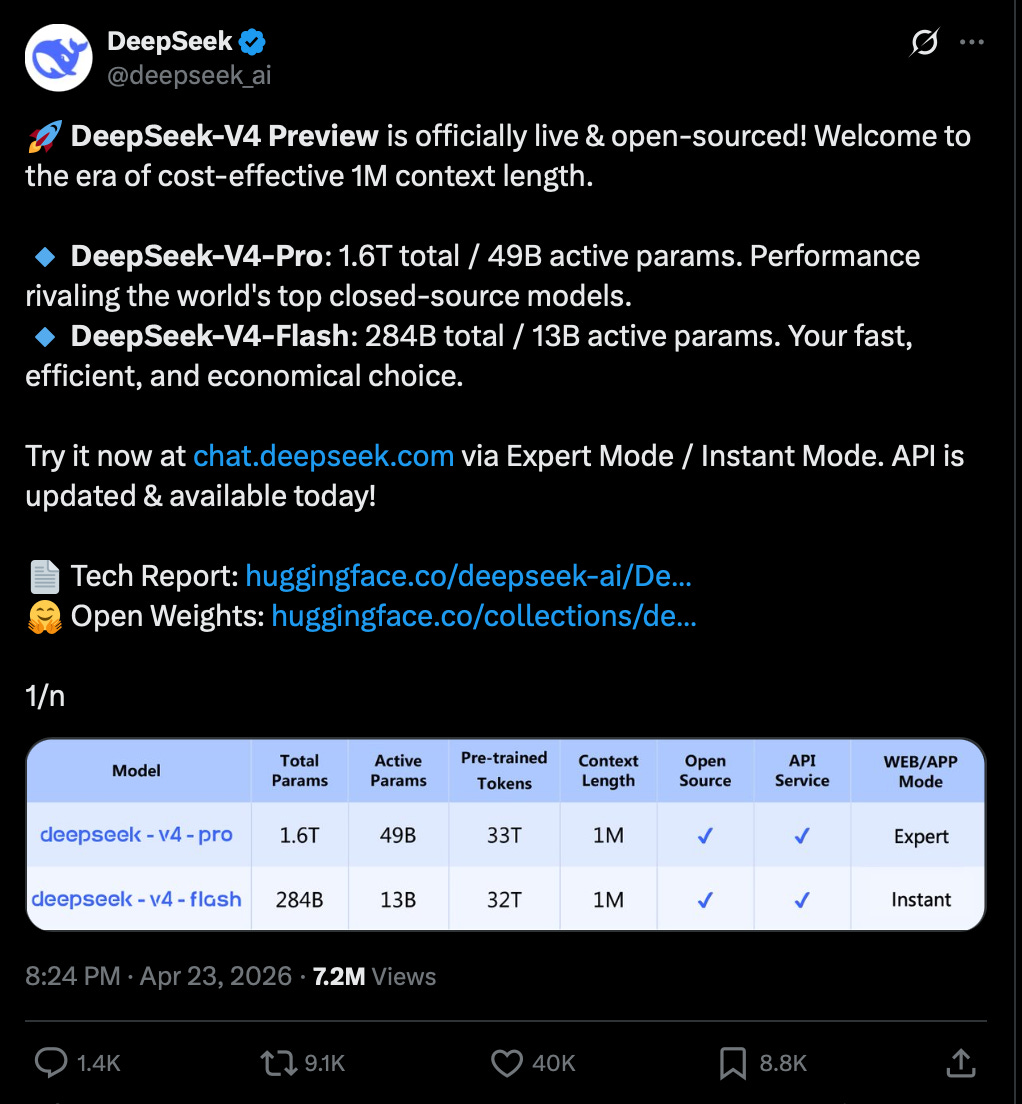
The DSV4 family is roughly a Gemini 3.1, GPT 5.4, Opus 4.6 level model, up to 1.6T MOE withtrained on 32T tokens with FP4, with 1M token context (supported by their new Compressed Sparse Attention (CSA) and Heavily Compressed Attention (HCA) techniques), and incredibly rarely, they released both the Base and Instruct versions - surely setting the stage for a possible “DeepSeek R2” in future, though this one already has reasoning effort.
Семейство DSV4 примерно соответствует уровню Gemini 3.1, GPT 5.4 и Opus 4.6 — до 1.6T MOE, обученной на 32T токенов с FP4, с контекстом 1M токенов (благодаря новым техникам Compressed Sparse Attention (CSA) и Heavily Compressed Attention (HCA)). И что бывает крайне редко — выпущены сразу Base и Instruct версии, явно готовя почву для возможной «DeepSeek R2» в будущем, хотя у этой модели уже есть режим рассуждений.
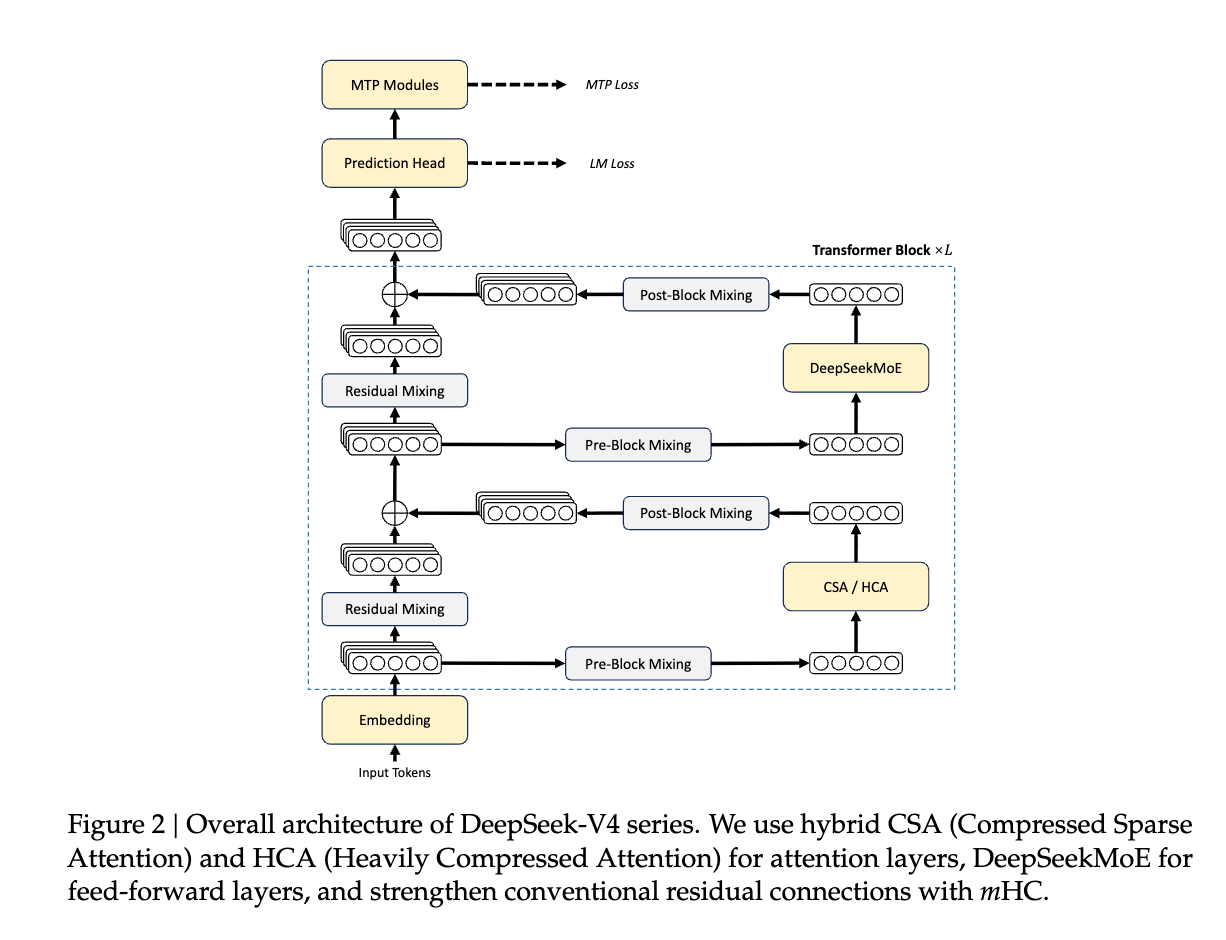
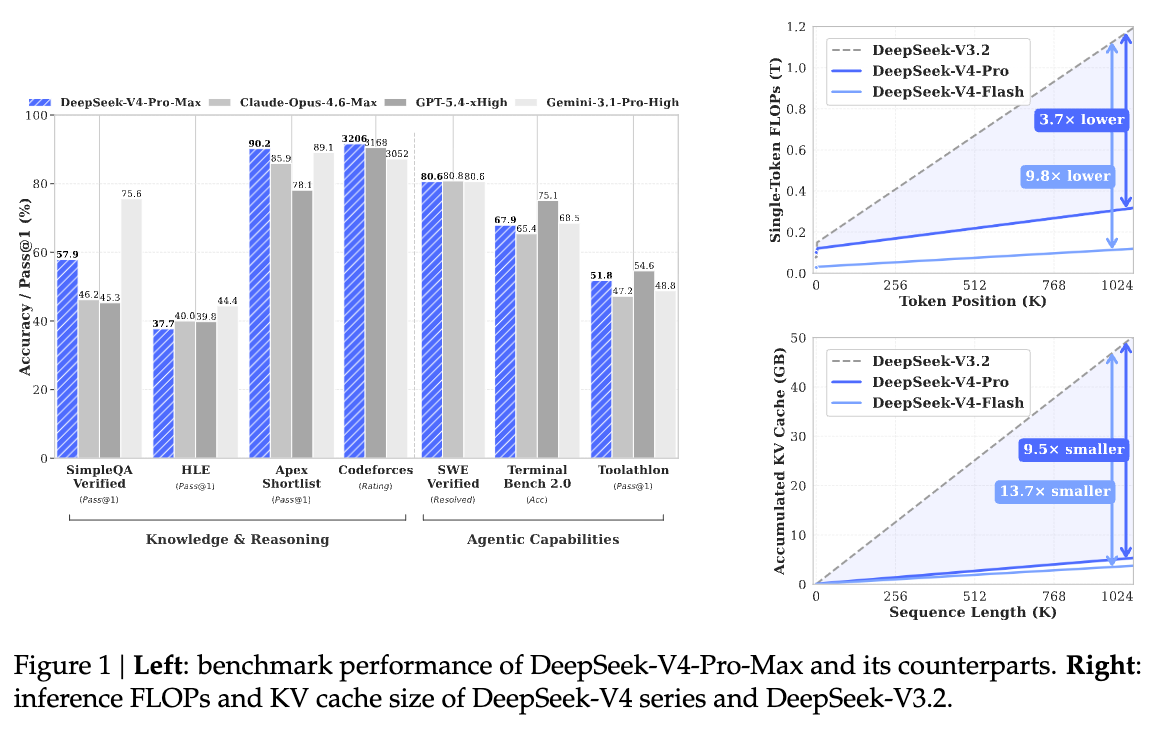
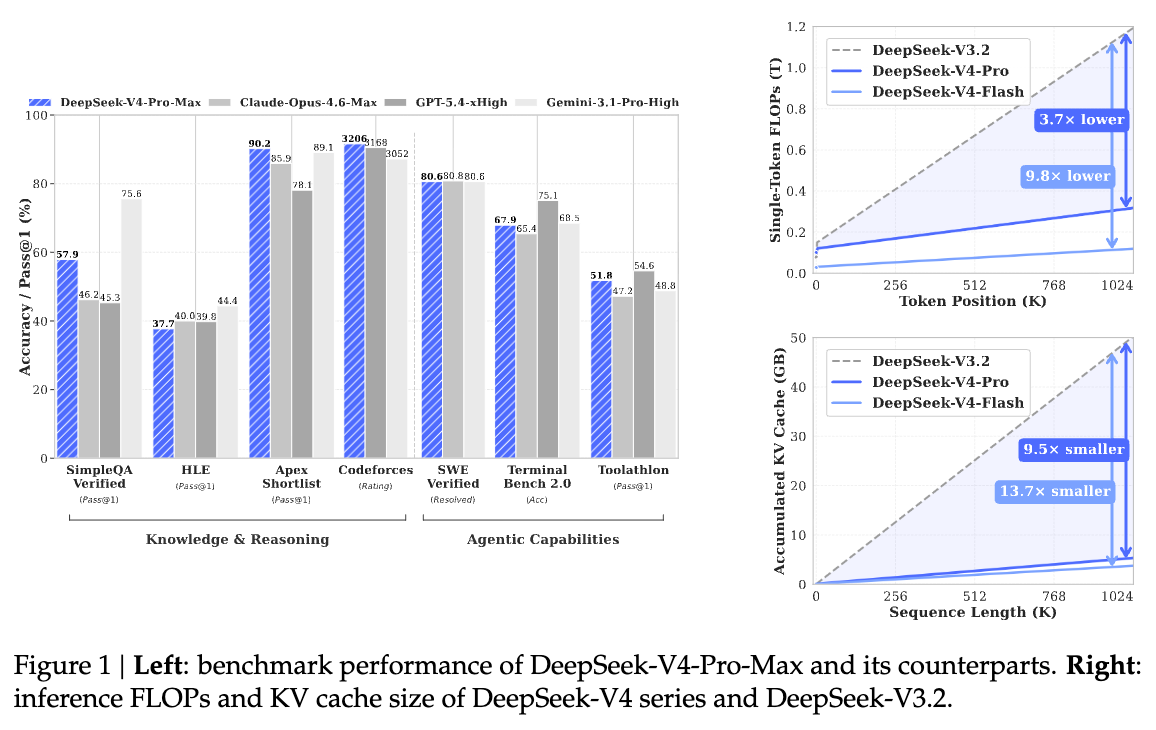
The technical report is a typically dense 58 pages, demonstrating training and inference insights and improvements from the Manifold Constrained Hyper-Connections (mHC) paper they released in January, continued usage of Moonshot’s Muon, and CSA/HCA’s overall INCREDIBLE efficiency improvements on DeepSeek 3.2-Exp’s already impressive Sparse Attention - at 1M tokens, requiring only 27% of FLOPs and 10% of KV cache memory compared with DeepSeek-V3.2:
Технический отчёт — типично плотный документ на 58 страниц, демонстрирующий инсайты и улучшения по обучению и инференсу из статьи о Manifold Constrained Hyper-Connections (mHC), выпущенной ими в январе, продолжающееся использование Muon от Moonshot, а также НЕВЕРОЯТНЫЕ улучшения эффективности CSA/HCA по сравнению с и без того впечатляющим Sparse Attention в DeepSeek 3.2-Exp — при 1M токенов требуется лишь 27% FLOPs и 10% памяти KV cache по сравнению с DeepSeek-V3.2:
The geopolitical backdrop behind the Huawei CANN compatibility is DeepSeek weaning dependence off export-controlled NVIDIA/CUDA chips — Ascends are still a quarter the supply of H100s, but this is an important milestone for Chinese total independence.
Геополитический контекст за совместимостью с Huawei CANN — это стремление DeepSeek снизить зависимость от подпадающих под экспортные ограничения чипов NVIDIA/CUDA. Ascend пока поставляются в четверть от объёмов H100, но это важная веха для полной независимости Китая.
AI News for 4/23/2026-4/24/2026. We checked 12 subreddits, 544 Twitters and no further Discords. AINews’ website lets you search all past issues. As a reminder, AINews is now a section of Latent Space. You can opt in/out of email frequencies!
AI News за 23–24 апреля 2026 года. Мы проверили 12 сабреддитов, 544 Twitter-аккаунта и больше никаких Discord-серверов. Сайт AINews позволяет искать по всем прошлым выпускам. Напоминаем, что AINews теперь — раздел Latent Space. Вы можете подписаться/отписаться от частоты рассылки!
AI Twitter Recap
Обзор AI Twitter
Top Story: DeepSeek V4
Главная история: DeepSeek V4
DeepSeek released DeepSeek-V4 Pro and DeepSeek-V4 Flash, its first major architecture refresh since V3 and first clear two-tier lineup, with 1M-token context, hybrid reasoning/non-reasoning modes, an MIT license, and a technical report detailed enough that multiple researchers called it one of the most important or best-written model papers of the year. Across the reactions, the factual consensus is that V4 materially advances open-weight long-context and agentic coding performance while remaining somewhat behind the top closed frontier models overall. Independent benchmarkers place V4 Pro around the #2 open-weights tier, roughly near Kimi K2.6 / GLM-5.1 / strong Claude Sonnet-class to Opus-ish depending on benchmark and mode, with especially strong long-context and agentic performance; opinions diverge on how close it is to GPT-5.x / Opus 4.7 and on whether this is “democratizing” progress or an architecture so complex that few open labs can realistically reproduce it. Key sources include deep-dive commentary from @ArtificialAnlys, @scaling01, @nrehiew_, @ben_burtenshaw, @TheZachMueller, @ZhihuFrontier, and infra/vendor posts from @vllm_project, @NVIDIAAI, and @Togethercompute.
DeepSeek выпустила DeepSeek-V4 Pro и DeepSeek-V4 Flash — первое крупное архитектурное обновление со времён V3 и первую чёткую двухуровневую линейку с контекстом 1M токенов, гибридными режимами рассуждения/без рассуждения, лицензией MIT и техническим отчётом настолько подробным, что многие исследователи назвали его одной из самых важных или лучше всего написанных научных работ по моделям этого года. По общему мнению, V4 существенно продвигает производительность open-weight моделей в длинном контексте и агентном программировании, оставаясь при этом несколько позади топовых закрытых frontier-моделей в целом. Независимые бенчмаркеры размещают V4 Pro примерно на уровне #2 среди open-weight моделей, около Kimi K2.6 / GLM-5.1 / уровня сильного Claude Sonnet до Opus-подобного в зависимости от бенчмарка и режима, с особенно сильной производительностью в длинном контексте и агентных задачах; мнения расходятся в том, насколько близка модель к GPT-5.x / Opus 4.7 и является ли это «демократизацией» прогресса или архитектурой настолько сложной, что мало какие open-лаборатории смогут её реалистично воспроизвести. Ключевые источники включают подробные комментарии от @ArtificialAnlys, @scaling01, @nrehiew_, @ben_burtenshaw, @TheZachMueller, @ZhihuFrontier, а также посты от инфраструктурных вендоров: @vllm_project, @NVIDIAAI и @Togethercompute.
Core facts and technical details
Ключевые факты и технические детали
The most concrete technical claims repeated across the discussion:
Наиболее конкретные технические утверждения, повторяющиеся в обсуждении:
Two models
V4 Pro: 1.6T total parameters / 49B active
V4 Flash: 284B total / 13B active
Reported by @ArtificialAnlys, @teortaxesTex, @baseten, @NVIDIAAI
Context
1M tokens, up from 128K in V3.2 per @ArtificialAnlys
Multiple posters frame this as the headline achievement: “solid ultra-long context” @teortaxesTex
Training scale
32T–33T tokens cited repeatedly
@nrehiew_ notes 32T tokens over 1.6T parameters, i.e. roughly 20 tokens/parameter
@teortaxesTex cites 33T
@nrehiew_ estimates pretraining compute at ~1e25 FLOPs
Reasoning / modes
DeepSeek exposes three reasoning modes per @Togethercompute
Hybrid “thinking/non-thinking” positioning noted by @ArtificialAnlys
Long-context architecture
Several threads summarize a new hybrid attention system:
shared KV vectors
compressed KV streams
sparse attention over compressed tokens
local/sliding-window attention for nearby context
@ZhihuFrontier gives the most compact public summary:
2× KV reduction via shared key-value vectors
c4a ≈ 4× compression
c128a ≈ 128× compression
top-k sparse attention on compressed tokens
128-token sliding window
1M context KV cache = 9.62 GiB/sequence (bf16)
8.7× smaller than DeepSeek V3.2’s 83.9 GiB
FP4 index cache + FP8 attention cache gives another ~2× reduction
@ben_burtenshaw condenses this to “10× smaller KV cache”
@TheZachMueller and @TheZachMueller describe CSA + HCA layer patterns, with alternating layers and V4 Flash using sliding-window layers instead of HCA in some places
Quantization / checkpoint format
@LambdaAPI: checkpoint is mixed FP4 + FP8
MoE expert weights in FP4
attention / norm / router in FP8
claim: the full model fits on a single 8×B200 node
Inference hardware / serving
@NVIDIAAI: on Blackwell Ultra, V4 Pro can deliver 150+ TPS/user interactivity for agentic workflows
@NVIDIAAI: published day-0 V4 Pro performance pareto using vLLM
@SemiAnalysis_: day-0 support and benchmarking across H200, MI355, B200, B300, GB200/300
@Prince_Canuma: DeepSeek4-Flash on 256GB Mac
@Prince_Canuma: MLX quants published
@simonw asks about smaller-RAM Mac viability, implying community interest but incomplete support story
@QuixiAI reminds users that many local stacks still lack tensor parallel, relevant because V4-class models strongly stress inference infra
License / availability / pricing
MIT license per @ArtificialAnlys
first-party API plus rapid third-party availability via @Togethercompute, @baseten, @NousResearch, @Teknium
V4 Pro pricing: $1.74 / $3.48 per 1M input/output tokens
V4 Flash pricing: $0.14 / $0.28
cache-hit pricing also given by @ArtificialAnlys
@scaling01 views the pricing as a glimpse of future “Mythos-level” cheap coding models
Reuters-via-posted quote from @scaling01: DeepSeek said Pro pricing could fall sharply once Huawei Ascend 950 supernodes are deployed at scale in H2
Две моделиV4 Pro: 1.6T всего параметров / 49B активныхV4 Flash: 284B всего / 13B активныхСообщают @ArtificialAnlys, @teortaxesTex, @baseten, @NVIDIAAIКонтекст1M токенов, по сравнению со 128K в V3.2 по данным @ArtificialAnlysМногие постеры называют это главным достижением: «солидный сверхдлинный контекст» @teortaxesTexОбъём обученияМногократно упоминаются 32T–33T токенов@nrehiew_ отмечает 32T токенов на 1.6T параметров, т.е. примерно 20 токенов/параметр@teortaxesTex приводит 33T@nrehiew_ оценивает вычисления претрейна в ~1e25 FLOPsРассуждения / режимыDeepSeek предоставляет три режима рассуждений по данным @TogethercomputeГибридное позиционирование «thinking/non-thinking» отмечает @ArtificialAnlysАрхитектура для длинного контекстаНесколько тредов резюмируют новую гибридную систему внимания:общие KV-векторысжатые KV-потокиразреженное внимание над сжатыми токенамилокальное/sliding-window внимание для близкого контекста@ZhihuFrontier даёт наиболее компактное публичное резюме:2× сокращение KV за счёт общих key-value векторовc4a ≈ 4× сжатиеc128a ≈ 128× сжатиеtop-k разреженное внимание на сжатых токенахsliding window на 128 токеновKV cache для 1M контекста = 9.62 GiB/последовательность (bf16)В 8.7× меньше чем 83.9 GiB у DeepSeek V3.2FP4 index cache + FP8 attention cache дают ещё ~2× сокращение@ben_burtenshaw сводит это к «в 10× меньше KV cache»@TheZachMueller и @TheZachMueller описывают паттерны слоёв CSA + HCA, с чередующимися слоями, причём V4 Flash в некоторых местах использует sliding-window слои вместо HCAКвантизация / формат чекпойнта@LambdaAPI: чекпойнт — смешанный FP4 + FP8Веса MoE-экспертов в FP4attention / norm / router в FP8утверждение: полная модель помещается на одну ноду 8×B200Инференс-оборудование / serving@NVIDIAAI: на Blackwell Ultra V4 Pro может выдавать 150+ TPS/user интерактивности для агентных workflow@NVIDIAAI: опубликовали day-0 Парето-фронт производительности V4 Pro на vLLM@SemiAnalysis_: day-0 поддержка и бенчмарки на H200, MI355, B200, B300, GB200/300@Prince_Canuma: DeepSeek4-Flash на 256GB Mac@Prince_Canuma: опубликованы MLX-кванты@simonw спрашивает о жизнеспособности на Mac с меньшим объёмом RAM, что подразумевает интерес сообщества, но неполную поддержку@QuixiAI напоминает, что многие локальные стеки до сих пор не поддерживают tensor parallel, что важно, так как модели уровня V4 серьёзно нагружают инференс-инфраструктуруЛицензия / доступность / ценыЛицензия MIT по данным @ArtificialAnlysfirst-party API плюс быстрая доступность через @Togethercompute, @baseten, @NousResearch, @TekniumЦена V4 Pro: $1.74 / $3.48 за 1M input/output токеновЦена V4 Flash: $0.14 / $0.28цена с попаданием в кэш также указана у @ArtificialAnlys@scaling01 рассматривает ценообразование как проблеск будущих дешёвых coding-моделей «уровня Mythos»Цитата из Reuters, приведённая @scaling01: DeepSeek заявила, что цены на Pro могут резко упасть, когда суперноды Huawei Ascend 950 будут развёрнуты в большом масштабе во второй половине года
Independent evaluations and where V4 lands
Независимые оценки и место V4
The most useful independent benchmark synthesis came from @ArtificialAnlys:
Наиболее полезный синтез независимых бенчмарков пришёл от @ArtificialAnlys:
V4 Pro Max: 52 on Artificial Analysis Intelligence Index
up 10 points from V3.2 at 42
becomes #2 open weights reasoning model, behind Kimi K2.6 (54)
V4 Flash Max: 47
positioned around strong mid/high open models, “Claude Sonnet 4.6 max level intelligence”
GDPval-AA (agentic real-world work):
V4 Pro: 1554, leading open-weight models
ahead of Kimi K2.6 (1484), GLM-5.1 (1535), MiniMax-M2.7 (1514)
AA-Omniscience
V4 Pro: -10, an 11-point improvement over V3.2
but still paired with 94% hallucination rate
V4 Flash: 96% hallucination rate
Cost to run AA Index
V4 Pro: $1,071
V4 Flash: $113
Output tokens used on AA Index
V4 Pro: 190M
V4 Flash: 240M
This is a major caveat: cheap per-token pricing does not imply cheap total task cost if the model spills huge token volumes
V4 Pro Max: 52 в Artificial Analysis Intelligence Indexрост на 10 пунктов с 42 у V3.2становится open-weights reasoning моделью #2, после Kimi K2.6 (54)V4 Flash Max: 47располагается среди сильных моделей среднего/высокого уровня, «уровень интеллекта Claude Sonnet 4.6 max»GDPval-AA (агентная работа в реальных условиях):V4 Pro: 1554, лидирует среди open-weight моделейопережает Kimi K2.6 (1484), GLM-5.1 (1535), MiniMax-M2.7 (1514)AA-OmniscienceV4 Pro: -10, улучшение на 11 пунктов по сравнению с V3.2но всё равно с 94% уровнем галлюцинацийV4 Flash: 96% галлюцинацийСтоимость прогона AA IndexV4 Pro: $1,071V4 Flash: $113Использовано output-токенов на AA IndexV4 Pro: 190MV4 Flash: 240MЭто важная оговорка: дешёвая цена за токен не означает дешёвую общую стоимость задачи, если модель «выливает» огромные объёмы токенов
Additional eval perspectives:
Дополнительные перспективы по бенчмаркам:
#2 open in Text Arena overall at debut
category wins/placements:
#1 Medical & Healthcare
#15 Creative Writing
#18 Multi-Turn
thinking variant:
#8 Math
#9 Life/Physical/Social Science
@arena emphasizes the Pro vs Flash tradeoff:
Pro ranks ~30 places higher
costs 12× more
Flash is still competitive in Chinese, medicine, math
“~Opus 4.5 estimate holds for now, at least on SimpleBench”
V4 is “definitely better than GLM-5.1 but not quite Opus 4.7, GPT-5.4 or Gemini 3.1 Pro”
@scaling01 lists what scores would confirm <6 month gap:
ARC-AGI-1 ~75%
ARC-AGI-2 ~35%
GSO ~26%
METR 4.5–5 hours
WeirdML ~63%
on his evals, Flash@max ≈ Pro@high on reasoning
Pro focuses more on knowledge (SimpleQA)
after fixing benchmark bugs and letting long-running models run longer, DeepSeek and Kimi improved materially
a simple negative early impression with no detail
on BullshitBench, not about capability but refusal/pushback behavior, GPT-5.5 underperformed; included here because many readers compare V4 in an eval-skeptical environment
@arena:#2 open в Text Arena в целом при дебютепобеды/места по категориям:#1 Medical & Healthcare#15 Creative Writing#18 Multi-Turnthinking-вариант:#8 Math#9 Life/Physical/Social Science@arena подчёркивает tradeoff Pro vs Flash:Pro выше примерно на 30 местстоит в 12× большеFlash остаётся конкурентоспособной в китайском, медицине, математике@scaling01:«оценка ~Opus 4.5 пока держится, по крайней мере на SimpleBench»@scaling01:V4 «определённо лучше GLM-5.1, но не дотягивает до Opus 4.7, GPT-5.4 или Gemini 3.1 Pro»@scaling01 перечисляет, какие баллы подтвердят отставание <6 месяцев:ARC-AGI-1 ~75%ARC-AGI-2 ~35%GSO ~26%METR 4.5–5 часовWeirdML ~63%@TheZachMueller:по его оценкам, Flash@max ≈ Pro@high на reasoningPro больше фокусируется на знаниях (SimpleQA)@VictorTaelin:после исправления багов в бенчмарках и предоставления длительно работающим моделям больше времени, DeepSeek и Kimi существенно улучшились@mbusigin:простое негативное первое впечатление без деталей@petergostev:на BullshitBench (про refusal/pushback поведение, не про возможности) GPT-5.5 показала себя хуже; включено сюда, потому что многие читатели сравнивают V4 в скептической к eval среде
Facts vs opinions
Факты vs мнения
Facts / relatively well-supported claims
Факты / относительно хорошо подкреплённые утверждения
V4 Pro / Flash were released with the specs above, MIT-licensed, 1M context, and open technical documentation: @ArtificialAnlys, @TheZachMueller
The architecture introduces a new long-context attention system with dramatic KV-cache reduction: @ZhihuFrontier, @ben_burtenshaw
Independent benchmarkers broadly place V4 Pro near the very top of open weights but below the best proprietary models overall: @ArtificialAnlys, @arena, @scaling01
DeepSeek V4 is heavily token-intensive in some evaluations: @ArtificialAnlys
The checkpoint uses FP4/FP8 mixed precision and can fit on an 8×B200 node: @LambdaAPI
Rapid ecosystem support arrived via vLLM and other providers day 0: @vllm_project, @SemiAnalysis_
V4 Pro / Flash выпущены с указанными спецификациями, под лицензией MIT, с контекстом 1M и открытой технической документацией: @ArtificialAnlys, @TheZachMuellerАрхитектура вводит новую систему внимания для длинного контекста с драматическим сокращением KV-кэша: @ZhihuFrontier, @ben_burtenshawНезависимые бенчмаркеры в целом располагают V4 Pro близко к вершине open-weights, но ниже лучших проприетарных моделей в целом: @ArtificialAnlys, @arena, @scaling01DeepSeek V4 сильно «токеноёмкая» в некоторых оценках: @ArtificialAnlysЧекпойнт использует смешанную точность FP4/FP8 и помещается на ноду 8×B200: @LambdaAPIБыстрая поддержка экосистемы появилась через vLLM и других провайдеров в день релиза: @vllm_project, @SemiAnalysis_
Opinions / interpretation
Мнения / интерпретация
“V4 is ~4–5 months behind the frontier” from @scaling01, @scaling01, @scaling01 is an informed estimate, not a measured fact
“Top three open” vs “only open model close to frontier” debate from @teortaxesTex is partly about benchmark trust and framing
“Strongest pretrained model we have” from @teortaxesTex is an opinion hinging on scale + architecture, not direct benchmark supremacy
“Most significant AI paper of the year” from @Dorialexander is enthusiasm, not consensus
“This is what research should look like” from @scaling01 speaks to transparency/style rather than only capability
“Not exactly a democratizing technology” from @teortaxesTex is a strong architectural/political interpretation
«V4 отстаёт от frontier на ~4–5 месяцев» от @scaling01, @scaling01, @scaling01 — это обоснованная оценка, а не измеренный факт«Топ-3 open» vs «единственная открытая модель близкая к frontier» — дебаты от @teortaxesTex отчасти про доверие к бенчмаркам и фрейминг«Самая сильная претрейн-модель что у нас есть» от @teortaxesTex — мнение, зависящее от масштаба + архитектуры, а не от прямого доминирования в бенчмарках«Самая значимая AI-статья года» от @Dorialexander — энтузиазм, а не консенсус«Вот как должны выглядеть исследования» от @scaling01 — про прозрачность/стиль, а не только возможности«Не совсем демократизирующая технология» от @teortaxesTex — сильная архитектурная/политическая интерпретация
Different opinions and fault lines
Разные мнения и линии разлома
1) Is V4 near frontier, or clearly behind?
1) V4 близко к frontier или явно позади?
More favorable
Более благосклонные
@scaling01: puts it at roughly GPT-5.2 / Opus 4.5+ tier
@scaling01: SimpleBench supports ~Opus 4.5
@teortaxesTex: argues it is the strongest pretraining base among opens and implies people are underestimating what post-training can do
@scaling01: ставит её примерно на уровень GPT-5.2 / Opus 4.5+@scaling01: SimpleBench подтверждает ~Opus 4.5@teortaxesTex: утверждает, что это сильнейший претрейн-базис среди открытых, и подразумевает, что люди недооценивают, что может сделать post-training
More skeptical
Более скептичные
@scaling01: below Opus 4.7 / GPT-5.4 / Gemini 3.1 Pro
@scaling01: the gap may widen again because closed labs have bigger models, better science/law/medicine coverage, faster inference with GB200s
@mbusigin: early impressions “not great”
@teortaxesTex: says polished models like K2.6 and GLM 5.1 may still feel better in coding despite lower intrinsic capacity
@scaling01: ниже Opus 4.7 / GPT-5.4 / Gemini 3.1 Pro@scaling01: разрыв может снова увеличиться, потому что у закрытых лабораторий модели больше, лучше покрытие науки/права/медицины, более быстрый инференс на GB200@mbusigin: первые впечатления «не очень»@teortaxesTex: говорит, что отполированные модели вроде K2.6 и GLM 5.1 могут всё ещё ощущаться лучше в кодинге несмотря на меньшую внутреннюю ёмкость
2) Is V4’s real contribution model quality, or long-context systems design?
2) Главный вклад V4 — это качество модели или дизайн систем длинного контекста?
A big split in reactions is that many technical readers think the long-context architecture matters more than the raw benchmark position.
Большой раскол в реакциях: многие технические читатели считают, что архитектура длинного контекста важнее, чем сырая позиция в бенчмарках.
@teortaxesTex: “They’ve completed their quest: Solid Ultra-Long Context”
@ben_burtenshaw: first open model where long context and agentic post-training “meet”
@scaling01: expects other open labs to adopt pieces of the architecture
@Dorialexander: frames Huawei/sovereignty constraints as an opportunity to reshape hardware and memory/interconnect design
@jukan05: reads the paper as evidence that NVIDIA’s hardware roadmap is unusually well aligned to where MoE/long-context models are going
@teortaxesTex: «Они выполнили свою миссию: солидный сверхдлинный контекст»@ben_burtenshaw: первая открытая модель, где длинный контекст и агентный post-training «встречаются»@scaling01: ожидает, что другие open-лаборатории примут части архитектуры@Dorialexander: рассматривает ограничения Huawei/суверенитета как возможность переосмыслить дизайн оборудования и памяти/межсоединений@jukan05: читает статью как доказательство того, что hardware roadmap NVIDIA необычайно хорошо согласован с направлением, в котором развиваются MoE/длинно-контекстные модели
3) Is V4 “open democratization,” or too hard to copy?
3) V4 — это «открытая демократизация» или слишком сложна для копирования?
This was one of the sharpest strategic disagreements.
Это одно из самых острых стратегических разногласий.
@teortaxesTex: says V4 is “not exactly a democratizing technology” because the architecture is too difficult for most labs to replicate
@teortaxesTex: suggests even DeepSeek may not want to do this exact architecture again without refactoring
@stochasticchasm: notes the sheer hyperparameter complexity is daunting
Against that, @Prince_Canuma and @Prince_Canuma show that the ecosystem is already compressing and adapting Flash for localish Apple Silicon use, softening the “not democratizing” claim on the inference side if not the training side
@teortaxesTex: говорит, что V4 «не совсем демократизирующая технология», потому что архитектура слишком сложна для большинства лабораторий для воспроизведения@teortaxesTex: предполагает, что даже DeepSeek может не захотеть повторять именно эту архитектуру без рефакторинга@stochasticchasm: отмечает, что сама сложность гиперпараметров пугает В противовес этому, @Prince_Canuma и @Prince_Canuma показывают, что экосистема уже сжимает и адаптирует Flash для локального использования на Apple Silicon, что смягчает утверждение «не демократизирует» на стороне инференса, если не на стороне обучения
4) Are people underrating Flash?
4) Недооценивают ли Flash?
Several reactions suggest Flash may be more important than Pro for practical adoption.
Несколько реакций предполагают, что Flash может быть важнее Pro для практического внедрения.
@arena: Flash shifts the price/performance frontier
@TheZachMueller: Flash@max ≈ Pro@high on reasoning tasks
@teortaxesTex: benchmarks may underweight “legit 1M context for pennies”
@Prince_Canuma: Flash runs on 256GB Mac
@baseten and @Togethercompute emphasize long-document analysis and agentic use cases where Flash’s economics matter
@arena: Flash сдвигает границу цена/производительность@TheZachMueller: Flash@max ≈ Pro@high в reasoning-задачах@teortaxesTex: бенчмарки могут недооценивать «настоящий 1M контекст за копейки»@Prince_Canuma: Flash работает на 256GB Mac@baseten и @Togethercompute подчёркивают анализ длинных документов и агентные сценарии, где экономика Flash имеет значение
China, chips, Huawei, and sovereignty context
Контекст Китая, чипов, Huawei и суверенитета
DeepSeek V4 was not discussed as a pure model release; it was treated as evidence in the larger US–China compute and sovereignty debate.
DeepSeek V4 обсуждалась не как чистый релиз модели; её рассматривали как свидетельство в большем дебате США–Китай о вычислениях и суверенитете.
@scaling01: Chinese labs are already in or near “takeoff” in the sense that their models help build better models, though still shifted 5+ months behind
@scaling01: thinks chip bans are likely to widen the gap in broad domains over time
@teortaxesTex, @teortaxesTex: disputes simplistic Huawei-dismissal and notes mixed Chinese sentiment toward Huawei
@ogawa_tter: points to analysis of Ascend 950 / A3 clusters and V4 deployment plans
@Dorialexander: argues the sovereignty play around Huawei may reshape hardware architecture
@scaling01: cites DeepSeek saying prices could drop sharply once Ascend 950 supernodes scale in H2
@jukan05: interprets V4 as validating NVIDIA’s Blackwell/Rubin/HBM/interconnect strategy
@NVIDIAAI, @NVIDIAAI: unsurprisingly highlight Blackwell day-0 performance, but this is vendor framing rather than independent proof of strategic superiority
@scaling01: китайские лаборатории уже в «взлёте» или близко к нему в том смысле, что их модели помогают создавать лучшие модели, хотя всё ещё сдвинуты на 5+ месяцев назад@scaling01: считает, что запреты на чипы вероятно увеличат разрыв в широких областях со временем@teortaxesTex, @teortaxesTex: оспаривает упрощённое отвержение Huawei и отмечает смешанные настроения китайцев по отношению к Huawei@ogawa_tter: указывает на анализ Ascend 950 / кластеров A3 и планов развёртывания V4@Dorialexander: утверждает, что суверенная игра вокруг Huawei может переосмыслить архитектуру оборудования@scaling01: цитирует DeepSeek о том, что цены могут резко упасть, когда суперноды Ascend 950 масштабируются во второй половине года@jukan05: интерпретирует V4 как подтверждение стратегии NVIDIA Blackwell/Rubin/HBM/межсоединений@NVIDIAAI, @NVIDIAAI: неудивительно подчёркивают day-0 производительность Blackwell, но это вендорский фрейминг, а не независимое доказательство стратегического превосходства
There is also a more ideological thread:
Есть также более идеологический тред:
@teortaxesTex, @teortaxesTex, @teortaxesTex argues that Western discourse often misreads Chinese labs as purely state proxies or distillation shops, and instead sees them as serious mission-driven actors. This is interpretive, but it helps explain why the release drew such emotionally charged geopolitical reactions.
@teortaxesTex, @teortaxesTex, @teortaxesTex утверждает, что западный дискурс часто неправильно понимает китайские лаборатории как чисто государственные прокси или фабрики дистилляции, и вместо этого видит их как серьёзных, миссионерно-ориентированных акторов. Это интерпретация, но она помогает объяснить, почему релиз вызвал такие эмоционально заряженные геополитические реакции.
Distillation, training data, and data quality
Дистилляция, обучающие данные и качество данных
A recurring undercurrent: does V4 mainly reflect architectural innovation, or can critics dismiss it as “distillation”?
Повторяющийся подтекст: V4 — это в основном архитектурная инновация, или критики могут отвергнуть её как «дистилляцию»?
@yacineMTB speculates that some complaints about Chinese distillation may partly come from people discovering they’re outperformed
@cloneofsimo: “Very interesting... given they distilled claude 🤔🤔”
@kalomaze: jokes about DeepSeek training on DeepSeek reasoning traces
On the more substantive side, @teortaxesTex says DeepSeek’s writing quality, especially Chinese, reflects long-standing obsession with data cleanliness and cites job listings @teortaxesTex, @teortaxesTex
@nrehiew_ notes the report still lacks much detail on pretraining data beyond standard categories
Overall, factual public evidence in this tweet set supports “DeepSeek trains at large scale with strong data work,” but not any strong claim about the degree of external distillation beyond speculation
@yacineMTB предполагает, что некоторые жалобы на китайскую дистилляцию могут частично идти от людей, обнаруживших, что их превзошли@cloneofsimo: «Очень интересно… учитывая, что они дистиллировали claude 🤔🤔»@kalomaze: шутит про обучение DeepSeek на reasoning-трейсах DeepSeek На более существенной стороне, @teortaxesTex говорит, что качество письма DeepSeek, особенно на китайском, отражает давнюю одержимость чистотой данных, и цитирует объявления о вакансиях @teortaxesTex, @teortaxesTex@nrehiew_ отмечает, что в отчёте по-прежнему не хватает деталей о данных претрейна за пределами стандартных категорий В целом, публичные фактические доказательства в этой подборке твитов поддерживают «DeepSeek обучается в большом масштабе с сильной работой над данными», но не сильное утверждение о степени внешней дистилляции за пределами спекуляций
Architecture lineage and prior art
Архитектурная родословная и предшественники
Several researchers pointed out that V4 did not emerge from nowhere.
Несколько исследователей отметили, что V4 возникла не из ниоткуда.
@jaseweston: says DeepSeek uses hash routing from a 2021 ParlAI approach
@suchenzang: criticizes routing-induced outliers, with a jab at hashing
@teortaxesTex: notes Mixtral-style MoE was a reasonable earlier hack, but claims DSMoE changed things
@art_zucker broadly attacks MoEs as a dead end
@gabriberton counters that MoEs are provably effective despite inelegance
@stochasticchasm is even more positive: “MoEs are amazing”
@jaseweston: говорит, что DeepSeek использует хеш-роутинг из подхода ParlAI 2021 года@suchenzang: критикует выбросы, вызванные роутингом, с насмешкой над хешированием@teortaxesTex: отмечает, что MoE в стиле Mixtral был разумным более ранним хаком, но утверждает, что DSMoE изменил ситуацию@art_zucker в целом атакует MoE как тупик@gabriberton возражает, что MoE доказали свою эффективность несмотря на неэлегантность@stochasticchasm ещё более позитивен: «MoE — это потрясающе»
This matters because V4 was read not just as a stronger checkpoint, but as a possible new design point for open long-context MoEs.
Это важно, потому что V4 воспринималась не просто как более сильный чекпойнт, а как возможная новая точка дизайна для открытых long-context MoE.
Why the technical report itself mattered
Почему сам технический отчёт имел значение
A striking amount of praise was directed not just at the model but at the paper/report quality.
Поразительное количество похвал было направлено не только на модель, но и на качество статьи/отчёта.
@scaling01: “the technical paper is a big deal”
@Dorialexander: “most significant AI paper of the year”
@morqon: “one of the best I’ve ever read”
@scaling01: “this is what research should look like”
@TheZachMueller, @iamgrigorev, @nrehiew_: all signal unusually high effort to digest and test the report
@scaling01: «технический отчёт — это большое дело»@Dorialexander: «самая значимая AI-статья года»@morqon: «одна из лучших, что я когда-либо читал»@scaling01: «вот как должны выглядеть исследования»@TheZachMueller, @iamgrigorev, @nrehiew_: все сигнализируют о необычно высоких усилиях по разбору и тестированию отчёта
For expert readers, this is important because many frontier releases now arrive with sparse technical disclosure. V4’s report appears to have reset expectations for what a serious open release can look like.
Для экспертных читателей это важно, потому что многие frontier-релизы сейчас выходят со скудным техническим раскрытием. Отчёт V4, по-видимому, сбросил планку ожиданий того, как может выглядеть серьёзный открытый релиз.
Practical limitations and caveats
Практические ограничения и оговорки
Despite the enthusiasm, several caveats recur:
Несмотря на энтузиазм, повторяются несколько оговорок:
Still behind closed frontier in aggregate capability
especially sciences/law/medicine and broad “general domains” per @scaling01
Reasoning RL may be undercooked
@scaling01: reasoning efficiency not much changed vs V3.2 Speciale
Serving remains hard
@scaling01: many labs serve at only 20–30 tok/s and limited concurrency; running evals can take a day
@ClementDelangue: acknowledges concurrency bottlenecks on HF
High token usage
major practical caveat from @ArtificialAnlys
API controls
@stochasticchasm: notes DeepSeek API appears not to allow sampler control
Adoptability
@teortaxesTex: too complex for many labs to copy cleanly
По-прежнему позади закрытых frontier-моделей по общей способностиособенно в науках/праве/медицине и широких «общих доменах» по данным @scaling01Reasoning RL может быть недодоведённым@scaling01: эффективность рассуждений мало изменилась по сравнению с V3.2 SpecialeСервинг остаётся сложным@scaling01: многие лаборатории сервят только на 20–30 ток/с и с ограниченным параллелизмом; прогон eval может занимать день@ClementDelangue: признаёт узкие места параллелизма на HFВысокое использование токеновглавная практическая оговорка от @ArtificialAnlysКонтроль API@stochasticchasm: отмечает, что API DeepSeek, по-видимому, не позволяет контролировать сэмплерАдаптируемость@teortaxesTex: слишком сложна для многих лабораторий, чтобы чисто скопировать
Broader implications
Более широкие импликации
Three implications stand out.
Выделяются три импликации.
Open-weight long-context is no longer just marketing.
V4’s strongest contribution may be proving that 1M context can be made operationally credible in an open-weight model, with concrete KV-cache engineering and open inference support. This is why multiple posters focused less on benchmark deltas and more on systems design: @ben_burtenshaw, @ZhihuFrontier, @scaling01.
China’s top labs remain competitive in open models, even if not fully closing the closed-model gap.
The benchmark picture across @ArtificialAnlys, @arena, and @scaling01 suggests Chinese labs now dominate much of the open-weight top tier: Kimi, GLM, DeepSeek, and soon MiMo.
The bar for “open” is rising from checkpoint release to full-stack co-design.
V4 was instantly discussed alongside vLLM, Blackwell, MLX quants, Mac viability, Ascend clusters, and cache/memory architectures. In other words, “the model” is increasingly inseparable from the inference substrate.
Open-weight длинный контекст больше не просто маркетинг.Самый сильный вклад V4 может быть в доказательстве того, что 1M контекст может быть сделан операционно правдоподобным в open-weight модели, с конкретной инженерией KV-кэша и открытой поддержкой инференса. Поэтому многие постеры фокусировались меньше на дельтах бенчмарков и больше на дизайне систем: @ben_burtenshaw, @ZhihuFrontier, @scaling01.Топовые китайские лаборатории остаются конкурентоспособными в открытых моделях, даже если не полностью закрывают разрыв с закрытыми моделями.Картина бенчмарков от @ArtificialAnlys, @arena и @scaling01 предполагает, что китайские лаборатории теперь доминируют в значительной части верхнего эшелона open-weight: Kimi, GLM, DeepSeek и скоро MiMo.Планка «открытости» поднимается с релиза чекпойнта до полностековой со-разработки.V4 сразу обсуждался вместе с vLLM, Blackwell, MLX-квантами, жизнеспособностью на Mac, кластерами Ascend и архитектурами кэша/памяти. Иными словами, «модель» всё более неотделима от субстрата инференса.
Infrastructure, inference, and local/open ecosystem
Инфраструктура, инференс и локальная/открытая экосистема
Hugging Face launched ML Intern, an open-source CLI “AI intern” for ML work that can research papers, write code, run experiments, use HF datasets/jobs, search GitHub, and iterate up to 300 steps, per @MillieMarconnni. Related sentiment: HF’s $9 Pro tier is unusually strong value per @getpy.
Meta said it will add tens of millions of AWS Graviton cores to its compute portfolio to scale Meta AI and agentic systems for billions of users, per @AIatMeta.
Local/open coding stack momentum stayed strong:
@julien_c: Qwen3.6-27B via llama.cpp on a MacBook Pro feels close to latest Opus for many coding tasks
@p0: free CLI agent built with Pi + Ollama + Gemma 4 + Parallel web search MCP
@Prince_Canuma: DeepSeek V4 quants incoming
@QuixiAI: reminder that llama.cpp / Ollama / LM Studio do not support tensor parallel, pushing serious multi-GPU serving users toward vLLM
Nous/Hermes shipped heavily:
Hermes Agent v0.11.0 introduced a rewritten React TUI, dashboard plugin, theming, more inference providers, image backends, and QQBot support, per @WesRoth
Hermes got broad praise and rapid support for both DeepSeek V4 and GPT-5.5, via @mr_r0b0t, @Teknium
@JulianGoldieSEO and @LoicBerthelot compared Hermes favorably to OpenClaw on learning loops, memory, model support, deployment flexibility, and security
A native Linux sandbox backend for Deep Agents using bubblewrap + cgroups v2 was released by @nu_b_kh
Hugging Face запустил ML Intern, open-source CLI «AI-стажёр» для ML-работы, который может исследовать статьи, писать код, запускать эксперименты, использовать датасеты/jobs HF, искать в GitHub и итерировать до 300 шагов, по данным @MillieMarconnni. Связанное мнение: тариф $9 Pro от HF — необычайно выгодное предложение по данным @getpy.Meta заявила, что добавит десятки миллионов ядер AWS Graviton в свой compute-портфель для масштабирования Meta AI и агентных систем для миллиардов пользователей, по данным @AIatMeta.Импульс локального/открытого coding-стека остался сильным:@julien_c: Qwen3.6-27B через llama.cpp на MacBook Pro ощущается близко к последнему Opus для многих задач кодинга@p0: бесплатный CLI-агент, построенный на Pi + Ollama + Gemma 4 + Parallel web search MCP@Prince_Canuma: кванты DeepSeek V4 на подходе@QuixiAI: напоминание, что llama.cpp / Ollama / LM Studio не поддерживают tensor parallel, что подталкивает пользователей серьёзного multi-GPU сервинга к vLLMNous/Hermes выпустил много нового:Hermes Agent v0.11.0 представил переписанный React TUI, dashboard-плагин, темизацию, больше инференс-провайдеров, image-бэкенды и поддержку QQBot, по данным @WesRothHermes получил широкую похвалу и быструю поддержку как для DeepSeek V4, так и для GPT-5.5, через @mr_r0b0t, @Teknium@JulianGoldieSEO и @LoicBerthelot сравнили Hermes благосклонно с OpenClaw по learning-петлям, памяти, поддержке моделей, гибкости развёртывания и безопасностиНативный Linux sandbox-бэкенд для Deep Agents с использованием bubblewrap + cgroups v2 был выпущен @nu_b_kh
Research papers and benchmarks
Исследовательские статьи и бенчмарки
On-policy distillation token selection:
@TheTuringPost highlights a paper showing only some tokens carry most learning signal; using ~50% of tokens can match or beat full training and cut memory by ~47%, while even <10% focused on confident-wrong tokens nearly matches full training.
Google Research pushed several ICLR demos:
MesaNet, a transformer alternative / linear sequence layer optimized for in-context learning under fixed memory, via @GoogleResearch
robotics/3D reasoning and efficient transformer work via @GoogleResearch
“reasoning can lead to honesty” demo via @GoogleResearch
MIT Hyperloop Transformers mix looped and normal transformer blocks, using ~50% fewer parameters while beating regular transformers at 240M / 1B / 2B, per @TheTuringPost.
“Learning mechanics” tries to synthesize a theory of deep learning dynamics, via @learning_mech.
Tool/agent systems papers:
Tool Attention Is All You Need claims 95% tool-token reduction (47.3k → 2.4k/turn) with dynamic gating and lazy schema loading, per @omarsar0
StructMem for long-horizon structured memory highlighted by @dair_ai
HorizonBench targets long-horizon personalization with shifting user preferences, via @StellaLisy
Clarifying questions for software engineering:
@gneubig shared work on a model trained specifically to ask clarifying questions, improving results with fewer questions.
Выбор токенов в on-policy дистилляции:@TheTuringPost выделяет статью, показывающую, что только некоторые токены несут большую часть обучающего сигнала; использование ~50% токенов может сравняться с или превзойти полное обучение и сократить память на ~47%, тогда как даже <10%, сфокусированные на уверенно-неверных токенах, почти соответствуют полному обучению.Google Research продвинули несколько ICLR-демо:MesaNet, альтернатива трансформеру / линейный sequence-слой, оптимизированный для in-context learning при фиксированной памяти, через @GoogleResearchработа по робототехнике/3D-рассуждениям и эффективным трансформерам через @GoogleResearchдемо «рассуждение может вести к честности» через @GoogleResearchMIT Hyperloop Transformers смешивают looped и обычные трансформер-блоки, используя ~50% меньше параметров, превосходя обычные трансформеры при 240M / 1B / 2B, по данным @TheTuringPost.«Learning mechanics» пытается синтезировать теорию динамики deep learning, через @learning_mech.Статьи по tool/agent-системам:Tool Attention Is All You Need заявляет сокращение tool-токенов на 95% (47.3k → 2.4k/ход) с динамическим gating и ленивой загрузкой схем, через @omarsar0StructMem для long-horizon структурированной памяти выделен @dair_aiHorizonBench нацелен на long-horizon персонализацию со смещающимися пользовательскими предпочтениями, через @StellaLisyУточняющие вопросы для software engineering:@gneubig поделился работой над моделью, специально обученной задавать уточняющие вопросы, улучшая результаты с меньшим количеством вопросов.
GPT-5.5 rollout and coding agents
Раскатка GPT-5.5 и coding-агенты
OpenAI rolled GPT-5.5 and GPT-5.5 Pro into API and ecosystem products with a 1M context window, per @OpenAI, @OpenAIDevs.
Distribution was immediate across Cursor, GitHub Copilot, Codex/OpenAI API, OpenRouter, Perplexity, Devin, Droid, Fleet, Deep Agents:
@cursor_ai: GPT-5.5 is top on CursorBench at 72.8%
@cline: #1 on Terminal-Bench at 82.7
@OpenAIDevs: Perplexity Computer saw 56% fewer tokens on complex tasks
@scaling01: GPT-5.5 medium became strongest non-thinking model on LisanBench with 45.6% fewer tokens than GPT-5.4 medium and higher scores
User feedback clustered around better coding quality and token efficiency, despite mixed feelings about some evals:
@almmaasoglu: best code they’ve read from an LLM; less verbose, less defensive
@KentonVarda: caught a deep Cap’n Proto RPC corner case from a 6-year-old comment
@willdepue: underwhelmed by evals, impressed in Codex on complex technical projects
@omarsar0: smooth switch from Claude Code to Codex/GPT-5.5 thanks to better “effort calibration”
Cursor also shipped /multitask async subagents and multi-root workspaces, via @cursor_ai.
There is growing market emphasis on limits and economics rather than tiny quality gaps:
@nrehiew_ argues usage caps now matter more than small frontier deltas
@HamelHusain says Codex’s subscription structure makes it hard not to use
OpenAI выкатила GPT-5.5 и GPT-5.5 Pro в API и экосистемные продукты с контекстным окном 1M, через @OpenAI, @OpenAIDevs.Дистрибуция была мгновенной по Cursor, GitHub Copilot, Codex/OpenAI API, OpenRouter, Perplexity, Devin, Droid, Fleet, Deep Agents:@cursor_ai: GPT-5.5 топ на CursorBench с 72.8%@cline: #1 на Terminal-Bench с 82.7@OpenAIDevs: Perplexity Computer показал на 56% меньше токенов на сложных задачах@scaling01: GPT-5.5 medium стал сильнейшей non-thinking моделью на LisanBench с на 45.6% меньше токенов чем у GPT-5.4 medium и более высокими баллами Фидбек пользователей сгруппировался вокруг лучшего качества кода и токен-эффективности, несмотря на смешанные ощущения от некоторых evals:@almmaasoglu: лучший код, что они читали от LLM; менее многословный, менее защитный@KentonVarda: поймал глубокий corner case в Cap'n Proto RPC из 6-летнего комментария@willdepue: разочарован evals, впечатлён работой в Codex на сложных технических проектах@omarsar0: плавный переход с Claude Code на Codex/GPT-5.5 благодаря лучшей «калибровке усилий»Cursor также выкатил /multitask async-субагентов и multi-root workspaces, через @cursor_ai.Растёт рыночный акцент на лимитах и экономике, а не на крошечных разрывах в качестве:@nrehiew_ утверждает, что лимиты использования теперь важнее, чем небольшие frontier-дельты@HamelHusain говорит, что подписочная структура Codex делает его трудно не использовать
Industry moves, funding, and policy
Индустриальные движения, финансирование и политика
Google reportedly plans to invest up to $40B in Anthropic, reported by @FT and echoed by @zerohedge. Reactions centered on how large Anthropic’s compute commitment may now be.
Cohere and Aleph Alpha announced a Canada/Germany sovereign AI partnership, framed as enterprise-grade and privacy/security focused by @cohere, @aidangomez, @nickfrosst.
ComfyUI raised $30M at a $500M valuation, while keeping core/open-local positioning, via @yoland_yan.
Mechanize announced $9.1M raised at a $500M post-money valuation, via @MechanizeWork.
Arcee AI hired Cody Blakeney as Head of Research, emphasizing open-weight American frontier models, via @code_star.
Safety / governance:
OpenAI announced a Bio Bug Bounty for GPT-5.5, per @OpenAINewsroom
Anthropic launched Project Deal, a marketplace where Claude negotiated on behalf of employees, and highlighted model-quality asymmetry and policy challenges, via @AnthropicAI
Google, по сообщениям, планирует инвестировать до $40B в Anthropic, по данным @FT и эхом от @zerohedge. Реакции сосредоточились на том, насколько большим может быть compute-обязательство Anthropic.Cohere и Aleph Alpha объявили о суверенном AI-партнёрстве Канада/Германия, представленном как enterprise-grade и сфокусированном на приватности/безопасности по данным @cohere, @aidangomez, @nickfrosst.ComfyUI привлёк $30M при оценке $500M, сохраняя core/open-local позиционирование, через @yoland_yan.Mechanize объявила о привлечении $9.1M при post-money оценке $500M, через @MechanizeWork.Arcee AI наняла Cody Blakeney на пост Head of Research, подчёркивая open-weight американские frontier-модели, через @code_star.Безопасность / governance:OpenAI объявила Bio Bug Bounty для GPT-5.5, по данным @OpenAINewsroomAnthropic запустила Project Deal, маркетплейс, где Claude вёл переговоры от имени сотрудников, и подчеркнула асимметрию качества моделей и политические вызовы, через @AnthropicAI
Creative AI and multimodal
Креативный AI и мультимодальность
GPT Image 2 + Seedance 2 workflows kept drawing attention:
@_OAK200 and @awesome_visuals showed high-fidelity image→video pipelines
@BoyuanChen0 said 2K/4K images are already available via experimental API and active fixes are underway
Kling announced native 4K output and a $25k short film contest, via @Kling_ai.
Some evaluative nuance:
@goodside noted GPT Images 2.0 could render a valid-looking Rubik’s Cube state, which is surprisingly hard
@venturetwins framed recent image/video gains as a major step toward personalized game-like content generation
Workflow GPT Image 2 + Seedance 2 продолжали привлекать внимание:@_OAK200 и @awesome_visuals показали высококачественные image→video пайплайны@BoyuanChen0 сказал, что изображения 2K/4K уже доступны через экспериментальный API, и активные исправления в работеKling объявил нативный 4K вывод и конкурс короткометражек на $25k, через @Kling_ai.Некоторые оценочные нюансы:@goodside отметил, что GPT Images 2.0 смог отрисовать корректно выглядящее состояние Кубика Рубика, что удивительно сложно@venturetwins представил недавние достижения в image/video как крупный шаг к персонализированной игровой генерации контента
AI Reddit Recap
Обзор AI Reddit
/r/LocalLlama + /r/localLLM Recap
Обзор /r/LocalLlama + /r/localLLM
1. Deepseek V4 and Related Releases
1. Deepseek V4 и связанные релизы
Deepseek V4 AGI comfirmed (Activity: 1138): The image is a meme and does not contain any technical content. The title “Deepseek V4 AGI confirmed” suggests a humorous or exaggerated claim about an AI model, possibly referencing advancements in artificial general intelligence (AGI). The comments further imply a satirical tone, mentioning uncensored datasets and military applications, which are likely not serious claims. The comments reflect a satirical take on AI capabilities, with mentions of uncensored datasets and military applications, indicating skepticism or humor rather than a serious technical discussion.
UserXtheUnknown discusses a test scenario with Deepseek V4, highlighting its tendency to overthink problems. The model interprets constraints like ‘using only one knife’ as mandatory rather than optional, which affects its problem-solving approach. This reflects a nuanced understanding of task constraints, but also indicates potential areas for improvement in handling implicit instructions.
Deepseek V4 Flash and Non-Flash Out on HuggingFace (Activity: 1393): DeepSeek V4 has been released on HuggingFace, featuring two models: DeepSeek-V4-Pro with 1.6T parameters (of which 49B are activated) and DeepSeek-V4-Flash with 284B parameters (with 13B activated). Both models support a context length of one million tokens, which is significant for handling extensive sequences. The models are released under the MIT license, allowing for broad use and modification. A notable comment highlights the challenge of hardware limitations, particularly RAM, when working with such large models. Another comment suggests the potential benefit of a 0.01bit quantization to manage the model size more effectively.
The DeepSeek-V4 models are notable for their massive parameter sizes, with the Pro version having 1.6 trillion parameters (49 billion activated) and the Flash version having 284 billion parameters (13 billion activated). Both models support an extensive context length of one million tokens, which is significant for handling large-scale data inputs and complex tasks.
A user expressed interest in a 0.01-bit quantization of the DeepSeek-V4 models, which suggests a focus on reducing the model size and computational requirements while maintaining performance. Quantization is a common technique to optimize models for deployment on hardware with limited resources.
The mention of the MIT license indicates that DeepSeek-V4 is open-source, allowing for broad use and modification by the community. This licensing choice can facilitate collaboration and innovation, as developers can freely integrate and adapt the models into their own projects.
Buried lede: Deepseek v4 Flash is incredibly inexpensive from the official API for its weight category (Activity: 404): The image provides a comparison between two models, “deepseek-v4-flash” and “deepseek-v4-pro,” highlighting that the “deepseek-v4-flash” model is significantly more affordable in terms of input and output token costs. Despite its affordability, the model supports advanced features like JSON output, tool calls, and chat prefix completion in both non-thinking and thinking modes. The discussion around the image suggests that while the “deepseek-v4-flash” is marketed as inexpensive, some users argue that it is actually overpriced compared to previous versions when considering parameter scaling, with the “V3.2” model being cheaper per parameter. Commenters discuss the impact of GPU shortages on current pricing, suggesting that prices may decrease as GPU production increases. There is also debate about the pricing strategy, with some users noting that the new model is more expensive per parameter compared to older versions.
DistanceSolar1449 highlights a pricing comparison between DeepSeek V3.2 and V4 Flash, noting that V3.2 was priced at
$0.26/0.38for input/output at671b, whereas V4 Flash is$0.14/$0.28at284b. This suggests that V4 Flash is actually more expensive if pricing were to scale linearly with parameters, challenging the notion of its cost-effectiveness.jwpbe provides a comparative analysis of DeepSeek V4 Flash’s API cost, stating that at
14 cents in / 28 cents out, it is significantly cheaper than competitors like Minimax 2.7, which is3xthe cost, and Qwen’s equivalent, which is even higher. They also mention that Trinity Thinking Large is twice as expensive, indicating that V4 Flash offers a competitive pricing advantage in the market.Worried-Squirrel2023 discusses the strategic implications of Huawei’s silicon developments, suggesting that DeepSeek’s pricing strategy involves trading NVIDIA margins for Ascend supply. They predict that once the
950 supernodesscale, DeepSeek could potentially undercut competitors in the open weights tier, leveraging Huawei’s advancements to optimize costs.
Deepseek has released DeepEP V2 and TileKernels. (Activity: 396): Deepseek has released DeepEP V2 and TileKernels, which are significant advancements in AI model optimization and parallelization. DeepEP V2 focuses on enhancing model efficiency and accuracy, while TileKernels introduces a novel parallelization technique that reportedly scales linearly, meaning that doubling computational capacity results in a doubling of processing speed. This release is open-sourced, fostering transparency and collaboration in AI research. For more details, see the DeepEP V2 pull request and the TileKernels repository. One commenter highlights that Deepseek is fulfilling a role that OpenAI was expected to play by advancing research and sharing findings openly, which builds goodwill despite proprietary technologies. Another commenter questions if the parallelization technique indeed scales linearly, suggesting a significant technical breakthrough if true.
DeepEP V2 and TileKernels by DeepSeek are noted for their potential advancements in parallelization techniques. A user speculates that these techniques might achieve linear scaling, meaning that doubling computational capacity could directly double processing speed. This could represent a significant efficiency improvement in model training and inference.
There is speculation about DeepSeek’s hardware usage, particularly regarding the SM100 and Blackwell GPUs. One commenter suggests that DeepSeek might be using Blackwell GPUs for training, possibly through rented B200 units on Vast.ai. This hardware choice could influence the performance and capabilities of their models.
The potential innovations in DeepSeek’s next model, possibly named v4, are highlighted. The focus is on the integration of Engram and mHC technologies, which are expected to play a crucial role in the model’s performance. The success of these innovations will likely depend on the new dataset DeepSeek has developed.
Deepseek V4 AGI comfirmed (Активность: 1138): Изображение представляет собой мем и не содержит технического контента. Заголовок «Deepseek V4 AGI confirmed» намекает на юмористическое или преувеличенное утверждение об AI-модели, возможно ссылаясь на достижения в artificial general intelligence (AGI). Комментарии подразумевают сатирический тон, упоминая нецензурированные датасеты и военные применения, что вряд ли является серьёзными заявлениями. Комментарии отражают сатирический взгляд на возможности AI, с упоминаниями нецензурированных датасетов и военных применений, указывая на скептицизм или юмор, а не серьёзное техническое обсуждение.UserXtheUnknown обсуждает тестовый сценарий с Deepseek V4, выделяя его тенденцию переусложнять задачи. Модель интерпретирует ограничения вроде «использовать только один нож» как обязательные, а не опциональные, что влияет на её подход к решению задач. Это отражает нюансированное понимание ограничений задач, но также указывает на потенциальные области для улучшения в обработке неявных инструкций.Deepseek V4 Flash и Non-Flash вышли на HuggingFace (Активность: 1393): DeepSeek V4 выпущен на HuggingFace, с двумя моделями: DeepSeek-V4-Pro с 1.6T параметров (из которых 49B активированы) и DeepSeek-V4-Flash с 284B параметров (с 13B активированными). Обе модели поддерживают длину контекста один миллион токенов, что существенно для обработки длинных последовательностей. Модели выпущены под лицензией MIT, что позволяет широкое использование и модификацию. Заметный комментарий выделяет проблему ограничений железа, особенно RAM, при работе с такими большими моделями. Другой комментарий предполагает потенциальную выгоду от 0.01-битной квантизации для более эффективного управления размером модели.Модели DeepSeek-V4 примечательны массивными размерами параметров: Pro-версия с 1.6 триллионами параметров (49 миллиардов активированных) и Flash-версия с 284 миллиардами параметров (13 миллиардов активированных). Обе модели поддерживают расширенную длину контекста в один миллион токенов, что значимо для обработки крупномасштабных входов и сложных задач.Один пользователь выразил интерес к 0.01-битной квантизации моделей DeepSeek-V4, что предполагает фокус на сокращении размера модели и вычислительных требований при сохранении производительности. Квантизация — распространённая техника для оптимизации моделей для развёртывания на железе с ограниченными ресурсами.Упоминание лицензии MIT указывает на то, что DeepSeek-V4 является open-source, что позволяет широкое использование и модификацию сообществом. Этот выбор лицензии может способствовать сотрудничеству и инновациям, так как разработчики могут свободно интегрировать и адаптировать модели в свои проекты.Скрытая суть: Deepseek v4 Flash невероятно дешёв в официальном API для своей весовой категории (Активность: 404): Изображение даёт сравнение между двумя моделями, «deepseek-v4-flash» и «deepseek-v4-pro», выделяя что «deepseek-v4-flash» значительно доступнее по стоимости входных и выходных токенов. Несмотря на доступность, модель поддерживает продвинутые функции, такие как JSON-вывод, tool calls и chat prefix completion как в non-thinking, так и в thinking режимах. Обсуждение вокруг изображения предполагает, что хотя «deepseek-v4-flash» позиционируется как недорогая, некоторые пользователи утверждают, что она на самом деле переоценена по сравнению с предыдущими версиями при учёте масштабирования параметров, с моделью «V3.2», более дешёвой за параметр. Комментаторы обсуждают влияние нехватки GPU на текущие цены, предполагая что цены могут снизиться по мере роста производства GPU. Также идут дебаты о ценовой стратегии: некоторые пользователи отмечают, что новая модель дороже за параметр по сравнению со старыми версиями.DistanceSolar1449 выделяет сравнение цен между DeepSeek V3.2 и V4 Flash, отмечая что V3.2 был оценён в $0.26/0.38 за input/output при 671b, тогда как V4 Flash — $0.14/$0.28 при 284b. Это предполагает, что V4 Flash на самом деле дороже, если бы ценообразование масштабировалось линейно с параметрами, что бросает вызов представлению о его экономической эффективности.jwpbe предоставляет сравнительный анализ стоимости API DeepSeek V4 Flash, утверждая что при 14 центов в / 28 центов из он значительно дешевле конкурентов вроде Minimax 2.7, который в 3 раза дороже, и эквивалента Qwen, который ещё дороже. Они также упоминают, что Trinity Thinking Large вдвое дороже, указывая что V4 Flash предлагает конкурентное ценовое преимущество на рынке.Worried-Squirrel2023 обсуждает стратегические импликации развития кремния Huawei, предполагая что ценовая стратегия DeepSeek включает обмен маржи NVIDIA на поставки Ascend. Они прогнозируют, что когда суперноды 950 масштабируются, DeepSeek может потенциально подрезать конкурентов в open-weights уровне, используя достижения Huawei для оптимизации затрат.Deepseek выпустил DeepEP V2 и TileKernels. (Активность: 396): Deepseek выпустил DeepEP V2 и TileKernels — значительные достижения в оптимизации и параллелизации AI-моделей. DeepEP V2 фокусируется на повышении эффективности и точности моделей, а TileKernels вводит новую технику параллелизации, которая, как сообщается, масштабируется линейно — то есть удвоение вычислительной мощности приводит к удвоению скорости обработки. Этот релиз открытый, что способствует прозрачности и сотрудничеству в AI-исследованиях. Подробности в pull request DeepEP V2 и репозитории TileKernels. Один комментатор выделяет, что Deepseek выполняет роль, которую должен был играть OpenAI — продвигая исследования и открыто делясь находками, что создаёт goodwill несмотря на проприетарные технологии. Другой комментатор сомневается, действительно ли техника параллелизации масштабируется линейно, предполагая значительный технический прорыв, если это правда.DeepEP V2 и TileKernels от DeepSeek отмечены за потенциальные достижения в техниках параллелизации. Один пользователь предполагает, что эти техники могут достичь линейного масштабирования, что означает, что удвоение вычислительной мощности может напрямую удваивать скорость обработки. Это могло бы представлять значительное улучшение эффективности в обучении и инференсе моделей.Есть спекуляции об использовании железа DeepSeek, особенно относительно GPU SM100 и Blackwell. Один комментатор предполагает, что DeepSeek может использовать Blackwell GPU для обучения, возможно через арендуемые B200 на Vast.ai. Этот выбор железа мог повлиять на производительность и возможности их моделей.Подчёркиваются потенциальные инновации в следующей модели DeepSeek, возможно названной v4. Фокус на интеграции технологий Engram и mHC, которые, как ожидается, сыграют ключевую роль в производительности модели. Успех этих инноваций будет вероятно зависеть от нового датасета, разработанного DeepSeek.
2. Qwen 3.6 Model Performance and Benchmarks
2. Производительность и бенчмарки модели Qwen 3.6
This is where we are right now, LocalLLaMA (Activity: 1755): The image depicts a MacBook Pro running a Qwen3.6 27B model via Llama.cpp, showcasing the capability of executing complex AI models locally, even in airplane mode. This highlights the potential for local AI models to enhance efficiency, security, privacy, and sovereignty by operating independently of cloud services. The post underscores the technological advancement in making powerful AI models accessible on personal devices, emphasizing the importance of local execution for privacy and control. Commenters express skepticism about the overstatement of the Qwen3.6-27B model’s capabilities, suggesting that while it is impressive for its size, it does not match the performance of more advanced models like Sonnet or Opus. There is concern that exaggerated claims could lead to user disappointment and backlash against the broader LLM community.
ttkciar highlights the potential for user disappointment with the Qwen3.6-27B model, noting that while it’s impressive for its size and suitable for agentic code generation, it doesn’t match the capabilities of more advanced models like Sonnet or Opus. The concern is that overhyping its abilities could lead to backlash against the broader LLM community, not just the individual making the claims.
sooki10 agrees that while the model is impressive for local coding tasks, comparing it to more advanced models like Opus is misleading and could undermine the credibility of the claims being made. This suggests a need for more accurate benchmarking and communication about the model’s capabilities to manage user expectations effectively.
Melodic_Reality_646 points out the disparity in resources, comparing the use of a high-end 128GB RAM m5max system to a more accessible setup. This highlights the importance of considering hardware limitations when evaluating model performance, as not all users have access to such powerful systems, which can skew perceptions of a model’s capabilities.
DS4-Flash vs Qwen3.6 (Activity: 470): The image presents a benchmark comparison between DS4-Flash Max and Qwen3.6 models, specifically the 35B-A3B and 27B versions. The chart highlights that DS4-Flash Max generally outperforms the Qwen models across various categories, particularly excelling in ‘LiveCodeBench’ and ‘HLE’ benchmarks. This suggests that DS4-Flash Max may have superior capabilities in coding and reasoning tasks. The discussion in the comments hints at the potential for larger models like a 122B version of Qwen3.6, and emphasizes the significance of the 1M token context feature, which could impact performance in other benchmarks like ‘omniscense’. Commenters note that despite DS4-Flash Max’s larger size, its performance is only slightly better than Qwen3.6, raising questions about efficiency versus scale. The 1M token context is highlighted as a significant feature that could influence future benchmark results.
Rascazzione highlights the significant increase in context length with Qwen 3.6, noting its ability to handle a 1 million token context. This is a substantial improvement over previous models and could have significant implications for tasks requiring extensive context handling, such as document summarization or complex dialogue systems.
LinkSea8324 points out the size difference between the models, with DS4-Flash at 284 billion parameters compared to Qwen 3.6’s 27 billion. This raises questions about the efficiency and performance trade-offs between model size and capability, especially in terms of computational resources and inference speed.
madsheepPL discusses the non-linear nature of benchmark improvements, suggesting that even if a model appears only slightly better in benchmarks, the practical implications can be more significant. They emphasize that improvements in scores are not directly proportional and can have varying impacts on real-world applications.
Qwen 3.6 27B Makes Huge Gains in Agency on Artificial Analysis - Ties with Sonnet 4.6 (Activity: 964): Qwen 3.6 27B has achieved parity with Sonnet 4.6 on the Agentic Index from Artificial Analysis, surpassing models like Gemini 3.1 Pro Preview, GPT 5.2 and 5.3, and MiniMax 2.7. The model shows improvements across all indices, although the gains in the Coding Index are less pronounced due to its reliance on benchmarks like Terminal Bench Hard and SciCode, which are considered unconventional. The focus of training appears to be on agentic applications for OpenClaw/Hermes, highlighting the potential of smaller models to approach frontier capabilities. Anticipation is building for the upcoming Qwen 3.6 122B model. Commenters express excitement about the potential of smaller models like Qwen 3.6 27B, noting the significant improvements and potential for future versions. However, there is skepticism about the extent of these gains, suggesting that some improvements might be due to ‘benchmaxxing’ rather than inherent model capabilities.
Iory1998 highlights the impressive performance of the Qwen 3.6 27B model, noting that it surpasses a 670B model from the previous year. They mention running the Q8 version at 170K with KV cache at FP16 on an RTX 3090 and RTX 5070ti, utilizing 40GB of VRAM, which underscores the model’s efficiency and power.
AngeloKappos discusses the narrowing benchmark gap, sharing their experience running the Qwen3-30b-a3b model on an M2 chip. They note its capability to handle multi-step tool calls effectively, suggesting that if the 27B dense model performs this well, the upcoming 122B model could pose challenges for API providers due to its potential performance.
Velocita84 raises a point about potential “benchmaxxing” in the reported performance gains of the Qwen 3.6 27B model, implying that some of the improvements might be attributed to optimized benchmarking rather than inherent model capabilities. This suggests a need for scrutiny in evaluating model performance claims.
Compared QWEN 3.6 35B with QWEN 3.6 27B for coding primitives (Activity: 491): The post compares two versions of the QWEN 3.6 model, specifically the 35B and 27B parameter versions, on a MacBook Pro M5 MAX with 64GB RAM. The 35B model achieves 72 TPS (tokens per second), while the 27B model achieves 18 TPS. Despite the slower speed, the 27B model produces more precise and correct results for coding tasks, whereas the 35B model is faster but less accurate. The test involved generating a single HTML file to simulate a moving car with a parallax effect, using no external libraries. The models were hosted using Atomic.Chat, with source code available on GitHub. One comment highlights the output of the Qwen 3.6 27B FP8 model using opencode, taking approximately 52 seconds. Another comment provides a visual comparison with the Qwen 3.5 27B Q3 model, suggesting differences in output quality.
The user ‘sacrelege’ shared a performance result for the Qwen 3.6 27B model using FP8 precision, noting that it took approximately 52 seconds to complete a task with ‘opencode’. This suggests a focus on optimizing model performance through precision adjustments, which can significantly impact computational efficiency and speed.
User ‘nikhilprasanth’ provided a visual comparison for the Qwen 3.5 27B Q3 model, indicating a potential interest in comparing different versions and quantization levels of the Qwen models. This highlights the importance of understanding how different model configurations can affect performance and output quality.
‘Technical-Earth-3254’ inquired about the quantization methods used in the tests, which is crucial for understanding the trade-offs between model size, speed, and accuracy. Quantization can greatly influence the efficiency of large models like Qwen, especially in resource-constrained environments.
Qwen 3.6 27B is a BEAST (Activity: 1239): The post discusses the performance of the Qwen 3.6 27B model on a high-end laptop with an RTX 5090 GPU and 24GB VRAM, highlighting its effectiveness for pyspark/python and data transformation debugging tasks. The user employs llama.cpp with q4_k_m at q4_0 and is exploring further optimizations with IQ4_XS at 200k q8_0. The user has not yet implemented speculative decoding. The setup includes an ASUS ROG Strix SCAR 18 with 64GB DDR5 RAM. Comments suggest avoiding kv cache as q4 for coding, recommending q8 for 130k context. Another comment anticipates performance improvements with upcoming releases from z-lab and a specific GitHub pull request that promises a 2x decode speed increase. There is also curiosity about the model’s performance on systems with 16GB VRAM and 32GB DDR5 RAM with offloading.
sagiroth highlights a technical consideration when using Qwen 3.6 27B for coding tasks, advising against using the KV cache as q4 due to limitations, and instead suggests using q8 to achieve a
130kcontext window, which can significantly enhance performance for large context tasks.inkberk points out an upcoming improvement in decoding speed, referencing a pull request #22105 on the
llama.cpprepository. This update, along with the anticipated release of the ‘dflash drafter’ by z-lab, promises a potential2xincrease in decode speed, which could greatly benefit users in terms of efficiency.Johnny_Rell inquires about the performance of Qwen 3.6 27B on a system with
16 GB VRAMand32 GB DDR5, specifically regarding the effectiveness of offloading. This suggests a focus on optimizing resource allocation to handle the model’s demands, which is crucial for running large models efficiently on consumer-grade hardware.
Вот где мы сейчас, LocalLLaMA (Активность: 1755): Изображение показывает MacBook Pro, на котором работает модель Qwen3.6 27B через Llama.cpp, демонстрируя возможность выполнения сложных AI-моделей локально, даже в режиме «в самолёте». Это подчёркивает потенциал локальных AI-моделей для повышения эффективности, безопасности, приватности и суверенитета, работая независимо от облачных сервисов. Пост подчёркивает технологическое продвижение в том, чтобы делать мощные AI-модели доступными на персональных устройствах, акцентируя важность локального исполнения для приватности и контроля. Комментаторы выражают скептицизм относительно завышения возможностей модели Qwen3.6-27B, предполагая, что хотя она впечатляет для своего размера, она не дотягивает до производительности более продвинутых моделей вроде Sonnet или Opus. Есть опасение, что преувеличенные заявления могут привести к разочарованию пользователей и ответной реакции против более широкого LLM-сообщества.ttkciar выделяет потенциал разочарования пользователей от модели Qwen3.6-27B, отмечая, что хотя она впечатляет для своего размера и подходит для агентной генерации кода, она не соответствует возможностям более продвинутых моделей вроде Sonnet или Opus. Озабоченность в том, что переоценка её возможностей может привести к негативной реакции против более широкого LLM-сообщества, не только против отдельного автора заявления.sooki10 соглашается, что хотя модель впечатляет для локальных задач кодинга, сравнение её с более продвинутыми моделями вроде Opus вводит в заблуждение и может подорвать доверие к делаемым заявлениям. Это предполагает необходимость более точного бенчмаркинга и коммуникации о возможностях модели для эффективного управления ожиданиями пользователей.Melodic_Reality_646 указывает на неравенство ресурсов, сравнивая использование топовой системы m5max с 128GB RAM с более доступной конфигурацией. Это подчёркивает важность учёта аппаратных ограничений при оценке производительности модели, так как не у всех пользователей есть доступ к таким мощным системам, что может искажать восприятие возможностей модели.DS4-Flash vs Qwen3.6 (Активность: 470): Изображение представляет сравнение бенчмарков моделей DS4-Flash Max и Qwen3.6, конкретно версий 35B-A3B и 27B. График подчёркивает, что DS4-Flash Max в целом превосходит модели Qwen по различным категориям, особенно отличаясь в бенчмарках 'LiveCodeBench' и 'HLE'. Это предполагает, что DS4-Flash Max может иметь превосходящие возможности в задачах кодинга и рассуждений. Обсуждение в комментариях намекает на потенциал больших моделей вроде 122B версии Qwen3.6 и подчёркивает значимость функции контекст 1M токенов, которая может повлиять на производительность в других бенчмарках, например 'omniscence'. Комментаторы отмечают, что несмотря на больший размер DS4-Flash Max, её производительность лишь немного лучше Qwen3.6, что поднимает вопросы об эффективности vs масштабе. Контекст 1M токенов выделен как значимая функция, которая может повлиять на будущие результаты бенчмарков.Rascazzione выделяет значительное увеличение длины контекста с Qwen 3.6, отмечая её способность обрабатывать контекст 1 миллион токенов. Это существенное улучшение по сравнению с предыдущими моделями и может иметь значительные импликации для задач, требующих обширной обработки контекста, таких как саммаризация документов или сложные диалоговые системы.LinkSea8324 указывает на разницу в размере между моделями: DS4-Flash на 284 миллиарда параметров против Qwen 3.6 на 27 миллиардов. Это поднимает вопросы об эффективности и tradeoff в производительности между размером модели и возможностями, особенно с точки зрения вычислительных ресурсов и скорости инференса.madsheepPL обсуждает нелинейную природу улучшений в бенчмарках, предполагая, что даже если модель кажется только немного лучше в бенчмарках, практические импликации могут быть более значимыми. Они подчёркивают, что улучшения в баллах не прямо пропорциональны и могут иметь различное влияние на реальные приложения.Qwen 3.6 27B делает огромные шаги в Agency на Artificial Analysis — равняется с Sonnet 4.6 (Активность: 964): Qwen 3.6 27B достиг паритета с Sonnet 4.6 на Agentic Index от Artificial Analysis, обойдя модели вроде Gemini 3.1 Pro Preview, GPT 5.2 и 5.3, и MiniMax 2.7. Модель показывает улучшения по всем индексам, хотя успехи в Coding Index менее выражены из-за её зависимости от бенчмарков вроде Terminal Bench Hard и SciCode, которые считаются нетрадиционными. Фокус обучения, по-видимому, на агентных приложениях для OpenClaw/Hermes, подчёркивая потенциал меньших моделей приблизиться к frontier-возможностям. Растёт ожидание предстоящей модели Qwen 3.6 122B. Комментаторы выражают восторг по поводу потенциала меньших моделей вроде Qwen 3.6 27B, отмечая значительные улучшения и потенциал будущих версий. Однако есть скептицизм относительно масштаба этих успехов, предполагая, что некоторые улучшения могут быть из-за «benchmaxxing», а не присущих возможностей модели.Iory1998 выделяет впечатляющую производительность модели Qwen 3.6 27B, отмечая что она превосходит модель 670B прошлого года. Они упоминают запуск версии Q8 на 170K с KV cache при FP16 на RTX 3090 и RTX 5070ti, используя 40GB VRAM, что подчёркивает эффективность и мощь модели.AngeloKappos обсуждает сужающийся разрыв в бенчмарках, делясь опытом запуска модели Qwen3-30b-a3b на чипе M2. Они отмечают её способность эффективно обрабатывать многошаговые tool calls, предполагая, что если 27B dense модель так хорошо работает, предстоящая модель 122B может создать вызовы для API-провайдеров из-за её потенциальной производительности.Velocita84 поднимает вопрос о потенциальном «benchmaxxing» в заявленных улучшениях производительности модели Qwen 3.6 27B, подразумевая, что некоторые улучшения могут быть приписаны оптимизированному бенчмаркингу, а не присущим возможностям модели. Это предполагает необходимость внимательного изучения при оценке заявлений о производительности модели.Сравнение QWEN 3.6 35B с QWEN 3.6 27B для coding-примитивов (Активность: 491): Пост сравнивает две версии модели QWEN 3.6, конкретно версии с 35B и 27B параметрами, на MacBook Pro M5 MAX с 64GB RAM. Модель 35B достигает 72 TPS (tokens per second), а модель 27B — 18 TPS. Несмотря на меньшую скорость, модель 27B производит более точные и корректные результаты для задач кодинга, тогда как модель 35B быстрее, но менее точна. Тест включал генерацию одного HTML-файла для симуляции движущейся машины с эффектом параллакса, без использования внешних библиотек. Модели хостились через Atomic.Chat, с исходным кодом, доступным на GitHub. Один комментарий выделяет вывод модели Qwen 3.6 27B FP8 с использованием opencode, занявший примерно 52 секунды. Другой комментарий предоставляет визуальное сравнение с моделью Qwen 3.5 27B Q3, предполагая различия в качестве вывода.Пользователь 'sacrelege' поделился результатом производительности для модели Qwen 3.6 27B с использованием точности FP8, отметив что выполнение задачи с 'opencode' заняло примерно 52 секунды. Это предполагает фокус на оптимизации производительности модели через корректировки точности, что может значительно влиять на вычислительную эффективность и скорость.Пользователь 'nikhilprasanth' предоставил визуальное сравнение для модели Qwen 3.5 27B Q3, указывая на потенциальный интерес к сравнению разных версий и уровней квантизации моделей Qwen. Это подчёркивает важность понимания того, как разные конфигурации модели могут влиять на производительность и качество вывода.'Technical-Earth-3254' спросил о методах квантизации, использованных в тестах, что критично для понимания tradeoff между размером модели, скоростью и точностью. Квантизация может сильно влиять на эффективность больших моделей вроде Qwen, особенно в условиях ограниченных ресурсов.Qwen 3.6 27B — это зверь (Активность: 1239): Пост обсуждает производительность модели Qwen 3.6 27B на топовом ноутбуке с GPU RTX 5090 и 24GB VRAM, подчёркивая её эффективность для pyspark/python и задач отладки трансформации данных. Пользователь применяет llama.cpp с q4_k_m при q4_0 и исследует дальнейшие оптимизации с IQ4_XS при 200k q8_0. Пользователь ещё не реализовал speculative decoding. Конфигурация включает ASUS ROG Strix SCAR 18 с 64GB DDR5 RAM. Комментарии предлагают избегать kv cache как q4 для кодинга, рекомендуя q8 для контекста 130k. Другой комментарий ожидает улучшений производительности с предстоящими релизами от z-lab и конкретным GitHub pull request, обещающим увеличение скорости декодирования в 2x. Также есть любопытство о производительности модели на системах с 16GB VRAM и 32GB DDR5 RAM с offloading.sagiroth выделяет техническое соображение при использовании Qwen 3.6 27B для задач кодинга, советуя не использовать KV cache как q4 из-за ограничений, а вместо этого использовать q8 для достижения окна контекста 130k, что может значительно улучшить производительность для задач с большим контекстом.inkberk указывает на предстоящее улучшение скорости декодирования, ссылаясь на pull request #22105 в репозитории llama.cpp. Это обновление, наряду с ожидаемым релизом 'dflash drafter' от z-lab, обещает потенциальное увеличение скорости декодирования в 2x, что может значительно принести пользу пользователям с точки зрения эффективности.Johnny_Rell спрашивает о производительности Qwen 3.6 27B на системе с 16 GB VRAM и 32 GB DDR5, конкретно об эффективности offloading. Это предполагает фокус на оптимизации распределения ресурсов для обработки требований модели, что критично для эффективного запуска больших моделей на консьюмерском железе.
Keep reading with a 7-day free trial
Продолжайте чтение с 7-дневной бесплатной пробной версией
Subscribe to Latent.Space to keep reading this post and get 7 days of free access to the full post archives.
Подпишитесь на Latent.Space, чтобы продолжить чтение этой публикации и получить 7 дней бесплатного доступа к полному архиву постов.