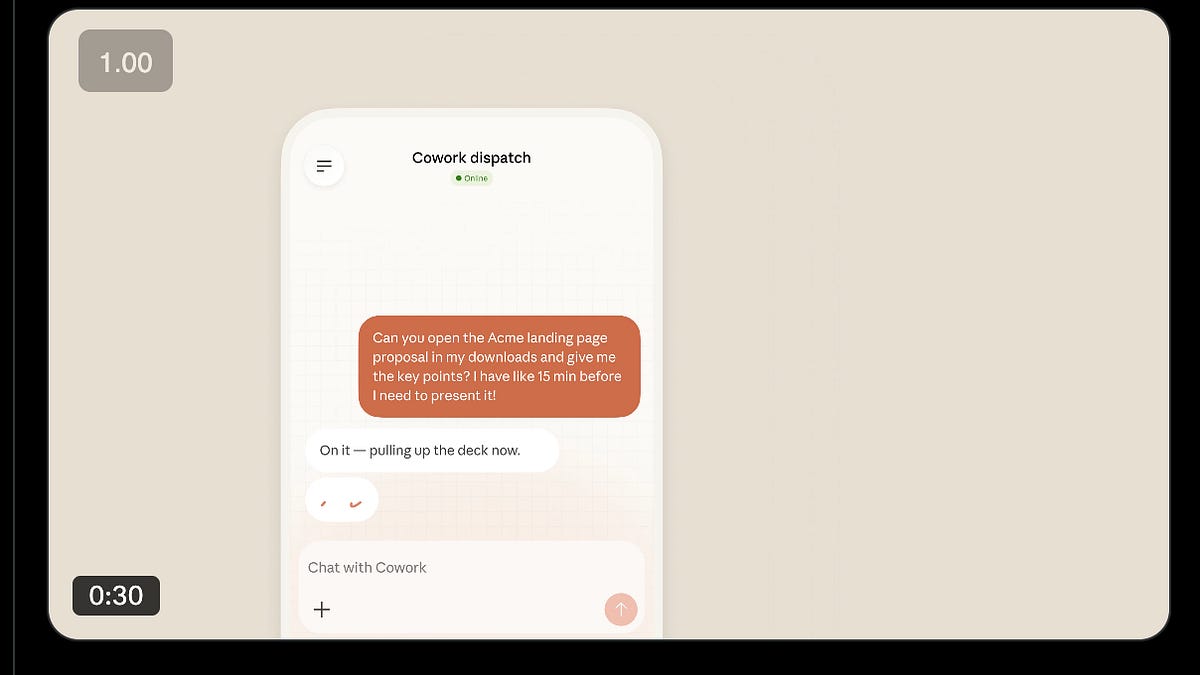
[AINews] Claude Cowork Dispatch: Anthropic's Answer to OpenClaw
Выпуск AINews посвящён Claude Cowork — ответу Anthropic на OpenClaw, который положительно сравнивают SimonW и Ethan Mollick; полная история и архитектурные решения (sandboxing, Electron) разобраны в подкасте Latent Space с Феликсом. OpenAI выпустила GPT-5.4 mini и nano с контекстом 400k, в 2 раза быстрее предшественника и использующие лишь 30% квоты GPT-5.4 Codex, но по более высокой цене ($0.75/M input, $4.5/M output). Среди архитектурных новинок — Attention Residuals от Moonshot (вертикальное внимание между слоями) и Mamba-3 от Albert Gu и Tri Dao, ориентированная на эффективность инференса. На GTC Дженсен Хуанг развивал тезис «фабрики токенов»; LangChain преодолела 1B загрузок и открыла Open SWE, H Company выпустила Holotron-12B, Perplexity — Comet Enterprise. Unsloth Studio предлагает локальный веб-UI для обучения 500+ моделей с 2x ускорением и -70% VRAM, Mistral выпустила Small 4 (119B MoE, 256k контекст, 6.5B активных параметров). CEO Anthropic прогнозирует ликвидацию 50% позиций junior white-collar за 3 года, а опрос NBC показал, что лишь 26% американцев положительно относятся к ИИ.
[AINews] Claude Cowork Dispatch: Anthropic's Answer to OpenClaw
[AINews] Claude Cowork Dispatch: ответ Anthropic на OpenClaw
a quiet day.
тихий день.
Note: AIE Europe is ~sold out! Tickets and limited sponsorships for AIE Miami are next — as you can see from online buzz, speakers are excited and prepping. We’ll be there!
Заметка: AIE Europe почти распродан! Билеты и ограниченные спонсорские пакеты на AIE Miami — следующие на очереди. Как видно по онлайн-обсуждениям, спикеры воодушевлены и готовятся. Мы там будем!
By total coincidence, today’s main pod guest also released today’s title story:
По чистому совпадению, сегодняшний главный гость подкаста также сегодня выпустил историю, ставшую заголовком:
swyx: Does remote control work for Claude Cowork yet? No. Right.
Felix: Excellent question.
swyx: Coming soon.
swyx: А удалённое управление для Claude Cowork уже работает? Нет. Точно.Felix: Отличный вопрос.swyx: Скоро будет.
And today, here it is:
И сегодня — вот оно:
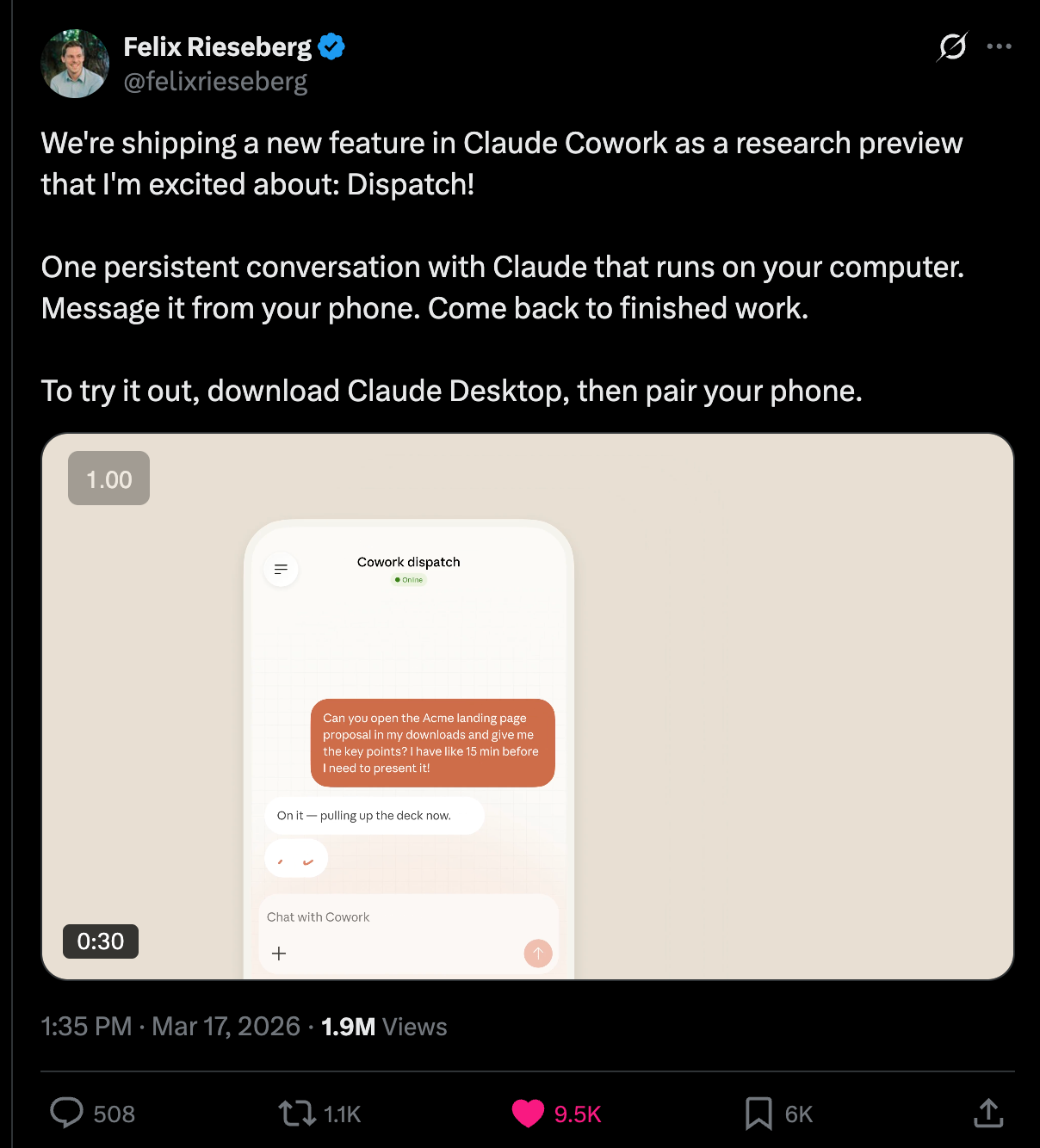
Multiple people, from SimonW to Ethan Mollick, are comparing it (favorably) to OpenClaw. As Jensen said yesterday, every company needs an OpenClaw strategy. Now Anthropic, which famously “fumbled” the Clawdbot relationship, has an answer, and it’s a pretty pretty good one.
Многие люди, от SimonW до Ethan Mollick, сравнивают это (благоприятно) с OpenClaw. Как сказал Jensen вчера, каждой компании нужна стратегия в отношении OpenClaw. Теперь у Anthropic, которая, как известно, «упустила» отношения с Clawdbot, есть ответ — и он довольно хорош.
Tune in to the full pod to get the full origin story, usecases, and design thinking (particularly around the technical choices of sandboxing and Electron), on today’s pod.
Послушайте полный подкаст, чтобы узнать всю историю возникновения, сценарии использования и дизайн-мышление (особенно вокруг технических выборов sandboxing и Electron) в сегодняшнем выпуске.
AI News for 3/14/2026-3/16/2026. We checked 12 subreddits, 544 Twitters and no further Discords. AINews’ website lets you search all past issues. As a reminder, AINews is now a section of Latent Space. You can opt in/out of email frequencies!
AI News за 14.03.2026–16.03.2026. Мы проверили 12 сабреддитов, 544 аккаунта в Twitter и больше никаких Discord. Сайт AINews позволяет искать по всем прошлым выпускам. Напоминаем, AINews теперь является разделом Latent Space. Вы можете подписаться или отписаться от частоты email-рассылки!
AI Twitter Recap
Обзор AI Twitter
OpenAI’s GPT-5.4 Mini/Nano Release and the Shift to Small, Coding-Optimized Models
Релиз GPT-5.4 Mini/Nano от OpenAI и сдвиг к маленьким моделям, оптимизированным под код
GPT-5.4 mini and nano shipped across API, ChatGPT, and Codex: OpenAI launched GPT-5.4 mini and GPT-5.4 nano, positioning them as its most capable small models yet. Per @OpenAIDevs, GPT-5.4 mini is more than 2x faster than GPT-5 mini, targets coding, computer use, multimodal understanding, and subagents, and offers a 400k context window in the API. OpenAI also claims mini approaches larger GPT-5.4 performance on evaluations including SWE-Bench Pro and OSWorld-Verified, while using only 30% of GPT-5.4 Codex quota, making it the new default for many background coding workflows and subagent fan-out.
Early reception focused on coding value, but also on pricing and truthfulness tradeoffs: Developers immediately highlighted mini’s utility for subagents in Codex, computer-use workloads, and external products such as Windsurf. However, commentary also converged on a familiar OpenAI pattern: better performance but higher price. Posts from @scaling01 note $0.75/M input and $4.5/M output for mini, with nano likewise priced above prior nano tiers. Third-party evals were mixed: Mercor’s APEX-Agents result reported 24.5% Pass@1 for mini with xhigh reasoning, ahead of some lightweight and midweight competitors on that benchmark, while BullshitBench placed the new small models relatively low on resistance to false-premise/jargon traps. OpenAI also quietly acknowledged behavior tuning issues, with @michpokrass saying a recent 5.3 instant update reduced “annoyingly clickbait-y” behavior.
GPT-5.4 mini и nano выпущены в API, ChatGPT и Codex: OpenAI запустила GPT-5.4 mini и GPT-5.4 nano, позиционируя их как самые способные малые модели на сегодня. По словам @OpenAIDevs, GPT-5.4 mini более чем в 2 раза быстрее GPT-5 mini, ориентирована на программирование, computer use, мультимодальное понимание и субагентов и предлагает контекст 400k в API. OpenAI также утверждает, что mini приближается к производительности более крупной GPT-5.4 на оценках, включая SWE-Bench Pro и OSWorld-Verified, при этом используя лишь 30% квоты GPT-5.4 Codex, что делает её новым выбором по умолчанию для многих фоновых задач программирования и развертывания субагентов.Раннее восприятие сосредоточилось на ценности для кода, но также на компромиссах в цене и правдивости: Разработчики сразу подчеркнули полезность mini для субагентов в Codex, computer-use нагрузок и внешних продуктов вроде Windsurf. Однако комментарии сошлись на знакомом паттерне OpenAI: лучшая производительность, но более высокая цена. Посты от @scaling01 отмечают $0.75/M input и $4.5/M output для mini, а nano также стоит выше предыдущих уровней nano. Сторонние оценки оказались смешанными: результат Mercor APEX-Agents сообщил о 24.5% Pass@1 для mini с xhigh reasoning, опережая некоторых легковесных и средневесных конкурентов на этом бенчмарке, тогда как BullshitBench поставил новые малые модели относительно низко по устойчивости к ложным предпосылкам и жаргонным ловушкам. OpenAI также негласно признала проблемы с настройкой поведения: @michpokrass сообщил, что недавнее обновление 5.3 instant уменьшило «раздражающе кликбейтное» поведение.
Agent Infrastructure: Sandboxes, Subagents, Open SWE, and the Harness Wars
Инфраструктура для агентов: песочницы, субагенты, Open SWE и войны харнесов
Code-executing agents are becoming the center of product architecture: Several launches point to a stack maturing around secure execution, orchestration, and deployment ergonomics rather than just better base models. LangChain introduced LangSmith Sandboxes for secure ephemeral code execution, with @hwchase17 explicitly arguing that “more and more agents will write and execute code.” In parallel, LangChain open-sourced Open SWE, a background coding agent patterned after internal systems reportedly used at Stripe, Ramp, and Coinbase. The system integrates with Slack, Linear, and GitHub, uses subagents plus middleware, and separates harness, sandbox, invocation layer, and validation. This is a notable step from “chat copilots” toward deployable internal engineering agents.
Subagents and secure execution are now first-class product features across the ecosystem: OpenAI’s Codex now supports subagents, and GPT-5.4 mini was framed by OpenAI as especially good for that use case. Hermes Agent’s v0.3.0 release is another strong signal: 248 PRs in 5 days, first-class plugin architecture, live Chrome control via CDP, IDE integrations, local Whisper-based voice mode, PII redaction, and provider integrations like Browser Use. The resulting direction is consistent across vendors: agent value increasingly depends on safe execution environments, composable skills/plugins, and workflow-native surfaces rather than raw benchmark gains alone.
Агенты, выполняющие код, становятся центром продуктовой архитектуры: Несколько запусков указывают на то, что стек созревает вокруг безопасного выполнения, оркестрации и эргономики развертывания, а не просто более мощных базовых моделей. LangChain представила LangSmith Sandboxes для безопасного эфемерного выполнения кода, причем @hwchase17 явно утверждает, что «всё больше агентов будут писать и выполнять код». Параллельно LangChain открыла исходный код Open SWE, фонового кодинг-агента по образцу внутренних систем, как сообщается, используемых в Stripe, Ramp и Coinbase. Система интегрируется со Slack, Linear и GitHub, использует субагентов плюс middleware и разделяет харнес, песочницу, слой вызова и валидацию. Это заметный шаг от «чат-копилотов» к развертываемым внутренним инженерным агентам.Субагенты и безопасное выполнение теперь являются первоклассными функциями продуктов по всей экосистеме: Codex от OpenAI теперь поддерживает субагентов, а GPT-5.4 mini была представлена OpenAI как особенно подходящая для этого случая. Релиз Hermes Agent v0.3.0 — ещё один сильный сигнал: 248 PR за 5 дней, первоклассная плагинная архитектура, live-управление Chrome через CDP, интеграции с IDE, локальный голосовой режим на основе Whisper, редактирование PII и интеграции с провайдерами вроде Browser Use. Получающееся направление одинаково у всех вендоров: ценность агентов всё больше зависит от безопасных сред выполнения, компонуемых навыков/плагинов и поверхностей, нативных для рабочих процессов, а не только от голых выигрышей в бенчмарках.
Architecture Research: Attention Residuals, Vertical Attention, and Mamba-3
Исследования архитектур: Attention Residuals, вертикальное внимание и Mamba-3
Attention over depth is having a moment: Moonshot’s Attention Residuals paper on arXiv triggered substantial technical discussion around “vertical attention” or attention across layers. A detailed explainer from @ZhihuFrontier frames the idea as each layer querying prior-layer states, effectively extending attention from horizontal sequence interactions to inter-layer memory. Community reactions emphasized that this is not entirely isolated: @rosinality noted ByteDance also implemented attention over depth, and @arjunkocher published an implementation walkthrough. The interesting systems claim here is that because number of layers << sequence length, some forms of vertical attention may be hidden under existing compute and impose little or no extra latency.
Mamba-3 strengthens the case for inference-first hybrid architectures: The other major architecture release was Mamba-3, presented by @_albertgu and @tri_dao as the latest step in making linear/state-space models more competitive in the hybrid era. The emphasis is explicitly on inference efficiency, not replacing transformers outright. Together summarized it as a MIMO variant that improves model strength at similar decode speed, with claims of strongest performance among linear models and fastest prefill+decode at 1.5B. Tri Dao also pointed to inference-heavy RL and long-rollout workloads as especially fertile ground for such architectures. The broader takeaway from both Attention Residuals and Mamba-3 is that labs are still searching for ways to relax the full-transformer bottleneck without sacrificing too much ecosystem compatibility.
Внимание по глубине переживает момент: Статья Attention Residuals на arXiv от Moonshot вызвала существенное техническое обсуждение «вертикального внимания» или внимания между слоями. Подробное объяснение от @ZhihuFrontier представляет идею так, что каждый слой запрашивает состояния предыдущих слоёв, эффективно расширяя внимание от горизонтальных взаимодействий последовательности к межслойной памяти. Реакции сообщества подчеркнули, что это не совсем изолированно: @rosinality отметил, что ByteDance также реализовала внимание по глубине, а @arjunkocher опубликовал разбор реализации. Интересное системное утверждение здесь в том, что поскольку число слоёв << длина последовательности, некоторые формы вертикального внимания могут быть скрыты под существующими вычислениями и приводить к небольшой или нулевой дополнительной задержке.Mamba-3 укрепляет аргумент в пользу гибридных архитектур, ориентированных на инференс: Другой крупный релиз архитектуры — Mamba-3, представленный @_albertgu и @tri_dao как последний шаг в повышении конкурентоспособности линейных/state-space моделей в эпоху гибридов. Акцент явно сделан на эффективности инференса, а не на полной замене трансформеров. Together резюмировала её как MIMO-вариант, который улучшает силу модели при сопоставимой скорости декодирования, с заявлениями о самой высокой производительности среди линейных моделей и самом быстром prefill+decode на 1.5B. Tri Dao также указал на инференс-интенсивный RL и долгие rollout-нагрузки как особенно плодородную почву для таких архитектур. Более широкий вывод из Attention Residuals и Mamba-3 в том, что лаборатории всё ещё ищут способы ослабить ботлнек полного трансформера, не жертвуя слишком многим в совместимости с экосистемой.
GTC: NVIDIA’s Agent Push, Open Models, and the Infrastructure Thesis
GTC: продвижение агентов от NVIDIA, открытые модели и инфраструктурный тезис
GTC messaging centered on inference, agents, and the “token factory” worldview: Multiple posts reflected Jensen Huang’s framing of future computers as systems for “manufacturing tokens”, with inference now driving the next capacity wave. This showed up in product and ecosystem announcements: LangChain said its frameworks crossed 1B downloads and joined the NVIDIA Nemotron Coalition; @ggerganov highlighted Nemotron 3 Nano 4B support in llama.cpp; and Hugging Face’s @jeffboudier recapped a range of open NVIDIA drops spanning reasoning models, robotics datasets, and world models.
Open and enterprise agent tooling dominated side announcements: H Company released Holotron-12B, an open multimodal model built with NVIDIA for computer-use agents. Perplexity announced Comet Enterprise, bringing its AI browser to enterprise teams with rollout controls and CrowdStrike Falcon integration. NVIDIA’s broader business thesis also got amplified: @TheTuringPost highlighted Jensen’s remark that the often-cited $1T AI infra opportunity only covers a subset of the stack through 2027, reinforcing that the industry is still very early in inference infrastructure buildout.
Месседжинг GTC сосредоточился на инференсе, агентах и мировоззрении «фабрики токенов»: Множество постов отражали обрамление Дженсена Хуанга будущих компьютеров как систем для «производства токенов», причём инференс теперь движет следующей волной мощности. Это проявилось в продуктовых и экосистемных объявлениях: LangChain заявила, что её фреймворки преодолели 1B загрузок и присоединились к NVIDIA Nemotron Coalition; @ggerganov отметил поддержку Nemotron 3 Nano 4B в llama.cpp; а @jeffboudier из Hugging Face резюмировал ряд открытых релизов NVIDIA, охватывающих модели рассуждений, датасеты для робототехники и world models.Открытое и корпоративное агентское инструментарий доминировало в побочных объявлениях: H Company выпустила Holotron-12B, открытую мультимодальную модель, построенную с NVIDIA для computer-use агентов. Perplexity объявила Comet Enterprise, принеся свой AI-браузер корпоративным командам с контролем развертывания и интеграцией с CrowdStrike Falcon. Также усилился более широкий бизнес-тезис NVIDIA: @TheTuringPost подчеркнул замечание Дженсена о том, что часто цитируемая возможность AI-инфраструктуры в $1T покрывает лишь часть стека до 2027 года, подтверждая, что индустрия всё ещё на очень ранней стадии построения инференс-инфраструктуры.
Open-Source Tooling, Local Agents, and Developer Stack Upgrades
Open-source инструменты, локальные агенты и обновления стека разработчика
Local/private agent workflows keep improving: Hugging Face shipped an hf CLI extension that auto-detects the best local model/quant for available hardware and spins up a local coding agent. Unsloth launched Unsloth Studio, an open-source web UI to train and run 500+ models locally across Mac/Windows/Linux, with claims of 2x faster training using 70% less VRAM, GGUF support, synthetic data tooling, tool calling, and code execution. Ollama added web search/fetch plugins and headless launch support for OpenClaw workflows, while also showing up as a provider in CodexBar.
The “open coding agent” ecosystem is becoming legible: There’s increasing convergence on patterns: model-agnostic harnesses, structured skills, filesystem/state abstractions, and ephemeral cloud or local execution. LangChain’s Deep Agents was described as an MIT-licensed, inspectable replica of the Claude Code style of agentic harness. Hermes Agent’s plugin system and local-model friendliness pushed it into the same conversation. This is one of the clearer trends in the dataset: the frontier is no longer just open-weight models, but open harnesses and runtime layers for actually deploying agents.
Локальные/приватные рабочие процессы агентов продолжают улучшаться: Hugging Face выпустила расширение hf CLI, которое автоматически определяет лучшую локальную модель/квант для доступного оборудования и поднимает локального кодинг-агента. Unsloth запустила Unsloth Studio, open-source веб-UI для обучения и запуска 500+ моделей локально на Mac/Windows/Linux, с заявлениями о 2x более быстром обучении при -70% VRAM, поддержкой GGUF, инструментами для синтетических данных, tool calling и выполнением кода. Ollama добавила плагины web search/fetch и поддержку headless запуска для рабочих процессов OpenClaw, а также появилась как провайдер в CodexBar.Экосистема «открытых кодинг-агентов» становится разборчивой: Наблюдается всё большая сходимость по паттернам: модельно-агностичные харнесы, структурированные навыки, абстракции файловой системы/состояния и эфемерное облачное или локальное выполнение. Deep Agents от LangChain описали как открытую под MIT, инспектируемую копию агентского харнеса в стиле Claude Code. Плагинная система Hermes Agent и дружелюбие к локальным моделям втянули его в ту же дискуссию. Это один из самых ясных трендов в данных: фронтир — это уже не только модели с открытыми весами, но и открытые харнесы и runtime-слои для реального развертывания агентов.
Top tweets (by engagement)
Топ-твиты (по вовлечённости)
OpenAI small-model launch: @OpenAIDevs on GPT-5.4 mini/nano was among the day’s most consequential technical announcements, especially for coding-agent workloads.
Cursor’s RL-based context compaction: @cursor_ai said it trained Composer to self-summarize through RL instead of prompting, cutting compaction error by 50% and enabling harder long-horizon coding tasks.
Mamba-3 release: @_albertgu and @tri_dao marked one of the most important architecture updates in sequence modeling this cycle.
Unsloth Studio: @UnslothAI had one of the strongest open-source product launches, aimed squarely at local training/inference practitioners.
Kimi Attention Residuals: @Kimi_Moonshot drove much of the architecture discussion, with follow-on analysis around vertical attention and inter-layer memory.
Запуск малой модели OpenAI: @OpenAIDevs о GPT-5.4 mini/nano стал одним из самых значимых технических объявлений дня, особенно для рабочих нагрузок кодинг-агентов.Компактирование контекста на основе RL у Cursor: @cursor_ai сообщил, что обучил Composer самосуммированию через RL вместо промптов, сократив ошибку компактирования на 50% и обеспечив более сложные долгосрочные задачи программирования.Релиз Mamba-3: @_albertgu и @tri_dao отметили одно из самых важных обновлений архитектуры в моделировании последовательностей в этом цикле.Unsloth Studio: @UnslothAI провёл один из самых сильных open-source продуктовых запусков, нацеленный прямо на практиков локального обучения/инференса.Kimi Attention Residuals: @Kimi_Moonshot возглавил большую часть архитектурной дискуссии с последующим анализом вертикального внимания и межслойной памяти.
AI Reddit Recap
Обзор AI Reddit
/r/LocalLlama + /r/localLLM Recap
Обзор /r/LocalLlama + /r/localLLM
1. Unsloth Studio Launch and Features
1. Запуск Unsloth Studio и функции
Unsloth announces Unsloth Studio - a competitor to LMStudio? (Activity: 998): Unsloth Studio has been announced as a new open-source, no-code web interface for training and running AI models locally, potentially challenging the dominance of LMStudio in the GGUF ecosystem. It is compatible with Llama.cpp and offers features such as auto-healing tool calling, Python and bash code execution, and support for audio, vision, and LLM finetuning. The platform supports GGUFs and runs on Mac, Windows, and Linux, with capabilities for SVG rendering, synthetic data generation, and fast parallel data preparation. Installation is straightforward via pip install unsloth. More details can be found in the Unsloth Documentation. Some users question the characterization of LMStudio as the ‘go-to’ for advanced users, suggesting alternatives like vLLM or llama.cpp. Others express excitement over the UI’s capabilities, particularly for training and data preparation.
danielhanchen highlights the extensive feature set of Unsloth Studio, noting its capabilities such as auto-healing tool calling, Python and bash code execution, and support for multiple operating systems including Mac, Windows, and Linux. The tool also offers advanced functionalities like SVG rendering, synthetic data generation, and fast parallel data preparation, making it a comprehensive solution for various AI tasks. More details and installation instructions are available on GitHub.
sean_hash points out the convenience of having both fine-tuning and inference capabilities integrated into a single tool like Unsloth Studio. This contrasts with the current need to use multiple projects to achieve the same functionality, highlighting Unsloth Studio’s potential to streamline AI development workflows.
Specter_Origin expresses appreciation for Unsloth Studio’s open-source nature, contrasting it with the closed-source LM Studio. This openness could be a significant advantage for developers who prefer transparency and the ability to modify the tool according to their needs.
Introducing Unsloth Studio: A new open-source web UI to train and run LLMs (Activity: 579): Unsloth Studio is a new open-source web UI designed to train and run large language models (LLMs) locally on Mac, Windows, and Linux. It claims to train over 500+ models at twice the speed while using 70% less VRAM. The platform supports GGUF, vision, audio, and embedding models, and includes features like model comparison, self-healing tool calling, and web search. It also offers auto-creation of datasets from formats like PDF, CSV, and DOCX, and allows for code execution to enhance LLM output accuracy. Models can be exported to formats such as GGUF and Safetensors, with auto-tuning of inference parameters. Installation is facilitated via pip install unsloth. GitHub and documentation are available for further details. Commenters are enthusiastic about Unsloth Studio as a fully open-source alternative to existing platforms, highlighting its accessibility for fine-tuning models, especially for users with less expertise. There is anticipation for upcoming support for AMD, which is expected to broaden its usability.
A user highlights the importance of making fine-tuning accessible, noting that Unsloth Studio provides an easy way to fine-tune models, which has been a challenge since the release of LLaMA 2. This accessibility could potentially revive the ‘golden age of fine-tunes’, making it easier for those with less expertise to engage in model customization.
Another user points out a technical issue encountered during installation, where an OSError due to insufficient disk space occurred while downloading a large
torchpackage. This highlights a common challenge in AI/ML projects related to managing dependencies and system resources, suggesting that atomic installation of components might be necessary to lower the entry barrier.An AMD representative expresses readiness to support the upcoming official AMD support for Unsloth Studio, indicating potential improvements in compatibility and performance for AMD hardware users. This collaboration could enhance the usability of Unsloth Studio across different hardware platforms.
Unsloth анонсирует Unsloth Studio — конкурента LMStudio? (Активность: 998): Unsloth Studio была объявлена как новый open-source, no-code веб-интерфейс для обучения и запуска AI-моделей локально, потенциально бросая вызов доминированию LMStudio в экосистеме GGUF. Он совместим с Llama.cpp и предлагает функции, такие как auto-healing tool calling, выполнение Python и bash кода, поддержку аудио, vision и LLM finetuning. Платформа поддерживает GGUF и работает на Mac, Windows и Linux, с возможностями SVG-рендеринга, генерации синтетических данных и быстрой параллельной подготовки данных. Установка проста через pip install unsloth. Подробности можно найти в документации Unsloth. Некоторые пользователи ставят под сомнение характеристику LMStudio как «инструмента выбора» для продвинутых пользователей, предлагая альтернативы вроде vLLM или llama.cpp. Другие выражают восторг от возможностей UI, особенно для обучения и подготовки данных.danielhanchen подчёркивает обширный набор функций Unsloth Studio, отмечая такие возможности, как auto-healing tool calling, выполнение Python и bash кода и поддержку нескольких ОС, включая Mac, Windows и Linux. Инструмент также предлагает продвинутые функциональности вроде SVG-рендеринга, генерации синтетических данных и быстрой параллельной подготовки данных, делая его комплексным решением для различных AI-задач. Подробности и инструкции по установке доступны на GitHub.sean_hash указывает на удобство интеграции функций fine-tuning и инференса в одном инструменте, таком как Unsloth Studio. Это контрастирует с текущей необходимостью использовать несколько проектов для достижения той же функциональности, подчёркивая потенциал Unsloth Studio для упрощения рабочих процессов разработки AI.Specter_Origin выражает признательность за open-source природу Unsloth Studio, противопоставляя его закрытому LM Studio. Эта открытость может быть значительным преимуществом для разработчиков, предпочитающих прозрачность и возможность модифицировать инструмент в соответствии со своими потребностями.Представляем Unsloth Studio: новый open-source веб-UI для обучения и запуска LLM (Активность: 579): Unsloth Studio — новый open-source веб-UI, разработанный для обучения и запуска больших языковых моделей (LLM) локально на Mac, Windows и Linux. Он заявляет об обучении более 500+ моделей в два раза быстрее при использовании на 70% меньше VRAM. Платформа поддерживает GGUF, vision, audio и embedding модели и включает функции вроде сравнения моделей, self-healing tool calling и web search. Она также предлагает автосоздание датасетов из форматов вроде PDF, CSV и DOCX и позволяет выполнять код для повышения точности вывода LLM. Модели можно экспортировать в форматы вроде GGUF и Safetensors с автонастройкой параметров инференса. Установка осуществляется через pip install unsloth. GitHub и документация доступны для дальнейших подробностей. Комментаторы с энтузиазмом относятся к Unsloth Studio как к полностью open-source альтернативе существующим платформам, подчёркивая её доступность для fine-tuning моделей, особенно для пользователей с меньшим опытом. Есть ожидание предстоящей поддержки AMD, которая, как ожидается, расширит её применимость.Пользователь подчёркивает важность сделать fine-tuning доступным, отмечая, что Unsloth Studio предоставляет простой способ fine-tuning моделей, что было сложностью с момента выхода LLaMA 2. Эта доступность потенциально может возродить «золотой век fine-tune», облегчая моделирование для тех, у кого меньше опыта.Другой пользователь указывает на техническую проблему при установке: возникла OSError из-за недостатка места на диске при загрузке большого пакета torch. Это подчёркивает распространённую сложность в AI/ML проектах, связанную с управлением зависимостями и системными ресурсами, предполагая, что атомарная установка компонентов может быть необходима для снижения порога входа.Представитель AMD выражает готовность поддержать предстоящую официальную поддержку AMD для Unsloth Studio, указывая на потенциальные улучшения в совместимости и производительности для пользователей оборудования AMD. Это сотрудничество может улучшить применимость Unsloth Studio на различных аппаратных платформах.
2. Qwen3.5-9B Document Benchmark Results
2. Результаты бенчмарков документов Qwen3.5-9B
Qwen3.5-9B on document benchmarks: where it beats frontier models and where it doesn’t. (Activity: 295): The image compares the performance of Alibaba’s Qwen3.5-9B and OpenAI’s GPT-5.4 on document AI benchmarks. Qwen3.5-9B ranks #9 with a score of 77.0, excelling in “Key Information Extraction” and “Table Understanding,” while GPT-5.4 ranks #4 with a score of 81.0, leading in other areas. The benchmark results highlight Qwen3.5-9B’s superior performance in “OmniOCR” but its lag in “OmniDoc” and “IDP Core.” This aligns with the detailed breakdown in the post, where Qwen models outperform in OCR and VQA tasks but fall behind in table extraction and handwriting OCR. One commenter suggests that AI technology is reaching a functional ceiling, indicating that current models are sufficient for many tasks and can run efficiently on less powerful hardware. Another comment anticipates interesting comparisons with GLM-OCR, while a third notes the potential energy efficiency of using smaller Qwen models for tasks that can tolerate longer processing times.
Qwen3.5-9B’s performance: The model demonstrates competitive performance against larger frontier models, particularly in document processing tasks. Its ability to run efficiently on lower-end hardware, such as ultrabooks, highlights its energy efficiency and accessibility for broader applications. This suggests a shift towards optimizing smaller models for specific tasks rather than relying solely on larger, more resource-intensive models.
Energy efficiency and reasoning: The Qwen3.5-9B model is noted for its energy efficiency, especially in tasks requiring extended reasoning. Compared to larger models like Gemini or GPT, Qwen3.5-9B offers a more sustainable option if processing time is not a critical factor. This positions it as a viable alternative for applications where energy consumption is a priority.
Model variants and benchmarks: There is curiosity about the absence of larger Qwen model variants, such as the 27B dense and 35B MoE, in the benchmarks. This absence raises questions about the comparative performance and potential advantages of these larger models in specific tasks, suggesting a need for further exploration and benchmarking of these variants.
Qwen3.5-9B на бенчмарках документов: где она побеждает frontier-модели, а где нет. (Активность: 295): Изображение сравнивает производительность Qwen3.5-9B от Alibaba и GPT-5.4 от OpenAI на бенчмарках Document AI. Qwen3.5-9B занимает 9-е место со счётом 77.0, превосходя в «Key Information Extraction» и «Table Understanding», тогда как GPT-5.4 занимает 4-е место со счётом 81.0, лидируя в других областях. Результаты бенчмарка подчёркивают превосходство Qwen3.5-9B в «OmniOCR», но её отставание в «OmniDoc» и «IDP Core». Это согласуется с детальным разбором в посте, где модели Qwen превосходят в задачах OCR и VQA, но отстают в извлечении таблиц и OCR рукописного текста. Один из комментаторов предполагает, что технология AI достигает функционального потолка, указывая, что текущие модели достаточны для многих задач и могут эффективно работать на менее мощном оборудовании. Другой комментарий ожидает интересных сравнений с GLM-OCR, а третий отмечает потенциальную энергоэффективность использования меньших моделей Qwen для задач, которые могут терпеть более длительное время обработки.Производительность Qwen3.5-9B: Модель демонстрирует конкурентную производительность по сравнению с более крупными frontier-моделями, особенно в задачах обработки документов. Её способность эффективно работать на оборудовании более низкого уровня, таком как ультрабуки, подчёркивает её энергоэффективность и доступность для более широких применений. Это указывает на сдвиг в сторону оптимизации меньших моделей для конкретных задач, а не полагание исключительно на более крупные, ресурсоёмкие модели.Энергоэффективность и рассуждения: Модель Qwen3.5-9B отмечена за её энергоэффективность, особенно в задачах, требующих расширенных рассуждений. По сравнению с более крупными моделями вроде Gemini или GPT, Qwen3.5-9B предлагает более устойчивый вариант, если время обработки не критично. Это позиционирует её как жизнеспособную альтернативу для приложений, где энергопотребление является приоритетом.Варианты моделей и бенчмарки: Есть любопытство по поводу отсутствия более крупных вариантов моделей Qwen, таких как 27B dense и 35B MoE, в бенчмарках. Это отсутствие поднимает вопросы о сравнительной производительности и потенциальных преимуществах этих более крупных моделей в конкретных задачах, указывая на необходимость дальнейшего исследования и бенчмаркинга этих вариантов.
3. Mistral Small 4 and DGX Station Availability
3. Mistral Small 4 и доступность DGX Station
Mistral Small 4:119B-2603 (Activity: 1057): Mistral Small 4 is a hybrid AI model with 119 billion parameters and a 256k context length, integrating Instruct, Reasoning, and Devstral capabilities. It supports multimodal input and features an efficient architecture that reduces latency by 40%. The model includes advanced features like speculative decoding and 4-bit float quantization, optimized for tasks such as general chat, coding, and document analysis. It is available under an Apache 2.0 license for both commercial and non-commercial use. More details can be found on the Hugging Face page. Commenters humorously note the shift in scale, with 120 billion parameters now considered ‘small’, reflecting the rapid evolution in AI model sizes and capabilities.
The Mistral Small 119B model is being compared to the Qwen3.5-122B-A10B model, with a focus on parameter activation. Mistral activates 6.5 billion parameters, whereas Qwen3.5 utilizes 10 billion, which may explain why Mistral does not outperform Qwen3.5 overall. This highlights the importance of parameter activation in model performance.
DGX Station is available (via OEM distributors) (Activity: 418): The image depicts a high-performance workstation, likely the NVIDIA DGX Station, which is now available through OEM distributors. This machine is designed for AI and deep learning applications, featuring advanced cooling and performance capabilities. The DGX Station is equipped with NVIDIA’s latest technology, making it a ‘dream machine’ for many in the AI community. The discussion highlights its availability through distributors like Dell and Exxact, with prices reportedly in the 85-90k USD range. The concept of ‘coherent memory’ is mentioned, which refers to a memory architecture that allows for efficient data sharing between CPUs and GPUs, potentially enhancing performance in AI workloads. There is a discussion about the pricing and availability of the DGX Station, with some users noting discrepancies in Dell’s product listings. The concept of ‘coherent memory’ is also questioned, indicating a curiosity about its implications for GPU performance.
The DGX Station is priced between
85-90k USD, as noted by users observing current market listings. This pricing positions it as a high-end machine, likely targeting enterprise or research institutions rather than individual consumers.The DGX Station, despite its high cost and advanced capabilities, lacks a video output unless an additional card is installed. This design choice highlights its focus on computational tasks rather than traditional graphical output, aligning with its role as a data center or AI research tool rather than a consumer-grade product.
The concept of “coherent memory” in the DGX Station is questioned, with users speculating whether it allows full memory access to the GPU, similar to the DGX Spark. This feature would be significant for tasks requiring large datasets and high-speed processing, emphasizing the machine’s suitability for AI and machine learning applications.
Mistral Small 4 | Mistral AI (Activity: 323): Mistral Small 4 is a multimodal AI model with 119 billion parameters and a 256k context window, utilizing a Mixture of Experts (MoE) architecture with 128 experts. It is designed to optimize performance across reasoning, multimodal processing, and coding tasks, allowing configurable reasoning effort. Released under the Apache 2.0 license, it supports both text and image inputs, aiming for efficient enterprise deployment with reduced latency and improved throughput over its predecessor, Mistral Small 3. More details can be found in the original announcement. Commenters are intrigued by the model’s 6.5B active parameters, comparing its inference cost to Qwen 3.5 35B-A3B, but with a larger expert pool. Concerns were raised about Mistral’s tool calling issues in previous versions, particularly with hallucinating function signatures and dropping parameters. The model’s performance on agentic tasks and context quality beyond 32k are key areas of interest.
RestaurantHefty322 highlights the competitive positioning of Mistral Small 4, noting that its
119Bparameters with6.5Bactive parameters align its inference cost with models like Qwen 3.5 35B-A3B, but with a larger expert pool. This could challenge Qwen’s dominance in the~7Bactive parameter tier, especially if Mistral has improved its tool calling capabilities, which were problematic in Devstral 2 due to issues like hallucinating function signatures and dropping parameters in multi-step chains.The discussion touches on the importance of text and code quality at the
6-7Bactive parameter range for local deployments, with a particular interest in how Mistral Small 4 handles context quality beyond32k. This is a critical area where smaller MoE models often struggle, despite having longer advertised context lengths.RepulsiveRaisin7 expresses skepticism about Mistral Small 4’s improvements over Devstral 2, which was perceived as lagging behind competitors. The comment reflects a broader concern about whether Mistral Small 4 can offer tangible advantages over existing models like Qwen, especially given its size and the competitive landscape.
Mistral 4 Family Spotted (Activity: 687): The Mistral 4 family introduces a hybrid model that integrates capabilities from three distinct model families: Instruct, Reasoning (formerly Magistral), and Devstral. The Mistral-Small-4 model features a Mixture of Experts (MoE) architecture with 128 experts and 4 active, totaling 119 billion parameters with 6.5 billion activated per token. It supports a 256k context length and accepts multimodal input (text and image) with text output. Key functionalities include configurable reasoning effort, multilingual support, and agentic capabilities with native function calling. The model is open-sourced under the Apache 2.0 License. Mistral-Small-4 is designed for both speed and performance, offering a large context window and vision capabilities. Commenters are enthusiastic about the model’s capabilities, particularly its position in the 120 billion parameter range, comparable to models like gpt-oss-120B and Qwen-122B. There is anticipation for its performance and potential applications.
The Mistral 4 model is a hybrid architecture that integrates capabilities from three distinct model families: Instruct, Reasoning (formerly Magistral), and Devstral. It features a mixture of experts (MoE) with 128 experts and 4 active, allowing for 119 billion parameters with 6.5 billion activated per token. The model supports a 256k context length and accepts multimodal input, including both text and images, with text output. It also offers configurable reasoning effort, enabling a switch between fast instant replies and more computationally intensive reasoning modes.
Mistral 4 is designed to be highly versatile, supporting multilingual capabilities across dozens of languages and offering advanced agentic functionalities with native function calling and JSON output. It is optimized for speed and performance, maintaining strong adherence to system prompts. The model is released under the Apache 2.0 license, which allows for both commercial and non-commercial use and modification, making it accessible for a wide range of applications.
The model’s integration with llama.cpp is underway, as indicated by a pull request on GitHub. This suggests that Mistral 4 will soon be supported by llama.cpp, a popular framework for running large language models efficiently. This integration is likely to enhance the model’s accessibility and usability for developers looking to leverage its capabilities in various applications.
Mistral Small 4:119B-2603 (Активность: 1057): Mistral Small 4 — гибридная AI-модель с 119 миллиардами параметров и длиной контекста 256k, объединяющая возможности Instruct, Reasoning и Devstral. Она поддерживает мультимодальный ввод и обладает эффективной архитектурой, снижающей задержку на 40%. Модель включает продвинутые функции вроде speculative decoding и 4-битную float-квантизацию, оптимизирована для задач вроде обычного чата, программирования и анализа документов. Доступна под лицензией Apache 2.0 как для коммерческого, так и для некоммерческого использования. Подробности на странице Hugging Face. Комментаторы юмористически отмечают сдвиг в масштабе, где 120 миллиардов параметров теперь считаются «small», отражая быструю эволюцию размеров и возможностей AI-моделей.Модель Mistral Small 119B сравнивают с моделью Qwen3.5-122B-A10B с фокусом на активации параметров. Mistral активирует 6.5 миллиардов параметров, тогда как Qwen3.5 использует 10 миллиардов, что может объяснить, почему Mistral не превосходит Qwen3.5 в целом. Это подчёркивает важность активации параметров для производительности модели.DGX Station доступна (через OEM-дистрибьюторов) (Активность: 418): Изображение изображает высокопроизводительную рабочую станцию, вероятно NVIDIA DGX Station, которая теперь доступна через OEM-дистрибьюторов. Эта машина разработана для приложений AI и deep learning, обладает продвинутыми возможностями охлаждения и производительности. DGX Station оснащена новейшими технологиями NVIDIA, делая её «машиной мечты» для многих в AI-сообществе. Обсуждение подчёркивает её доступность через дистрибьюторов вроде Dell и Exxact, с ценами, как сообщается, в диапазоне 85-90k USD. Упоминается концепция «coherent memory», которая относится к архитектуре памяти, позволяющей эффективно делиться данными между CPU и GPU, потенциально улучшая производительность в AI-нагрузках. Есть обсуждение цены и доступности DGX Station, причём некоторые пользователи отмечают расхождения в списках продуктов Dell. Концепция «coherent memory» также ставится под вопрос, указывая на любопытство относительно её последствий для производительности GPU.DGX Station стоит между 85-90k USD, как отмечают пользователи, наблюдающие текущие рыночные предложения. Эта цена позиционирует её как машину высокого класса, вероятно нацеленную на корпоративные или исследовательские учреждения, а не на индивидуальных потребителей.DGX Station, несмотря на её высокую стоимость и продвинутые возможности, не имеет видеовыхода, если не установлена дополнительная карта. Этот выбор дизайна подчёркивает её фокус на вычислительных задачах, а не на традиционном графическом выводе, согласуясь с её ролью инструмента для дата-центров или AI-исследований, а не потребительского продукта.Концепция «coherent memory» в DGX Station ставится под вопрос, пользователи размышляют, позволяет ли она GPU полный доступ к памяти, аналогично DGX Spark. Эта функция была бы значимой для задач, требующих больших датасетов и высокоскоростной обработки, подчёркивая пригодность машины для AI и приложений machine learning.Mistral Small 4 | Mistral AI (Активность: 323): Mistral Small 4 — мультимодальная AI-модель с 119 миллиардами параметров и контекстным окном 256k, использующая архитектуру Mixture of Experts (MoE) с 128 экспертами. Она разработана для оптимизации производительности в задачах рассуждения, мультимодальной обработки и программирования, позволяя настраиваемое усилие рассуждения. Выпущена под лицензией Apache 2.0, поддерживает ввод текста и изображений, нацелена на эффективное корпоративное развёртывание с уменьшенной задержкой и улучшенной пропускной способностью по сравнению с предшественником Mistral Small 3. Подробности в оригинальном анонсе. Комментаторов заинтересовали 6.5B активных параметров модели, сравнивающие её стоимость инференса с Qwen 3.5 35B-A3B, но с большим пулом экспертов. Были высказаны опасения о проблемах tool calling в предыдущих версиях Mistral, особенно с галлюцинированием сигнатур функций и потерей параметров. Производительность модели на агентских задачах и качество контекста за пределами 32k — ключевые области интереса.RestaurantHefty322 подчёркивает конкурентное позиционирование Mistral Small 4, отмечая, что её 119B параметров с 6.5B активных параметров приводят её стоимость инференса в соответствие с моделями вроде Qwen 3.5 35B-A3B, но с большим пулом экспертов. Это может бросить вызов доминированию Qwen в уровне ~7B активных параметров, особенно если Mistral улучшила свои возможности tool calling, которые были проблемными в Devstral 2 из-за проблем вроде галлюцинирования сигнатур функций и потери параметров в многошаговых цепочках.Обсуждение касается важности качества текста и кода в диапазоне 6-7B активных параметров для локальных развёртываний с особым интересом к тому, как Mistral Small 4 обрабатывает качество контекста за пределами 32k. Это критическая область, где меньшие MoE-модели часто борются, несмотря на более длинные заявленные длины контекста.RepulsiveRaisin7 выражает скептицизм относительно улучшений Mistral Small 4 над Devstral 2, который воспринимался как отстающий от конкурентов. Комментарий отражает более широкое беспокойство о том, может ли Mistral Small 4 предложить ощутимые преимущества по сравнению с существующими моделями вроде Qwen, особенно учитывая её размер и конкурентный ландшафт.Замечено семейство Mistral 4 (Активность: 687): Семейство Mistral 4 представляет гибридную модель, объединяющую возможности трёх различных семейств моделей: Instruct, Reasoning (ранее Magistral) и Devstral. Модель Mistral-Small-4 обладает архитектурой Mixture of Experts (MoE) с 128 экспертами и 4 активными, в общей сложности 119 миллиардов параметров с 6.5 миллиардами активированных на токен. Она поддерживает длину контекста 256k и принимает мультимодальный ввод (текст и изображение) с текстовым выводом. Ключевые функциональности включают настраиваемое усилие рассуждения, многоязычную поддержку и агентские возможности с нативным function calling. Модель открыта под лицензией Apache 2.0. Mistral-Small-4 разработана как для скорости, так и для производительности, предлагая большое контекстное окно и vision-возможности. Комментаторы с энтузиазмом относятся к возможностям модели, особенно к её позиции в диапазоне 120 миллиардов параметров, сопоставимом с моделями вроде gpt-oss-120B и Qwen-122B. Есть ожидание её производительности и потенциальных применений.Модель Mistral 4 — гибридная архитектура, объединяющая возможности трёх различных семейств моделей: Instruct, Reasoning (ранее Magistral) и Devstral. Она обладает mixture of experts (MoE) с 128 экспертами и 4 активными, позволяя 119 миллиардов параметров с 6.5 миллиардами активированных на токен. Модель поддерживает длину контекста 256k и принимает мультимодальный ввод, включая текст и изображения, с текстовым выводом. Также предлагает настраиваемое усилие рассуждения, позволяя переключаться между быстрыми мгновенными ответами и более вычислительно интенсивными режимами рассуждения.Mistral 4 разработана быть высоко универсальной, поддерживая многоязычные возможности на десятках языков и предлагая продвинутые агентские функциональности с нативным function calling и JSON-выводом. Оптимизирована для скорости и производительности, сохраняя сильное следование системным промптам. Модель выпущена под лицензией Apache 2.0, которая позволяет коммерческое и некоммерческое использование и модификацию, делая её доступной для широкого спектра применений.Интеграция модели с llama.cpp идёт полным ходом, как указано в pull request на GitHub. Это предполагает, что Mistral 4 скоро будет поддерживаться llama.cpp, популярным фреймворком для эффективного запуска больших языковых моделей. Эта интеграция, вероятно, улучшит доступность и применимость модели для разработчиков, желающих использовать её возможности в различных приложениях.
Less Technical AI Subreddit Recap
Менее технический обзор AI-сабреддитов
/r/Singularity, /r/Oobabooga, /r/MachineLearning, /r/OpenAI, /r/ClaudeAI, /r/StableDiffusion, /r/ChatGPT, /r/ChatGPTCoding, /r/aivideo, /r/aivideo
/r/Singularity, /r/Oobabooga, /r/MachineLearning, /r/OpenAI, /r/ClaudeAI, /r/StableDiffusion, /r/ChatGPT, /r/ChatGPTCoding, /r/aivideo, /r/aivideo
1. AI Model and Tool Innovations
1. Инновации AI-моделей и инструментов
INCREDIBLE STUFF INCOMING (Activity: 483): The image presents a slide from a presentation on the NVIDIA Nemotron 3 Ultra Base model, which is approximately 500B in size. It claims to be the “Best Open Base Model” with 5X efficiency and high reasoning accuracy. The slide includes bar graphs that compare the performance of Nemotron 3 Ultra against other models like GLM and Kimi K2 across various benchmarks, including Peak Throughput, Understanding MMLU Pro, Code HumanEval, Math GSM8K, and Multilingual Global MMLU. The Nemotron 3 Ultra is highlighted for its superior performance in these categories. Commenters express skepticism about the benchmarks, noting that NVIDIA does not specify which GLM model is used for comparison and that the Kimi K2 model is relatively old, being eight months old. There is also a critique of the presentation technique, suggesting that starting the graph at 60% exaggerates the performance gap.
elemental-mind points out the ambiguity in NVIDIA’s announcement, noting that they don’t specify which GLM model is being referred to. They highlight that the Kimi K2 model, if it’s the base version, is comparable to MiniMax M2.1 and GLM-5-no-reasoning in terms of intelligence, suggesting that the comparison might not be as impressive as it seems.
FullOf_Bad_Ideas clarifies the distinction between base models and their finetuned counterparts. They suggest that the models being compared are likely Kimi K2 Base 1T and GLM 4.5 355B Base, rather than the more advanced K2.5 or GLM 5, which are instruct/reasoning finetunes. This distinction is crucial for understanding the performance and capabilities being discussed.
ThunderBeanage expresses skepticism about the relevance of Kimi K2, describing it as outdated. They doubt that the GLM model mentioned is the latest GLM 5, implying that the comparison might not reflect the current state-of-the-art models. This skepticism highlights the importance of specifying model versions in performance discussions.
НА ПОДХОДЕ НЕВЕРОЯТНЫЕ ВЕЩИ (Активность: 483): Изображение представляет слайд из презентации о модели NVIDIA Nemotron 3 Ultra Base, размер которой составляет примерно 500B. Заявляется, что она является «Лучшей открытой Base-моделью» с 5X эффективностью и высокой точностью рассуждений. Слайд включает столбчатые графики, сравнивающие производительность Nemotron 3 Ultra с другими моделями вроде GLM и Kimi K2 по различным бенчмаркам, включая Peak Throughput, Understanding MMLU Pro, Code HumanEval, Math GSM8K и Multilingual Global MMLU. Nemotron 3 Ultra выделяется превосходной производительностью в этих категориях. Комментаторы выражают скептицизм относительно бенчмарков, отмечая, что NVIDIA не указывает, какая модель GLM используется для сравнения, и что модель Kimi K2 относительно старая, ей восемь месяцев. Также критикуется техника презентации, предполагая, что начало графика с 60% преувеличивает разрыв в производительности.elemental-mind указывает на двусмысленность в анонсе NVIDIA, отмечая, что они не указывают, на какую модель GLM ссылаются. Он подчёркивает, что модель Kimi K2, если это базовая версия, сопоставима с MiniMax M2.1 и GLM-5-no-reasoning по уровню интеллекта, предполагая, что сравнение может быть не таким впечатляющим, как кажется.FullOf_Bad_Ideas уточняет различие между базовыми моделями и их fine-tuned аналогами. Он предполагает, что сравниваемые модели — вероятно, Kimi K2 Base 1T и GLM 4.5 355B Base, а не более продвинутые K2.5 или GLM 5, которые являются instruct/reasoning fine-tune. Это различие критично для понимания обсуждаемой производительности и возможностей.ThunderBeanage выражает скептицизм относительно актуальности Kimi K2, описывая её как устаревшую. Он сомневается, что упомянутая GLM-модель — это последняя GLM 5, подразумевая, что сравнение может не отражать текущее состояние state-of-the-art моделей. Этот скептицизм подчёркивает важность указания версий моделей в обсуждениях производительности.
2. AI in Creative and Entertainment Applications
2. AI в творческих и развлекательных приложениях
Showing real capability of LTX loras! Dispatch LTX 2.3 LORA with multiple characters + style (Activity: 932): The post discusses the creation of a LORA model using LTX 2.3, trained on approximately 440 clips from the game Dispatch, each with 121 frames on average. The model includes over 6 characters with distinct voices and styles, achieved by assigning each character a unique trigger word and detailed captions. The training was conducted using the musubi fork by akanetendo25 and involved splitting clips with pyscene, converting them to 24 fps, and using a custom captioning tool. The dataset was divided into HD and SD groups based on clip length, and training involved 31GB VRAM usage with 4 blockswap. The model was trained to 64 rank to accommodate the complexity of the data, and checkpoints were made every 500 steps. The author notes that LTX, while not as visually strong as WAN, offers significant potential for pre-visualization in game development. One commenter expressed skepticism about WAN 2.5 being open source, while another praised the dedication involved in training with 440 clips, noting the clean results.
Lars-Krimi-8730 inquires about the technical details of training the LTX 2.3 LORA model, specifically asking about the trainer used, settings, captioning methods, and resolution. This indicates a keen interest in the reproducibility and technical setup of the model training process.
Anxious_Sample_6163 highlights the use of 440 clips in the training process, which suggests a significant level of dedication and effort in data preparation. This number of clips implies a robust dataset that likely contributes to the model’s performance and cleanliness.
SvenVargHimmel asks about the training duration on a
5090GPU, which points to interest in the computational resources and time efficiency of the model training process. This question is relevant for understanding the scalability and feasibility of training similar models.
oldNokia Ultrareal. Flux2.Klein 9b LoRA (Activity: 541): The post announces a retrained version of the Nokia 2MP Camera LoRA, named OldNokia UltraReal, designed to replicate the aesthetic of mid-2000s phone cameras. Key features include a soft-focus plastic lens effect, a washed-out color palette, and digital artifacts like JPEG compression and chroma noise, all trained on the author’s Nokia E61i photo archive. The model is available for download on Civitai and Hugging Face. One commenter humorously notes that Nokia cameras historically lacked the dynamic range depicted in the model. Another suggests training the model on qwen-image for further enhancement, while a third expresses enthusiasm for the LoRA and shares a personal project involving frame injection.
jigendaisuke81 suggests training the model on
qwen-image, indicating interest in exploring how the model performs with different datasets or architectures. This could imply a focus on enhancing image generation capabilities or testing the model’s adaptability to various image styles.Striking-Long-2960 mentions an interest in ‘frame injection in Wan2GP’, which suggests a technical exploration of integrating frames into generative models. This could involve manipulating or enhancing image sequences, potentially for video or animation purposes, using the LoRA model.
berlinbaer highlights the technical achievement of the LoRA model in replicating specific visual effects, such as ‘blown out highlights with their blue-red color shift’. This suggests a focus on the model’s ability to accurately mimic complex photographic effects, which might be challenging to achieve through simple prompting alone.
Демонстрация реальных возможностей LTX LoRA! Dispatch LTX 2.3 LORA с несколькими персонажами + стилем (Активность: 932): В посте обсуждается создание модели LORA с использованием LTX 2.3, обученной примерно на 440 клипах из игры Dispatch, каждый со средним числом 121 кадров. Модель включает более 6 персонажей с различными голосами и стилями, достигнутыми путём присвоения каждому персонажу уникального триггерного слова и подробных подписей. Обучение проводилось с использованием musubi fork от akanetendo25 и включало разделение клипов с pyscene, конвертацию в 24 fps и использование пользовательского инструмента для подписей. Датасет был разделён на HD и SD группы по длине клипа, а обучение включало использование 31GB VRAM с 4 blockswap. Модель была обучена до 64 rank, чтобы соответствовать сложности данных, чекпоинты делались каждые 500 шагов. Автор отмечает, что LTX, хотя и не так визуально силён, как WAN, предлагает значительный потенциал для пре-визуализации в разработке игр. Один комментатор выразил скептицизм относительно того, что WAN 2.5 является open source, а другой похвалил преданность, связанную с обучением на 440 клипах, отмечая чистые результаты.Lars-Krimi-8730 интересуется техническими деталями обучения модели LTX 2.3 LORA, в частности спрашивая о тренере, настройках, методах подписи и разрешении. Это указывает на острый интерес к воспроизводимости и технической настройке процесса обучения модели.Anxious_Sample_6163 подчёркивает использование 440 клипов в процессе обучения, что предполагает значительный уровень преданности и усилий в подготовке данных. Это число клипов подразумевает надёжный датасет, который, вероятно, способствует производительности и чистоте модели.SvenVargHimmel спрашивает о продолжительности обучения на GPU 5090, что указывает на интерес к вычислительным ресурсам и временной эффективности процесса обучения модели. Этот вопрос актуален для понимания масштабируемости и осуществимости обучения подобных моделей.oldNokia Ultrareal. Flux2.Klein 9b LoRA (Активность: 541): Пост анонсирует переобученную версию Nokia 2MP Camera LoRA под названием OldNokia UltraReal, разработанную для воспроизведения эстетики телефонных камер середины 2000-х. Ключевые функции включают эффект мягкофокусного пластикового объектива, выцветшую цветовую палитру и цифровые артефакты вроде JPEG-сжатия и chroma noise, всё обученное на архиве фотографий Nokia E61i автора. Модель доступна для загрузки на Civitai и Hugging Face. Один комментатор юмористически отмечает, что камеры Nokia исторически не обладали динамическим диапазоном, изображённым в модели. Другой предлагает обучить модель на qwen-image для дальнейшего улучшения, а третий выражает энтузиазм по поводу LoRA и делится личным проектом, связанным с frame injection.jigendaisuke81 предлагает обучить модель на qwen-image, указывая на интерес к изучению того, как модель работает с разными датасетами или архитектурами. Это может подразумевать фокус на улучшении возможностей генерации изображений или тестировании адаптивности модели к различным стилям изображений.Striking-Long-2960 упоминает интерес к «frame injection в Wan2GP», что предполагает техническое изучение интеграции кадров в генеративные модели. Это может включать манипуляцию или улучшение последовательностей изображений, потенциально для видео или анимационных целей, с использованием модели LoRA.berlinbaer подчёркивает техническое достижение модели LoRA в воспроизведении специфических визуальных эффектов, таких как «выгоревшие highlights с их сине-красным сдвигом цвета». Это предполагает фокус на способности модели точно имитировать сложные фотографические эффекты, которые могут быть сложно достичь только простым промптингом.
3. AI and Employment Impact
3. AI и влияние на занятость
Antrophic CEO says 50% entry-level white-collar jobs will be eradicated within 3 years (Activity: 2162): Anthropic CEO predicts that 50% of entry-level white-collar jobs will be eliminated within the next three years due to advancements in AI technologies. This statement highlights the rapid integration of AI in the workplace, potentially replacing tasks traditionally performed by humans, even when AI solutions like copilot may not yet match human expertise in quality and accuracy. The prediction underscores a significant shift in the job market, emphasizing the need for adaptation and skill evolution among the workforce. A notable comment highlights a personal experience where AI is being used to perform tasks inadequately, leading to errors and incorrect conclusions. This reflects a broader concern about the premature reliance on AI in professional settings, potentially undermining human expertise and job security.
Due_Answer_4230 highlights a practical issue with AI integration in workplaces, where AI tools like Copilot are being used to replace human work, even when they perform poorly. This results in errors and incorrect conclusions, yet management may prefer AI for its speed, undermining skilled workers who have invested years in developing their expertise.
Stahlboden references a prediction from a year ago that AI would write 100% of code, noting that while this hasn’t fully materialized, AI’s role in coding has significantly increased. This reflects a broader trend of AI’s growing capabilities in technical fields, suggesting a potential future where AI could dominate certain tasks.
Environmental_Dog331 points out the lack of solutions from AI leaders regarding job displacement due to AI advancements. The comment underscores the challenge of creating new jobs at a pace that matches AI-driven job losses, highlighting a critical gap in strategic planning for workforce transitions.
NBC News survey finds Americans hate AI even more than ICE (Activity: 1146): An NBC News survey reveals that only 26% of voters have a positive view of AI, while 46% hold negative views, making AI less favorable than most topics except the Democratic Party and Iran. This reflects a broader skepticism towards AI, despite its widespread use and potential as a productivity tool. The survey highlights a disconnect between AI’s perceived capabilities and its actual utility, particularly in replacing jobs that require significant industry knowledge. Commenters note a paradox where frequent AI users still harbor resentment due to overhyped claims about AI’s capabilities, particularly its potential to replace white-collar jobs. There’s a consensus that while AI is a powerful tool, it is not yet capable of replacing jobs requiring deep industry knowledge.
TimeTravelingChris highlights the gap between AI’s potential and its current practical applications, noting that while AI can be a powerful productivity tool, it is not yet capable of replacing jobs that require significant industry and company knowledge. The commenter emphasizes the importance of validating AI outputs, as the technology still has notable gaps when scrutinized closely.
AlexWorkGuru discusses the disparity between AI’s potential as demonstrated by labs and the everyday experiences of users, which often involve frustrating interactions with basic AI implementations like chatbots and automated phone systems. This gap contributes to a credibility issue for AI, as the companies promoting it are often those that users already distrust, exacerbating negative perceptions.
bjxxjj points out that public perception of AI is heavily influenced by negative associations such as job layoffs and surveillance, rather than practical applications like educational chatbots. This suggests that survey results on AI sentiment may be skewed by the specific aspects of AI that respondents are considering.
CEO Anthropic говорит, что 50% позиций начального уровня в white-collar будут ликвидированы в течение 3 лет (Активность: 2162): CEO Anthropic предсказывает, что 50% позиций начального уровня в white-collar будут ликвидированы в течение следующих трёх лет из-за развития AI-технологий. Это заявление подчёркивает быструю интеграцию AI на рабочем месте, потенциально заменяя задачи, традиционно выполняемые людьми, даже когда AI-решения вроде copilot пока могут не соответствовать человеческой экспертизе по качеству и точности. Прогноз подчёркивает значительный сдвиг на рынке труда, акцентируя необходимость адаптации и эволюции навыков среди рабочей силы. Заметный комментарий подчёркивает личный опыт, когда AI используется для неадекватного выполнения задач, что приводит к ошибкам и неверным выводам. Это отражает более широкую озабоченность по поводу преждевременной зависимости от AI в профессиональной среде, потенциально подрывающей человеческую экспертизу и безопасность работы.Due_Answer_4230 подчёркивает практическую проблему интеграции AI на рабочих местах, где AI-инструменты вроде Copilot используются для замены человеческой работы, даже когда они работают плохо. Это приводит к ошибкам и неверным выводам, однако руководство может предпочитать AI за скорость, подрывая квалифицированных работников, инвестировавших годы в развитие своей экспертизы.Stahlboden ссылается на предсказание годовой давности о том, что AI будет писать 100% кода, отмечая, что, хотя это полностью не материализовалось, роль AI в программировании значительно возросла. Это отражает более широкий тренд растущих возможностей AI в технических областях, предполагая потенциальное будущее, где AI может доминировать в определённых задачах.Environmental_Dog331 указывает на отсутствие решений от лидеров AI относительно вытеснения рабочих мест из-за развития AI. Комментарий подчёркивает сложность создания новых рабочих мест с темпом, соответствующим потерям рабочих мест из-за AI, выделяя критический пробел в стратегическом планировании переходов рабочей силы.Опрос NBC News обнаружил, что американцы ненавидят AI даже больше, чем ICE (Активность: 1146): Опрос NBC News показывает, что только 26% избирателей имеют позитивное мнение об AI, тогда как 46% имеют негативные взгляды, делая AI менее благоприятным, чем большинство тем, кроме Демократической партии и Ирана. Это отражает более широкий скептицизм к AI, несмотря на его широкое использование и потенциал как инструмента производительности. Опрос подчёркивает разрыв между воспринимаемыми возможностями AI и его фактической полезностью, особенно в замене работ, требующих значительных знаний индустрии. Комментаторы отмечают парадокс, при котором частые пользователи AI всё ещё испытывают негодование из-за переоценённых заявлений о возможностях AI, особенно его потенциале заменить white-collar работу. Существует консенсус, что хотя AI — мощный инструмент, он пока не способен заменить работу, требующую глубоких знаний индустрии.TimeTravelingChris подчёркивает разрыв между потенциалом AI и его текущими практическими применениями, отмечая, что хотя AI может быть мощным инструментом производительности, он пока не способен заменить работу, требующую значительных знаний индустрии и компании. Комментатор подчёркивает важность валидации выводов AI, поскольку у технологии всё ещё есть заметные пробелы при тщательном рассмотрении.AlexWorkGuru обсуждает разрыв между потенциалом AI, демонстрируемым лабораториями, и повседневными опытами пользователей, которые часто включают разочаровывающие взаимодействия с базовыми реализациями AI, такими как чат-боты и автоматизированные телефонные системы. Этот разрыв способствует проблеме доверия к AI, поскольку компании, продвигающие его, часто те, которым пользователи уже не доверяют, усугубляя негативные восприятия.bjxxjj указывает, что общественное восприятие AI сильно зависит от негативных ассоциаций, таких как увольнения и слежка, а не от практических применений вроде образовательных чат-ботов. Это предполагает, что результаты опросов о настроениях относительно AI могут быть искажены конкретными аспектами AI, которые респонденты рассматривают.
AI Discords
AI Discord-каналы
Unfortunately, Discord shut down our access today. We will not bring it back in this form but we will be shipping the new AINews soon. Thanks for reading to here, it was a good run.
К сожалению, Discord сегодня закрыл нам доступ. Мы не будем возвращать это в текущей форме, но скоро выпустим новый AINews. Спасибо, что дочитали до сюда — это был хороший путь.