Using Claude Code: The Unreasonable Effectiveness of HTML
Симон Уиллисон комментирует статью Тарика Шихипара (из команды Claude Code в Anthropic), который предлагает запрашивать у Claude вывод в формате HTML, а не Markdown. HTML позволяет встраивать SVG-диаграммы, интерактивные виджеты, навигацию по странице и другие способы сделать информацию удобнее для восприятия. Уиллисон признаётся, что со времён GPT-4 по умолчанию просил Markdown ради экономии токенов при лимите в 8192 токена, но теперь пересматривает этот подход, особенно для вывода. В качестве эксперимента он попросил GPT-5.5 создать интерактивное HTML-объяснение Linux-эксплойта с сайта copy.fail, скормив ему обфусцированный Python-код через llm. Результат вышел неплохим, хотя Симон отмечает, что стоило сделать упор на сам эксплойт, а не на обёртку-харнесс вокруг него.
8th May 2026 - Link Blog
8 мая 2026 — Блог ссылок
Using Claude Code: The Unreasonable Effectiveness of HTML. Thought-provoking piece by Thariq Shihipar (on the Claude Code team at Anthropic) advocating for HTML over Markdown as an output format to request from Claude.
Using Claude Code: The Unreasonable Effectiveness of HTML. Заставляющая задуматься статья Тарика Шихипара (из команды Claude Code в Anthropic), который выступает за то, чтобы запрашивать у Claude вывод в формате HTML, а не Markdown.
The article is crammed with interesting examples (collected on this site) and prompt suggestions like this one:
Статья наполнена интересными примерами (собранными на этом сайте) и подсказками для промптов вроде такой:
Help me review this PR by creating an HTML artifact that describes it. I'm not very familiar with the streaming/backpressure logic so focus on that. Render the actual diff with inline margin annotations, color-code findings by severity and whatever else might be needed to convey the concept well.
Help me review this PR by creating an HTML artifact that describes it. I'm not very familiar with the streaming/backpressure logic so focus on that. Render the actual diff with inline margin annotations, color-code findings by severity and whatever else might be needed to convey the concept well.
I've been defaulting to asking for most things in Markdown since the GPT-4 days, when the 8,192 token limit meant that Markdown's token-efficiency over HTML was extremely worthwhile.
Я по умолчанию запрашивал большинство вещей в Markdown ещё со времён GPT-4, когда лимит в 8192 токена делал токен-эффективность Markdown по сравнению с HTML чрезвычайно ценной.
Thariq's piece here has caused me to reconsider that, especially for output. Asking Claude for an explanation in HTML means it can drop in SVG diagrams, interactive widgets, in-page navigation and all sorts of other neat ways of making the information more pleasant to navigate.
Статья Тарика заставила меня пересмотреть это, особенно в отношении вывода. Запрос объяснения у Claude в HTML означает, что он может вставить SVG-диаграммы, интерактивные виджеты, навигацию по странице и множество других изящных способов сделать информацию приятнее для восприятия.
I wrote about Useful patterns for building HTML tools last December, but that was focused very much on interactive utilities like the ones on my tools.simonwillison.net site. I'm excited to start experimenting more with rich HTML explanations in response to ad-hoc prompts.
В декабре прошлого года я писал про полезные паттерны для создания HTML-инструментов, но там речь шла в основном про интерактивные утилиты вроде тех, что есть на моём сайте tools.simonwillison.net. Мне не терпится начать больше экспериментировать с богатыми HTML-объяснениями в ответ на спонтанные промпты.
Trying this out on copy.fail
Пробуем это на copy.fail
copy.fail describes a recently discovered Linux security exploit, including a proof of concept distributed as obfuscated Python.
copy.fail описывает недавно обнаруженный эксплойт безопасности в Linux, включая proof of concept, распространяемый в виде обфусцированного Python-кода.
I tried having GPT-5.5 create an HTML explanation of the exploit like this:
Я попробовал заставить GPT-5.5 создать HTML-объяснение эксплойта вот так:
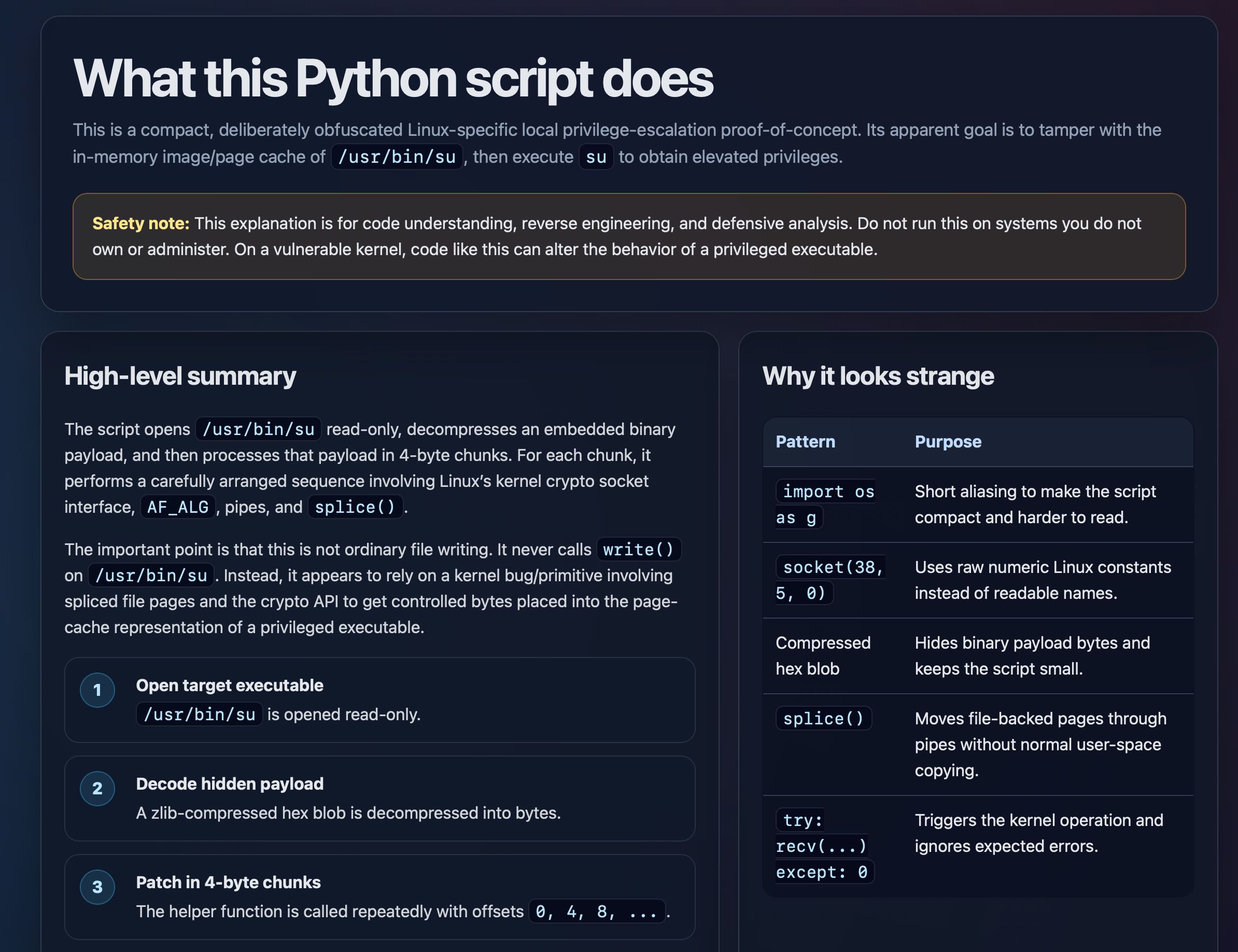
curl https://copy.fail/exp | llm -m gpt-5.5 -s 'Explain this code in detail. Reformat it, expand out any confusing bits and go deep into what it does and how it works. Output HTML, neatly styled and using capabilities of HTML and CSS and JavaScript to make the explanation rich and interactive and as clear as possible'
curl https://copy.fail/exp | llm -m gpt-5.5 -s 'Explain this code in detail. Reformat it, expand out any confusing bits and go deep into what it does and how it works. Output HTML, neatly styled and using capabilities of HTML and CSS and JavaScript to make the explanation rich and interactive and as clear as possible'
Here's the resulting HTML page. It's pretty good, though I should have emphasized explaining the exploit over the Python harness around it.
Вот получившаяся HTML-страница. Вышло довольно неплохо, хотя мне следовало сделать упор на объяснении самого эксплойта, а не Python-обёртки вокруг него.
Recent articles
Свежие статьи
Заметки о сделке xAI/Anthropic по дата-центру — 7 мая 2026 Прямой эфир: Code w/ Claude 2026 — 6 мая 2026 Vibe coding и agentic engineering сближаются сильнее, чем мне бы хотелось — 6 мая 2026
This is a link post by Simon Willison, posted on 8th May 2026.
Это ссылочный пост Симона Уиллисона, опубликованный 8 мая 2026.
Monthly briefing
Ежемесячная рассылка
Sponsor me for $10/month and get a curated email digest of the month's most important LLM developments.
Поддержите меня на $10/месяц и получайте кураторский email-дайджест важнейших событий в мире LLM за месяц.
Pay me to send you less!
Заплатите мне, чтобы я присылал вам меньше!
Раскрытие информации Колофон © 2002 2003 2004 2005 2006 2007 2008 2009 2010 2011 2012 2013 2014 2015 2016 2017 2018 2019 2020 2021 2022 2023 2024 2025 2026