SpaceX, OpenAI & Anthropic IPOs : A $3 Trillion Stress Test
Автор разбирает предстоящие IPO трёх крупнейших технологических компаний: SpaceX с оценкой $1,5 трлн, OpenAI — $1 трлн и Anthropic — $380 млрд. Совокупная капитализация в $2,9 трлн создаёт беспрецедентную нагрузку на рынок: при стандартном free float в 15-25% этим компаниям пришлось бы привлечь $432-576 млрд за один квартал, тогда как весь рынок IPO США за 2016-2025 годы привлёк $469 млрд. Поэтому компании, скорее всего, дебютируют с минимальным free float в 3-8%, что не даст им сразу попасть в S&P 500 (требуется 50%). Когда они всё же квалифицируются, пассивные фонды с $20 трлн под управлением будут вынуждены покупать новые акции, продавая существующие мега-капы. Это запустит самоусиливающийся механизм давления на крупнейшие бумаги индекса.
We’re about to witness three of the largest IPOs in history. SpaceX is targeting $1.5t.1 OpenAI aims for $1t.2 Anthropic is valued at $380b.3 Combined, $2.9t in market cap.
The scale is unprecedented. But the real problem isn’t the market cap. It’s the float.
Typical IPOs offer 15-25% of their shares to public markets. This creates enough liquidity for price discovery while allowing founders & early investors to maintain control. Facebook floated 15%. Google floated 19%. Alibaba floated 15%.
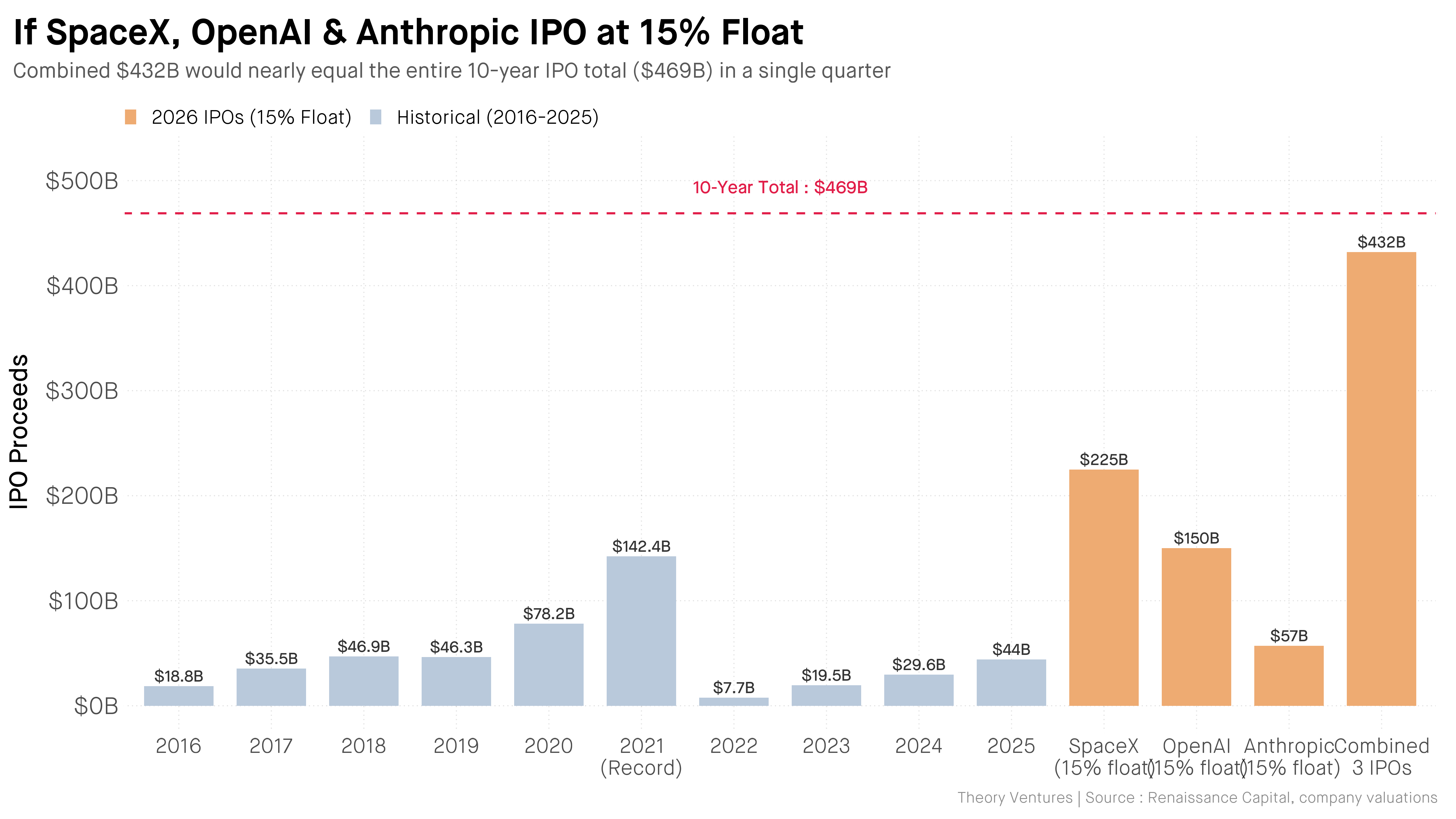
At a 15% float, here’s what these three IPOs would require :
At standard float percentages, these three companies would need to raise $432-576b from public markets in a single quarter. From 2016 to 2025, the entire US IPO market raised $469b.4
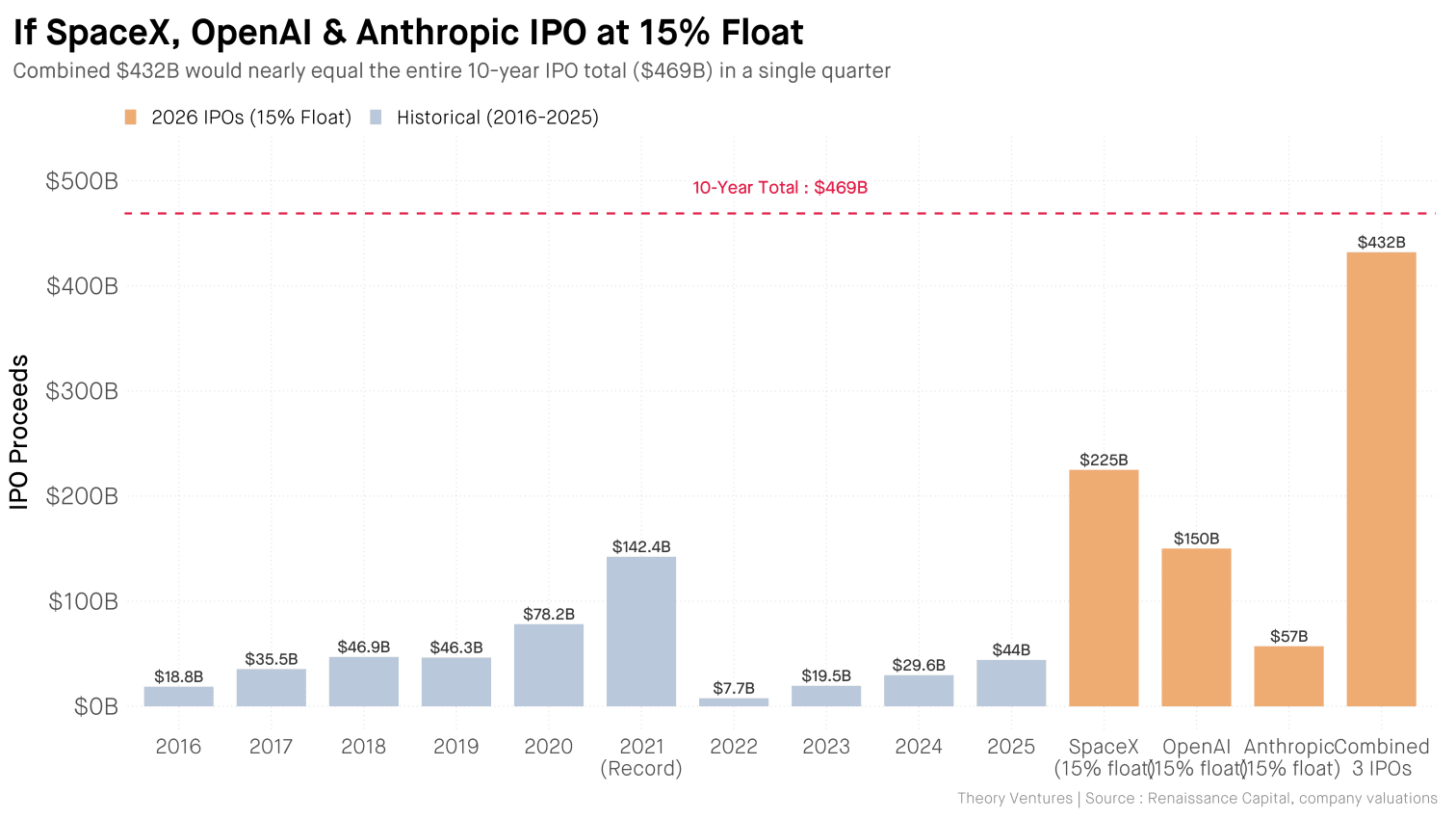
It’s like throwing a boulder into a pond. Standard floats are impossible, so these companies will debut with tiny ones, likely 3-8%.
But that creates a different problem. The S&P 500 requires 50% public float for inclusion.5 At 3-8%, none qualify initially. When they do, the disruption begins.
Source : Yahoo Finance6
SpaceX at $1.6-2t would challenge Meta for spot #6, potentially slotting in behind Amazon. When they qualify, passive funds managing $20t must buy. Index funds can’t raise cash. They sell existing holdings.
The mechanics become self-reinforcing. Index funds sell existing mega-caps to buy new entrants. Lower mega-cap prices trigger momentum strategies to sell further. Additional selling creates more pressure on the very stocks index funds track.
These companies have challenged every assumption within their core markets. Now their IPOs will challenge every assumption about public financial markets.
References
Bloomberg. “SpaceX Said to Pursue 2026 IPO Raising Far Above $30 Billion.” December 2025. https://www.bloomberg.com/news/articles/2025-12-09/spacex-said-to-pursue-2026-ipo-raising-far-above-30-billion ↩︎
Bloomberg. “OpenAI May Target $1 Trillion Valuation in IPO.” October 2025. https://www.bloomberg.com/news/articles/2025-10-29/openai-could-target-1-trillion-value-in-ipo-reuters-says ↩︎
CNBC. “Anthropic closes $30 billion funding round at $380 billion valuation.” February 2026. https://www.cnbc.com/2026/02/12/anthropic-closes-30-billion-funding-round-at-380-billion-valuation.html ↩︎
Renaissance Capital. IPO proceeds data 2016-2025. https://www.renaissancecapital.com/IPO-Center/Stats ↩︎
S&P Dow Jones Indices. “S&P U.S. Indices Methodology.” October 2025. https://spindices.com/documents/methodologies/methodology-sp-us-indices.pdf ↩︎
Yahoo Finance. Market capitalization & float data accessed February 23, 2026. https://finance.yahoo.com/ ↩︎