The Model T Comes to Silicon Valley
В 1908 году за американский авторынок боролись 253 производителя автомобилей, но к 1929-му осталось лишь 44: конвейер Форда на заводе Highland Park сократил время сборки Model T с 12 часов до 93 минут — прирост производительности на 90%, который перестроил всю отрасль. При этом занятость в автопроме не упала, а резко выросла — с 76 000 рабочих в 1910 году до 471 000 в 1929-м, а вторичные эффекты (дилеры, заправки, ремонтные мастерские, цепочки поставок) дали почти 4 миллиона рабочих мест — в 8 раз больше, чем основное производство. Tomasz Tunguz проводит параллель с софтом: AI-ассистенты для кода уже сокращают время разработки на 55–81%, повторяя кривую Форда. Но если в автопроме капиталоёмкость концентрировала власть, то ИИ действует наоборот: дата-центры — «конвейеры софта» — дают сотням миллионов разработчиков возможности гигантской корпорации с одним ноутбуком и кредиткой. Итог — больше софта, больше разработчиков и тысячи новых компаний ежегодно вместе со взрывным ростом вторичных рабочих мест.
In 1908, 253 American automobile manufacturers competed for the market1. By 1929, just 44 remained. The assembly line didn’t just change how cars were made. It changed who got to make them.
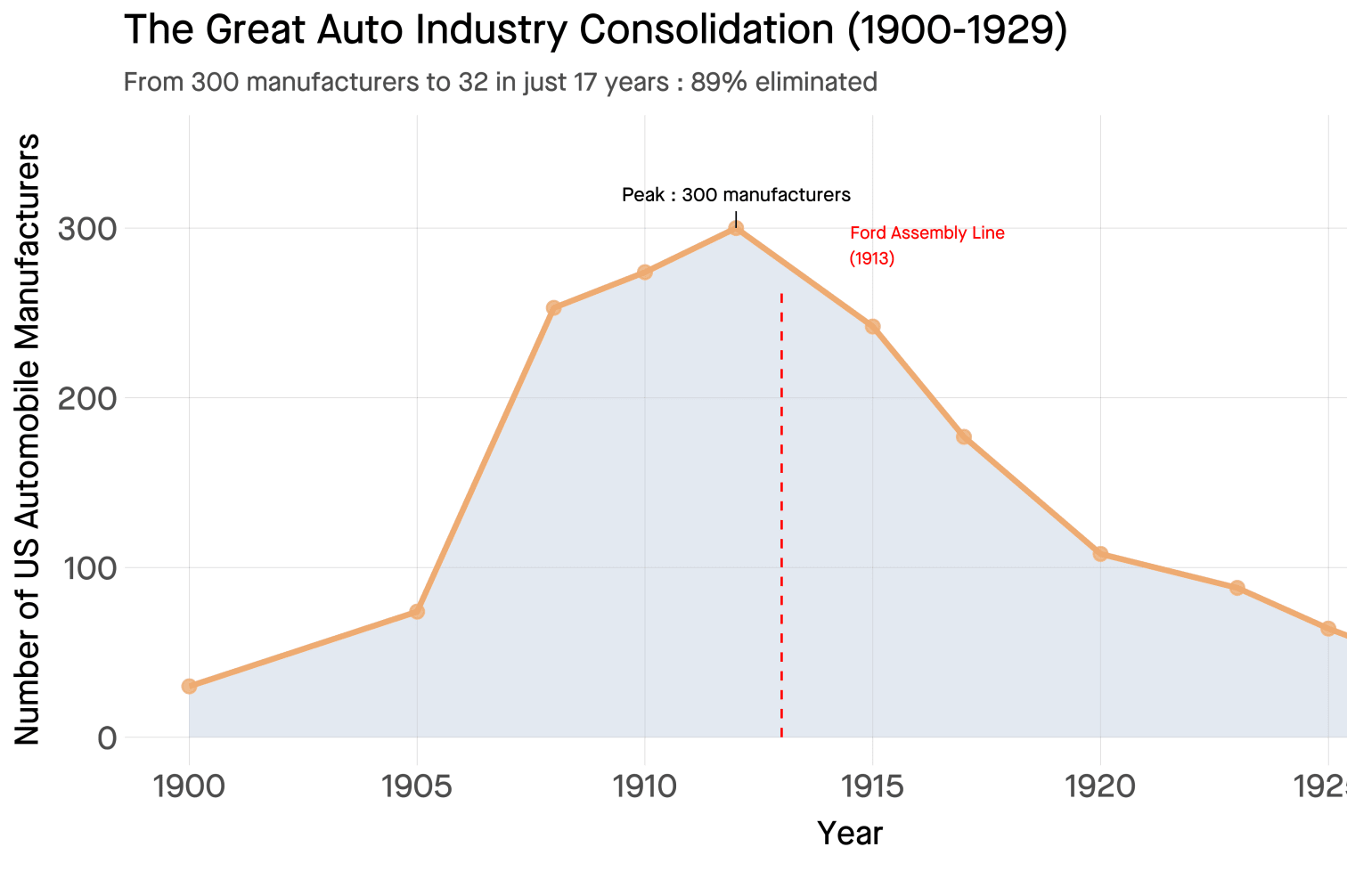
Ford’s Highland Park plant, operational in 1913, slashed the time to build a Model T from 12 hours to 93 minutes2. That 90% productivity gain restructured an entire industry. Manufacturers who couldn’t match Ford’s efficiency faced a simple choice : adapt or exit.
The consolidation was swift. Between 1908 & 1929, 83% of automakers vanished. Some merged. Most failed. The survivors shared a common trait : they adopted Ford’s methods. General Motors, Chrysler & the handful of remaining independents all built assembly lines.
An analogous revolution is happening in software, with important differences. AI coding assistants now reduce development time by 55-81%3. The curve is familiar.
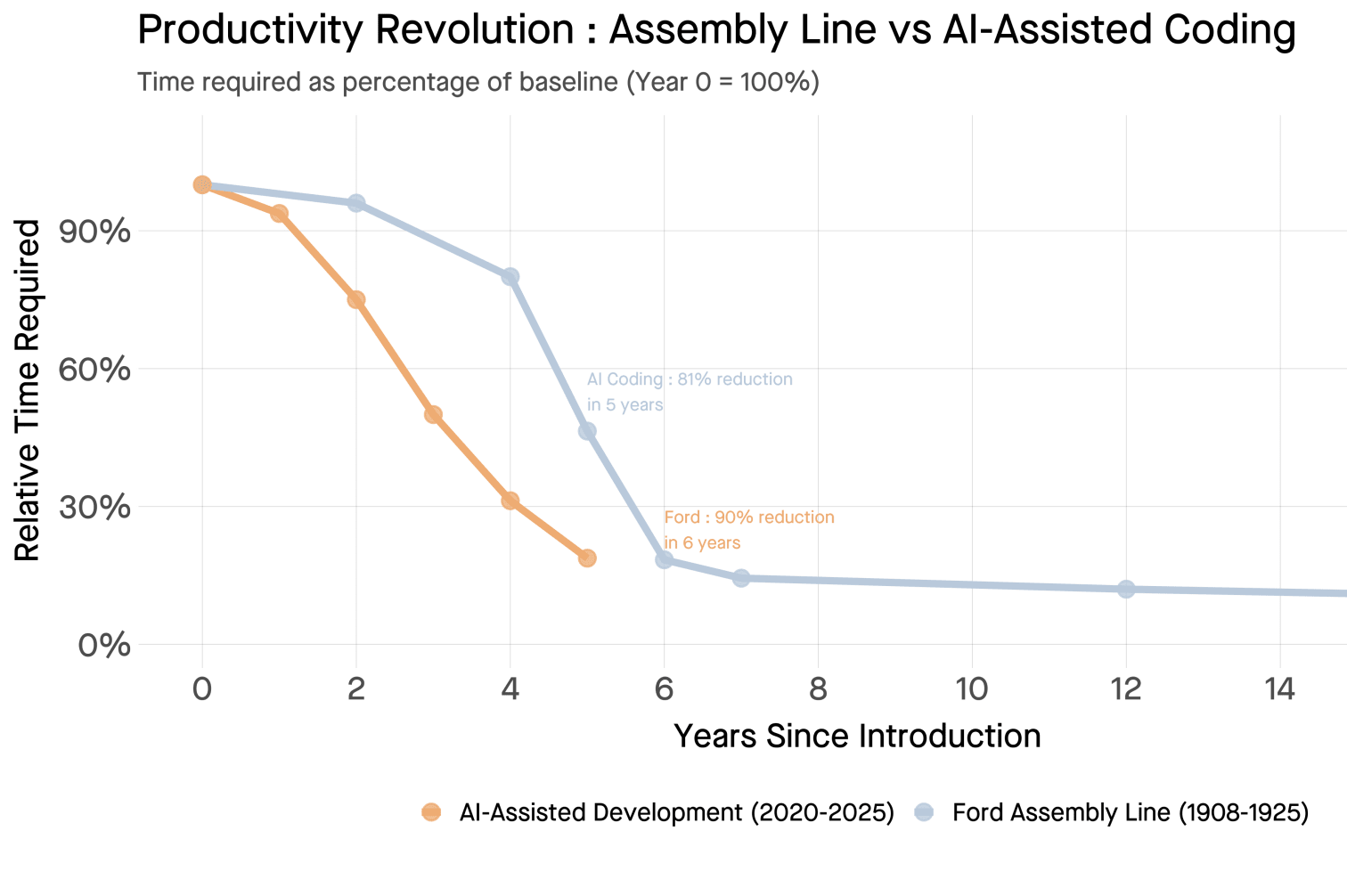
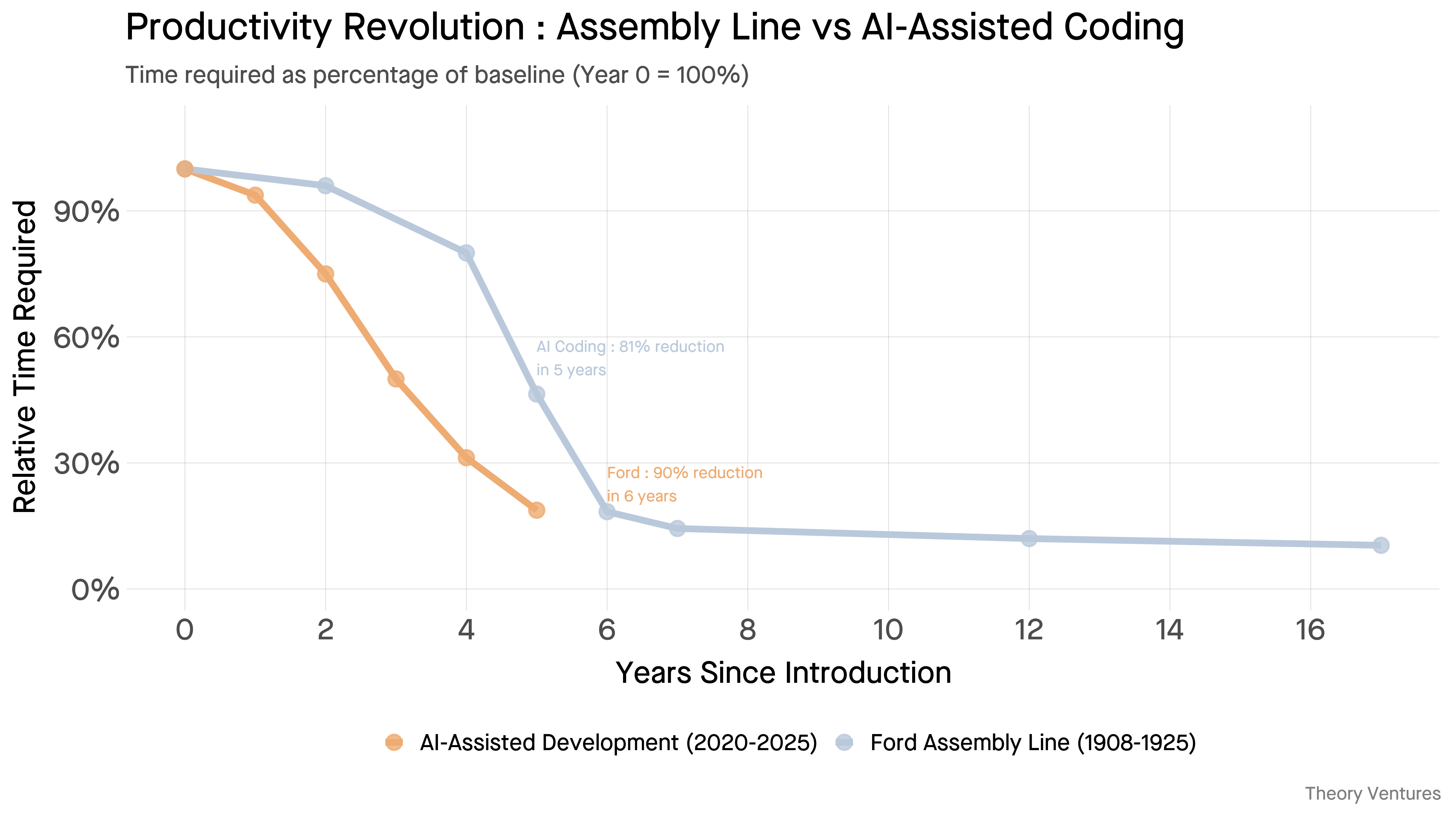
Ford took six years to achieve 90% time reduction. AI coding tools reached 81% in five. The slopes are nearly identical.
What happened to auto industry employment? It grew. Massively. In 1910, US auto plants employed 76,000 workers. By 1929, that number reached 471,0004. Mass production created mass consumption, & mass consumption demanded more workers.
The real explosion came from second-order effects. By 1929, for every one person building a car, seven others had a job because that car existed.
Dealerships, service stations, repair shops & supply chains employed nearly 4 million people. The industry didn’t just create more manufacturing jobs; it spawned an entirely new economy of “enablers” that was 8x larger than the core manufacturing base.
The software industry will follow a different pattern. In autos, capital intensity consolidated power. It’s the opposite in the world of AI.
AI data centers, the assembly lines of software, enable hundreds of millions of developers to build software as if they had the capabilities of an automobile behemoth. Any developer can access state-of-the-art models with a laptop & a credit card.
Easier software creation means more software. More software means more developers, not fewer. We should expect many thousands of new businesses each year as a result, & a similar explosion in second-order jobs.
EBSCO Research : Number of US Automakers Falls to Forty-Four. The number of active automobile manufacturers dropped from 253 in 1908 to only 44 in 1929, with about 80% of the industry’s output accounted for by Ford, General Motors, & Chrysler. ↩︎
Library of Congress : Ford Implements the Moving Assembly Line. Assembly line reduced Model T production time from 12.5 hours to 93 minutes by 1914. ↩︎
GitHub/Microsoft Research : The Impact of AI on Developer Productivity found developers completed tasks 55.8% faster. GitHub’s enterprise study with Accenture showed 67% daily usage & 84% increase in successful builds. Google’s Gemini Code Assist research found developers were 2.5x more likely to complete tasks successfully. ↩︎
Richmond Fed : Wheels of Change. Auto industry employment expanded dramatically during this period as mass production created new job categories in manufacturing, sales, service, & infrastructure. ↩︎