
Vercel’s Path to Product-Market Fit — From Open-Source Project to Billion-Dollar Business
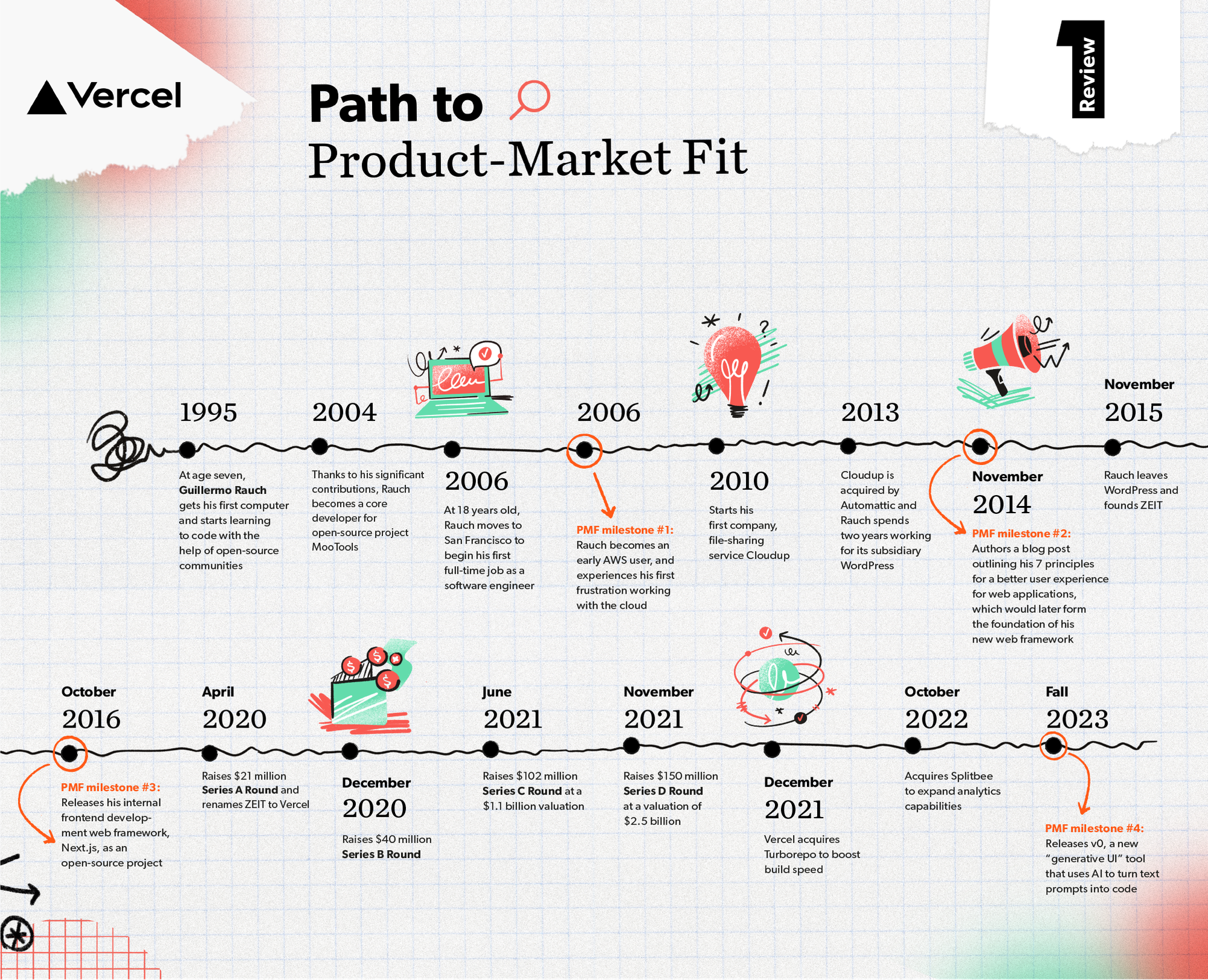
Гильермо Раух, основатель Vercel, вырос в пригороде Буэнос-Айреса и с детства учился программированию через open-source сообщество, что в итоге привело его в Сан-Франциско и Facebook. После работы во WordPress (купившей его первый стартап Cloudup) он в 2015 году основал ZEIT (позже Vercel), решив сделать развёртывание во фронтенд-облаке мгновенным. В 2016 году он выпустил open-source фреймворк Next.js, которым сегодня пользуются более 850 000 разработчиков (ChatGPT, TikTok, Notion), а Vercel недавно был оценён в $2,5 млрд при общем финансировании $313 млн. Раух выстроил необычную модель монетизации: Next.js остаётся полностью бесплатным, а Vercel зарабатывает на инфраструктуре, заменяющей целые команды platform engineering. Ключевыми сигналами product-market fit для него стали крупные конкуренты (Redfin, Trulia), пытавшиеся построить то же самое. Его уроки: упрощать предложение, ценить velocity выше speed, делать ставку на интеграции и использовать понятный, а не категориальный язык на старте.
Growing up in a suburb of Buenos Aires in the 90s, Guillermo Rauch didn’t know many people with computers. So at seven years old, when he booted up Windows 95 on the PC his father brought home, Rauch was mesmerized by this new technology.
Выросший в пригороде Буэнос-Айреса в 90-х, Guillermo Rauch знал немного людей с компьютерами. Поэтому в семь лет, когда он запустил Windows 95 на ПК, который отец принёс домой, Раух был заворожён этой новой технологией.
“My dad challenged my brother and me to explore what we could do with it,” he recalls. “Could we install software? Could we hack it? He had this very experimental mindset about it.”
«Папа бросил нам с братом вызов — исследовать, что мы можем с ним делать, — вспоминает он. — Сможем ли мы установить софт? Сможем ли его взломать? У него был очень экспериментальный взгляд на всё это».
Up for the challenge, Rauch began teaching himself to code. It was the early days of the internet, so there wasn’t much information online, and it wasn’t usually in Spanish. So, undeterred, Rauch taught himself English, too. His first goal was to replace Windows with Linux, a difficult task that led him to an enthusiastic group of strangers online who shared their programming expertise for free: the open-source community.
Приняв вызов, Раух начал учиться программировать самостоятельно. Это были ранние дни интернета, поэтому информации в сети было немного, и обычно она была не на испанском. Но это его не остановило — Раух также самостоятельно выучил английский. Его первой целью было заменить Windows на Linux — сложная задача, которая привела его к восторженной группе незнакомцев в интернете, бесплатно делившихся своими знаниями в программировании: к open-source сообществу.
Through his early teens, Rauch had an insatiable appetite to learn everything he could about Linux, JavaScript and web development and built up his reputation as an open-source contributor and frontend developer.
В ранней юности у Рауха был ненасытный аппетит — он узнавал всё, что мог, о Linux, JavaScript и веб-разработке, и заработал себе репутацию open-source контрибьютора и фронтенд-разработчика.
“I would create these demos that would make it to the front page of Digg and Reddit. I was becoming a five-minute internet celebrity every time I would create a really cool demo using these frontend technologies,” he says. “The thing that I was most passionate about, which was making UIs faster, more dynamic, more real time, also started gaining more prominence.”
«Я создавал такие демо, которые попадали на главную Digg и Reddit. Я становился пятиминутной интернет-знаменитостью каждый раз, когда делал по-настоящему крутое демо с использованием этих фронтенд-технологий, — говорит он. — То, что меня больше всего увлекало — делать UI быстрее, динамичнее, в реальном времени, — тоже начинало приобретать большую известность».
When he was just 16, Rauch became a core developer for the open-source project MooTools, and later, Facebook came calling with interest in hiring the young phenom. That’s when he realized that this hobby could become a career. He dropped out of high school and eventually moved to San Francisco to start his first full-time job as a software engineer — at just 18 years old. “Open source really was my path out of Argentina in the end,” says Rauch.
Всего в 16 лет Раух стал основным разработчиком open-source проекта MooTools, а позже к нему обратился Facebook с предложением нанять юного феномена. Тогда он понял, что это хобби может стать карьерой. Он бросил школу и в итоге переехал в Сан-Франциско, чтобы начать свою первую полноценную работу инженером-программистом — всего в 18 лет. «Open source в конечном счёте стал моим путём из Аргентины», — говорит Раух.
He didn’t know it at the time, but open source was also his path to a billion-dollar business. His company, Vercel — the frontend cloud service behind open-source development framework Next.js — was recently valued at $2.5 billion. If you’ve ever visited the websites of eBay, Zapier or The Washington Post, you’ve seen Vercel in action. As for Next.js, more than 850,000 developers use it to build websites with billions of global users, like ChatGPT, TikTok and Notion.
Тогда он этого не знал, но open source также стал его путём к миллиардному бизнесу. Его компания Vercel — фронтенд-облачный сервис, стоящий за open-source фреймворком Next.js, — недавно была оценена в $2,5 млрд. Если вы когда-либо заходили на сайты eBay, Zapier или The Washington Post, вы видели Vercel в действии. Что касается Next.js, более 850 000 разработчиков используют его для создания сайтов с миллиардами пользователей по всему миру — таких как ChatGPT, TikTok и Notion.
While achieving product-market fit in any form is cause for celebration, Rauch has managed to reach its highest level, what we at First Round call “extreme product-market fit.” This means his product has earned profound, widespread customer love and demand and is delivered through a scalable, profitable go-to-market motion.
Достижение product-market fit в любой форме — повод для празднования, но Рауху удалось достичь его высшей степени, того, что мы в First Round называем «экстремальным product-market fit». Это значит, что его продукт заслужил глубокую и широко распространённую любовь и спрос клиентов и поставляется через масштабируемую, прибыльную go-to-market модель.
In this exclusive interview, we deep-dive into Rauch’s process for building such beloved developer tools, his fresh approach to monetizing an open-source project, the early PMF signals he detected and what he would go about differently if he could do it all over again.
В этом эксклюзивном интервью мы подробно разбираем подход Рауха к созданию таких любимых инструментов для разработчиков, его свежий взгляд на монетизацию open-source проекта, ранние сигналы PMF, которые он заметил, и что бы он сделал иначе, если бы мог начать всё заново.
EARLY INSPIRATION FOR VERCEL
РАННЕЕ ВДОХНОВЕНИЕ ДЛЯ VERCEL
When Rauch packed his bags and moved from Buenos Aires to San Francisco in 2006, it was a pivotal year for cloud computing. Amazon Web Services had just launched its first product to the masses, and Rauch was among its first users. With AWS, developers worldwide were now freed from having to manage their own servers and hardware resources, and could build and deploy web applications more quickly and easily than ever before — or so, that’s what was promised.
Когда Раух собрал чемоданы и переехал из Буэнос-Айреса в Сан-Франциско в 2006 году, это был переломный год для облачных вычислений. Amazon Web Services только что запустила свой первый продукт для масс, и Раух был среди его первых пользователей. С AWS разработчики по всему миру теперь были освобождены от необходимости управлять собственными серверами и аппаратными ресурсами и могли создавать и развёртывать веб-приложения быстрее и проще, чем когда-либо прежде, — или, по крайней мере, так это обещали.
“Computers were now in the cloud. It was magic,” Rauch recalls. “Hardware became software. It’s so abstract, the idea that there are robots moving hardware around in racks somewhere, and I just don't see it. So we had that foundation of magic, in theory. But then, when you actually used it, doing anything with the cloud was so freaking hard.”
«Компьютеры теперь были в облаке. Это было волшебство, — вспоминает Раух. — Железо стало софтом. Это так абстрактно, идея, что где-то роботы перемещают железо в стойках, а я этого просто не вижу. То есть в теории у нас была эта основа волшебства. Но потом, когда ты действительно начинал им пользоваться, делать что-либо в облаке было чертовски сложно».
Even as a technical wizard, the cloud’s flaws frustrated Rauch — but he tucked away this little kernel of an idea for a few years while he worked as a frontend engineer. His foray into entrepreneurship, and the foundation for what would later become Vercel, officially began in 2010 with his first startup, Cloudup.
Даже как технический волшебник Раух был расстроен недостатками облака, но он отложил эту маленькую идею на несколько лет, пока работал фронтенд-инженером. Его погружение в предпринимательство и фундамент того, что позже стало Vercel, официально началось в 2010 году с его первого стартапа Cloudup.
“Cloudup was an early inspiration for Vercel in many ways,” he says, “because one of the killer features was you would get this application that sat on your menu bar, and you could drag and drop any file or even a folder of files, and it would immediately give you a hyperlink. It was the easiest way to share anything on the internet and collaborate with others. And you could actually drag and drop a folder of files, and if those files were HTML, you would get really high-performance static hosting.”
«Cloudup был ранним вдохновением для Vercel во многих отношениях, — говорит он, — потому что одной из убийственных фич было приложение, которое сидело у тебя на панели меню, и ты мог перетащить любой файл или даже папку с файлами, и оно мгновенно давало тебе гиперссылку. Это был самый простой способ поделиться чем угодно в интернете и сотрудничать с другими. И ты мог реально перетащить папку с файлами, и если эти файлы были HTML, то получал высокопроизводительный статический хостинг».
While Cloudup was still in private beta, Rauch showed it to the founder of WordPress, whom he’d connected with thanks to his involvement in the open source community.
Пока Cloudup был ещё в закрытой бете, Раух показал его основателю WordPress, с которым познакомился благодаря своему участию в open-source сообществе.
“When I showed him Cloudup, he thought it made a ton of sense in the context of WordPress because they’d been investing really heavily in modernizing the frontend layer. They were really interested in the real-time technologies for collaboration so that you could go to WordPress and edit posts, which later became the foundation of their block-based editor for WordPress 5.0.”
«Когда я показал ему Cloudup, он подумал, что это имеет огромный смысл в контексте WordPress, потому что они тогда очень активно инвестировали в модернизацию фронтенд-слоя. Они были очень заинтересованы в технологиях реального времени для совместной работы, чтобы можно было зайти в WordPress и редактировать посты, что позже стало основой их блочного редактора в WordPress 5.0».
WordPress’ parent company, Automattic, actually snapped up Rauch’s company before Cloudup even launched to the public.
Материнская компания WordPress, Automattic, на самом деле купила компанию Рауха ещё до того, как Cloudup был выпущен публично.

A familiar problem rears its ugly head
Знакомая проблема снова поднимает свою уродливую голову
After the acquisition was finalized, Rauch began working at WordPress. But in his new role, Rauch bumped up against that thorny problem once again: Why was the cloud so difficult for developers to use?
После того, как сделка была закрыта, Раух начал работать в WordPress. Но в новой роли Раух снова столкнулся с той же тернистой проблемой: почему облако такое сложное для разработчиков?
“At WordPress, they had invested millions and millions of dollars into becoming proficient at hosting one application: Wordpress.com. But adding any incremental new app, product or feature was extremely tedious,” says Rauch. When everything is in one code base (a “monolith”), the database and the code are so intricately tied that it constrains what developers can do.
«В WordPress они вложили миллионы и миллионы долларов в то, чтобы стать мастерами хостинга одного приложения: Wordpress.com. Но добавление любого нового приложения, продукта или фичи было крайне утомительным», — говорит Раух. Когда всё находится в одной кодовой базе («монолите»), база данных и код настолько тесно связаны, что это ограничивает возможности разработчиков.
It was hard to get that freedom as a developer. I wanted to try new frameworks, new frontend solutions, but I was constrained within the confines of a monolithic solution.
Было сложно получить эту свободу как разработчику. Я хотел пробовать новые фреймворки, новые фронтенд-решения, но был ограничен рамками монолитного решения.
“This wasn’t solely a WordPress problem — at the time, the entire industry was primarily these monolithic architectures,” says Rauch. “But the world was slowly starting to move in the direction of microservices and composability, breaking down these monolithic ways of building. And the promise of doing that was that developers would get a lot of flexibility. That's what the cloud promised me — that I was going to be able to move really fast.”
«Это была не только проблема WordPress — в то время вся индустрия была преимущественно в монолитных архитектурах, — говорит Раух. — Но мир медленно начинал двигаться в сторону микросервисов и композируемости, разбивая эти монолитные способы построения. И обещание этого было в том, что разработчики получат много гибкости. Это то, что обещало мне облако — что я смогу двигаться очень быстро».
The gears were turning in Rauch’s head. In November 2014, he outlined his seven principles for a better user experience for web applications in a blog post that would later become the blueprint for Next.js and Vercel.
Шестерёнки в голове Рауха крутились. В ноябре 2014 года он изложил свои семь принципов улучшенного пользовательского опыта для веб-приложений в блог-посте, который позже стал чертежом для Next.js и Vercel.
“At the time, I didn't have a framework yet. I didn't have the technology to turn these principles into action, but that blog post kind of became the master plan for what later became Next.js,” he explains. “I had reverse-engineered how Google Search, Facebook and Amazon were built, and I realized that whatever framework I built in the future should have no compromises. It should be able to build anything from a small website to something that scales. I wanted to be able to put it in the hands of someone who's building the next Amazon.com or the next Google.com. Setting that really high bar gave me that direction to be able to build.”
«На тот момент у меня ещё не было фреймворка. У меня не было технологии, чтобы превратить эти принципы в действие, но тот блог-пост стал чем-то вроде генерального плана того, что позже стало Next.js, — объясняет он. — Я провёл реверс-инжиниринг того, как построены Google Search, Facebook и Amazon, и понял, что какой бы фреймворк я ни строил в будущем, он не должен иметь компромиссов. Он должен уметь построить что угодно — от маленького сайта до того, что масштабируется. Я хотел, чтобы его можно было дать в руки тому, кто строит следующий Amazon.com или следующий Google.com. Установка такой высокой планки дала мне направление для строительства».
Everything around me had failed to fulfill the cloud’s promise of making development faster. So I decided I was going to make deploying software completely instantaneous and give that power back to the developer.
Всё вокруг меня не выполнило обещание облака — сделать разработку быстрее. Поэтому я решил, что сделаю развёртывание софта полностью мгновенным и верну эту силу разработчику.
In November 2015, Rauch left WordPress to build his solution, which he called ZEIT (later, the name would become Vercel). As soon as he began the task of building a website for his new company, he encountered friction that further solidified his belief that the cloud needed a major overhaul. Sure, there were SaaS solutions for launching simple websites (like Squarespace), but Rauch wanted to build a production-grade stack that had the complexity of AWS and a marketing website that was on par with any top-tier enterprise marketing website.
В ноябре 2015 года Раух ушёл из WordPress, чтобы построить своё решение, которое он назвал ZEIT (позже название станет Vercel). Как только он взялся за задачу построить сайт для своей новой компании, он столкнулся с трением, которое ещё больше укрепило его веру в то, что облако нуждается в серьёзном пересмотре. Конечно, были SaaS-решения для запуска простых сайтов (вроде Squarespace), но Раух хотел построить production-уровень стека со сложностью AWS и маркетинговым сайтом на уровне любого топового корпоративного маркетингового сайта.
“Just that first three or four weeks of trying to put up a website confirmed all of my previous hypotheses of, ‘Holy crap, how have we made the cloud so hard to use? How have we made the simple act of putting up a new idea, a new website, so difficult?” he recalls.
«Только эти первые три-четыре недели попыток поднять сайт подтвердили все мои предыдущие гипотезы: «Боже, как мы сделали облако таким сложным в использовании? Как мы сделали простое действие — выложить новую идею, новый сайт — таким трудным?» — вспоминает он.
If Rauch, a solo developer, was struggling to build a highly dynamic website for his company of one, imagine the next 100,000 businesses that would struggle with their digital transformations because the technology they were building with was lagging behind. His solution, then, would be a deployment platform specifically for the frontend (his specialty and the part that users actually see) that would make it easier, faster and more reliable for developers to get their projects out into the world.
Если Раух, разработчик-одиночка, изо всех сил пытался построить высокодинамичный сайт для своей компании из одного человека, представьте следующие 100 000 бизнесов, которые будут бороться со своей цифровой трансформацией, потому что технология, на которой они строят, отстаёт. Его решением, таким образом, будет платформа развёртывания специально для фронтенда (его специализация и часть, которую пользователи действительно видят), которая сделает для разработчиков проще, быстрее и надёжнее вывод их проектов в мир.
BUILDING THE PROTOTYPE
СОЗДАНИЕ ПРОТОТИПА
While he was still in the process of finding two co-founding engineers, Rauch tasked himself with an ambitious goal: He would put out a prototype of his deployment platform in just three months.
Пока он ещё искал двух соучредителей-инженеров, Раух поставил себе амбициозную цель: выпустить прототип своей платформы развёртывания всего за три месяца.
“Creating infrastructure like that in three months is very, very difficult, but I wanted to create a deadline for myself to start getting feedback. In the process of building, we realized that a deployment platform needs a dynamic web application to be able to do things like orchestrate and see logs. There was a lot needed for a platform like that.”
«Создать такую инфраструктуру за три месяца очень, очень сложно, но я хотел установить себе дедлайн, чтобы начать получать обратную связь. В процессе строительства мы поняли, что платформе развёртывания нужно динамическое веб-приложение для таких вещей, как оркестрация и просмотр логов. Для такой платформы требовалось многое».
React, the JavaScript library with which he was building, was great for developing an app, but when it came time to get the finished work in front of end users, React was frustratingly slow. Rauch wanted a framework to expedite the process.
React, JavaScript-библиотека, с которой он работал, была отличной для разработки приложения, но когда приходило время донести готовую работу до конечных пользователей, React был раздражающе медленным. Рауху нужен был фреймворк, чтобы ускорить процесс.
“I describe it like this: React was a great engine, but I needed a car to get from point A to point B. That’s why I started working on this framework, Next.js, which at the time was internal. We started kicking the tires on this tool, at the time we called it N4, and every day, we're like, ‘Hmm, this is working really well, we're moving really fast, it's giving us the results that we wanted.’”
«Я описываю это так: React был отличным двигателем, но мне нужна была машина, чтобы добраться из точки А в точку Б. Поэтому я начал работать над этим фреймворком, Next.js, который тогда был внутренним. Мы начали обкатывать этот инструмент, тогда мы называли его N4, и каждый день мы говорили: «Хм, это работает действительно хорошо, мы движемся очень быстро, он даёт нам те результаты, которые мы хотели»».
Six months later, N4 was too good to keep to themselves. Rauch released it as an open-source project under the name Next.js in October 2016. It was an instant hit with developers.
Шесть месяцев спустя N4 был слишком хорош, чтобы держать его при себе. Раух выпустил его как open-source проект под названием Next.js в октябре 2016 года. Он стал мгновенным хитом среди разработчиков.
“To outsiders, it seemed like an overnight success because Next.js had a lot of attention and adoption from basically day one. But they hadn't seen all this development that went into it before. They hadn't seen all these internal battles and pressure testing. I had been thinking about the principles that the framework would live up to since two years prior, or even more. So the overnight success story is a bit of a myth.”
«Для посторонних это казалось мгновенным успехом, потому что Next.js получил много внимания и адопшна буквально с первого дня. Но они не видели всей разработки, которая шла до этого. Они не видели всех этих внутренних битв и стресс-тестов. Я думал о принципах, которым будет соответствовать фреймворк, ещё за два года до этого, а то и больше. Так что история о мгновенном успехе — это немного миф».
When your product solves a huge pain, you should see pretty fast growth almost right out of the gate. It's obviously hard to get the product ready, but at the point you release it to customers, you should see rapid growth.
Когда ваш продукт решает огромную боль, вы должны видеть довольно быстрый рост практически с самого старта. Очевидно, что подготовить продукт сложно, но в момент, когда вы выпускаете его клиентам, вы должны видеть быстрый рост.
MONETIZING AN OPEN-SOURCE PROJECT
МОНЕТИЗАЦИЯ OPEN-SOURCE ПРОЕКТА
You could call it a happy accident: Rauch had initially set out to build a platform to help engineers deploy their projects, but along the way, built a React framework that became an instant open-source sensation.
Можно назвать это счастливой случайностью: Раух изначально намеревался построить платформу, помогающую инженерам развёртывать их проекты, но по пути построил React-фреймворк, который стал мгновенной open-source сенсацией.
But coding a successful open-source project and building a successful business are often at odds with each other in one key aspect: money. Most open-source software is available for free and doesn’t aim to ever turn a profit. The few that do, face limited options.
Но кодирование успешного open-source проекта и построение успешного бизнеса часто противоречат друг другу в одном ключевом аспекте: деньги. Большинство open-source софта доступно бесплатно и никогда не стремится приносить прибыль. У тех немногих, кто стремится, есть ограниченные варианты.
“When you try to go from open source to business, there's not a ton of creativity there. You either go open core, which is where you basically limit the free features, or you use some kind of license that allows you to give features but constrains how they're used and deployed.”
«Когда вы пытаетесь перейти от open source к бизнесу, там не очень много креативности. Вы либо идёте в open core, где вы по сути ограничиваете бесплатные фичи, либо используете какую-то лицензию, которая позволяет вам отдавать фичи, но ограничивает то, как они используются и развёртываются».
Having come up in the open source community, this rankled Rauch, and he didn’t want to restrict his Next.js customers. So, he took a fresh approach.
Выросший в open-source сообществе, Раух был этим раздражён, и он не хотел ограничивать своих клиентов Next.js. Поэтому он выбрал свежий подход.
You have to align the value creation of open source with the value creation of the business that supports that open source project.
Нужно выровнять создание ценности open source с созданием ценности бизнеса, который поддерживает этот open source проект.
“In our case, we developed an infrastructure business with Vercel at a global scale that aims not to just host the products, but entirely outsource teams’ worth of responsibility for the companies that use our system,” he says.
«В нашем случае мы развили инфраструктурный бизнес с Vercel в глобальном масштабе, который стремится не просто хостить продукты, а полностью аутсорсить целые команды ответственности для компаний, использующих нашу систему», — говорит он.
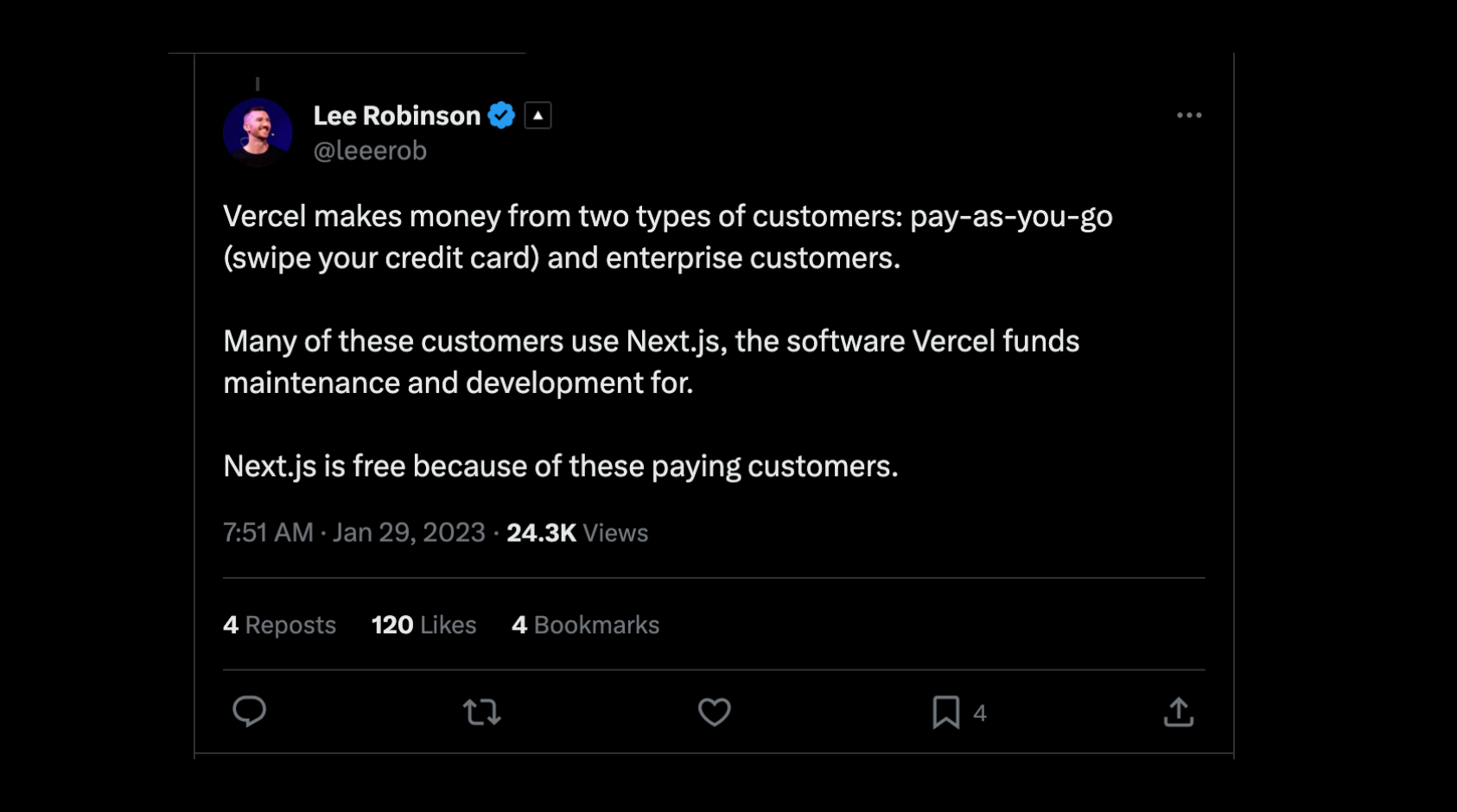
Here’s how it works: To this day, anyone can use the entirety of the Next.js framework for free. If they want their projects hosted on a platform specifically built for Next.js, one that enhances what they’re building, they pay Vercel for that upgrade. And because Next.js remains open source, if the customer ever decides they want to take their workload off of Vercel and self-host it, they’re free to do so. They’re not locked into a single vendor.
Вот как это работает: на сегодняшний день любой может бесплатно использовать весь фреймворк Next.js. Если они хотят, чтобы их проекты хостились на платформе, специально построенной для Next.js, которая улучшает то, что они строят, они платят Vercel за этот апгрейд. И поскольку Next.js остаётся open source, если клиент когда-нибудь решит снять свою нагрузку с Vercel и захостить самостоятельно, он может это сделать. Они не привязаны к одному вендору.
“So it's a very simple equation on the infrastructure side for a company to say: ‘Do I stand up a team of like 20 software engineers? Or do I hand this off to Vercel so they take care of it?’ I had a customer in Japan recently give me a presentation of how many engineering resources they were able to redirect from platform engineering to product engineering and data science because Vercel freed up the infrastructure resources of that company to be able to create customer value and customer insights instead,” Rauch says.
«Так что это очень простое уравнение на стороне инфраструктуры для компании: «Поднять ли мне команду из 20 инженеров-программистов? Или передать это Vercel, чтобы они позаботились об этом?» Один клиент в Японии недавно показал мне презентацию о том, сколько инженерных ресурсов они смогли перенаправить из platform engineering в продуктовый инжиниринг и data science, потому что Vercel освободил инфраструктурные ресурсы их компании, чтобы они могли вместо этого создавать ценность для клиента и инсайты», — говорит Раух.
“So that's the other type of business that you can build with open source. As the company gets better at evolving its own infrastructure, it's very hard to compete with.”
«Так что это другой тип бизнеса, который можно построить с open source. По мере того, как компания становится лучше в развитии собственной инфраструктуры, с ней очень трудно конкурировать».
He points to the example of MongoDB, an open-source project turned business that generates $1.5 billion in annual revenue. It makes money by charging for hosting on its fully-managed MongoDB Atlas database as well as for support and consulting services.
Он указывает на пример MongoDB — open-source проекта, превратившегося в бизнес, который генерирует $1,5 млрд годовой выручки. Он зарабатывает, беря плату за хостинг полностью управляемой базы данных MongoDB Atlas, а также за поддержку и консалтинговые услуги.
“If I use MongoDB, I’ll be the first to tell my team, ‘Let's give Mongo to the experts of hosting Mongo. Let's give it to the folks that have been hardening this system at scale.’ But it gives me confidence to know that I'm betting on an open platform, so if I decide not to do so, I have the freedom to take the workload with me. That’s why open source is, in my opinion, the best option. Because if there's a company supporting it, I can automate a lot of my work away. And if, for whatever reason, I need to do it on premise, I also have that option.”
«Если я использую MongoDB, я первый скажу своей команде: «Давайте отдадим Mongo экспертам по хостингу Mongo. Давайте отдадим её ребятам, которые закаляли эту систему в масштабе». Но мне даёт уверенность знание, что я ставлю на открытую платформу, поэтому если я решу не делать этого, у меня есть свобода забрать нагрузку с собой. Именно поэтому open source, на мой взгляд, лучший вариант. Потому что если есть компания, поддерживающая его, я могу автоматизировать кучу своей работы. И если по какой-то причине мне нужно сделать это on premise, у меня тоже есть такая возможность».
If I were to do it over again, I would do it the same way: using open source. And I would continue to invest in making the product as free and available as possible.
Если бы я делал это снова, я бы делал то же самое: использовал бы open source. И я бы продолжал инвестировать в то, чтобы продукт был максимально бесплатным и доступным.
Rauch managed to create a brilliant synergy between his products: The widespread popularity of Next.js, which remains open source, set up Vercel to become a revenue-generating complementary product because Next.js users naturally gravitate toward the platform built for that framework. And in turn, Vercel’s revenue funds the upkeep of Next.js. It’s a win-win for both the software and its customers.
Рауху удалось создать блестящую синергию между своими продуктами: широкая популярность Next.js, который остаётся open source, настроила Vercel на то, чтобы стать выручкогенерирующим дополнительным продуктом, потому что пользователи Next.js естественным образом тяготеют к платформе, построенной для этого фреймворка. А в свою очередь, выручка Vercel финансирует поддержку Next.js. Это win-win для софта и его клиентов.
SIGNALS OF ‘EXTREME PRODUCT-MARKET FIT’
СИГНАЛЫ «ЭКСТРЕМАЛЬНОГО PRODUCT-MARKET FIT»
Identifying the precise moment you’ve found product-market fit can be tricky for any founder. For Rauch, it was especially so because of his existing popularity in the open-source world.
Определение точного момента, когда вы нашли product-market fit, может быть сложным для любого основателя. Для Рауха это было особенно так из-за его существующей популярности в open-source мире.
“At the time that I released Next.js, I already had quite a bit of a following in the developer community because of my work on MooTools, Socket.IO and Mongoose, so I could easily get folks to at least look at what I was going to ship.”
«К моменту, когда я выпустил Next.js, у меня уже было довольно много фолловеров в сообществе разработчиков благодаря моей работе над MooTools, Socket.IO и Mongoose, поэтому я мог легко заставить людей хотя бы посмотреть на то, что я собираюсь выпустить».
So the fact that other developers were eager to get their hands on his latest software wasn’t enough for Rauch to believe he’d nailed product-market fit. Were people clamoring for Next.js because of the solution, or because of his own cache? Instead, the strongest indicator that he’d built a product that solved a real problem was that he had some competitors. Big ones.
Поэтому того факта, что другие разработчики жаждали заполучить его новейший софт, было недостаточно, чтобы Раух поверил, что он нащупал product-market fit. Кричали ли люди о Next.js из-за решения или из-за его собственного статуса? Вместо этого самым сильным индикатором того, что он построил продукт, решающий реальную проблему, было то, что у него появились конкуренты. Крупные.
“Right after we released Next.js, someone from Redfin reached out saying they were building the same thing. And then a week later, someone from Trulia reached out saying they were building the same thing. These were not just folks doing little experiments. I had all these people running businesses at scale telling me that they were either building a version of this, about to assemble a team to start building a version of this or asking me to share ideas and best practices.”
«Сразу после того, как мы выпустили Next.js, кто-то из Redfin связался со мной, сказав, что они строят то же самое. А неделю спустя кто-то из Trulia связался со мной, сказав, что они строят то же самое. Это были не просто ребята, делающие маленькие эксперименты. У меня были все эти люди, управляющие бизнесами в масштабе, которые говорили мне, что они либо строят версию этого, либо собираются собрать команду, чтобы начать строить версию этого, либо просили меня поделиться идеями и лучшими практиками».
One signal of product-market fit that I recommend you pay attention to: When something is really needed, you’ll find there are lots of very intelligent people at other organizations trying to build a version of it.
Один сигнал product-market fit, на который я рекомендую обратить внимание: когда что-то действительно нужно, вы обнаружите, что в других организациях есть множество очень умных людей, пытающихся построить версию этого.
And despite all the customer love for what Rauch had built, that doesn’t mean it was without its critics.
И несмотря на всю любовь клиентов к тому, что построил Раух, это не значит, что у него не было критиков.
“Not everyone in the developer community was jazzed about Next.js, and there were some competitive alternatives at the time that had a completely different philosophy,” says Rauch. “So it wasn't that we’d won right away. We had to navigate that market and the competition for quite a few years.”
«Не все в сообществе разработчиков были в восторге от Next.js, и тогда были конкурентные альтернативы с совершенно другой философией, — говорит Раух. — Так что нельзя сказать, что мы выиграли сразу. Нам пришлось маневрировать на этом рынке и в конкуренции довольно много лет».
One aspect of Next.js that ruffled some feathers? It uses server-side rendering, going against the grain of the more popular client-side rendering. But thanks to his thorough market research, Rauch was confident he’d made the right call.
Один аспект Next.js, который вызвал раздражение? Он использует серверный рендеринг, идя против течения более популярного клиентского рендеринга. Но благодаря своему тщательному маркетинговому исследованию Раух был уверен, что сделал правильный выбор.
“Years ago, when I’d reverse-engineered Amazon and Google and Facebook, it was like, ‘Wait, these folks are not doing it that way. There must be a good reason for performance and scale and privacy and many other things.’ So it was interesting because, for a couple of years, we had these almost competing signals, with certain individual developers not liking it but larger organizations being super excited about it.”
«Годами раньше, когда я провёл реверс-инжиниринг Amazon, Google и Facebook, было: «Подождите, эти ребята не делают это таким образом. Должна быть веская причина для производительности, масштаба, приватности и многого другого». Поэтому было интересно, что в течение пары лет у нас были эти почти конкурирующие сигналы: некоторым отдельным разработчикам это не нравилось, но крупные организации были очень рады».
4 LESSONS ON BUILDING SOFTWARE THAT CUSTOMERS ARE OBSESSED WITH
4 УРОКА О ПОСТРОЕНИИ СОФТА, ОТ КОТОРОГО КЛИЕНТЫ В ВОСТОРГЕ
From Cloudup’s acquisition by Automattic to Vercel’s impressive customer list that includes Adobe, Loom and Meta, Rauch has clearly figured out the formula for building software that solves real problems. He unpacks the most poignant lessons he’s learned from his decade-long journey of entrepreneurship.
От покупки Cloudup компанией Automattic до впечатляющего списка клиентов Vercel, включающего Adobe, Loom и Meta, Раух явно нашёл формулу построения софта, решающего реальные проблемы. Он распаковывает самые проникновенные уроки, которые он извлёк из своего десятилетнего пути в предпринимательстве.
Instead of building more, become exceptionally good at less.
Вместо того чтобы строить больше, станьте исключительно хороши в меньшем.
Rauch's first startup, Cloudup, actually began as a product for a particular industry vertical: as an edtech platform with a wide variety of products. But when Rauch noticed that teachers were using one specific feature, file sharing, to send lesson plans, he decided to distill the product offerings down to that most-loved feature and pivot the edtech startup to what became Cloudup. Rauch credits this move for helping him achieve a successful exit. Later, he applied this same crucial lesson to building Vercel.
Первый стартап Рауха, Cloudup, на самом деле начинался как продукт для определённой отраслевой вертикали: как edtech-платформа с широким разнообразием продуктов. Но когда Раух заметил, что учителя используют одну конкретную функцию — обмен файлами — для рассылки планов уроков, он решил свести продуктовое предложение к этой самой любимой функции и развернуть edtech-стартап в то, что стало Cloudup. Раух считает, что именно этот шаг помог ему достичь успешного экзита. Позже он применил тот же ключевой урок при построении Vercel.
“One of the catalysts for finding joint product-market fit for Next.js and Vercel was us simplifying the offering. In the beginning, the very first prototype of the deploying platform was focused on deploying absolutely everything. And then we realized, we're making the frontend-facing part of a website better. We were giving people the best React experience. So why were we trying to make everybody happy? Why don't we simplify the offering? After that, we decided to build the frontend cloud, whereas, in the beginning, we were trying to build the cloud.”
«Одним из катализаторов нахождения совместного product-market fit для Next.js и Vercel было упрощение нашего предложения. В начале самый первый прототип платформы развёртывания был ориентирован на развёртывание абсолютно всего. А потом мы поняли — мы делаем лучше фронтенд-часть сайта. Мы давали людям лучший React-опыт. Так зачем мы пытались сделать всех счастливыми? Почему бы нам не упростить предложение? После этого мы решили строить frontend cloud, тогда как в начале мы пытались строить cloud».
“The last thing an enterprise wants to hear is, “Oh, here's a thing that does everything and promises it can solve every single one of your problems.” Buyers are just so tuned out of that narrative.
«Последнее, что хочет услышать энтерпрайз, это: «О, вот эта штука, которая делает всё и обещает решить каждую вашу проблему». Покупатели просто настолько отключились от этого нарратива.
Velocity matters more than speed.
Velocity важнее, чем speed.
“Move fast and break things” has come to represent the ethos of Silicon Valley startup culture, but Rauch cautions against pursuing speed for the sake of speed.
«Move fast and break things» стало представлять этос культуры стартапов Кремниевой долины, но Раух предостерегает от погони за скоростью ради скорости.
Focus on iteration velocity, rather than speed. Velocity is speed with direction — you know where you're headed. Or even if you don't know where you're headed, you're seeking direction. That doesn't mean you're just writing code 20 hours a day and churning out features left and right.
Фокусируйтесь на velocity итераций, а не на speed. Velocity — это speed с направлением: вы знаете, куда направляетесь. Или даже если не знаете, куда направляетесь, вы ищете направление. Это не значит, что вы просто пишете код по 20 часов в день и штампуете фичи направо и налево.
Rauch is admittedly speed-obsessed, so this was a particularly important tool for his toolbelt.
Раух, по его собственному признанию, одержим скоростью, поэтому это был особенно важный инструмент в его арсенале.
“The ways that this has shown up in my career is that sometimes the solution was to build less and focus more. Sometimes, it was to really pay attention to what customers were trying to tell us. For someone who loves to move fast more than anything else, I think that was the right complement that I needed to add to my framework to be truly successful in a durable fashion. In the early days, finding that direction is the most important thing you could be doing.”
«В моей карьере это проявлялось так: иногда решением было строить меньше и больше фокусироваться. Иногда нужно было действительно обращать внимание на то, что клиенты пытались нам сказать. Для того, кто любит двигаться быстро больше всего на свете, я думаю, это было правильное дополнение, которое мне нужно было добавить в мой фреймворк, чтобы быть по-настоящему успешным надолго. На раннем этапе нахождение этого направления — самое важное, чем вы можете заниматься».
Don’t underestimate the power of integrations.
Не недооценивайте силу интеграций.
“In the early days, I underestimated just how much value can be accrued in having exceptionally good integrations,” says Rauch. “That's a trap that founders can fall into: Instead of integrating, they try to boil the entire ocean.”
«На раннем этапе я недооценил, сколько ценности можно накопить, имея исключительно хорошие интеграции, — говорит Раух. «Это ловушка, в которую могут попасть основатели: вместо того чтобы интегрироваться, они пытаются вскипятить весь океан».
“It's much better to say, ‘We do not solve that set of problems, but we integrate into solutions that you’ve already bought.’ Your strength can be in what you don't build, and instead, in what you integrate with. And that's especially true if you want to reverse engineer Vercel’s product-market fit,” Rauch says.
«Гораздо лучше сказать: «Мы не решаем этот набор проблем, но мы интегрируемся с решениями, которые вы уже купили». Ваша сила может быть в том, что вы не строите, а вместо этого в том, с чем вы интегрируетесь. И это особенно верно, если вы хотите провести реверс-инжиниринг product-market fit Vercel», — говорит Раух.
“That was a key unlock for our growth. Instead of saying, ‘Oh, by the way, we also have a Git hosting service. Please use ours.’ We can say, ‘Vercel has Git integrations so you can deploy your GitHub or GitLab projects with us.”
«Это было ключевым ключом к нашему росту. Вместо того чтобы говорить: «Кстати, у нас тоже есть Git-хостинг. Пожалуйста, используйте наш», — мы можем сказать: «У Vercel есть Git-интеграции, чтобы вы могли разворачивать ваши GitHub или GitLab проекты с нами»».
When your product is new, make the messaging relatable — not category-defining.
Когда ваш продукт новый, делайте сообщения понятными — а не категориеобразующими.
In the present day, Vercel is known as the category-defining frontend cloud. But that wasn’t the framing for the product in the early days, and Rauch cautions founders against trying to launch with brand-new messaging when storming onto the market.
Сегодня Vercel известен как категориеобразующий frontend cloud. Но это не было фреймингом продукта на раннем этапе, и Раух предостерегает основателей от попыток запускаться с совершенно новым месседжингом при выходе на рынок.
In the early days, your priority should be to make your product relatable. If you’ve got a small team, only three landing pages and you're kicking the tires on an earlier version of the product, giving yourself some very lofty tagline ends up playing against you because no one knows what you do yet, so they don’t understand.
На раннем этапе ваш приоритет должен быть в том, чтобы сделать ваш продукт понятным. Если у вас маленькая команда, всего три лендинга и вы обкатываете раннюю версию продукта, давать себе очень возвышенный слоган в итоге играет против вас, потому что никто ещё не знает, что вы делаете, и они не понимают.
“Today, I think Vercel has earned the right to try to define a category and adopt that lofty position as ‘frontend cloud,’ but in the early days, we had to be super specific and humble in our language. The team and I were laughing because we looked at earlier versions of the Vercel website the other day, and we're a little bit embarrassed because we had oversimplified the product’s tagline in the hero image. I can't remember exactly what it was, but imagine saying, like, ‘Faster websites, made easier.’ It was a very simplistic thing, but it was relatable for where we were, so it worked at the time.”
«Сегодня, я думаю, Vercel заслужил право пытаться определить категорию и занять эту возвышенную позицию как «frontend cloud», но на раннем этапе нам приходилось быть очень конкретными и скромными в нашем языке. Команда и я смеялись, потому что мы недавно посмотрели на ранние версии сайта Vercel, и нам немного стыдно, потому что мы слишком упростили слоган продукта на главном изображении. Я точно не помню, что это было, но представьте, скажем, «Faster websites, made easier». Это была очень упрощённая вещь, но она была понятной для того места, где мы находились, поэтому в то время это работало».
THE PATH FORWARD
ПУТЬ ВПЕРЁД
Today, Vercel is a Series D startup with a total funding of $313 million. As the company has grown, it’s expanded to offerings that fall under two product categories: managed infrastructure and developer experience (DX) platform. And in 2023, Vercel made big bets on artificial intelligence with the release of v0.
Сегодня Vercel — стартап серии D с общим финансированием $313 млн. По мере роста компании она расширилась до предложений, попадающих в две продуктовые категории: managed infrastructure и developer experience (DX) платформа. А в 2023 году Vercel сделала большую ставку на искусственный интеллект с выпуском v0.
“With v0, we're pioneering this concept we call ‘generative UI.’ You type the text prompt in plain English, and we give you the real-world React and Tailwind code that does exactly what you described. AI is the next frontier for how we’ll improve the developer experience, make developers more productive and help companies iterate faster. ”
«С v0 мы пионерим эту концепцию, которую называем «generative UI». Вы вводите текстовый промпт на простом английском, и мы даём вам реальный React и Tailwind код, который делает именно то, что вы описали. AI — это следующий рубеж в том, как мы будем улучшать developer experience, делать разработчиков более продуктивными и помогать компаниям итерировать быстрее».
For aspiring entrepreneurs, Rauch sees a huge opportunity to leverage AI and the move toward frontend services to take a bite out of the market. And as we’ve covered time and time again in this series, product-market fit is a moving target, and Rauch looks to take his PMF lessons to build and scale this new iteration.
Для начинающих предпринимателей Раух видит огромную возможность использовать AI и движение в сторону фронтенд-сервисов, чтобы откусить кусок рынка. И как мы освещали раз за разом в этой серии, product-market fit — это движущаяся мишень, и Раух стремится взять свои уроки PMF, чтобы построить и масштабировать эту новую итерацию.
“Too much is discussed in the context of ‘AI will replace A, B, and C.’ I think AI will act as an accelerator of human potential. As a programmer, a lot of my tasks are very tedious, very manual. AI takes those things off of my plate plus generates ideas for inspiration so that I can be more creative,” Rauch says.
«Слишком много обсуждается в контексте «AI заменит А, Б и В». Я думаю, AI будет действовать как ускоритель человеческого потенциала. Как у программиста, многие мои задачи очень утомительны, очень ручные. AI снимает эти вещи с моей тарелки плюс генерирует идеи для вдохновения, чтобы я мог быть более креативным», — говорит Раух.
“Obviously, as a platform, we're biased because we're seeing so much excitement on building AI products. But even as an entrepreneur, I get really giddy about all of these new products that will be brought to market because of AI, if you're willing to go beyond focusing on how products were built in the past.”
«Очевидно, как платформа, мы пристрастны, потому что видим столько энтузиазма в построении AI-продуктов. Но даже как предприниматель, я очень радуюсь всем этим новым продуктам, которые будут выведены на рынок благодаря AI, если вы готовы выйти за рамки того, как продукты строились в прошлом».