How Clay Runs ABM Campaigns: A 2026 Playbook - The GTM with Clay Blog
Команда роста Clay провела ABM-кампанию на 300 топовых корпоративных аккаунтов, отобранных из сотен тысяч с помощью трёхмерной системы скоринга: соответствие продукту, вовлечённость и потенциальная стоимость контракта (от $50K). Кампания объединила физическую рассылку — наборы для лепки из глины за $20 с персонализированной запиской и уникальным QR-кодом, ведущим на индивидуальную лендинг-страницу, — с таргетированной рекламой в LinkedIn и четырёхэтапной последовательностью SDR-фоллоу-апов. Все цифровые этапы — от формирования списков и обогащения данных до синхронизации рекламных аудиторий и генерации лендингов — были реализованы внутри Clay. После создания переиспользуемого плейбука повторный запуск кампании занимает около 20 минут; почти всю работу выполнила один growth-лид Talia Schleifer. Главная идея — не дорогие подарки, а эмоциональная ценность и демонстрация глубокого понимания бизнеса получателя ещё до первого разговора.
Claygent Builder: The easiest way to build, test, and deploy GTM Agents
Build production-ready Claygents in natural language with Sculptor. Test on real data for free, track versions, and deploy once across every workflow. All inside Clay.
How Clay Uses Clay Ads: From $250 to $25 CPL
See how Clay uses its own Ads feature to cut LinkedIn CPL from $250 to $25 and unlock Meta with enriched CRM audiences. No manual uploads needed.
HG Insights Corporate Hierarchy: GTM Precision in Clay
Use HG Insights corporate hierarchy data in Clay to clean CRMs, map parent-child accounts, and trigger expansion plays. See how it works.
Sales GTM Engineering: How Clay Built the Role From Scratch
Learn what sales GTM engineering is, how it collapses SDR, AE, and SE roles into one, and how Clay built and hires for this high-leverage function. See how it works.
How to Automate Inbound Lead Outreach: The Clay Playbook
Learn how to automate inbound lead outreach with enrichment, scoring, and personalized sequences. See the exact Clay workflow that runs without manual work.
demandDrive Joins Clay’s Partner Ecosystem as an Official Clay Studio Partner
demandDrive joins Clay’s partner ecosystem to help B2B teams turn account intelligence into pipeline and revenue with GTM engineering and automation.
B2B Sales Prospecting: 15 Strategies to Drive More Conversions
Master B2B sales prospecting with 15 proven strategies covering ICP building, multi-channel outreach, and list hygiene. Build a pipeline that converts.
AI Sales Assistants: 11 Ways to Accelerate Your Outbound
Discover 11 ways AI sales assistants automate lead research, enrichment, and email personalization. See how top B2B teams use them to accelerate outbound.
The Three Laws of GTM: How to Win in the AI Era
The three laws of GTM explain why uniqueness, saturation, and iteration speed determine who wins. Learn how AI changes the rules and what to do about it.
Best Work Email Finders by Segment: SMB vs. Enterprise
We tested 12 email finders across 4,700+ contacts to find the best work emails by segment. See accuracy, cost, and coverage winners for SMB and enterprise.
How Clay Converts Trial Users Into Customers With Automated Outreach
See how Clay uses automated outreach to convert trial users into customers, with enrichment, lead scoring, and personalized HubSpot campaigns. Learn how.
Best Mobile Phone Data Providers for B2B Sales Teams
We tested 9,806 numbers across 10 B2B mobile phone data providers. See which wins on accuracy, coverage, and cost for NAMER, EMEA, and APAC.
How to Build a Complete AI Outbound Sales Funnel
Learn how to build a complete AI outbound sales funnel—from account scoring to personalized outreach—using Clay waterfalls and automation. See how it works.
How to Get More Customers Using Outbound Sales: A Complete Guide
Learn how outbound sales works, who it's right for, and how to build a strategy from prospecting to closing. Covers cold calling, email, and more.
How to Automate 6 Cold Email Campaigns in One Clay Workflow
Learn how to automate 6 cold email campaigns from a single Clay table — with enrichment, AI classification, and deduplication built in. See how it works.
How Clay Identifies Tier 1 Accounts: A Three-Score System
See how Clay identifies tier 1 accounts using a three-score system: fit, engagement, and contract value. Learn how sales and marketing align on the same priorities.
Lead Scoring in Clay: A Step-by-Step Formula Guide
Learn how to build lead scoring formulas in Clay to prioritize your ICP leads by employee count, job postings, and more. See how it works.
How to Validate Cold Outbound Offers and Find Message-Market Fit
Learn how to validate cold outbound offers by finding message-market fit — from breaking down your value prop to testing with a phased email approach. See how it works.
Troubleshooting Outbound Sales and Prospecting: A Comprehensive Guide
Fix broken outbound sales campaigns with this guide. Diagnose open and reply rates, reduce no-shows, qualify prospects with MEDDIC, and optimize what's working.
Bulk Enrichment: Enrich Millions of CRM Records in Clay
Bulk enrichment lets Enterprise teams enrich millions of Salesforce records with firmographics, tech stack, and AI research — then write results back automatically.
Clay Templates: Automate, Customize, and Replicate Any GTM Workflow
Clay Templates let you replicate full GTM workflows in hours, not days. Automate prospecting from data scraping to AI messaging, free and fully customizable.
How to Optimize Your Credit Usage in Clay
Learn how to optimize your credit usage in Clay with conditional formulas, Clearbit waterfall lookups, and smarter enrichment workflows. Save credits fast.
AI for sales prospecting
Learn about how to use AI for sales prospecting in this comprehensive guide, including framework for creating AI prompts and examples of cold email templates using AI that real sales teams have used successfully to land clients. AI sales prospecting can save your team thousands of hours—and double or triple your positive response rates.
The Reverse Demo: How Clay Replaced Traditional B2B Sales Demos
A reverse demo lets prospects solve real problems live, guided by your rep. Learn how Clay used 100+ sessions to boost conversion, retention, and product quality.
Data Waterfalls: How to Maximize Contact Coverage with Clay
Data waterfalls query multiple providers in sequence so you only pay for matches. See how Clay pushes coverage from 30% to 80%+ without annual contracts.
How Clay Runs ABM Campaigns: A Step-by-Step Playbook
See how Clay runs ABM campaigns — scoring 300 accounts, personalizing mailers and landing pages, and automating SDR follow-up. Learn how.
How We Built Clay's GTM Engineering Function
See how Clay built its GTM engineering function with sprint-based delivery, founder-level reporting, and full sales automation. A practical inside look.
Best Personal Email Finder Tools: Tested and Ranked
We tested 5 personal email finder tools across 2,354 prospects. See accuracy, coverage, and pricing data — plus the waterfall order that hit 79% coverage.
How to Use OpenAI to Write Cold Emails from Scratch with Clay
Learn how to use OpenAI to write personalized cold emails at scale with Clay. Set up the integration, craft better prompts, and boost deliverability.
How to Run a Personalized Demo Play at Scale with Clay
Learn how to automate a personalized demo play using Clay, Claygent, and AI enrichment to build custom mockups at scale. See how it works.
Automated Slide Deck Creation: How Clay Builds QBRs from Your Data
Clay's automated slide deck creation pulls from Snowflake, Salesforce, and Gong to build QBRs in minutes. Save 90+ hours per quarter. See how it works.
HG Insights + Clay: B2B Technographic and Firmographic Data
HG Insights surfaces deep technographic and firmographic data from billions of documents. Use it in Clay workflows to enrich accounts and power GTM. See how it works.
B2B Cold Email Deliverability: 21 Best Practices
Master B2B cold email deliverability with 21 proven best practices: domain setup, inbox warmup, authentication, and copy tips that keep you out of spam. Learn how.
Basics of Google Search Operators: A Practical Guide
Learn the basics of Google Search Operators and how to use them in Clay for prospecting, list building, and company research. See how it works.
AI Lead Generation: The Complete B2B Guide
Learn how AI lead generation automates list building, enrichment, and personalized outreach for B2B teams. Scale your pipeline without scaling headcount. See how it works.
Clay MCP: Ops-built workflows, consumable by reps
Clay MCP: Ops-built workflows, consumable by reps
How to Manage and Enrich Inbound Leads Automatically
Learn how to manage and enrich inbound leads automatically using a four-phase workflow that scores, segments, and triggers outreach from one email. See how it works.
GTM Alpha: How Winning Teams Build a Competitive Edge
GTM alpha is the edge winning teams build with unique data and signal-based plays. Learn how to find hidden signals, run better plays, and outpace competitors.
Why Good CRM Data Matters and How Clay Helps
Poor CRM data kills outreach. Learn why CRM data coverage fails and how Clay's waterfall enrichment lifts coverage rates from 20% to 80%. See how it works.
How to Use Formulas in Clay: AI Generator and Manual Entry
Learn how to use formulas in Clay with the AI Formula Generator or manual entry. Transform and clean your data faster. See how it works.
GTM Engineering: What It Is, How It Works, and How to Hire
GTM engineering turns ops teams into revenue builders using AI and automation. Learn what GTM engineers do, how to structure the role, and how to hire one.
Formulas in Clay: A Beginner's Intro for Non-Engineers
Learn how to use formulas in Clay without coding. This intro covers conditional statements, combining columns, and auto-qualifying leads. Start in 30 minutes.
How Clay Uses Clay for SEO and AEO: 3 Systems That Scale
See how Clay uses Clay for SEO and AEO: automated content refresh, video-to-page conversion, and a custom AI visibility dashboard. Learn how.
Turn Web Visitors into Leads: A Warm Outbound Play for B2B Sales
Learn how to turn web visitors into leads using a warm outbound play for B2B sales — with RB2B, Clay, and Lemlist. See how it works.
How to Use Web Scraping to Enrich Your Data with Clay
Learn how to use web scraping to enrich your data without code. Clay's Claygent answers deep GTM research questions at scale. See how it works.
How to Create a Sales Prospect List in Minutes
Learn how to create your own sales prospect list in minutes using Clay. Pull from 40+ sources, enrich with ICP data, and export to your CRM. See how it works.
Best B2B Email List Providers: Tested and Ranked (2026)
We tested 8 B2B email list providers head-to-head. See accuracy results, per-email pricing, and how to waterfall providers for maximum coverage.
Outbound Sales Automation: How to 10x Pipeline Without More SDRs
Learn how outbound sales automation replaces manual SDR work, cuts cost per email by 100x, and scales pipeline without growing headcount. See how it works.
The Wake the Dead Play: Reactivate Closed-Lost Deals with Clay
The wake the dead play uses Clay + ChatGPT to send automated, personalized emails to closed-lost prospects. Restart stalled deals in a few steps. Learn how.
Three Tips to Guarantee Email Deliverability for Cold Outbound
Split volume, verify contacts, and personalize copy to guarantee email deliverability for cold outbound. Three actionable tips that keep you out of spam.
How Clay Uses Clay for Customer Support: 3 Real Workflows
See how Clay's customer support team uses Clay to enrich Intercom tickets, automate QA, and draft help articles. Real workflows, real results.
B2B Cold Email Copywriting: The Complete Guide
Master B2B cold email copywriting with proven templates, a research framework, and a checklist used to send 800k+ emails a month. Start writing emails that get replies.
Introducing Clay Functions
Build Your GTM Logic Once, Apply It Everywhere
Clay and Apollo Integration: Enrichment, Sequencing, and More
The Clay and Apollo integration unlocks 5X faster enrichment and direct sequencer API access. See how joint customers go from data to booked meetings.
The Many Lives of Spreadsheets: A History and What Comes Next
Explore the many lives of spreadsheets — from VisiCalc in 1979 to self-filling automation tools today. See how the no-code vision keeps evolving.
AI recruiting strategies
Learn our top AI recruiting workflows to help you identify, research, and reach out to qualified candidates for open roles. AI can eliminate manual work and help you reach out to—and land—better employees for your clients.
How to Hire a GTM Engineer: The Complete Guide
Learn how to hire a GTM engineer: when to make the hire, what skills to screen for, red flags to avoid, and where to find the best candidates. See how it works.
Inside Clay's GTM Engineering Lab: Plays, Principles, and Automation
See how Clay's GTM engineering lab turns internal problems into revenue plays using AI, automation, and data-driven principles. Learn how it works.
How to Build the Most Targeted Account Lists Possible
Generic tools leave bad-fit companies in your account list. Learn how to build targeted account lists using AI enrichment and real workflow examples in Clay.
Personalized Direct Mail at Scale: The Gifting Play with Clay
Learn how to run personalized direct mail campaigns using Clay — validate contacts, generate AI gift copy, and export to email. See how it works.
How to Set Up Your Full Inbound Sales Process on Clay
Learn how to set up your full inbound sales process on Clay — enrich leads, tag MQLs, and automate email campaigns from form to demo. See how it works.
AI-Enabled GTM for Private Equity: The Value Creation Playbook
Learn how AI-enabled GTM for private equity drives value creation across portfolios—from data quality to agentic workflows. See how it works.
Do More With Your Data: Clay's Post-Data-Provider Approach
Clay's post-data-provider approach combines 150+ providers, waterfall enrichment, and AI scraping to maximize data coverage. See how it works.
Google Maps Lead Generation for Niche Local Businesses
Learn how to use Google Maps lead generation to find niche local businesses, enrich owner contacts, and send personalized outreach at scale with Clay.
24 AI Email Personalization Examples for Cold Outreach (With Prompts)
Get 24 AI email personalization examples for cold outreach, with ChatGPT prompts you can run at scale in Clay. Learn how to write emails that actually convert.
How to Ace Your Follow-Ups: A Practical Sales Guide
Learn how to ace your follow-ups with value-driven outreach, personalization tips, multi-channel tactics, and automation tools that keep deals moving. See how it works.
How to Prioritize Your Waitlist with Lead Enrichment
Learn how to prioritize your waitlist using lead enrichment. Turn raw signups into qualified leads by company, title, and role — no long forms needed. See how.
B2B Cold Email Templates: Frameworks That Get Replies
Learn how to write B2B cold email templates that convert with a proven 5-part framework, follow-up strategy, and real examples. See how it works.
Audiences: now in Enterprise beta
Clay Audiences unifies your CRM, product data, and intent signals into one layer — so reps and agents can run precise, personalized GTM plays at scale.
The thinking behind our new pricing: our internal memo
Clay pricing memo: INTERNAL
Introducing Clay’s new pricing
Today, we’re launching a pricing update that reduces data costs, and simplifies and improves the value of our plans. Our goal is to have Clay be your default tool for GTM Engineering.
Clay partners with Lusha and Beauhurst to expand European data coverage
Lusha adds lookalike prospecting, contact enrichment, and signals in EMEA. Beauhurst adds private funding and corporate structure data in the UK and Germany.
Source your precise TAM from lookalikes you can trust with Ocean.io and Clay
Clay + Ocean now enable preview-based B2B lookalike discovery. Preview leads before committing credits and expand your TAM with greater precision.
Clay doubles down on supporting European GTM teams
Clay's waterfall enrichment delivers 2–3x more mobile phone coverage than leading solo providers across Europe. Plus new data partnerships, a London office, and timezone-aligned support.
In Nigeria, she built a life where money wouldn’t decide
Clay blog | In Nigeria, she built a life where money wouldn’t decide
Sculptor Analyst Mode: Turning Context-Rich Data Into Actionable GTM Insights
Gather business intelligence and share documents of this analysis directly from Sculptor
In a place where girls often choose between career or marriage, she carved her own path
Javeria Shah won the Clay Cup 2025 despite being denied a US visa and competing remotely from Pakistan. Learn how she transitioned from electronics engineering into GTM engineering and built her own business.
How we designed Sculpt
Our first conference, Sculpt, is where the analog soul of Clay met the digital mind of Clay.
Clay announces second employee tender offer in nine months at a $5B valuation
A rare repeat employee liquidity event, designed to give builders flexibility as Clay accelerates
Clay is now available as a connector in Claude
Bring Clay's contact databases, enrichment providers, and AI agents into your Claude workflow.
Sellers have a new AI edge: Clay in ChatGPT
Use Clay directly in ChatGPT to find the right buyers, research people and companies, and draft personalized outbound. One conversation, powered by live GTM data.
Clay reaches $100M ARR
Clay has crossed $100M ARR, growing from $1M to $100M in two years after six years of foundational product work. The milestone reflects durable customer adoption, efficient growth, and an ecosystem of GTM builders using Clay to power their business.
Clay Certifications: Turning mastery into credentials that matter
The Clay education team has built a certification program that runs entirely on Clay and gives users credentials that actually matter
Mobile Phone Verification Methodology
Clay has partnered with The Kiln to setup a series of large-scale data test across mobile phone, work email, personal email, email verification, and more. Below, we explain the approach to these tests.
Work Email Verification Methodology
Clay has partnered with The Kiln to setup a series of large-scale data test across mobile phone, work email, personal email, email verification, and more. Below, we explain the approach to these tests.
Stop Guessing, Start Analyzing: How Sculptor Turns Your GTM Data Into Your Competitive Advantage
Analyze your GTM data with Sculptor to turn fragmented information into actionable insight.
Find and outreach local businesses with Openmart and Clay Sequencer
Get the right contacts for local businesses without stitching together multiple tools or wasting valuable time on setup instead of selling.
Announcing Web Intent
Use Website Intent in Clay to see which companies visit your site, track engagement, and trigger personalized GTM plays. Turn website traffic into real buyer intent data.
How Clay Uses Clay: Conversational Data
How we use Clay to mine millions of pages of call transcripts to generate revenue, and how you can use it too.
Sculpting GTM’s future with six major launches
Today at Sculpt, we're launching six major features that will help teams turn any growth idea into reality faster.
Introducing Claygent Navigator
A new Claygent model that can use a browser to take actions and extract information from webpages.
Announcing the Clay Partner Program
The Clay Partner Program is to a partner, what a toolbox is to an artist. It keeps essential resources within reach and grows more sophisticated as your expertise develops. We've designed everything around one simple principle: helping you grow your business as Clay grows.
Introducing GPT-5 in Claygent: sharper research, stronger formulas, better outbound
GPT-5 is now a model option across Clay, bringing the best research and conversational writing we've ever shipped to your GTM workflows.
Clay Series C announcement. The GTM engineering era begins now
We raised a $100M Series C at a $3.1B valuation to power GTM engineering!
Claygent surpasses 1 billion runs
The world's most loved AI research agent in GTM has passes a huge milestone at 1 billion runs.
Announcing Sculpt: Clay’s first annual user conference
Join us for Sculpt, Clay’s first annual user conference on Sept 17 in San Francisco where GTM leaders build AI workflows, share creative tactics, and get early access to new features.
Announcing custom signals at Clay
Clay's new custom signals platform helps sales teams track unique data changes that indicate buying opportunities. Turn any data point into a sales signal, enrich with context, and automate personalized outreach to find GTM alpha your competitors miss.
Clay announces employee tender offer led by Sequoia at $1.5B valuation
Clay allows employees to sell vested shares for immediate liquidity through a $20M tender offer at a $1.5B valuation. With 10x revenue growth in 2022-2023 and serving 8,000+ customers including OpenAI and Hubspot, Clay continues to change how businesses approach go-to-market strategies with their AI agent Claygent.
Create personalized presentations at scale with Clay and Google Slides
Automate personalized sales decks with Clay’s Google Slides integration. Instantly generate tailored presentations for leads, customers, QBRs, and internal updates. Use one template to create hundreds of presentations at scale.
Turn Gong conversations into automated GTM workflows
Clay now integrates with Gong—turn messy call transcripts into powerful automations in Salesforce, HubSpot, Notion, Slack, Google Sheets, and 100+ other integrations.
Product
Use Cases
Solutions
Resources
Company
Pricing
Features


.



Additional
How Clay uses Clay
LinkedIn + Meta Ads on Autopilot








CRM enrichment
Keep your CRM clean with the highest quality data
BY TEAM



BY STAGE


BY CUSTOMERS

Merge
Link long form description will go in this slot here.
Exit Five
Link long form description will go in this slot here.
Rootly
Link long form description will go in this slot here.
AlertMedia
Link long form description will go in this slot here.
Sendoso
Link long form description will go in this slot here.
Intercom
Grew their outbound-sourced pipeline by +140%
START GROWING




DISCOVER
Community
PARTNER WITH US
Clay Commnity
In Nigeria, she built a life where money wouldn’t decide
OUR COMPANY



GET IN TOUCH


SOCIALS



Article – NY Times
Clay allows employees to sell shares at a $5b valuation.
How Clay Runs ABM Campaigns: A Step-by-Step Playbook
How Clay runs ABM campaigns
Most companies treat their tier 1 accounts like any other outbound target. They load them into a sequence, fire off a templated email, and wonder why nothing converts. The accounts get burned while the sales team gets frustrated and marketing declares the campaign a success based on open rates.
We wanted to do the opposite.
This post walks through the ABM campaign our growth team ran against our top 300 enterprise accounts including what we built, how we built it, and what it actually took to get 1:1 personalization without months of manual work.
TL;DR
- Clay scores accounts across three dimensions (fit, engagement, and potential contract value) to build a focused target list, filtering hundreds of thousands of accounts down to 300.
- The campaign combined a personalized physical mailer, unique QR-linked landing pages populated with Clay enrichment data, and synchronized LinkedIn ads running before the package arrived.
- Delivery confirmation automatically triggered a four-step SDR follow-up sequence. Every research and logistics task was handled inside Clay so reps only had to have the conversation.
- Once built as a reusable playbook, running the campaign again takes about 20 minutes of Clay setup. The hard decisions are about targeting and messaging, not tooling.
The problem with how most ABM gets done
There's a real tension at the center of any account-based campaign. The accounts that matter most are the ones with the largest potential contract value and your team has been working on for months. That also means they're the ones you can least afford to waste a shot on.
Account executives know this tension well. Every generic outreach that hits a tier 1 account is a small deduction from a finite, exhaustible amount of trust. SDRs feel it differently: they're making cold calls into companies where they have no context, no warm-in, and roughly 10 seconds to not get hung up on. Marketing, meanwhile, is under pressure to show activity which often means sending campaigns that prioritize volume over quality.
The result is a familiar failure mode: high-value accounts receiving low-quality outreach, getting conditioned to ignore you, and becoming harder to reach over time.
The conventional ABM answer to this is to go fully manual and dedicate a team member to researching and personalizing outreach for a handful of accounts at a time. That produces great output, but it doesn't scale. You end up with a choice between personalization and reach, and most teams quietly sacrifice one for the other.
Our goal was to break that tradeoff. We wanted 1:1 quality with hundreds of companies at scale. We also needed the whole thing built and running in two weeks.
How we scored and prioritized target accounts
The campaign started with account selection. It may sound obvious, but this is actually where most ABM efforts go wrong. Without a principled approach to prioritization, you either cast too wide and dilute the effort, or you rely on gut instinct and miss accounts that are actually in-market.
We score accounts across three dimensions:
Each score pulls from a combination of first- and third-party signals: company size, funding stage, hiring patterns, sales motion, website visits, event attendance, LinkedIn engagement, and product usage.
The engagement score is particularly important because it's dynamic. It updates on a 90-day rolling window, which means it reflects current behavior rather than a historical snapshot. An account that attended a Clay event last month and has three employees using the free tier looks very different from one that checked our website 18 months ago. The score captures that shift.
Plotting fit against engagement produces a prioritization matrix:
Each score pulls from a combination of first- and third-party signals including company size, funding stage, hiring patterns, sales motion, website visits, event attendance, LinkedIn engagement, and product usage.
The engagement score is particularly important because it's dynamic. It updates on a 90-day rolling window, which means it reflects current behavior rather than a historical snapshot. An account that attended a Clay event last month and has three employees using the free tier looks very different from one that checked our website 18 months ago. The score captures that shift.
Plotting fit against engagement produces a prioritization matrix. But just to be totally clear: this is a snapshot, not a permanent ranking. For us, the tiered lists were our H1 focus list. The tiers set the agenda for the half, and then we re-evaluate.
The logic works in two directions. Sales, SDRs, and growth are working to unlock the Tier 1 accounts and, ideally, closing deals. Meanwhile, marketing is seeding the best-fit Tier 2 accounts: running thought leadership, events, and content designed to warm them up so they're no longer freezing cold when H2 starts. The goal is to promote the strongest Tier 2 accounts into Tier 1 the next time around.
This matters because the point of the whole system is a coordinated effort across the company. Sales, SDRs, growth, and marketing are all running in the same direction, against the same accounts, at the same time. That coordination is what maximizes the yield your sales org gets from its prospecting, which in turn makes higher quota attainment realistic and shortens deal cycles on accounts that have been properly warmed up.
For this campaign, we filtered our CRM through Clay Audiences on three criteria: account fit rated "Good" or "Best," engagement score above "Passive" or "No Signal," and potential contract value over $50K. That brought us from hundreds of thousands of accounts down to 300. That's the list we worked from.
How we orchestrated the campaign across channels
We didn't want five tactics running in parallel with no relationship to one another. We wanted one campaign that happened to move across channels and every touchpoint reinforced the same message and the wider strategy.
The core of the campaign was a physical mailer: a custom air dry clay kit built in partnership with Claymoo (a small Canadian company). We wanted to send them to the most senior marketing leader at each of the 300 accounts and worked with &Open for our direct mailing. Each package included a personalized handwritten note and a unique QR code linking to a landing page built specifically for that recipient.
The QR codes were the core of the exercise. Because each code was tied to an individual, we could show different landing pages to different people when they scanned, including content pulled from the research we'd done on their company.
The landing pages were built in Webflow and populated with tokens from Clay enrichment to include the company's logo, their tech stack (Salesforce, HubSpot, etc.), their sales motion (self-serve, sales-led, or hybrid), and examples of Clay customers with similar profiles. The copy was human-written in modular sections; Clay selected which sections to show each visitor based on what we knew about them. AI handled token replacement and our team handled the actual arguments.
Alongside the mailer, we used Clay Ads to push the same list of 300 accounts into LinkedIn and ran ads across the full buying center including marketing, ops, finance, and sales. We wanted to go beyond the person receiving the package. Those ads ran during the two-to-three-week window between shipment and delivery, so by the time the package arrived on someone's desk, the company had already been seeing Clay in their feed.
When delivery confirmation came in, that triggered a four-step follow-up sequence. First, an email from our growth team copying the relevant SDR. This was a soft opener designed to catch easy replies. If there wasn't a response, the SDR got a call task with a detailed script: what was delivered, to which address, and what to say in the first 15 seconds. If the call didn't connect, the SDR manually added the prospect on LinkedIn and attempted to reach them there. And if that went nowhere, a final check-in email closed the loop.
The SDR's only job at each step was to have the conversation. Everything else was handled.
There's a version of outbound where marketing hands sales a list and calls it a day. We knew we needed to do more to be effective. The idea was to remove every possible obstacle between a rep and a booked meeting and then get out of the way.
What Clay made possible
The digital parts of this campaign including list building, contact enrichment, research, landing page population, ad audience syncing, and sequence triggers were all handled inside Clay. The first time you run this, there's real setup work. But once you've converted this into a reusable playbook, all the setup is done and you can just run the campaign. Future campaigns start from a working foundation, so your energy goes into the decisions that actually matter: who you're targeting, what you're saying, and what idea will get someone to open a box. The Clay part itself takes about 20 minutes.
A few specific pieces worth noting:
The counter-narrative this campaign is trying to make
There's a version of "GTM AI" content that's mostly about tools. Which integrations you're using, which APIs you're calling, how many enrichment providers you've stacked. The tools matter, but that framing misses what's actually interesting.
What we built here is a campaign that reflects a considered point of view about how to treat prospects. The $20 clay kit was chosen because of what it represents rather than its cost. Expensive gifts create their own problems: compliance teams at large and publicly traded companies flag them, and when you send something valuable enough to make someone feel obligated, you fill your pipeline with meetings that were never going to close. People take the call out of guilt rather than fit, and you've just made your own job harder.
What we wanted was something with emotional value, not monetary value. Something connected to our brand, something you'd actually do with your family, something that leaves a good impression even if the timing is wrong. If someone takes a meeting because they're genuinely curious about what kind of company sends a clay kit with a personalized note and a landing page built specifically for them then that's the meeting worth having. The landing page, too, was meant to show each recipient that we'd done the work of understanding their business before asking for their time.
There's also a real argument here about what good outbound feels like from the other side. Even if someone doesn't convert, they should come away from the interaction with a positive impression of the company. It affects referrals, brand perception in the buying center, and whether you get a second chance six months later when the account is actually in-market.
The tools enabled all of this. But the tools didn't make the decisions about what to send, what to say, or how to structure the sequence. Those were human calls, informed by years of running these campaigns at scale. Clay made it possible to execute those decisions across 300 accounts without asking the team to repeat themselves 300 times.
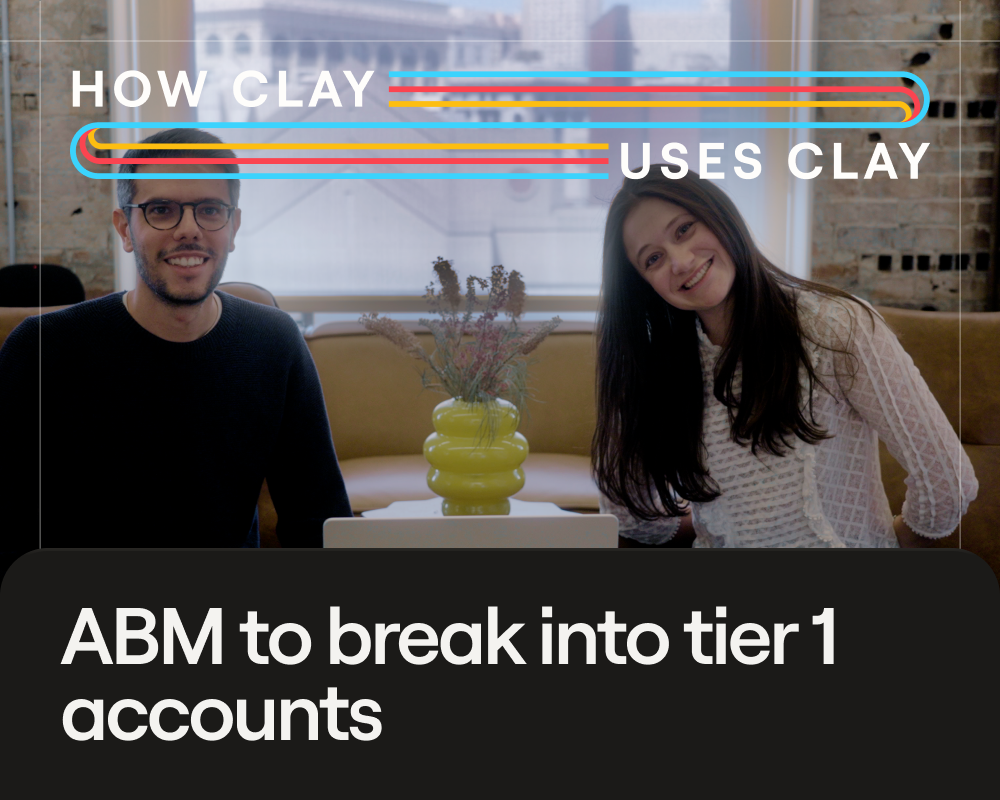
Want to see how this works in real-time? Watch Talia Schleifer, a growth lead at Clay who built 99% of this campaign, host a live workshop where she walks through the end-to-end flow inside Clay from account scoring to enrichment, landing page generation, ad syncing, and SDR handoff.
Frequently Asked Questions
How do you measure success with a Clay ABM campaign?
The post focuses on pipeline quality over volume metrics. The goal is meetings with accounts that are genuinely curious and in-fit, not meetings booked out of obligation. Downstream indicators include deal cycle length on warmed accounts and whether accounts that didn't convert still leave with a positive impression of the company.
How many accounts should you target in an ABM campaign run through Clay?
Clay's own campaign targeted 300 accounts, filtered from hundreds of thousands using three criteria: account fit rated "Good" or "Best," engagement score above "Passive," and potential contract value over $50K. The right number depends on your scoring thresholds, not an arbitrary list size.
How long does it take to build and run this kind of ABM campaign in Clay?
The first run requires real setup work to build the playbook. Once that foundation exists, the Clay portion of running a subsequent campaign takes about 20 minutes. The time investment shifts from tooling to the decisions that matter: who to target, what to say, and what creative will get someone to engage.
Does this ABM approach require a large team?
No. The campaign was built almost entirely by one growth lead (Talia Schleifer). Clay handled list building, enrichment, landing page population, ad audience syncing, and sequence triggers automatically. SDRs only needed to show up for the conversation itself.
How Clay runs ABM campaigns
Most companies treat their tier 1 accounts like any other outbound target. They load them into a sequence, fire off a templated email, and wonder why nothing converts. The accounts get burned while the sales team gets frustrated and marketing declares the campaign a success based on open rates.
We wanted to do the opposite.
This post walks through the ABM campaign our growth team ran against our top 300 enterprise accounts including what we built, how we built it, and what it actually took to get 1:1 personalization without months of manual work.
TL;DR
- Clay scores accounts across three dimensions (fit, engagement, and potential contract value) to build a focused target list, filtering hundreds of thousands of accounts down to 300.
- The campaign combined a personalized physical mailer, unique QR-linked landing pages populated with Clay enrichment data, and synchronized LinkedIn ads running before the package arrived.
- Delivery confirmation automatically triggered a four-step SDR follow-up sequence. Every research and logistics task was handled inside Clay so reps only had to have the conversation.
- Once built as a reusable playbook, running the campaign again takes about 20 minutes of Clay setup. The hard decisions are about targeting and messaging, not tooling.
The problem with how most ABM gets done
There's a real tension at the center of any account-based campaign. The accounts that matter most are the ones with the largest potential contract value and your team has been working on for months. That also means they're the ones you can least afford to waste a shot on.
Account executives know this tension well. Every generic outreach that hits a tier 1 account is a small deduction from a finite, exhaustible amount of trust. SDRs feel it differently: they're making cold calls into companies where they have no context, no warm-in, and roughly 10 seconds to not get hung up on. Marketing, meanwhile, is under pressure to show activity which often means sending campaigns that prioritize volume over quality.
The result is a familiar failure mode: high-value accounts receiving low-quality outreach, getting conditioned to ignore you, and becoming harder to reach over time.
The conventional ABM answer to this is to go fully manual and dedicate a team member to researching and personalizing outreach for a handful of accounts at a time. That produces great output, but it doesn't scale. You end up with a choice between personalization and reach, and most teams quietly sacrifice one for the other.
Our goal was to break that tradeoff. We wanted 1:1 quality with hundreds of companies at scale. We also needed the whole thing built and running in two weeks.
How we scored and prioritized target accounts
The campaign started with account selection. It may sound obvious, but this is actually where most ABM efforts go wrong. Without a principled approach to prioritization, you either cast too wide and dilute the effort, or you rely on gut instinct and miss accounts that are actually in-market.
We score accounts across three dimensions:
Each score pulls from a combination of first- and third-party signals: company size, funding stage, hiring patterns, sales motion, website visits, event attendance, LinkedIn engagement, and product usage.
The engagement score is particularly important because it's dynamic. It updates on a 90-day rolling window, which means it reflects current behavior rather than a historical snapshot. An account that attended a Clay event last month and has three employees using the free tier looks very different from one that checked our website 18 months ago. The score captures that shift.
Plotting fit against engagement produces a prioritization matrix:
Each score pulls from a combination of first- and third-party signals including company size, funding stage, hiring patterns, sales motion, website visits, event attendance, LinkedIn engagement, and product usage.
The engagement score is particularly important because it's dynamic. It updates on a 90-day rolling window, which means it reflects current behavior rather than a historical snapshot. An account that attended a Clay event last month and has three employees using the free tier looks very different from one that checked our website 18 months ago. The score captures that shift.
Plotting fit against engagement produces a prioritization matrix. But just to be totally clear: this is a snapshot, not a permanent ranking. For us, the tiered lists were our H1 focus list. The tiers set the agenda for the half, and then we re-evaluate.
The logic works in two directions. Sales, SDRs, and growth are working to unlock the Tier 1 accounts and, ideally, closing deals. Meanwhile, marketing is seeding the best-fit Tier 2 accounts: running thought leadership, events, and content designed to warm them up so they're no longer freezing cold when H2 starts. The goal is to promote the strongest Tier 2 accounts into Tier 1 the next time around.
This matters because the point of the whole system is a coordinated effort across the company. Sales, SDRs, growth, and marketing are all running in the same direction, against the same accounts, at the same time. That coordination is what maximizes the yield your sales org gets from its prospecting, which in turn makes higher quota attainment realistic and shortens deal cycles on accounts that have been properly warmed up.
For this campaign, we filtered our CRM through Clay Audiences on three criteria: account fit rated "Good" or "Best," engagement score above "Passive" or "No Signal," and potential contract value over $50K. That brought us from hundreds of thousands of accounts down to 300. That's the list we worked from.
How we orchestrated the campaign across channels
We didn't want five tactics running in parallel with no relationship to one another. We wanted one campaign that happened to move across channels and every touchpoint reinforced the same message and the wider strategy.
The core of the campaign was a physical mailer: a custom air dry clay kit built in partnership with Claymoo (a small Canadian company). We wanted to send them to the most senior marketing leader at each of the 300 accounts and worked with &Open for our direct mailing. Each package included a personalized handwritten note and a unique QR code linking to a landing page built specifically for that recipient.
The QR codes were the core of the exercise. Because each code was tied to an individual, we could show different landing pages to different people when they scanned, including content pulled from the research we'd done on their company.
The landing pages were built in Webflow and populated with tokens from Clay enrichment to include the company's logo, their tech stack (Salesforce, HubSpot, etc.), their sales motion (self-serve, sales-led, or hybrid), and examples of Clay customers with similar profiles. The copy was human-written in modular sections; Clay selected which sections to show each visitor based on what we knew about them. AI handled token replacement and our team handled the actual arguments.
Alongside the mailer, we used Clay Ads to push the same list of 300 accounts into LinkedIn and ran ads across the full buying center including marketing, ops, finance, and sales. We wanted to go beyond the person receiving the package. Those ads ran during the two-to-three-week window between shipment and delivery, so by the time the package arrived on someone's desk, the company had already been seeing Clay in their feed.
When delivery confirmation came in, that triggered a four-step follow-up sequence. First, an email from our growth team copying the relevant SDR. This was a soft opener designed to catch easy replies. If there wasn't a response, the SDR got a call task with a detailed script: what was delivered, to which address, and what to say in the first 15 seconds. If the call didn't connect, the SDR manually added the prospect on LinkedIn and attempted to reach them there. And if that went nowhere, a final check-in email closed the loop.
The SDR's only job at each step was to have the conversation. Everything else was handled.
There's a version of outbound where marketing hands sales a list and calls it a day. We knew we needed to do more to be effective. The idea was to remove every possible obstacle between a rep and a booked meeting and then get out of the way.
What Clay made possible
The digital parts of this campaign including list building, contact enrichment, research, landing page population, ad audience syncing, and sequence triggers were all handled inside Clay. The first time you run this, there's real setup work. But once you've converted this into a reusable playbook, all the setup is done and you can just run the campaign. Future campaigns start from a working foundation, so your energy goes into the decisions that actually matter: who you're targeting, what you're saying, and what idea will get someone to open a box. The Clay part itself takes about 20 minutes.
A few specific pieces worth noting:
The counter-narrative this campaign is trying to make
There's a version of "GTM AI" content that's mostly about tools. Which integrations you're using, which APIs you're calling, how many enrichment providers you've stacked. The tools matter, but that framing misses what's actually interesting.
What we built here is a campaign that reflects a considered point of view about how to treat prospects. The $20 clay kit was chosen because of what it represents rather than its cost. Expensive gifts create their own problems: compliance teams at large and publicly traded companies flag them, and when you send something valuable enough to make someone feel obligated, you fill your pipeline with meetings that were never going to close. People take the call out of guilt rather than fit, and you've just made your own job harder.
What we wanted was something with emotional value, not monetary value. Something connected to our brand, something you'd actually do with your family, something that leaves a good impression even if the timing is wrong. If someone takes a meeting because they're genuinely curious about what kind of company sends a clay kit with a personalized note and a landing page built specifically for them then that's the meeting worth having. The landing page, too, was meant to show each recipient that we'd done the work of understanding their business before asking for their time.
There's also a real argument here about what good outbound feels like from the other side. Even if someone doesn't convert, they should come away from the interaction with a positive impression of the company. It affects referrals, brand perception in the buying center, and whether you get a second chance six months later when the account is actually in-market.
The tools enabled all of this. But the tools didn't make the decisions about what to send, what to say, or how to structure the sequence. Those were human calls, informed by years of running these campaigns at scale. Clay made it possible to execute those decisions across 300 accounts without asking the team to repeat themselves 300 times.
Want to see how this works in real-time? Watch Talia Schleifer, a growth lead at Clay who built 99% of this campaign, host a live workshop where she walks through the end-to-end flow inside Clay from account scoring to enrichment, landing page generation, ad syncing, and SDR handoff.
Frequently Asked Questions
How do you measure success with a Clay ABM campaign?
The post focuses on pipeline quality over volume metrics. The goal is meetings with accounts that are genuinely curious and in-fit, not meetings booked out of obligation. Downstream indicators include deal cycle length on warmed accounts and whether accounts that didn't convert still leave with a positive impression of the company.
How many accounts should you target in an ABM campaign run through Clay?
Clay's own campaign targeted 300 accounts, filtered from hundreds of thousands using three criteria: account fit rated "Good" or "Best," engagement score above "Passive," and potential contract value over $50K. The right number depends on your scoring thresholds, not an arbitrary list size.
How long does it take to build and run this kind of ABM campaign in Clay?
The first run requires real setup work to build the playbook. Once that foundation exists, the Clay portion of running a subsequent campaign takes about 20 minutes. The time investment shifts from tooling to the decisions that matter: who to target, what to say, and what creative will get someone to engage.
Does this ABM approach require a large team?
No. The campaign was built almost entirely by one growth lead (Talia Schleifer). Clay handled list building, enrichment, landing page population, ad audience syncing, and sequence triggers automatically. SDRs only needed to show up for the conversation itself.