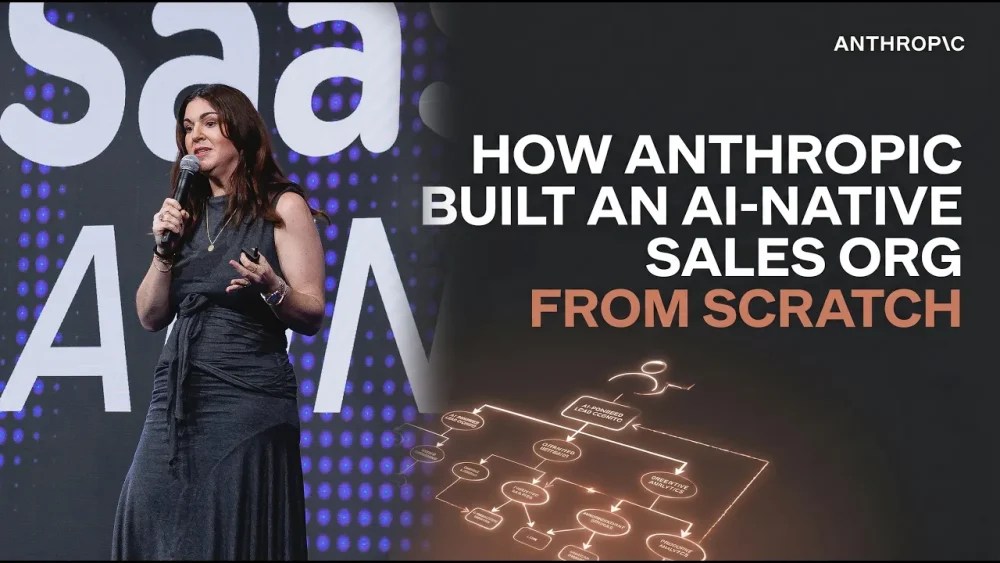
How Anthropic Rebuilt Its Sales Org From Scratch When Demand Went Vertical: 54% of New Enterprise Logos Now Come Self-Serve
Eleanor Dorfman, глава индустриального направления продаж Anthropic, рассказала на SaaStr AI Annual 2026, как после релиза Claude Opus 4.6 в декабре 2025 команда столкнулась с резким ростом спроса и в январе 2026 пересобрала отдел продаж с нуля вокруг AI. Они не стали менять существующий стек (Salesforce, Gong, Clay, LeanData, Ironclad, Slack, Jira, Intercom Fin), а сделали Claude связующей тканью между инструментами. Результат: 54% новых enterprise-логотипов в 2026 году пришли через self-serve воронку с реальным ACV и enterprise-условиями. Anthropic сделал четыре ключевых вложения: отказ от догмы PLG vs SLG, превращение Claude в connective tissue, Slack как единая точка входа для всех вспомогательных функций, и кодификация лучших практик AE в виде Skills (Morning Briefing, Call Prep, Customer Follow-Up, Competitive Intel, Create an Asset). Главный вывод: побеждают те, кто не заменяет стек, а добавляет AI в швы между уже существующими инструментами.
How Anthropic Rebuilt Its Sales Org From Scratch When Demand Went Vertical: 54% of New Enterprise Logos Now Come Self-Serve
by | Early
When Claude Opus 4.6 shipped in December 2025, Anthropic’s commercial team came back from winter break to find demand had gone vertical. They hadn’t hired for it. They hadn’t planned for it.
As Eleanor Dorfman, Anthropic’s Head of Industries who runs the commercial and industries sales team, put it on the SaaStr AI Annual 2026 stage: even if they’d been ready to 3x or 4x or 5x the sales team, you can’t absorb that many bodies fast enough to deliver a positive customer experience.
So in January 2026, they rebuilt the entire sales org around AI from scratch.
Four months later, the result: 54% of new enterprise logos in 2026 came through the self-serve funnel. Real enterprise logos. Real ACV. Real terms of service. Real invoicing. Self-served.
Here’s how they did it, and the four investments any B2B + AI sales leader can copy today.
The Four Constraints Nobody Could Move
Eleanor’s team had four constraints that defined the problem:
The fifth unspoken constraint: they couldn’t burn out the AEs. Late nights in Europe chasing approvals across time zones was already happening. That had to stop, not get worse.
The thesis they bet on: don’t buy a new stack. Thread Claude through the stack they already had. Make Claude the connective tissue between Clay, LeanData, Salesforce, Gong, Ironclad, Slack, Jira, Intercom Fin, Snowflake, BigQuery, and G Suite. Then build in the spaces between.
Investment #1: Kill the PLG vs. SLG Orthodoxy
For 15 years, B2B has operated on a religious belief: product-led growth and sales-led growth are different teams running different motions. Self-service was for SMB. Enterprise plans get dated by humans.
Eleanor threw that out in January.
They launched an enterprise self-service MVP in January 2026. Production in February. The funnel works like this:
54% of new enterprise logos in 2026 came through self-serve.
More than half of Anthropic’s new enterprise logos came in without an AE-led journey, on real enterprise terms, at real enterprise ACV.
If you’re still treating self-service as the consolation prize for buyers who don’t deserve a human, you’re leaving most of your 2026 motion on the table.
Investment #2: Make Claude the Connective Tissue, Not the Seventh Tool
Anthropic’s six core tools that define the lead-to-close journey:
Claude isn’t the seventh tool bolted on. Claude is what makes those six talk to each other. Here’s what a Tuesday looks like for an Anthropic AE:
Morning. Every customer-facing rep starts the day in Claude. A “morning brief” Skill pulls context from Gmail, Gong, Slack, Google Docs, calendar, Salesforce, Intercom, and Greenhouse, then prioritizes the day. Three actions to take. These emails to respond to. These Slacks to action. These deals at risk. Eleanor has hers delivered to Slack at 7am ET. She says she genuinely doesn’t know how she used to operate without it.
Before a call. A “call prep” Skill replaces 30 minutes of LinkedIn research, Slack archaeology, and Salesforce digging. The rep types /call prep and gets a tailored one-pager: who’s on the call, what they care about, historical context, discovery questions to ask, competitive landscape, what the company has said publicly about their needs.
Proposal time. Instead of opening nine tabs of deal desk guidance, scrubbing Gong transcripts, and manually checking precedent, the AE prompts Claude. Claude knows the product, the road map, where Anthropic has won and why, who the stakeholders are, and the shape of the negotiation. Claude drafts the proposal, validates it against policy, and uploads it to Ironclad.
Forecasting. This one’s still a work in progress. Eleanor was direct about it: they still spend at least 10 minutes at the top of every forecast call discussing how they should be forecasting. The ground is moving too fast. But the actual forecasts are now largely run by Claude and inspected by managers. Reps use Skills to make sure Salesforce is updated, next steps are accurate, account plans are current. Then Claude reconciles the consumption data against historical patterns for that cohort and product mix. Forecast calls become discussion forums about where AEs need help. Not data-scrubbing exercises.
Weekly coaching. Claude surfaces six coaching moments per week, tuned dynamically to what matters this month, not last quarter. With product launches and competitive moves happening hourly, a static methodology is dead weight. The dynamic coaching loop is how they preserve a coaching culture while absorbing new hires.
Investment #3: Make Slack the Front Door for Every Support Function
Sales doesn’t close deals alone. Deal desk, legal, RevOps, billing, compliance, customer support, customer success all have to move at the same speed.
Before this investment, supporting functions at Anthropic ran on DMs and institutional knowledge. AEs would walk past the deal desk to chase approvals in person. East Coast and European reps were staying up late chasing approvals from West Coast support functions. It was a gnarly system.
The fix:
This was the unlock for legal, deal desk, vendor onboarding, security questionnaires, and every other compliance step that quietly kills deal velocity.
Eleanor’s line: “Sales leaders are rapidly becoming systems thinkers over deal strategists.” If you’re not designing the supporting function elasticity at the same time as the AE elasticity, you’re going to choke on your own demand.
Investment #4: Codify Your Best Reps as Skills
The fourth investment is where it gets fun. Anthropic took the patterns their best reps were running and encoded them as Skills inside Claude. A “Skill” is a combination of MCP connectors and instructions that any rep can summon with a / shortcut.
Every new rep gets dropped into a territory with a sales plug-in that bundles these Skills. No more six-week onboarding curve. Boot camp, territory, plug-in, go.
The five Skills they ship to every rep:
1. Morning Briefing. Already covered above. The single highest-leverage Skill in the stack. Eleanor’s quote: “I am someone who gets lost taking the subway home, and it is incomprehensible to me that I used to navigate my day or week without Claude telling me every morning what is important.”
2. Call Prep. /call prep and you get a personalized briefing for the next meeting. Who’s on the call. What they care about. Historical context. Discovery questions. Competitive positioning. What the company has been saying publicly about their needs. Five-minute prep for any call, even if you’re back-to-back-to-back.
3. Customer Follow-Up. This is the one that keeps Eleanor up at night solved. The Skill extracts action items from email, Gong calls, Salesforce notes, and Slack threads. Drafts the responses. Drops them in your email provider. Sends a summary of what needs to ship. If you didn’t actually go review and click send, it shows up in your morning brief tomorrow. Internal SLA: 24 hours to follow up with every customer on every action item. The Skill makes that real.
4. Competitive Intel. A static battle card maintained quarterly by product marketing is useless in B2B + AI. The competitive landscape moves hourly. So Claude generates an interactive battle card on demand, tailored to the customer the rep is working on, with the matrix scoped to that deal. Always current. Always personalized.
5. Create an Asset. This is Eleanor’s favorite, and it’s the one that previously required either a top-five deal or a friend on the design team. Now, for any deal, any stakeholder, any stage, an AE can ask Claude to generate custom collateral. A prototype. A one-pager. A landing page. An interactive HTML file. An ROI calculator. Some reps drop entire Gong call transcripts into Claude Code and ask it to build a tailored prototype based on what the customer said they needed. Claude knows the brand, so it ships on-brand assets, not AI slop.
What B2B + AI Sales Leaders Should Do Tomorrow Morning
Four things to start today:
1. Turn on Claude (or your AI of choice) where it’s already embedded. Most B2B sales tools now have AI features. Most teams have a switch flipped without ever asking what it actually does. Be intentional. How does each AI feature connect to the rest of the customer journey?
2. Thread AI through the sales cycle you already run. Don’t rip and replace. Your cycle works. Use AI as the accelerant between stages. Where does context get lost between Salesforce and Slack? That’s where the leverage is. Sales motions have moved from deterministic workflows to probabilistic ones, and that’s an opportunity, not a threat.
3. Make Slack or Teams the front door for one support function. Pick the one that’s bottlenecking your AEs the most. For Anthropic, it was deal desk and legal. For you it might be vendor onboarding or security questionnaires. Slack ticket in, ticket out, Claude triages. Watch your cycle times collapse.
4. Document what your best reps do. Ship it as a Skill. The cognitive relief that comes from knowing your top-performer patterns are now the baseline for every rep is the real prize. You stop hoping new reps figure it out. You make their first day look like your top rep’s Tuesday.
Anthropic Didn’t Replace Their Stack. The Added AI To What They Already Had
Anthropic didn’t replace Salesforce. Didn’t replace Gong. Didn’t replace Ironclad. Didn’t replace Clay or LeanData or Slack or Jira.
They invested in what they already had, and threaded Claude through the seams.
That’s the playbook. Most B2B + AI companies are going to spend 2026 evaluating AI-native sales platforms and trying to rip out their stack. The teams that win will do what Anthropic did: keep the tools, encode the best practices, and let AI be the connective tissue between everything they’ve already built.
54% of new enterprise logos coming through self-serve, AEs that wake up with a personalized brief instead of an inbox, forecast calls that are discussions instead of data scrubs, support functions that respond in Slack instead of email threads three days later. That’s what an AI-native B2B sales org looks like in 2026. And almost none of it required new software.