
Speed-to-lead is a solved problem
Статья утверждает, что проблема speed-to-lead — скорости первого контакта с потенциальным клиентом — полностью решена благодаря AI-агентам. Раньше отделы продаж нанимали больше SDR, выстраивали сложные правила маршрутизации и измеряли время ответа, но структурные ограничения (графики смен, задержки маршрутизации, рабочий день 9–5) не позволяли убрать разрыв полностью. AI-агент вступает в разговор мгновенно, в момент пикового интереса покупателя, квалифицирует лида, проводит дискавери и даже демо в одном непрерывном диалоге. В Intercom после запуска Fin for Sales в июле объём pipeline на этапе S2 вырос на 77% год к году. Авторы призывают руководителей продаж переключить метрики с времени первого ответа на результаты: долю квалификации, созданный pipeline и удовлетворённость покупателей. SDR при этом высвобождаются для работы, которая продвигает сделки: телефонных продаж, навигации по сложным сделкам и многопоточного взаимодействия со стейкхолдерами.
Your customer finds your product and it looks right for them. They read the pricing page, watch the demo video, and feel ready to talk to someone. They hit “contact sales”.
Then they wait.
The entire industry oriented itself around managing that wait. We called it “speed-to-lead,” and it became the measure of a high-performing sales development org. We hired more SDRs, built faster routing rules, added shift coverage, and measured ourselves on response-time dashboards. At Fin, our SLA targets were one hour for best-fit leads, four hours for core MQLs, forty-eight hours for everyone else. Those were considered good numbers.
Nobody questioned the premise because nothing could change it. The gap existed because of structural constraints – shift scheduling, routing delays, and humans working 9–5. Even the fastest teams couldn’t remove it. They could shrink it, but that was it.
An AI Agent closes it completely. Now when a prospect arrives on your site, the conversation starts immediately, and that changes how you build your sales org: how you staff it, what your team focuses on, and the metrics it’s held accountable for.
Always-on, or leads are gone
First, let’s zoom out from the dashboards we use as sales leaders to the buyer’s actual experience.
We spend money to push as much traffic to the website as possible, and then point visitors towards filling in a form. This process doesn’t just create friction, it works against you at the exact moment a buyer is most likely to convert.
Intent peaks when someone actively seeks out your product. But by the time an SDR follows up, two or three hours later, they’re in another meeting. The urgency has faded and the moment has passed. Your sales team calls it a lead, but the customer has already moved on.
What AI changes
Agents eliminate every structural constraint that made speed-to-lead a problem, including shift scheduling, routing delays, CRM batch processing, and the SDR being on another call. None of it applies anymore because every single lead can be engaged immediately, at any hour and in any language.
The impact goes beyond response time. When an Agent engages at the moment of peak intent, qualification, discovery, and even an initial demo moment can happen in one continuous conversation. The gated funnel collapses. There’s no reason to qualify someone today, schedule discovery for Thursday, and demo the following week, when the conversation is already happening.
The constraint the entire industry built solutions around simply isn’t there anymore. We’re already seeing it with Fin, our Customer Agent. As sales leaders, we need to start framing this differently.
What this means for your sales org
If speed-to-lead is no longer the constraint, the knock-on effects run through the entire org.
SDRs focus on moving deals forward
Instead of spending their time on frontline triage and response, SDRs can focus on the work that moves deals forward: phone-based selling and relationship building, complex deal navigation, multi-threaded engagement across stakeholders – the kind of work that SDRs rarely had time for when they were tied to the frontline.
Pipeline gets more relevant
The old model built around speed-to-lead incentivized volume. The goal was to capture as many form fills as possible, respond fast, and figure out later if the lead was worth pursuing.
When an Agent engages at the moment of intent, it qualifies during the conversation. The low-fit leads get filtered out before they reach your team, and the ones that come through arrive with real context, rather than a name and email from a form field. Since we enabled Fin for Sales in July, our S2 pipeline volume is up 77% year-on-year.
You measure outcomes, not response time
Time-to-first-response stops being the metric that matters when first response is instant. The metrics that matter change. Sales leaders running an Agent-led frontline should be looking at three questions:
These three questions tell you whether your sales motion is working. Time-to-first-response can’t.
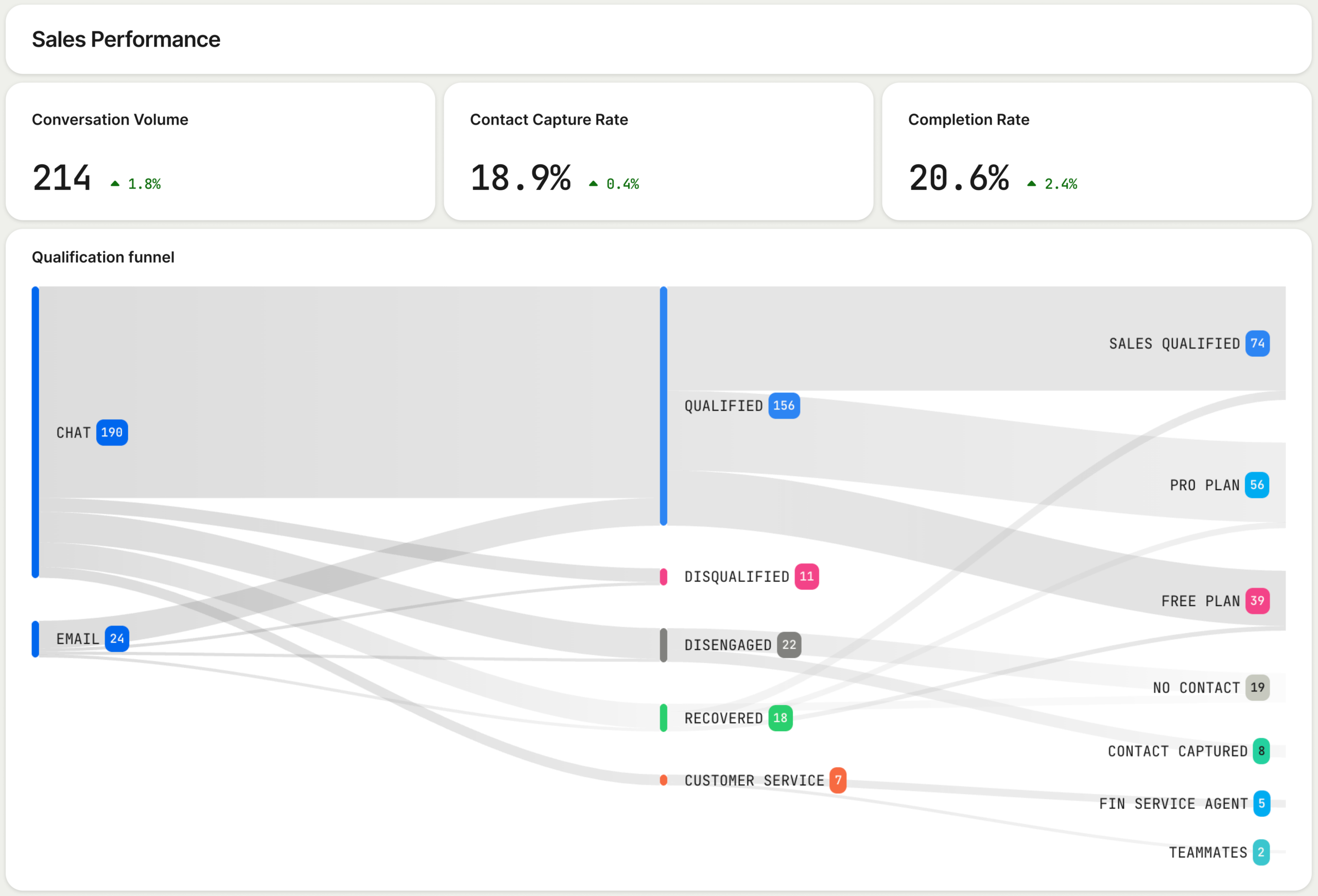
Once upon a time, sales teams relied on form fills, timing and luck to sort and serve these leads.
The end of speed-to-lead
Sales orgs built their hiring plans, workflows, and performance metrics around getting back to a lead before the intent decayed. That made sense when the lag was unavoidable, but it isn’t anymore.
An Agent is always on. It engages the moment a prospect arrives on your site, qualifies them in real time, and routes them to the right outcome without waiting for someone to be free. The lag that the entire industry built itself around doesn’t exist when the conversation starts immediately.
The companies that recognize this are already changing how they operate. They’re investing in what happens after the conversation starts: how well the Agent qualifies, where it creates pipeline, and what SDRs should actually spend their time on. What matters now is not how fast you respond, but what the conversation actually produces.
Speed-to-lead made sense when the lag was structural. It isn’t anymore, and the teams that still treat it as one are solving yesterday’s problem.