Dropbox Hit $1B Faster Than Any B2B Company Ever. But Now, It’s The End of an Era
Dropbox достигла $1 млрд ARR быстрее любой B2B-компании в истории благодаря идеальной PLG-модели и минимальному сжиганию капитала, но после этого рубежа рост неуклонно замедлялся — с 40% в 2016 году до −1% в 2025-м. Основатель Drew Houston, руководивший компанией 19 лет, передаёт пост CEO Ashraf Alkarmi, бывшему CPO Vimeo. Попытки найти «второй акт» — покупки HelloSign, DocSend, FormSwift — не смогли вернуть рост, а ставку на корпоративный AI-поиск перехватил стартап Glean, достигший $100 млн ARR с ростом 203% YoY. Главный урок: в эпоху AI преимущество инкамбента и «рвы из данных» конвертируются в AI-преимущество гораздо хуже, чем принято считать. Тем не менее Dropbox остаётся прибыльной компанией с выручкой $2,5 млрд и 18 млн платящих пользователей, а новый CEO получает мандат на превращение её в AI-native бизнес.
Dropbox Hit $1B Faster Than Any B2B Company Ever. But Now, It’s The End of an Era
by | Blog Posts, Scale
An end of an era
Of my generation of SaaS CEOs, no star burned brighter than Dropbox
It grew to $1B ARR faster than any before, and burning almost nothing, perfecting the PLG motion. The startup we all wished we founded.
But in the end, there was no second act even pre-AI.… https://t.co/96BycqNq82
— Jason ✨👾SaaStr.Ai✨ Lemkin (@jasonlk) May 26, 2026
Of my generation of B2B CEOs, no star burned brighter than Drew Houston and Dropbox.
Today, after 19 years at the helm, Drew is moving into the Executive Chairman role. Ashraf Alkarmi, who joined as GM of Core in November 2024 from Vimeo where he was CPO, takes over as co-CEO and will eventually become sole CEO once the transition is complete.
If you were building B2B in the 2010s, Dropbox was the company you wished you had founded. Now, a decade after its $1B moment, the story is more complicated.
The Revenue Story In One Chart
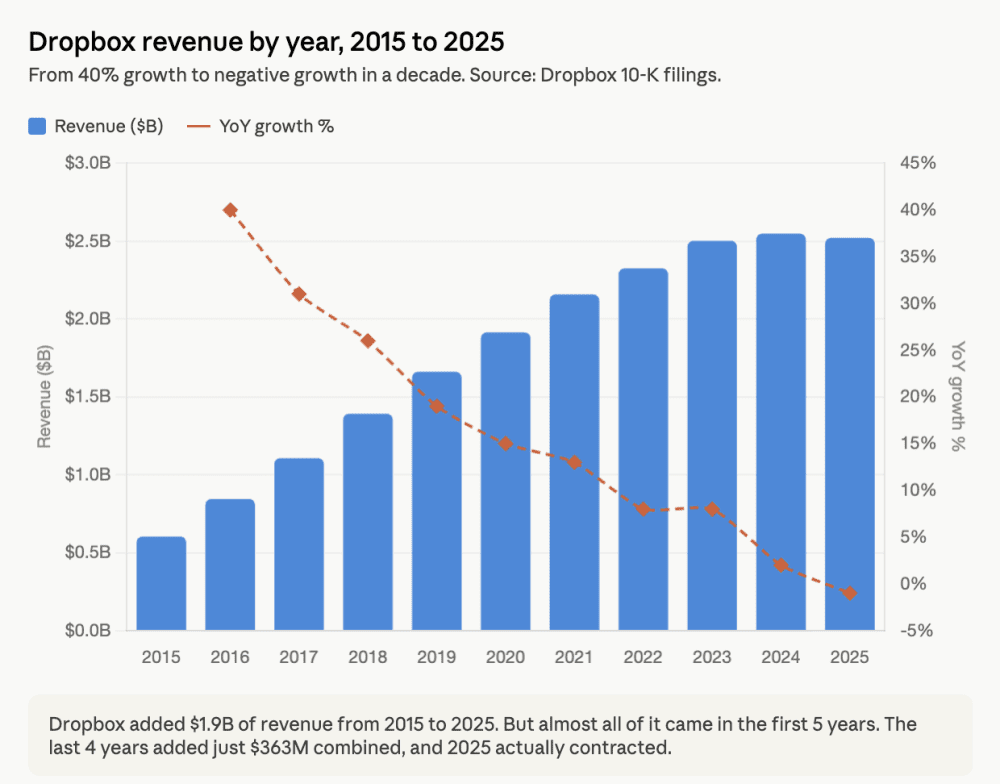
Dropbox revenue 2015 to 2025: from 40% growth to -1%:
The Greatest Pre-AI PLG Story Ever Told
Dropbox grew to $1B in revenue faster than any B2B company before it. And it did it burning almost nothing.
In an era where every cloud company was lighting cash on fire to grow, Drew built the perfected PLG motion. Revenue went from $603.8M in 2015 to $1.107B in 2017, growing 40% then 31%. The company generated positive free cash flow of $137M in 2016 and $305M in 2017.
File sync that just worked. Freemium that converted. Viral loops baked into the product. No outbound army. No 200-person SDR floor. Drew took it public in March 2018 at scale and at profitability. He was 35.
For the cohort of us building B2B companies in that era, Drew was the operator everyone quietly measured themselves against.
What Happened to Growth
The deceleration after $1B ARR is the story:
Fiscal 2025 revenue came in at $2.521B, down 1.1% year-over-year. Excluding FormSwift, which the company is winding down by end of 2026, revenue grew 0.2%.
A great business. A profitable business. But not a growth business anymore.
The pattern is one every public B2B founder fears. The core wedge commoditizes. Google Drive, OneDrive, iCloud, Box all came for file sync. Cloud storage went from a paid product to a free feature inside Workspace and Microsoft 365.
The Second Act That Never Quite Came
Drew tried. Multiple times.
HelloSign for e-signature (renamed Dropbox Sign). DocSend for sales document tracking. FormSwift for forms. Each was a real swing. Each added revenue. None of them re-accelerated the company.
The one that hurts to talk about is enterprise AI search.
Dropbox had the unfair advantage on paper. They had the files. They had hundreds of millions of users. They had the document graph that everyone else was trying to build connectors to reach. The agentic layer on top of all your work content was theirs to lose.
Then Glean built it.
By November 2023, Glean had hit $100M in ARR, growing 203% YoY, with plans starting at ~$30K/year and scaling to over $5M/year for Fortune 500 customers.
Dropbox launched Dash, their answer. It’s a fine product. It’s part of the AI story the company is telling investors today. But the agentic Glean-killer that should have been the natural Dropbox 2.0 didn’t materialize the way it should have, given the starting advantages.
The lesson for every B2B founder: incumbency in the AI era is worth far less than people thought. Data moats don’t automatically convert to AI moats. The AI-native startup with no users beats the legacy player with 700M users more often than not.
What Drew Got Right
Drew did the things that almost no founder does:
The list of B2B founders who can claim any of that is short. The list who can claim all of it is shorter.
The no-second-act critique is real. It’s also a luxury problem. Most companies never get a first act.
Today, we're promoting Ashraf Alkarmi to co-CEO of @Dropbox. Ashraf and I will jointly lead the company, and after a transition period, I'll move into the role of executive chairman and Ashraf will be sole CEO.
Ashraf has transformed our core business since joining — the…
— Drew Houston (@drewhouston) May 26, 2026
What The New CEO Inherits
Q1 2026 came in at $629.5M with management raising full-year revenue and operating margin guidance on the strength of stabilization in the core business and early traction with Dash and Dropbox Protect.
Ashraf is inheriting a company with:
The job is clear. Turn Dropbox into an AI-native company before the core erodes too far. Not easy. Not impossible either.
Three Lessons for B2B Founders Today
End of an era. Probably not the end of the Dropbox story.
A huge congrats to Drew. And good luck Ashraf. You have one of the most interesting jobs in B2B right now.
And probably, the story that is the bookend of the end of the pre-AI SaaS era. It was a fun time, while it lasted. Products that were tough to get to the first $1m ARR, even $10m ARR, but they just grew and grew if you did. A time when products often barely changed for 5+ years. When annual releases were a thing.
That was then. It had its charms. This is now.