How One AI Teammate Beat a Stack of 20 AI Sales Agents With Vivun’s CMO
Джарод Грин (Jarod Greene), CMO компании Vivun, в своём выступлении на SaaStr AI критикует распространённую за последние 18 месяцев стратегию покупать отдельного AI-агента под каждую задачу продаж — по совету Gartner. В результате внутри одной sales-команды нередко оказывается 15–20 сшитых вместе агентов, и каждая передача контекста между ними теряет данные и замедляет сделку. Сильнее всего этот «налог на фрагментацию» бьёт по живому звонку: продавец не может за секунды выбрать нужного агента, и около 40% первых встреч заканчиваются без решения — обычно списываются на «гостинг». Vivun обнаружила, что фундаментальные модели начинают сбоить и галлюцинировать примерно после третьего «прыжка» (hop), тогда как сложная B2B-сделка уходит на 8–20 прыжков вглубь. Грин формулирует это так: LLM — это карта, а не мозг; она не несёт ваше торговое мышление, процессы и методологию. Решение — консолидация: один AI-«коллега», удерживающий рассуждение, контекст и методологию поверх уже купленного стека; по данным Gartner это сокращает обучение на ~40% и ramp с восьми месяцев до двух, а опытные пользователи Vivun сообщают о снижении времени продаж на 50%.
How One AI Teammate Beat a Stack of 20 AI Sales Agents With Vivun’s CMO
by | Blog Posts, Sponsored Posts
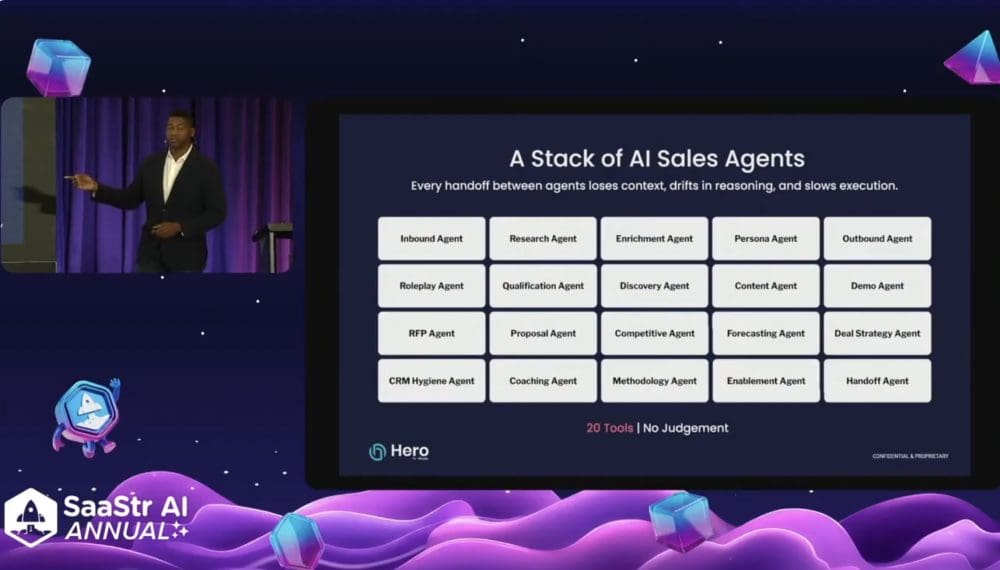
Most go-to-market teams spent the last 18 months buying an agent for every job. Gartner told them to. The advice was to evaluate agents for discrete parts of the sales cycle: a task, an agent; a process, an agent; a thing a rep does, an agent. So that is exactly what companies did. Jarod Greene, CMO of Vivun, says they now walk into deals and routinely find 15 to 20 agents stitched together inside one sales org.
His talk at SaaStr AI was about what that pile of agents does to a deal. What it costs you shows up where it hurts most: the live call.
The fragmentation tax shows up on the live call
Every handoff between agents loses context and slows execution, and speed is the whole game. The clearest place it breaks is the live sales call. A rep gets a hard question, and now there are 20 agents to choose from. Different context windows, different levels of fidelity, some updated, some stale. The rep has to pick one, in real time, while the buyer waits.
This matters more than it used to because buyers show up informed. They already did the research in AI. The only thing they need from the rep is the information they could not find on their own. So when the rep fumbles, or says “let me get back to you,” the deal quietly dies. Greene’s number: roughly 40 percent of first meetings end in no decision, usually filed as “ghosted.” You never hear from that person again, and you tell yourself they went dark. Often they went dark because the rep could not answer the one question that mattered.
Why the agents break: the third hop
Every founder building on top of LLMs should understand this part. Foundation models are excellent inside a single context window. Hand one a transcript, a doc, a set of call notes, and it will summarize, transcribe, and reason beautifully. No debate there.
But a real sales question is rarely one context. The question behind the question needs to know the persona, the buying cycle, how much power the person has, the incumbent, the competitor, the objection underneath the stated objection. Vivun calls each of those connections a “hop.” A complex B2B deal is 8, 10, even 20 hops deep. And their research found the foundation models start getting wonky after about the third hop. Great context once, twice, maybe three times. Then new information enters the picture and the model drifts, gets weird, and starts to hallucinate. That is the exact moment a high-stakes deal needs the model to be sharp, and it is the moment most agent stacks fall apart.
The model is the map, not the brain
Greene’s framing: the LLM is the map, not the brain. It is exceptional at breaking down language. It does not carry your sales reasoning. It does not know your process, your people, your platforms, or your methodology. Those are the things you spend years training into your best reps, and foundation models on their own do not retain them.
That reframes the whole agent question. The problem with the 20-agent stack is not that any single agent is bad. It is that no agent holds the full picture, and the handoffs between them are where the deal leaks. A teammate that carries sales reasoning, the winning behaviors pulled from millions of CRM interactions, and your specific context can hold the thread across all 20 hops. Twenty disconnected agents cannot.
What one teammate replaces
The bigger implication is enablement. The old playbook was to sit with your best seller, study what they do, and train the rest of the team toward it. That has been the pattern for a decade. About 90 percent of sales methodology training is forgotten if it is not applied in the first two weeks. Companies spend millions on methodology providers and watch most of it evaporate.
Give that methodology to one AI teammate instead, and it holds it permanently and reminds the rep what to do, what to know, what to say, and what to show in the moment that matters. Add the requirement that the teammate integrate cleanly with the CRM, collaboration tools, and conversational intelligence you already paid for, and you stop buying point agents and start consolidating.
The numbers that make the case
Greene leaned on Gartner’s predictions for orgs that adopt AI sales teammates, whether as ride-along agents or AI sales engineers. Shorter sales cycles, because the rep stops saying “let me get back to you.” Around 40 percent less product-specific training time, because the teammate is the product expert and the rep gets to sell. And much shorter ramp: eight months to first deal compressing to two, or eight weeks compressing to two.
Then his own customer data. Vivun’s power users reported a 50 percent reduction in sales time, plus higher win rates and bigger deals. The pitch, said plainly: one teammate, one intelligence layer, one platform, not 20 agents.
Stop adding your 21st agent
The instinct to buy an agent for every task felt responsible. It looked like progress. But the fragmentation tax is real, and your customers feel it on the calls that decide your quarter. If your AI GTM roadmap is still a shopping list of discrete agents, you are accumulating handoffs, stale context, and the third-hop drift that loses deals.
The move is consolidation. One teammate that carries the reasoning, the context, and the methodology across the whole deal, sitting on top of the stack you already own. Whether or not you buy Vivun, that architecture is the bet worth making. The companies still adding their 21st agent are solving last year’s problem.