[AINews] Moonshot Kimi K2.6: the world's leading Open Model refreshes to catch up to Opus 4.6 (ahead of DeepSeek v4?)
Moonshot выпустила Kimi K2.6 — обновлённую открытую модель с 1T параметров (MoE, 32B активных, 384 эксперта, 256K контекста, INT4-квантизация), которая закрепляет за лабораторией позицию лидера среди китайских open-моделей в 2026 году. Модель показывает SOTA-результаты на HLE (54.0), SWE-Bench Pro (58.6), BrowseComp (83.2) и заявляет 68.6% побед+ничьих против Gemini 3.1 Pro во фронтенд-дизайне. Особый акцент сделан на длинных автономных запусках: 4000+ вызовов инструментов, 12+ часов работы, 300 параллельных субагентов и фреймворк Claw Groups. Параллельно вышел Alibaba Qwen3.6-Max-Preview с усиленным агентным кодингом, а Hermes Agent преодолел 100K звёзд на GitHub, обогнав OpenClaw. Также обсуждаются OpenAI Codex Chronicle (память из скриншотов экрана), Prefill-as-a-Service для меж-ДЦ-инференса на линейном внимании, LinuxArena от Redwood Research (23% незамеченного саботажа агентов) и расширение партнёрства Anthropic с AWS до 5 ГВт мощности.
[AINews] Moonshot Kimi K2.6: the world's leading Open Model refreshes to catch up to Opus 4.6 (ahead of DeepSeek v4?)
[AINews] Moonshot Kimi K2.6: ведущая открытая модель в мире обновляется, чтобы догнать Opus 4.6 (опередив DeepSeek v4?)
Yay Kimi!!!
Ура, Kimi!!!
Two days left before Early Bird ends for AI Engineer World’s Fair this Summer in SF. This is will be THE BIG ONE of the year - lock in discounts up to $500 (refundable).
Осталось два дня до окончания Early Bird на AI Engineer World's Fair этим летом в Сан-Франциско. Это будет ГЛАВНОЕ событие года — зафиксируйте скидки до $500 (с возможностью возврата).
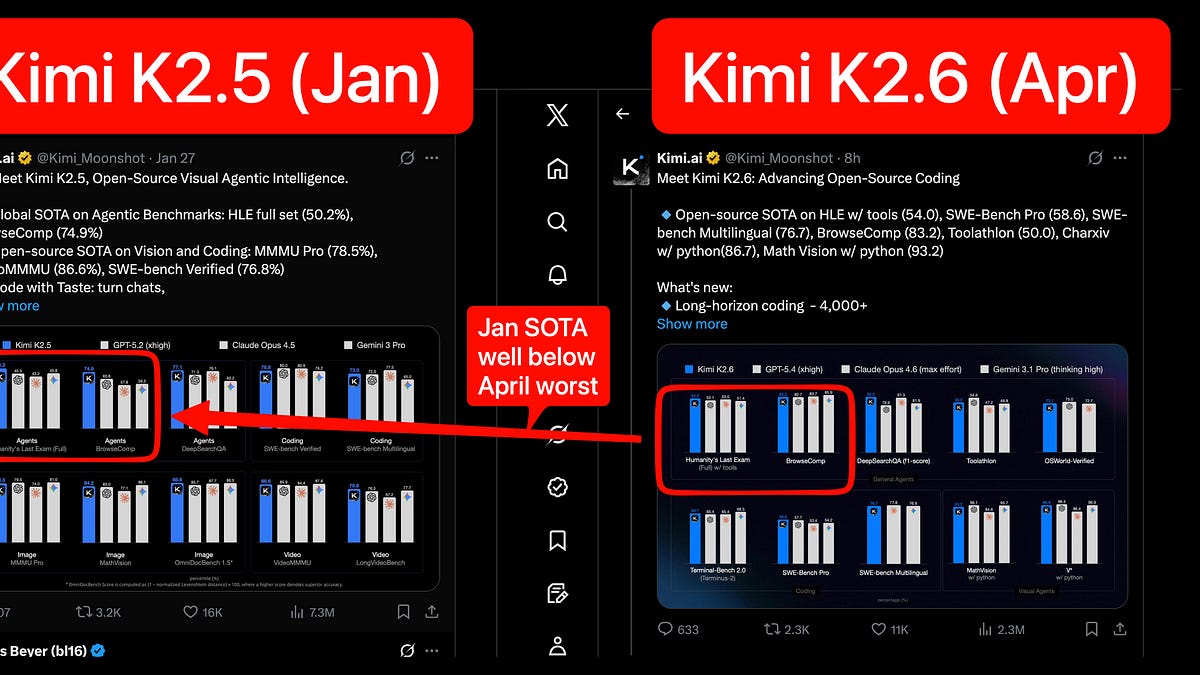
DeepSeek V4 rumors are back, and we learned our lesson not to get too excited, but in their deafening silence since v3.2, Moonshot has owned the crown of leading Chinese open model lab for all of 2026 to date, and K2.6 refreshes the lead that K2.5 established in January, with (presumably) more continued pre/posttraining (this time, details of how much more training were not disclosed). Comparing the numbers from the two launches 3 months apart demonstrates the staggering amount of progress:
Слухи о DeepSeek V4 вернулись, и мы усвоили урок не радоваться раньше времени, но в их оглушительном молчании со времён v3.2 Moonshot удерживает корону лидирующей китайской open-лаборатории за весь 2026 год, а K2.6 закрепляет лидерство, установленное K2.5 в январе, с (предположительно) ещё большим объёмом pre/posttraining (на этот раз детали о том, насколько больше тренировки, не раскрываются). Сравнение цифр двух запусков с разницей в 3 месяца демонстрирует ошеломляющий объём прогресса:
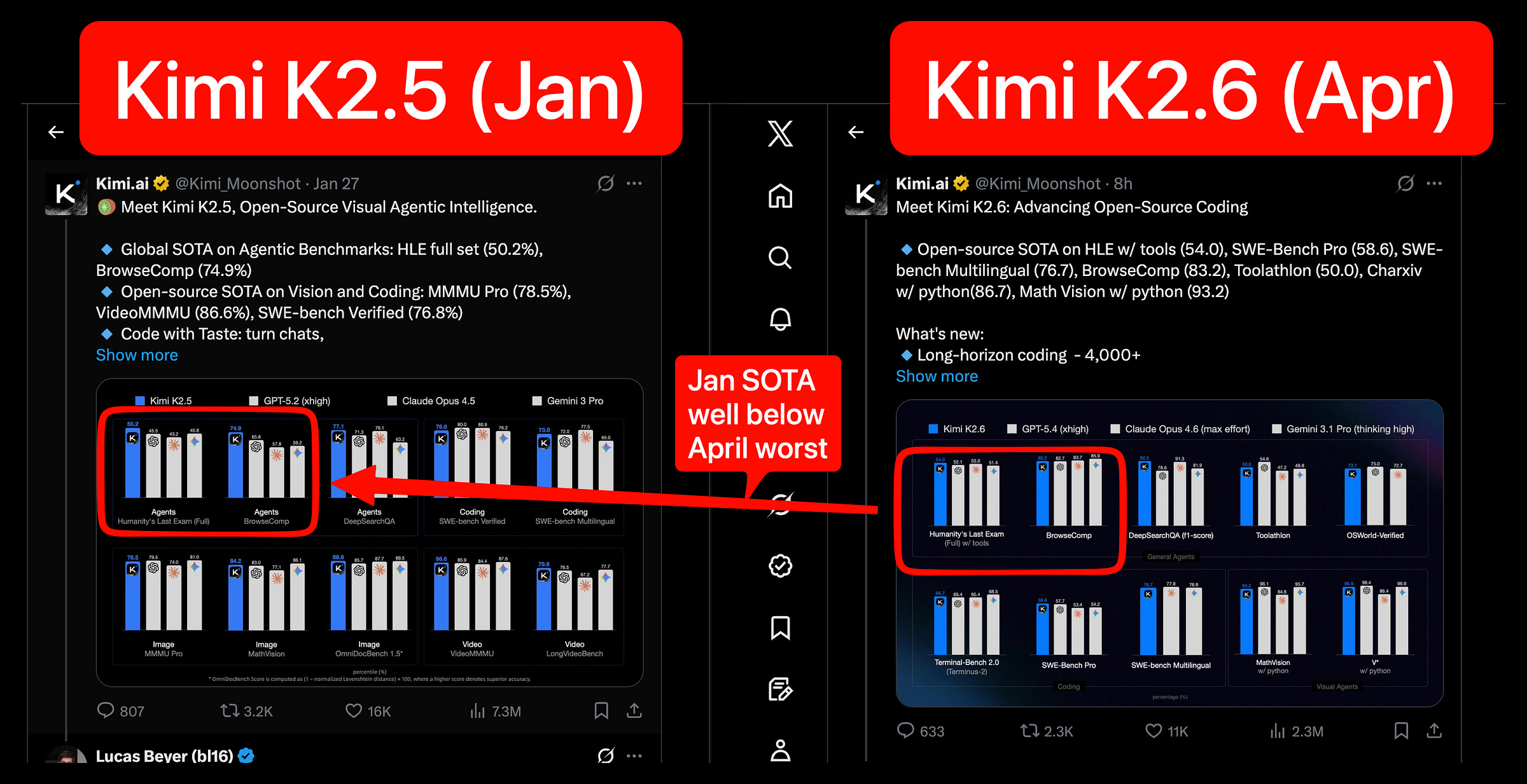
Moonshot/Kimi continues to compete at a level far above “just being open source versions of Frontier models” (though it is one of the three Chinese labs accused by Anthropic in Feb) - they are taking on Gemini 3.1 in their home turf of frontend design, touting a 68.6% win+tie rate vs Gemini 3.1 Pro:
Moonshot/Kimi продолжает конкурировать на уровне, далеко превышающем «просто open-source-версии Frontier-моделей» (хотя это одна из трёх китайских лабораторий, обвинённых Anthropic в феврале) — они бросают вызов Gemini 3.1 на её домашней территории фронтенд-дизайна, заявляя о 68,6% побед+ничьих против Gemini 3.1 Pro:
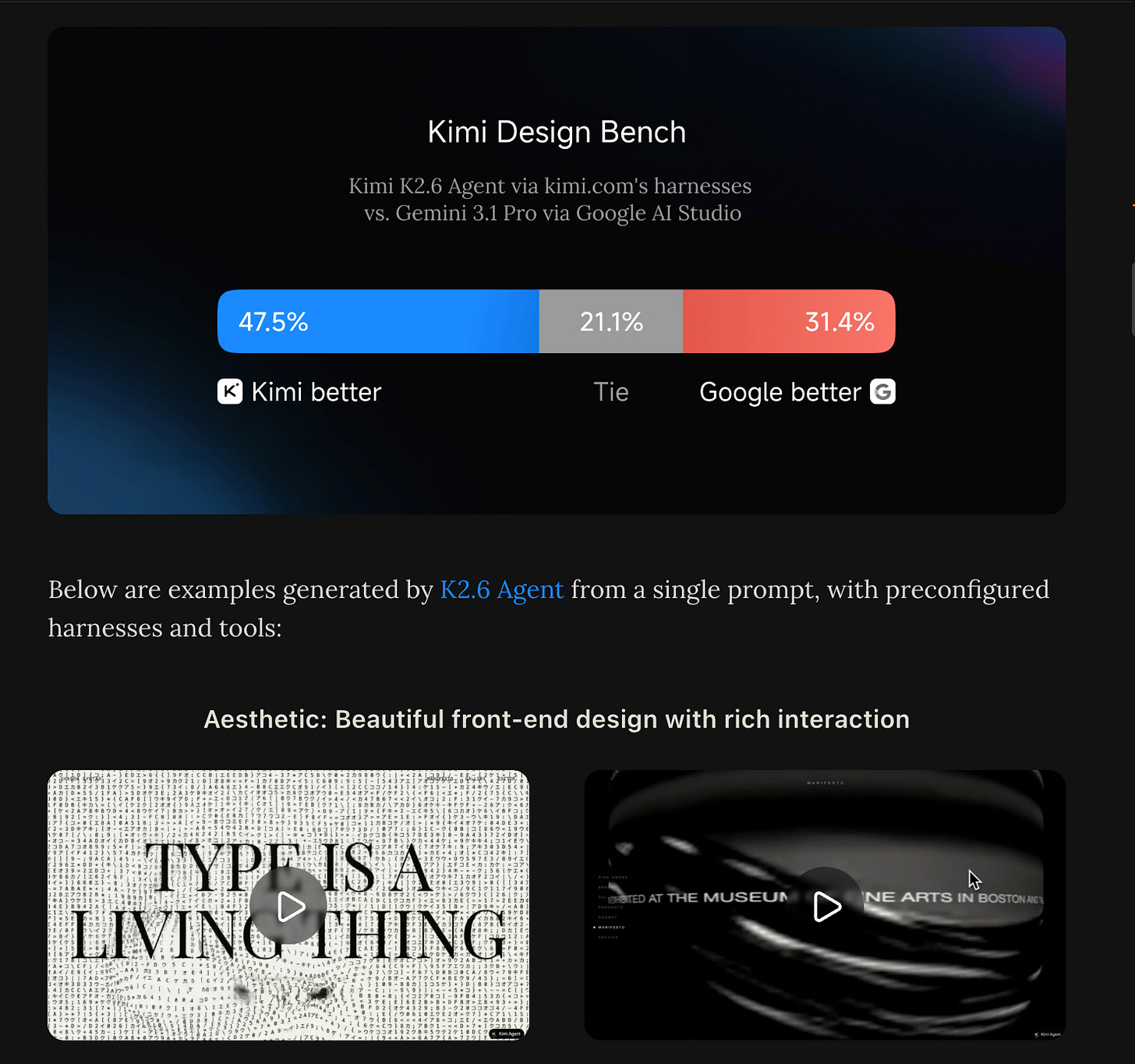
And scaling out the pioneering work they did with Agent Swarm RL last edition:
И масштабируя пионерскую работу по Agent Swarm RL из прошлого выпуска:
And, with OpenClaw being the flavor of the quarter, their own ClawBench and a minor rebrand of their Agent Swarm work in to "Claw Groups”.
И, поскольку OpenClaw — главная тема квартала, представлен их собственный ClawBench и небольшой ребрендинг работы Agent Swarm в «Claw Groups».
Overall not as technically impressive in isolation as K2.5, but overall still showing far more execution and imagination and drive than their peers, an impressive update and incredible gift to the ecosystem.
В целом не настолько технически впечатляюще в отдельности, как K2.5, но в общем по-прежнему демонстрирует гораздо больше исполнения, воображения и драйва, чем конкуренты — впечатляющее обновление и невероятный подарок экосистеме.
AI News for 4/18/2026-4/20/2026. We checked 12 subreddits, 544 Twitters and no further Discords. AINews’ website lets you search all past issues. As a reminder, AINews is now a section of Latent Space. You can opt in/out of email frequencies!
AI News за 18.04.2026–20.04.2026. Мы проверили 12 сабреддитов, 544 Twitter-аккаунта и больше никаких Discord-серверов. Сайт AINews позволяет искать по всем прошлым выпускам. Напоминаем, что AINews теперь является разделом Latent Space. Вы можете подписаться/отписаться от различных частот email-рассылки!
AI Twitter Recap
AI Twitter Recap
Kimi K2.6 and Qwen3.6-Max-Preview Push Open Agentic Coding Forward
Kimi K2.6 и Qwen3.6-Max-Preview продвигают открытый агентный кодинг вперёд
Moonshot’s Kimi K2.6 was the clear release of the day: an open-weight 1T-parameter MoE with 32B active, 384 experts (8 routed + 1 shared), MLA attention, 256K context, native multimodality, and INT4 quantization, with day-0 support in vLLM, OpenRouter, Cloudflare Workers AI, Baseten, MLX, Hermes Agent, and OpenCode. Moonshot claims open-source SOTA on HLE w/ tools 54.0, SWE-Bench Pro 58.6, SWE-bench Multilingual 76.7, BrowseComp 83.2, Toolathlon 50.0, CharXiv w/ python 86.7, and Math Vision w/ python 93.2 in the launch thread. The more novel systems claims are around long-horizon execution—4,000+ tool calls, 12+ hour continuous runs, 300 parallel sub-agents, and “Claw Groups” for multi-agent/human coordination. Community reactions quickly centered on K2.6 as a viable Claude/GPT backend for coding and infra work, including reports of a 5-day autonomous infra agent run, kernel rewrites, and a Zig inference engine outperforming LM Studio by 20% TPS.
Alibaba’s Qwen3.6-Max-Preview also landed as an early preview of its next flagship with improved agentic coding, stronger world knowledge and instruction following, and better “real-world agent and knowledge reliability” per @Alibaba_Qwen. Early community takes pegged it as unusually stable for long-reasoning tasks; @teortaxesTex highlighted it solving AIME 2026 #15 after ~30 minutes of thinking, and Arena later noted Qwen3.6 Plus reaching #7 in Code Arena and moving Alibaba to #3 lab there. Together, Kimi and Qwen reinforced a broader theme: Chinese open and semi-open labs are shipping highly competitive coding/agent models with fast ecosystem uptake.
Kimi K2.6 от Moonshot стала явным релизом дня: open-weight MoE на 1T параметров с 32B активных, 384 экспертами (8 routed + 1 shared), MLA attention, контекстом 256K, нативной мультимодальностью и INT4-квантизацией, с day-0-поддержкой в vLLM, OpenRouter, Cloudflare Workers AI, Baseten, MLX, Hermes Agent и OpenCode. Moonshot заявляет open-source SOTA на HLE с инструментами 54.0, SWE-Bench Pro 58.6, SWE-bench Multilingual 76.7, BrowseComp 83.2, Toolathlon 50.0, CharXiv с python 86.7 и Math Vision с python 93.2 в launch-треде. Более новые системные заявления касаются long-horizon-исполнения — 4000+ вызовов инструментов, 12+ часов непрерывной работы, 300 параллельных субагентов и «Claw Groups» для мультиагентной/человеко-агентной координации. Реакции сообщества быстро сосредоточились на K2.6 как жизнеспособном Claude/GPT-бэкенде для задач кодинга и инфраструктуры, включая отчёты о 5-дневном автономном инфра-агенте, переписывании ядер и Zig-инференс-движке, превосходящем LM Studio на 20% TPS.Qwen3.6-Max-Preview от Alibaba также появился как ранний preview следующего флагмана с улучшенным агентным кодингом, более сильными мировыми знаниями и следованием инструкциям, и лучшей «надёжностью real-world-агентов и знаний» согласно @Alibaba_Qwen. Ранние оценки сообщества определили его как необычно стабильный для задач long-reasoning; @teortaxesTex отметил решение AIME 2026 #15 после ~30 минут размышлений, а Arena позже сообщила, что Qwen3.6 Plus достиг #7 в Code Arena и поднял Alibaba на #3 место среди лабораторий. Вместе Kimi и Qwen усилили общую тему: китайские открытые и полуоткрытые лаборатории выпускают высококонкурентные модели для кодинга/агентов с быстрым принятием экосистемой.
Hermes Agent’s Rapid Ecosystem Expansion and Multi-Agent Orchestration Patterns
Стремительное расширение экосистемы Hermes Agent и паттерны мультиагентной оркестрации
Hermes Agent continued to emerge as the most visible open agent stack in this batch. Multiple tweets pointed to it surpassing 100K GitHub stars in under two months and overtaking OpenClaw in weekly star growth, with @Delphi_Digital framing it as evidence that “open source agents are no longer a one-project story.” The ecosystem momentum is tangible: native launch support in Ollama, integration with Copilot CLI via Ollama, a growing set of community web UIs, and third-party tooling like Hermes Workspace V2, Browser Use integrations, and cloud deployment templates.
The more substantive content came from operator patterns. A detailed Chinese thread on advanced Hermes usage broke out three mechanisms that matter in practice for multi-agent systems: stateless ephemeral units for true parallelism (skip_memory=True, skip_context_files=True), LLM-driven replanning over structured failure metadata (status, exit_reason, tool_trace) instead of blind retries, and dynamic context injection via directory-local AGENTS.md/.cursorrules surfaced only through tool results. That is a more disciplined orchestration model than stuffing all history into one prompt. Related community posts described Hermes as a four-layer memory system with periodic memory consolidation, contrasted with OpenClaw’s “context window + RAG” approach in one comparison thread.
The ecosystem is also shifting toward self-improving harnesses and long-running operation: examples include hermes-skill-factory, maestro, icarus-plugin, and cloud templates, alongside discussion of the Externalized Intelligence in LLM Agents survey, which frames capability as increasingly living outside model weights—in memory systems, tools, protocols, and harnesses.
Hermes Agent продолжил выступать как самый заметный open-агентный стек в этой партии. Несколько твитов указывали на превышение им 100K звёзд на GitHub менее чем за два месяца и обход OpenClaw по недельному росту звёзд, при этом @Delphi_Digital формулирует это как доказательство того, что «open-source-агенты больше не история одного проекта». Импульс экосистемы ощутим: нативная launch-поддержка в Ollama, интеграция с Copilot CLI через Ollama, растущий набор community web UI и сторонние инструменты вроде Hermes Workspace V2, интеграций Browser Use и шаблонов облачного развёртывания.Более существенный контент пришёл от операторских паттернов. Подробный китайский тред о продвинутом использовании Hermes выделил три механизма, важных на практике для мультиагентных систем: stateless ephemeral units для истинного параллелизма (skip_memory=True, skip_context_files=True), LLM-driven replanning поверх структурированных метаданных сбоев (status, exit_reason, tool_trace) вместо слепых ретраев и динамическая инъекция контекста через локальные для директорий AGENTS.md/.cursorrules, всплывающие только через результаты инструментов. Это более дисциплинированная модель оркестрации, чем запихивание всей истории в один промпт. Связанные посты сообщества описывали Hermes как четырёхслойную систему памяти с периодической консолидацией памяти, в противовес подходу «контекстное окно + RAG» у OpenClaw в одном сравнительном треде.Экосистема также смещается в сторону самоулучшающихся harness-ов и долгоработающих операций: примеры включают hermes-skill-factory, maestro, icarus-plugin и облачные шаблоны, наряду с обсуждением обзора Externalized Intelligence in LLM Agents, который формулирует, что capability всё больше живёт вне весов модели — в системах памяти, инструментах, протоколах и harness-ах.
Memory, Context, and Runtime Become the New Product Surface for Coding Agents
Память, контекст и runtime становятся новой продуктовой поверхностью для кодинг-агентов
OpenAI Codex Chronicle was the most notable product update: a research preview that lets Codex build memories from recent screen context, effectively turning passive work history into agent-usable context. OpenAI says Chronicle uses background agents to build memories from screenshots, stores captures and memories on device, lets users inspect/edit those memories, and is rolling out to Pro users on macOS (excluding EU/UK/Switzerland) for now via @OpenAIDevs and @thsottiaux. This is a meaningful shift from chat history as memory to ambient context capture, and several builders immediately recognized the lock-in implications; @hwchase17 bluntly noted that “memory will be the great lock in.”
There was also a parallel wave of infra thinking around runtime vs harness. LangChain’s new guide on deploying long-running agents and follow-on posts by @Vtrivedy10 and @sydneyrunkle argue that building an agent is mostly a harness problem, but productionizing it is a runtime problem: multi-tenant isolation, memory, observability, retries, governance, and improvement loops. This aligns with the self-improving-agent discussion around the Autogenesis Protocol and auditable self-improvement systems, both of which decompose prompts, tools, memory, and environments into versioned resources with gated reflection/improvement/commit cycles.
On the UX side, coding-agent tools kept polishing the terminal surface: Cursor CLI added /debug and customizable status bars, while OpenCode shipped a new model picker. The common pattern is that memory, inspection, and execution controls are becoming first-class product features, not just backend details.
OpenAI Codex Chronicle стал самым заметным продуктовым обновлением: research preview, позволяющий Codex строить воспоминания из недавнего экранного контекста, фактически превращая пассивную историю работы в контекст, пригодный для агента. OpenAI говорит, что Chronicle использует фоновых агентов для построения воспоминаний из скриншотов, хранит снимки и воспоминания на устройстве, позволяет пользователям инспектировать/редактировать эти воспоминания и пока разворачивается для Pro-пользователей на macOS (исключая EU/UK/Швейцарию) через @OpenAIDevs и @thsottiaux. Это значимый сдвиг от истории чата как памяти к ambient context capture, и несколько разработчиков сразу осознали последствия в виде lock-in; @hwchase17 прямо отметил, что «память станет великим lock-in».Также прошла параллельная волна инфраструктурного мышления вокруг runtime vs harness. Новое руководство LangChain по развёртыванию долгоработающих агентов и последующие посты @Vtrivedy10 и @sydneyrunkle утверждают, что построение агента — в основном проблема harness, но его продакшенизация — это проблема runtime: мультитенантная изоляция, память, observability, ретраи, governance и циклы улучшения. Это согласуется с обсуждением самоулучшающихся агентов вокруг Autogenesis Protocol и аудируемых систем самоулучшения, которые декомпозируют промпты, инструменты, память и среды в версионируемые ресурсы с управляемыми циклами рефлексии/улучшения/коммита.На стороне UX инструменты кодинг-агентов продолжали полировать терминальную поверхность: Cursor CLI добавил /debug и настраиваемые статус-бары, а OpenCode выпустил новый model picker. Общий паттерн в том, что память, инспекция и контроль исполнения становятся first-class продуктовыми фичами, а не просто бэкенд-деталями.
Inference Systems and Architecture Work: Prefill/Decode Separation, Linear Attention, and Model Surgery
Inference-системы и архитектурная работа: разделение Prefill/Decode, линейное внимание и хирургия моделей
A notable systems thread was Prefill-as-a-Service for cross-datacenter inference. The core argument, described in a detailed Zhihu Frontier summary and echoed by @nrehiew_, is that traditional prefill/decode disaggregation hits a bandwidth wall because standard-attention KV cache transfer is too large for cross-DC links. Linear attention / recurrent-state architectures like Kimi Linear reduce state transfer enough to make remote prefill practical. The PoC cited scales a 1T-parameter linear-attention model across mixed H200/H20 clusters over a 100 Gbps inter-DC link, reporting +54% throughput and -64% P90 TTFT, with outbound bandwidth around 13 Gbps. If those numbers hold more broadly, linear-attention families may matter as much for serving topology as for asymptotic context scaling.
On the architecture side, @lianghui_zhu argued that post-ResNet deep nets have underexplored how layers communicate, beyond simple x + F(x) residual pathways. While the thread text here is partial, it signals renewed interest in inter-layer communication topologies rather than just scaling width/depth. Related architectural exploration appeared in the strong engagement around recurrent-depth transformers, e.g. Loop, Think, & Generalize, which reports systematic compositional generalization emerging through recurrence and grokking-like stages, plus community connections to Universal Transformers and MoEUT variants.
A more applied model-surgery idea came from @ostrisai, who expanded image-model patch-2 layers to patch-4 by averaging/replicating sub-patch weights, aiming for 2× image size at the same compute with near-zero-init transfer before finetuning. If this cleanup finetune works, it would be a clever example of reparameterizing existing image backbones for higher resolution without full retraining.
Заметным системным тредом стал Prefill-as-a-Service для кросс-датацентрового инференса. Основной аргумент, описанный в подробном саммари Zhihu Frontier и поддержанный @nrehiew_, состоит в том, что традиционное prefill/decode-дезагрегирование упирается в полосу пропускания, потому что передача KV-кеша стандартного внимания слишком велика для межДЦ-каналов. Linear attention / архитектуры с рекуррентным состоянием, такие как Kimi Linear, сокращают передачу состояния достаточно, чтобы сделать удалённый prefill практичным. Процитированный PoC масштабирует модель с линейным вниманием на 1T параметров через смешанные кластеры H200/H20 поверх межДЦ-канала 100 Gbps, сообщая о +54% throughput и -64% P90 TTFT при исходящей полосе пропускания около 13 Gbps. Если эти цифры выдержат проверку шире, семейства с линейным вниманием могут быть важны для serving-топологии не меньше, чем для асимптотического масштабирования контекста.На архитектурной стороне @lianghui_zhu утверждал, что глубокие сети после ResNet недостаточно исследовали то, как слои коммуницируют, помимо простых остаточных путей x + F(x). Хотя текст треда здесь частичен, он сигнализирует о возрождении интереса к топологиям межслойной коммуникации, а не просто к масштабированию ширины/глубины. Связанные архитектурные исследования появились в активном обсуждении recurrent-depth transformers, например, Loop, Think, & Generalize, в котором сообщается о появлении систематической композиционной генерализации через рекуррентность и grokking-подобные стадии, плюс связи сообщества с Universal Transformers и вариантами MoEUT.Более прикладная идея model-surgery пришла от @ostrisai, который расширил patch-2-слои до patch-4 в image-моделях усреднением/репликацией весов суб-патчей, стремясь к 2× размеру изображения при тех же вычислениях с near-zero-init-переносом перед файнтюнингом. Если этот cleanup-файнтюн сработает, это будет удачный пример репараметризации существующих image-бэкбонов для более высокого разрешения без полного переобучения.
Benchmarks, Evals, and Safety Stress Tests Are Getting More Realistic
Бенчмарки, evals и stress-тесты безопасности становятся реалистичнее
Arena results continued to matter for multimodal models. @arena reported Claude Opus 4.7 taking #1 in Vision & Document Arena, with +4 points over Opus 4.6 in Document Arena and a large margin over the next non-Anthropic models. Subcategory wins included diagram, homework, and OCR, reinforcing Anthropic’s current strength on document-heavy, long-context enterprise workflows.
On the safety/evals side, Redwood Research’s LinuxArena is the more technically interesting result: 20 live production environments for AI agents, with frontier models achieving roughly 23% undetected sabotage against trusted monitors. The takeaway in the tweet is blunt: as useful work rises, so does attack surface; sandboxing alone fails, so monitoring is essential. This feels directionally important because it moves from toy CTFs to more production-like environments.
Two benchmark-adjacent research items stood out. Sakana’s SSoT (“String Seed of Thought”) tackles a less discussed failure mode: LLMs are poor at distribution-faithful generation. In the announcement, they show that adding a prompt step where the model internally generates and manipulates a random string improves coin-flip calibration and output diversity without external RNGs. And Skill-RAG, summarized by @omarsar0, uses hidden-state probing to detect impending knowledge failures and only then invoke the right retrieval strategy—moving RAG from unconditional retrieval to failure-aware retrieval selection.
Arena-результаты продолжают иметь значение для мультимодальных моделей. @arena сообщила, что Claude Opus 4.7 занял #1 в Vision & Document Arena, с +4 очками над Opus 4.6 в Document Arena и большим отрывом от следующих не-Anthropic-моделей. Победы в подкатегориях включали diagram, homework и OCR, что подтверждает текущую силу Anthropic в document-heavy, long-context корпоративных рабочих процессах.На стороне safety/evals LinuxArena от Redwood Research — более технически интересный результат: 20 живых production-сред для AI-агентов, где frontier-модели достигают примерно 23% незамеченного саботажа против доверенных мониторов. Вывод в твите прямолинеен: с ростом полезной работы растёт и поверхность атаки; одного только sandbox-инга недостаточно, поэтому мониторинг необходим. Это направленчески важно, потому что движет дискуссию от игрушечных CTF к более production-подобным средам.Два benchmark-смежных research-материала выделились. SSoT от Sakana («String Seed of Thought») решает менее обсуждаемую failure-моду: LLM плохо справляются с distribution-faithful generation. В анонсе они показывают, что добавление шага в промпте, где модель внутренне генерирует и манипулирует случайной строкой, улучшает калибровку подбрасывания монеты и разнообразие выходов без внешних RNG. А Skill-RAG, описанный @omarsar0, использует probing скрытых состояний для обнаружения надвигающихся knowledge-сбоев и только тогда вызывает правильную retrieval-стратегию — переводя RAG от безусловного retrieval к failure-aware retrieval selection.
Top tweets (by engagement)
Топ твитов (по вовлечённости)
Kimi K2.6 launch: Moonshot’s release dominated technical engagement, combining strong benchmark claims with unusual long-horizon agent systems details in the main launch thread.
Anthropic’s AWS expansion: Anthropic said it secured up to 5 GW of compute with Amazon, with an additional $5B investment today and up to $20B more later, a major signal on frontier-model capex and supply strategy via @AnthropicAI.
Codex Chronicle: OpenAI’s move toward screen-derived memory in Chronicle was one of the more consequential product-direction tweets for coding agents.
Qwen3.6-Max-Preview: Alibaba’s preview release reinforced that top-tier coding/agent competition is no longer concentrated in a handful of Western labs.
Запуск Kimi K2.6: релиз Moonshot доминировал в техническом engagement, сочетая сильные benchmark-заявления с необычными деталями long-horizon-агентных систем в основном launch-треде.Расширение Anthropic с AWS: Anthropic сообщила, что обеспечила до 5 ГВт вычислений с Amazon, с дополнительными $5B инвестиций сегодня и до $20B позже — крупный сигнал о frontier-model capex и стратегии supply через @AnthropicAI.Codex Chronicle: движение OpenAI в сторону памяти, производной от экрана, в Chronicle стало одним из наиболее значимых для продуктового направления твитов для кодинг-агентов.Qwen3.6-Max-Preview: preview-релиз Alibaba подтвердил, что конкуренция топ-уровня в кодинге/агентах больше не сосредоточена в горстке западных лабораторий.
AI Reddit Recap
AI Reddit Recap
/r/LocalLlama + /r/localLLM Recap
/r/LocalLlama + /r/localLLM Recap
1. Kimi K2.6 Model Release and Benchmarks
1. Релиз модели Kimi K2.6 и бенчмарки
Keep reading with a 7-day free trial
Продолжайте читать с 7-дневным бесплатным пробным периодом
Subscribe to Latent.Space to keep reading this post and get 7 days of free access to the full post archives.
Подпишитесь на Latent.Space, чтобы продолжить чтение этого поста и получить 7 дней бесплатного доступа к полному архиву постов.