The Org Chart Math Behind AI-Native Speed
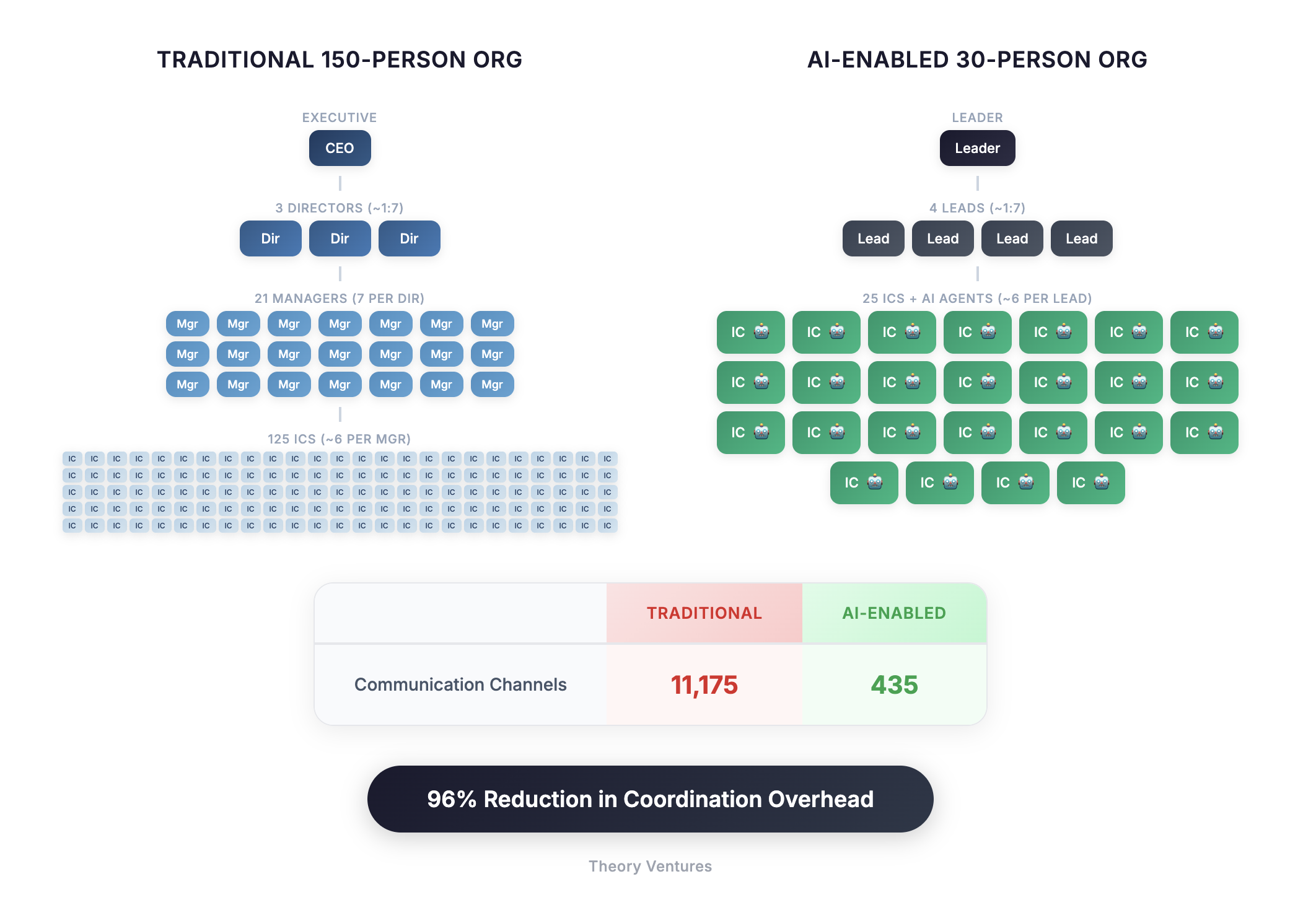
Борис Черни, создатель Claude Code, выпускает 20-30 пул-реквестов в день, запуская параллельно пять AI-инстансов, тогда как у обычного инженера показатель — 3 PR в неделю, то есть разница в производительности достигает 30 раз. Этот разрыв масштабируется на уровне компаний: Anthropic генерирует около $5 млн выручки на сотрудника, Cursor — $3,3 млн, Midjourney — $2 млн, против $200-300 тыс. у традиционных SaaS-компаний. Автор объясняет это законом Меткалфа: с каждым новым сотрудником число коммуникационных каналов растёт нелинейно, и в традиционной организации из 150 человек получается 11 175 потенциальных связей. AI-команда, выдающая тот же результат при 30 сотрудниках, имеет всего 435 каналов — сокращение на 96%. Главное преимущество AI-native стартапов кроется именно в организационной структуре: меньше людей, меньше каналов, быстрее итерации. Дискуссия о норме управляемости смещается от вопроса «сколькими людьми может управлять менеджер?» к вопросу «сколькими AI-агентами может оркестрировать один человек?».
“Since last November, 100% of my code has been written by Claude Code. I have not manually edited a single line, shipping 10 to 30 PRs per day.”
Boris Cherny, creator of Claude Code, ships 20-30 pull requests per day. Major code changes, not typo fixes. He runs five parallel AI instances, each on a separate branch.1
Compare that to a traditional engineer : 3 PRs per week.2 Cherny isn’t 10% more productive. He’s 30x more productive.
That productivity gap compounds at the company level. Anthropic generates ~$5 million per employee.3 Cursor, $3.3 million. Midjourney, $2 million.4 Traditional SaaS considers $200-300k strong. A 10-20x difference.
One explanation : communication overhead. The math follows Metcalfe’s Law.5 Each new team member adds n-1 new connections. Coordination drag doesn’t grow linearly. It explodes.
Now consider what AI does to this equation.
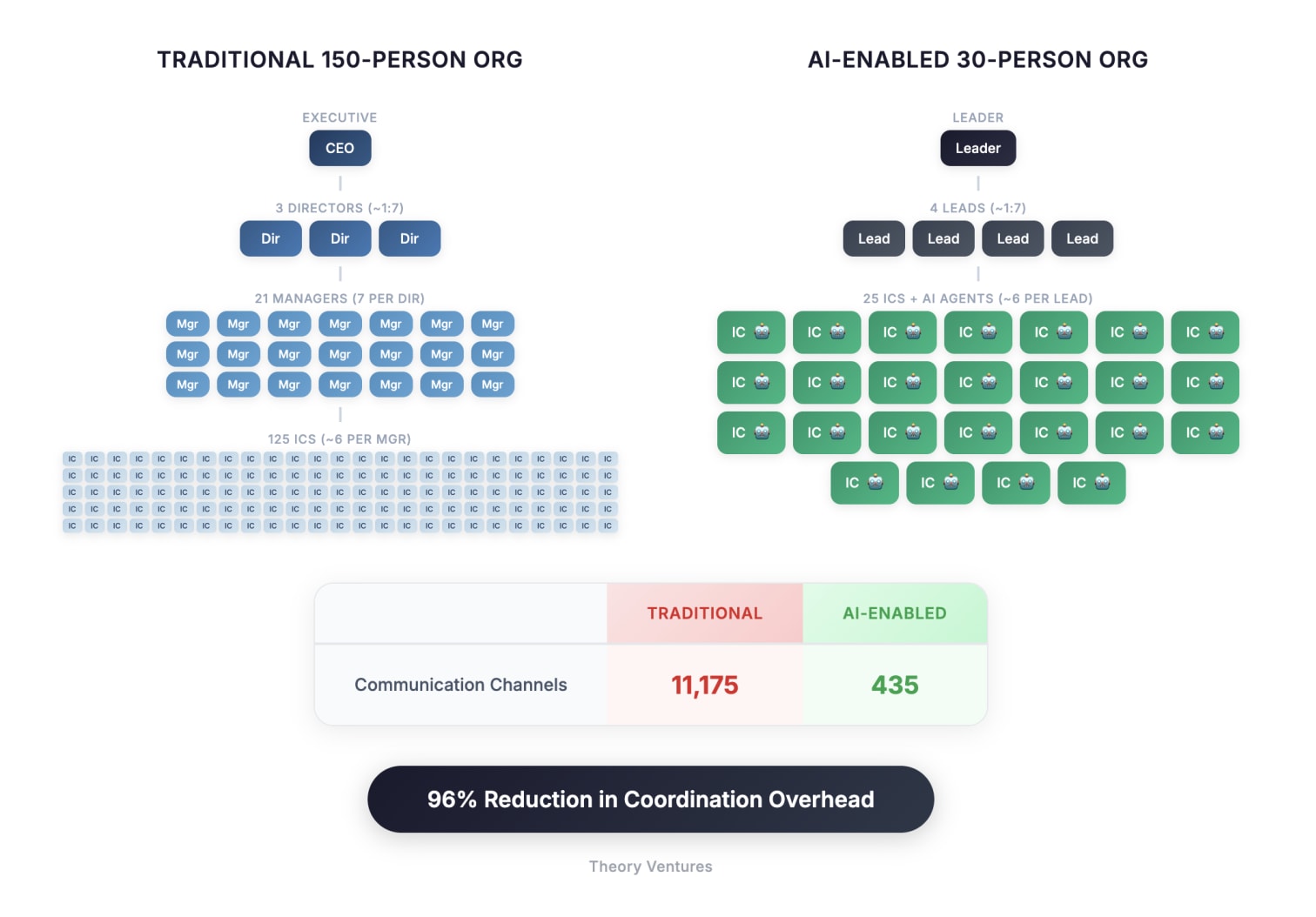
A traditional 150-person organization runs four layers deep. The org chart creates 11,175 potential communication channels. Meetings multiply. Alignment decays.
An AI-enabled team producing equivalent output might need 30 people. Communication channels drop to 435. A 96% reduction.
This is one reason AI-native startups are pulling ahead, and why building AI companies feels fun. The advantage comes from organizational structure. Fewer humans, fewer channels, faster iteration, compounding speed.6
R&D adopts this fastest. AI writes the code. Human communication becomes the bottleneck. The span of control debate shifts from “how many people can one manager oversee?” to “how many AI agents can one human orchestrate?”
Small teams have always paid less coordination tax. AI cuts it further.
Cherny, Boris. Claude Code creator landed 259 PRs in 30 days, Hacker News, 2025. ↩︎
Seporaitis, Julius. What Can 75,000 Pull Requests Tell?, 2021. Median developer opens 3 PRs per week; consistent with Google’s internal data. ↩︎
Estimated from Anthropic’s ~$20B revenue run rate (Bloomberg, March 2026) divided by ~4,300 employees (LinkedIn). ↩︎
Dealroom estimates. AI startups revenue per employee : Cursor $3.3M, Midjourney $2M, OpenAI $1.5M per employee. ↩︎
Metcalfe’s Law, Wikipedia. ↩︎
How to start a Lean, AI-Native Startup in 2025, Henry the 9th, 2025. ↩︎