
GitHub's plan for Agents — Kyle Daigle, GitHub
Кайл Дейгл, COO GitHub (а теперь и CMO по разработчикам в Microsoft), беседует со swyx о том, как ИИ меняет работу компании и всю экосистему разработки. Объём кода взрывообразно растёт: в 2026 году вклад агентов вырос на 1400%, число коммитов с одного миллиарда в 2025-м дошло до 275 миллионов в неделю (прогноз — 14 миллиардов за год), а число разработчиков на GitHub превысило 200 миллионов. Этот рост ломает инфраструктуру GitHub новыми способами — особенно слои прав доступа в базе MySQL One, Actions (нехватка CPU) и обработку огромных монорепозиториев, — что вызвало заметные публичные проблемы с аптаймом, которые компания устраняет через переход в Azure, шардирование (Vitess) и переписывание сервисов. Кайл рассказывает о внутренних ИИ-воркфлоу (микро-скиллы вместо мега-скиллов, WorkIQ, MCP, Slack, Teams, новое десктоп-приложение Copilot), о приобретениях npm, Semmle и Dependabot и о безопасности цепочки поставок, а также о том, что доверие к PR от агентов остаётся социальной проблемой. Обсуждаются будущее Copilot (единый SDK для CLI, десктопа и облачных агентов), ambient AI и OpenClaw, песочницы на уровне ОС в Windows и анонсы Microsoft Build, включая FoundryIQ. В финале Кайл советует спросить Сатью Наделлу, каким он видит мир через два-три года.
GitHub's plan for Agents — Kyle Daigle, GitHub
План GitHub по агентам — Kyle Daigle, GitHub
I’m excited to work with Microsoft once again as the presenting sponsors of the AI Engineer World’s Fair! We’ll streaming live from MS Build today for a special crossover pod with our friends at No Priors and the one and only Satya Nadella. However we did not hold back with this interview - we asked all the burning questions about uptime and Copilot that we know you have in your minds. Lets go!
Я в восторге снова работать с Microsoft в качестве титульного спонсора AI Engineer World's Fair! Сегодня мы ведём прямую трансляцию с MS Build — это специальный кроссовер-выпуск с нашими друзьями из No Priors и единственным и неповторимым Satya Nadella. Но в этом интервью мы не стали сдерживаться — мы задали все жгучие вопросы про аптайм и Copilot, которые, как мы знаем, вертятся у вас в голове. Поехали!
For almost two decades, GitHub has been the home of software, where both open source and closed flow, through commits, pull requests, reviews, actions, etc.
Почти два десятилетия GitHub остаётся домом для софта, где течёт и открытый, и закрытый код — через коммиты, pull request'ы, ревью, actions и так далее.
This ecosystem flourished as open-source maintainers and contributors would continue shipping code for the benefit of the community. However as coding agents began to ship mass quantities of code - growing 1400% in 2026, it marked a new era that was both extremely exciting and challenging for GitHub.
Эта экосистема процветала, потому что мейнтейнеры и контрибьюторы open-source продолжали выпускать код на благо сообщества. Однако когда кодинг-агенты начали выпускать код в огромных количествах — с ростом на 1400% в 2026 году — наступила новая эра, одновременно и крайне захватывающая, и сложная для GitHub.
While these agents help more people ship more projects, they also significantly increase the floor of how much code is shipped, how often it is shipped, how many people commit code, and basically orders of magnitude multiples in every dimension of GitHub infrastructure:
Хотя эти агенты помогают большему числу людей выпускать больше проектов, они также значительно поднимают нижнюю планку того, сколько кода выпускается, как часто он выпускается, сколько людей коммитят код — и фактически дают рост на порядки во всех измерениях инфраструктуры GitHub:
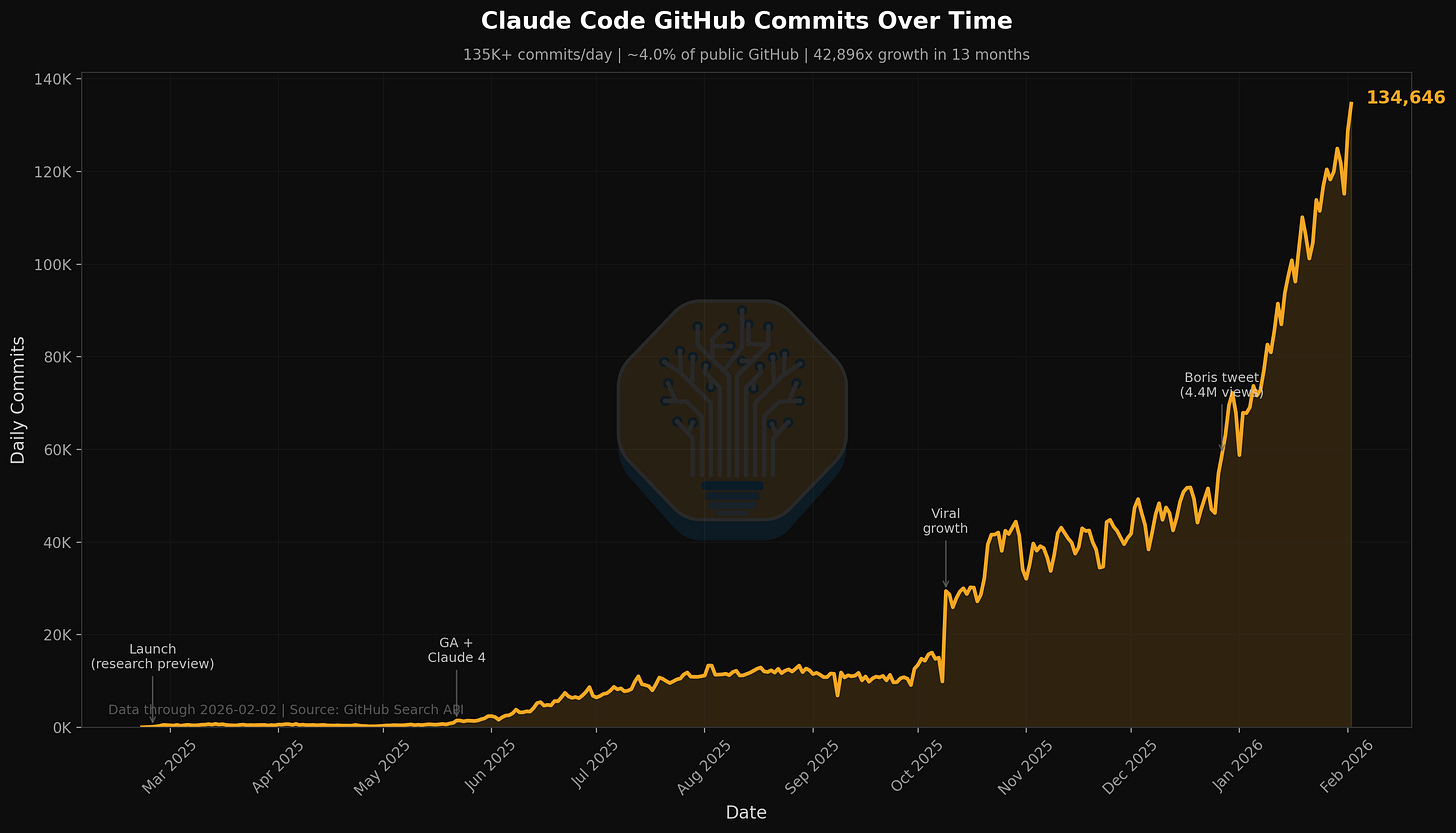
Now GitHub inevitably experiences more pressure on their infrastructure which was originally designed around human developers moving at human speed. This has resulted in a very publicly notable uptime story:
Теперь GitHub неизбежно испытывает большую нагрузку на свою инфраструктуру, которая изначально проектировалась под разработчиков-людей, движущихся с человеческой скоростью. Это вылилось в очень заметную публично историю с аптаймом:
So it begs the question of whether current systems around code can absorb what AI produces. Can CI/CD keep up when every idea becomes a build? Can open source maintainers survive floods of AI-generated slop contributions? Can GitHub preserve the human social contract of software while becoming the operating layer for agents?
Так что напрашивается вопрос: способны ли нынешние системы вокруг кода переварить то, что производит ИИ? Сможет ли CI/CD поспевать, когда каждая идея превращается в сборку? Переживут ли мейнтейнеры open-source потоки ИИ-генерированного мусора в контрибуциях? Сможет ли GitHub сохранить человеческий социальный контракт софта, став при этом операционным слоем для агентов?
Which brings us to the perfect person to answer these questions: GitHub COO Kyle Daigle. In this episode, he joins swyx to unpack what happens when AI doesn’t just autocomplete code, but starts changing how companies operate, how open source works, how pull requests get reviewed, and how GitHub itself has to scale.
Что подводит нас к идеальному человеку, способному ответить на эти вопросы: COO GitHub Kyle Daigle. В этом выпуске он присоединяется к swyx, чтобы разобрать, что происходит, когда ИИ не просто автодополняет код, а начинает менять то, как работают компании, как устроен open-source, как ревьюятся pull request'ы и как самому GitHub приходится масштабироваться.
We go deep on GitHub’s internal AI workflows: micro-skills, WorkIQ, MCP, Slack, Teams, email, Copilot workflows, the new Copilot desktop app, CLI, cloud agents, and how Kyle uses agents to look backwards across company context before deciding what to do next. Kyle also reflects on GitHub’s history building webhooks, APIs, Actions, npm, Dependabot, and Semmle, why the AI era is breaking GitHub in new ways, how Actions became a general-purpose compute layer, and what Copilot becomes after code completion.
Мы глубоко погружаемся во внутренние ИИ-воркфлоу GitHub: микро-скиллы, WorkIQ, MCP, Slack, Teams, email, воркфлоу Copilot, новое десктоп-приложение Copilot, CLI, облачные агенты — и то, как Кайл использует агентов, чтобы оглянуться назад на весь контекст компании, прежде чем решить, что делать дальше. Кайл также вспоминает историю GitHub — построение webhooks, API, Actions, npm, Dependabot и Semmle — почему эра ИИ ломает GitHub новыми способами, как Actions стали универсальным вычислительным слоем и чем становится Copilot после автодополнения кода.
Full Video Pod
Полное видео-подкаст
We discuss:
Мы обсуждаем:
Kyle’s expanded role across GitHub
How AI got Kyle coding again after years in leadership
Why GitHub rolls out AI through existing workflows instead of forcing new tools
WorkIQ, MCP, Slack, Teams, email, and GitHub as company context
Why massive “mega-skills” are giving way to small, atomic micro-skills
How AI changes summarization, communications, marketing, and analyst work
Why former developers in leadership may have a unique advantage in the AI era
Kyle’s “15 agents on Saturday” workflow
How Kyle built an AI-generated executive presentation for CRO/CFO teams
Why AI changes the chief of staff role without removing the human work
GitHub Actions, webhooks, arbitrary code execution, and secure agent compute
The npm acquisition, supply-chain security, 2FA, and token invalidation
Slop forks, vendoring, and whether AI agents change dependency management
What pull requests become when most PRs come from agents
Prompt requests, vouching, AI review, and trust in open source
What counts as a “developer” when AI lowers the barrier to building
GitHub Spark, low-code, and why GitHub refuses to hide the code
14x commit growth, Actions load, databases, monorepos, and availability
Copilot’s evolution from completion to CLI, desktop app, cloud agents, and SDK
Context, memory, rules, and making GitHub “act like Kyle wants it to act”
Ambient AI, OpenClaw, enterprise security, and the new operating system for agents
What swyx should ask Satya Nadella about Microsoft’s AI future
Расширенную роль Кайла в GitHubКак ИИ снова вернул Кайла к написанию кода после многих лет в руководствеПочему GitHub внедряет ИИ через существующие воркфлоу, а не навязывает новые инструментыWorkIQ, MCP, Slack, Teams, email и GitHub как контекст компанииПочему массивные «мега-скиллы» уступают место маленьким, атомарным микро-скилламКак ИИ меняет суммаризацию, коммуникации, маркетинг и работу аналитиковПочему у бывших разработчиков в руководстве может быть уникальное преимущество в эпоху ИИВоркфлоу Кайла «15 агентов в субботу»Как Кайл построил ИИ-генерированную презентацию для руководства для команд CRO/CFOПочему ИИ меняет роль chief of staff, не убирая человеческую работуGitHub Actions, webhooks, выполнение произвольного кода и безопасные вычисления для агентовПриобретение npm, безопасность цепочки поставок, 2FA и инвалидация токеновSlop-форки, вендоринг и меняют ли ИИ-агенты управление зависимостямиЧем становятся pull request'ы, когда большинство PR приходит от агентовPrompt request'ы, поручительство, ИИ-ревью и доверие в open-sourceЧто считается «разработчиком», когда ИИ снижает порог входа в создание софтаGitHub Spark, low-code и почему GitHub отказывается прятать код14-кратный рост коммитов, нагрузка на Actions, базы данных, монорепозитории и доступностьЭволюция Copilot от автодополнения к CLI, десктоп-приложению, облачным агентам и SDKКонтекст, память, правила и то, как заставить GitHub «вести себя так, как хочет Кайл»Ambient AI, OpenClaw, корпоративная безопасность и новая операционная система для агентовЧто swyx стоит спросить у Satya Nadella про будущее ИИ в Microsoft
Kyle Daigle
Kyle Daigle
LinkedIn: https://www.linkedin.com/in/kyledaigle
LinkedIn: https://www.linkedin.com/in/kyledaigleX: https://x.com/kdaigle
Timestamps
Тайм-коды
00:00:00 Introduction
00:00:00 Вступление
00:03:36 Why AI Got Kyle Coding Again
00:03:36 Почему ИИ снова вернул Кайла к коду
00:07:04 Running GitHub with AI: WorkIQ, MCP, Slack, Teams, and Skills
00:07:04 Управление GitHub с помощью ИИ: WorkIQ, MCP, Slack, Teams и скиллы
00:15:39 The Golden Age for Former Developers in Leadership
00:15:39 Золотой век для бывших разработчиков в руководстве
00:17:31 15 Agents on Saturday and AI-Generated Executive Work
00:17:31 15 агентов в субботу и ИИ-генерированная работа для руководства
00:20:20 How AI Changes the Chief of Staff Role
00:20:20 Как ИИ меняет роль chief of staff
00:21:45 GitHub’s History: Actions, npm, Webhooks, and Open Source
00:21:45 История GitHub: Actions, npm, webhooks и open-source
00:28:45 Slop Forks, Vendoring, and AI Dependency Management
00:28:45 Slop-форки, вендоринг и ИИ-управление зависимостями
00:33:57 Pull Requests, Prompt Requests, and Trust in Agent-Generated Code
00:33:57 Pull request'ы, prompt request'ы и доверие к коду, сгенерированному агентами
00:41:21 GitHub Stars, 200M+ Developers, and the New AI Builder Wave
00:41:21 Звёзды GitHub, 200M+ разработчиков и новая волна ИИ-билдеров
00:45:15 GitHub Spark, Low-Code, and Why GitHub Still Shows the Code
00:45:15 GitHub Spark, low-code и почему GitHub всё ещё показывает код
00:47:38 GitHub’s Hardest Era: 14x Growth, Reliability, and Scale
00:47:38 Самая трудная эра GitHub: 14-кратный рост, надёжность и масштаб
00:59:21 Actions as the Compute Layer for CI/CD and Automation
00:59:21 Actions как вычислительный слой для CI/CD и автоматизации
01:02:04 The State and Future of GitHub Copilot
01:02:04 Состояние и будущее GitHub Copilot
01:08:24 Ambient AI, Background Agents, and the Future of the SDLC
01:08:24 Ambient AI, фоновые агенты и будущее SDLC
01:13:09 OpenClaw, Enterprise Security, and the New OS for Agents
01:13:09 OpenClaw, корпоративная безопасность и новая ОС для агентов
01:18:03 Build Announcements, WorkIQ, FoundryIQ, and Microsoft Context
01:18:03 Анонсы Build, WorkIQ, FoundryIQ и контекст Microsoft
01:21:41 What Should swyx Ask Satya?
01:21:41 О чём swyx стоит спросить Сатью?
Transcript
Транскрипт
Introduction: Kyle Daigle’s Expanded Role at GitHub and Microsoft
Вступление: расширенная роль Kyle Daigle в GitHub и Microsoft
Swyx [00:00:00]: We’re here with Kyle Daigle, COO of GitHub. Welcome.
Swyx [00:00:00]: С нами Kyle Daigle, COO GitHub. Добро пожаловать.
Kyle [00:00:07]: Hey, thanks for having me.
Kyle [00:00:07]: Привет, спасибо, что позвали.
Swyx [00:00:08]: You’re not just CEO of GitHub. People know you as that. You have a new role.
Swyx [00:00:08]: Ты ведь не просто CEO GitHub. Люди знают тебя именно так. У тебя новая роль.
Kyle [00:00:11]: So I have an expanded role now. I’ve been working at GitHub for thirteen years and doing all things developer. Joined as a developer myself. And now, I’m also responsible as the CMO of Developer for Microsoft. And so all the kind of learnings and passion for developers and how we work with them and how we communicate and how we bring our products to market, we’re also bringing that expertise to the broader Microsoft ecosystem and helping every developer that uses a Microsoft product or would like to have a sort of similar experience that they’ve had with GitHub over the years. So it’s a different role in some ways, but it’s also just building on the experience that I’ve had at GitHub of just sort of tell the truth, be authentic, show people how to use it and then let the products speak for themselves. Now just doing that with, all of Microsoft.
Kyle [00:00:11]: Так вот, теперь у меня расширенная роль. Я работаю в GitHub тринадцать лет и занимался всем, что касается разработчиков. Пришёл сам как разработчик. А теперь я ещё и отвечаю как CMO по разработчикам в Microsoft. И все накопленные знания и страсть к разработчикам — как мы с ними работаем, как коммуницируем, как выводим продукты на рынок — мы теперь приносим этот опыт в более широкую экосистему Microsoft, помогая каждому разработчику, который пользуется продуктом Microsoft или хотел бы получить опыт, похожий на тот, что был у них с GitHub все эти годы. Так что в каком-то смысле это другая роль, но при этом она просто строится на опыте, который у меня был в GitHub: говорить правду, быть аутентичным, показывать людям, как этим пользоваться, а дальше пусть продукты говорят сами за себя. Только теперь делаю это со всем Microsoft.
Swyx [00:01:09]: We’ll be releasing this in conjunction with Build. You got lots of stuff planned, and we can sort of touch on that whenever it’s appropriate. I think one of the interesting things is I rarely meet a COO who’s also a CMO. I think you’re a very outward facing and you’re very confident publicly. That’s rare. Do you actually view yourself as COO? What’s What is your thing?
Swyx [00:01:09]: Мы выпустим это вместе с Build. У тебя много чего запланировано, и мы можем коснуться этого, когда будет уместно. Думаю, одна из интересных вещей в том, что я редко встречаю COO, который ещё и CMO. Кажется, ты очень обращён вовне и очень уверенно держишься публично. Это редкость. Ты сам-то считаешь себя COO? В чём твоя суть?
From GitHub Developer to COO/CMO: Building the Platform and Operating GitHub
От разработчика GitHub до COO/CMO: построение платформы и управление GitHub
Kyle [00:01:33]: I think for me, it’s been funny. The titles have always been, a— have always felt a little strange to me. I joined GitHub as a developer? I wrote so much of the
Kyle [00:01:33]: Думаю, для меня это было забавно. Титулы всегда казались... всегда казались мне немного странными. Я пришёл в GitHub разработчиком? Я написал так много того, что...
Swyx [00:01:46]: Let’s bring that up. You wrote the back ends?
Swyx [00:01:46]: Давай об этом. Ты писал бэкенды?
Kyle [00:01:48]: I was going through, I was going through, some old photos, when folks were talking about how things were being built or how there was a build GitHub. I built, webhooks and worked with teams building the API, built the platform layer. Anything that integrated with GitHub, up until really twenty eighteen, I built or ran the engineering teams. And that’s kind of where my the beginning of my passion always was helping people build things, deliver them to, their customers. And so being a developer, building for developers was always super unique. In a— I think as my role expanded, it became my ability to talk to not just developers, but also enterprise customers or business leaders and have this translation layer. And then through all those years, GitHub has always operated pretty uniquely. Post-pandemic, working remotely was not as novel as it was when GitHub started in two thousand and eight. But all that expertise of running remote teams, doing it well, became this sort of bigger role, ultimately turning into the COO role of how do we operate GitHub in the way that GitHub’s always operated after the Microsoft acquisition. And kind of so on from there. So like for me, I think the— I’ve, I still code. I love coding but the problem has always been, people. It’s a much harder problem to both support our own employees, a harder problem to communicate to developers and enterprise buyers what we’re building why it matters, ‘cause those are two very different messages. And so getting to work in the mix of COO, CMO, also just being a dev, I think is what’s kept me at GitHub for so long.
Kyle [00:01:48]: Я тут пересматривал старые фотографии, когда люди обсуждали, как что-то строилось или как был построен GitHub. Я строил webhooks, работал с командами над API, построил слой платформы. Всё, что интегрировалось с GitHub, вплоть где-то до 2018 года, я строил или руководил инженерными командами. И вот тут, в общем, и было начало моей страсти — помогать людям строить вещи, доставлять их своим клиентам. Так что быть разработчиком, строить для разработчиков всегда было чем-то совершенно уникальным. По мере того как моя роль расширялась, это превратилось в способность говорить не только с разработчиками, но и с корпоративными клиентами или бизнес-лидерами и быть таким переводческим слоем. А ещё все эти годы GitHub всегда работал довольно уникально. После пандемии удалённая работа была уже не такой в новинку, как когда GitHub только начинал в 2008-м. Но весь этот опыт управления удалёнными командами, причём хорошего управления, превратился в более крупную роль, в итоге вылившуюся в роль COO: как нам управлять GitHub так, как GitHub всегда управлялся, уже после приобретения Microsoft. И дальше в том же духе. Так что для меня... я всё ещё пишу код. Я обожаю код, но проблемой всегда были люди. Это гораздо более трудная задача — и поддерживать собственных сотрудников, и доносить до разработчиков и корпоративных покупателей, что мы строим и почему это важно, потому что это два очень разных сообщения. И возможность работать на стыке COO, CMO, а ещё и быть просто разработчиком — думаю, именно это и удерживало меня в GitHub так долго.
AI Workflows for Leadership: Commits, Retrospectives, and Context
ИИ-воркфлоу для руководства: коммиты, ретроспективы и контекст
Swyx [00:03:40]: Apparently, you have— your commits have gone up. What’s this? What’s going on?
Swyx [00:03:40]: По всей видимости, у тебя выросло число коммитов. Что это? Что происходит?
Kyle [00:03:45]: Rui’s called me out pretty aggressively. So I think— as you can imagine, right, you can see my normal era of being a dev In the twenty thirteen, twenty fourteen era, and then moving into management, and then ultimately the COO role. I think what you see there is me, really getting back to coding thanks to AI. I— similar to, attaching problems between how to market and how to operate a business and how to code, I find, building agents and workflows that are connecting very disparate problems to be what’s driving this. So that’s, some of it’s writing software. A lot of it is, connecting a ton of a different data sources to, help me out. But that is completely me really diving in on the AI side in trying out our tools, trying out everyone’s tools, But building for me, building for the non-technical leader, though I’m technical and how we’re, able to use these tools more than just the simple, call and response that I think a lot of the non-technical, your employers, you have to get— you have to use AI, and so everyone uses, ChatGPT or Copilot or Claude or whatever. To really get into, how is this going to help me out, it— I find that it’s not the I need to write a blog post, I need to those simple examples. Helping people find the workflows of, “Okay, I need you to go through all the PRs today. I need you to go through everything that we’ve posted online. I need you to go through what we did the last three months. Go through all of my Obsidian notes for any mentions of this then go through my transcripts at work.” We use, Teams, so, using WorkIQ, go call that MCP server, grab all the transcripts, go through all the Slack, and then build me out the plan of, what this week’s messaging actually was. That’s something that was, impossible because for me, I find AI in a what most of this launch here is actually, less building forward. It’s actually, a recursive loop backwards. I’m always looking at what had happened first. Go back through the week and tell me what we did, what worked, what didn’t work? And then tell me in the next three or four days-What would you tweak based on this sort of like looking backwards and then looking ahead a little bit? I find that to be so much more valuable, especially for like non-technical, because that retrospection is actually LLMs are very good at that. Like finding all the patterns, pulling them out, and then applying that retrospection to just a couple of days or just like a short period of time. Is all a bunch of apps that I’ve built and launched a bunch of, internal tools. I use the new, GitHub Copilot app, the desktop app with workflows. Every time I crack open my laptop, it’s running workflows for me. It’s just a ton of different stuff and of course, it all ends up on, it all ends up on GitHub.
Kyle [00:03:45]: Rui довольно жёстко меня на этом подловил. Так что, как ты можешь себе представить, можно увидеть мою обычную эпоху разработчика в районе 2013–2014, потом переход в менеджмент, а потом и роль COO. И то, что ты там видишь — это я, реально возвращающийся к коду благодаря ИИ. Мне, как и при состыковке задач между тем, как маркетировать, как управлять бизнесом и как писать код, нравится строить агентов и воркфлоу, которые соединяют очень разрозненные задачи — вот что мной движет. Так что отчасти это написание софта. Но в значительной мере это соединение кучи разных источников данных, чтобы помочь мне. Но это полностью я, реально нырнувший в ИИ — пробую наши инструменты, пробую инструменты всех остальных. Но строю для себя, строю для нетехнического лидера — хоть я и технарь — и для того, как мы можем использовать эти инструменты больше, чем как простой «запрос-ответ», который, мне кажется, у многих нетехнических... ваши работодатели говорят: вы должны пользоваться ИИ, и все пользуются ChatGPT, или Copilot, или Claude, или чем угодно. Чтобы реально дойти до того, как это мне поможет, я обнаружил, что дело не в «мне нужно написать пост в блог», не в этих простых примерах. Помогать людям находить воркфлоу типа: «Окей, мне нужно, чтобы ты прошёлся по всем PR за сегодня. Мне нужно, чтобы ты прошёлся по всему, что мы запостили онлайн. Мне нужно, чтобы ты прошёлся по тому, что мы делали последние три месяца. Пройдись по всем моим заметкам в Obsidian на упоминания этого, потом пройдись по моим рабочим транскриптам». Мы используем Teams, так что — используя WorkIQ, вызови вон тот MCP-сервер, собери все транскрипты, пройдись по всему Slack, и потом построй мне план: каким на самом деле было сообщение этой недели. Это было раньше невозможно, потому что для меня ИИ — большая часть этого запуска на самом деле менее про «строить вперёд». Это скорее рекурсивный цикл назад. Я всегда сначала смотрю на то, что уже произошло. Вернись назад по неделе и расскажи мне, что мы сделали, что сработало, что не сработало. А потом скажи мне на следующие три-четыре дня — что бы ты подправил, исходя из этого взгляда назад, а затем небольшого взгляда вперёд? Мне это кажется куда более ценным, особенно для нетехнических людей, потому что эта ретроспекция — на самом деле LLM в ней очень хороши. Находить все паттерны, вытаскивать их, а потом применять эту ретроспекцию к буквально паре дней или короткому отрезку времени. Это всё куча приложений, которые я построил, и куча внутренних инструментов, которые я запустил. Я использую новое приложение GitHub Copilot, десктоп-приложение с воркфлоу. Каждый раз, когда я открываю ноутбук, оно прогоняет для меня воркфлоу. Это просто куча разных штук — и, конечно, всё это в итоге оказывается на GitHub.
Swyx [00:06:47]: Of course. That’s where, that’s where, stuff is hosted. Man, there’s so much to ask you. I was going to leave the how do you run a company with AI thing at the end. I have to ask one— double click one thing. You said, you are looking back at the week. You’re, you’re understanding what happens. When you say we That’s three thousand people. How?
Swyx [00:06:47]: Конечно. Это там, где всё хостится. Слушай, столько хочется тебя спросить. Я собирался оставить тему «как управлять компанией с помощью ИИ» на конец. Но я обязан уточнить одну вещь. Ты сказал, что смотришь назад на неделю. Ты понимаешь, что происходит. Когда ты говоришь «мы» — это три тысячи человек. Как?
Rolling Out AI Internally: Skills, CLIs, and Company Context
Внутреннее внедрение ИИ: скиллы, CLI и контекст компании
Kyle [00:07:09]: I think when we started rolling out AI internally beyond engineering, right? One of the things that I was really, passionate about is like we have to do this in a way where no one has to change how they work. I don’t want to have to teach you a tool. I don’t want to have to teach you something new. And so for us, we tried out a few tools. Most of them don’t work because I got to get you on board? I got to teach you how to use it. What we’ve actually ended up doing is we’ve built like a set of skills internally. We have we each have our set of skills, and we’ve just been distributing even to the non-technical folks, the CLI. And then effectively, we’re just giving it access to like read about everything that we’re writing. So that’s for us, that’s usually GitHub, Teams, Email, and Slack. So Teams for, video chat, generally speaking.
Kyle [00:07:09]: Думаю, когда мы начали внедрять ИИ внутри за пределами инженерии — одна из вещей, которой я был по-настоящему увлечён, в том, что мы должны делать это так, чтобы никому не приходилось менять то, как он работает. Я не хочу учить тебя инструменту. Я не хочу учить тебя чему-то новому. И поэтому мы попробовали несколько инструментов. Большинство из них не работают, потому что мне надо тебя завести? Мне надо научить тебя ими пользоваться. А по факту мы пришли к тому, что построили внутри набор скиллов. У каждого из нас свой набор скиллов, и мы просто раздаём — даже нетехническим людям — CLI. И по сути мы просто даём ему доступ читать обо всём, что мы пишем. Для нас это обычно GitHub, Teams, email и Slack. То есть Teams — для видеочата, как правило.
Swyx [00:08:03]: Teams and Slack?
Swyx [00:08:03]: Teams и Slack?
Kyle [00:08:04]: so we use Teams for video communication, but we don’t use it for chat. W-we— GitHub for a long history, right? We’re always
Kyle [00:08:04]: Так вот, мы используем Teams для видеообщения, но не для чата. Мы... GitHub давно, верно? Мы всегда...
Swyx [00:08:13]: Also Slack
Swyx [00:08:13]: Ещё и Slack
Kyle [00:08:14]: Talking about ChatOps and like everything is built into Slack. Like every command, every flow.
Kyle [00:08:14]: Говорим про ChatOps — и типа всё встроено в Slack. Каждая команда, каждый флоу.
Swyx [00:08:18]: So even though you have been acquired for I don’t know, eight years now
Swyx [00:08:18]: То есть, хотя вас приобрели уже, не знаю, восемь лет назад...
Kyle [00:08:22]: we still
Kyle [00:08:22]: мы всё ещё...
Swyx [00:08:23]: You still use Slack?
Swyx [00:08:23]: Вы всё ещё используете Slack?
Kyle [00:08:23]: it’s a purpose-built tool for us, and I think the reality is that moving off of it would be so bluntly expensive? Simply because all the tooling is, baked in with that paradigm. And they both have their pros and cons but they don’t work the same way at all. We still use a bunch of different tools Because it’s the purpose-built tools that We need. And then
Kyle [00:08:23]: это специально заточенный под нас инструмент, и я думаю, что реальность в том, что уйти с него было бы настолько прямо-таки дорого? Просто потому, что весь тулинг встроен в эту парадигму. У них обоих есть свои плюсы и минусы, но работают они совершенно по-разному. Мы по-прежнему используем кучу разных инструментов, потому что это специально заточенные инструменты, которые нам нужны. А потом...
Swyx [00:08:47]: Well, the same doesn’t go for the rest of Microsoft, presumably.
Swyx [00:08:47]: Ну, для остального Microsoft, надо полагать, это не так.
Kyle [00:08:50]: like the like various teams like operate
Kyle [00:08:50]: типа разные команды работают...
Swyx [00:08:53]: They make their own decisions
Swyx [00:08:53]: Они сами принимают решения
Kyle [00:08:54]: Various ways. I think it just matters what you’re trying to what you’re trying to do. But we do we do work across kind of every tool that we use, and then by giving everyone access to all of that context and the new WorkIQ MCP server, which is quite cool if you do live in the M365 like world. I can ask it all these backwards-facing questions, and it’s incredibly important for our teams that are working remotely. There’s a lot of stuff you miss when you’re not in an office, and we are spread out all over the world. So most of that is looking back. And then we post, we post either auto-automatically into GitHub issues or discussions, these sorts of like findings or like our industry reports. Like what’s happening this morning, today, yesterday. A little automation gets run. We’ll use the app. We might use GitHub Actions like with, our agentic workflows just to go do that run, and then we push it into GitHub, and w-we keep having a conversation. So usually for us, it’s about that sort of like looking back, looking forward on the non-technical side. And then of course for a lot of those folks, it’s also building an app, pushing it to GitHub pages or pushing it somewhere to host it et cetera. But it’s just like enabling everyone with that power of it’s going to take me a week to figure this out. Instead, we’re going “Okay I built a skill. Let’s put it into a repo. We’ll all share that skill together, and then we’ll use the CLI or now the app-” “just to run it.”
Kyle [00:08:54]: По-разному. Думаю, всё зависит от того, что ты пытаешься сделать. Но мы работаем практически с каждым инструментом, который используем, и затем, давая всем доступ ко всему этому контексту и новому MCP-серверу WorkIQ — который, кстати, весьма крут, если ты живёшь в мире M365 — я могу задавать ему все эти вопросы, обращённые назад, и для наших команд, работающих удалённо, это невероятно важно. Очень многое упускаешь, когда ты не в офисе, а мы разбросаны по всему миру. Так что большая часть этого — взгляд назад. А потом мы постим — либо автоматически в GitHub Issues или Discussions — такие находки или наши отраслевые отчёты. Что происходит сегодня утром, сегодня, вчера. Запускается небольшая автоматизация. Мы можем использовать приложение. Можем использовать GitHub Actions с нашими агентными воркфлоу, просто чтобы прогнать этот ран, а потом запихиваем это в GitHub, и мы продолжаем разговор. Так что обычно для нас это про этот взгляд назад, взгляд вперёд на нетехнической стороне. А для многих из этих людей это ещё и построить приложение, запушить его на GitHub Pages или захостить где-то ещё и так далее. Но это просто наделение каждого этой силой: вот это займёт у меня неделю, чтобы разобраться. Вместо этого мы говорим: «Окей, я построил скилл. Давайте положим его в репо. Мы все будем делиться этим скиллом вместе, а потом будем использовать CLI или теперь приложение — просто чтобы его запустить».
Micro Skills vs. Mega Skills: How GitHub Uses AI at Work
Микро-скиллы против мега-скиллов: как GitHub использует ИИ в работе
Swyx [00:10:26]: All right. I think, I think we’re going straight into like the team management and productivity thing. I think a lot of people are getting various levels of LLM psychosis. How do you manage the bloat of skills? Like everyone Has their thing, and they’re Like trying to promote it to the rest of their peers in their org, right? And obviously, whoever becomes a skill influencer internally becomes like an AI leader, right? Of sorts. I assume you have those.
Swyx [00:10:26]: Ладно. Думаю, мы прямо переходим к теме управления командой и продуктивности. Мне кажется, у многих людей развиваются разные степени LLM-психоза. Как ты справляешься с разрастанием скиллов? Типа у каждого есть своё, и каждый пытается продвинуть это остальным коллегам в своей орге, верно? И очевидно, кто становится скилл-инфлюенсером внутри, становится этаким ИИ-лидером, верно? Своего рода. Полагаю, у вас такие есть.
Kyle [00:10:50]: like I think we have
Kyle [00:10:50]: типа, думаю, у нас есть...
Swyx [00:10:52]: And I assume it’s a mess a Yeah.
Swyx [00:10:52]: И полагаю, это бардак, а, да.
Kyle [00:10:54]: there’s like I— like I think the reality is there’s two pieces. Like first is I think that we’re ending the era of these like massive, beautiful, perfect skills that are just like not any of those things. ‘cause for a while, right every tweet every day is like go download the skills, the perfectly managed thing to do this entire workflow. And I think that like what we’ve found and what— I was just with my team, this week, and we were talking about the skill side, and we’re really talking about these like incredibly micro skills that are just doing one thing for us very well Versus a skill that’s going to do I said, that full report. That doesn’t really exist on our side anymore. It’s usually how do— like a single skill that’s going to identify the most important marketing information given any MCP server. Like this is the most important thing. Less about stitch a bunch of tools together and have it produce this mega output because then weeks go by, months go by, things change, and you want to tweak
Kyle [00:10:54]: там, типа... думаю, реальность в том, что есть две части. Первая — я думаю, что мы заканчиваем эру этих массивных, прекрасных, идеальных скиллов, которые на деле не являются ни одним из этих эпитетов. Потому что какое-то время в каждом твите каждый день было «скачайте скиллы, идеально отлаженную штуку, чтобы сделать вот этот целый воркфлоу». И я думаю, что то, что мы обнаружили — я как раз был со своей командой на этой неделе, и мы говорили про сторону скиллов — мы реально говорим про эти невероятно микро-скиллы, которые делают для нас одну вещь очень хорошо, в противовес скиллу, который сделает вот тот полный отчёт. У нас такого, по сути, больше не существует. Обычно это — как единичный скилл, который выявит самую важную маркетинговую информацию из любого MCP-сервера. Типа: вот самое важное. Меньше про «сшей кучу инструментов вместе и пусть оно выдаст этот мега-результат», потому что проходят недели, проходят месяцы, всё меняется, и ты хочешь подправить...
Swyx [00:11:58]: It’s brittle
Swyx [00:11:58]: Это хрупко
Kyle [00:11:58]: Your mega skill and you’re screwed? You can’t do that. And so now we’re really just talking about the Legos we’re using and just letting the instruction book be something we’re all putting together. Whereas I think a lot of AI skills for a while have been that mega instruction book style.
Kyle [00:11:58]: Свой мега-скилл, и ты попал? Так нельзя. И поэтому теперь мы реально говорим про детальки Lego, которые мы используем, и просто позволяем инструкции к сборке быть чем-то, что мы все собираем вместе. Тогда как, я думаю, многие ИИ-скиллы какое-то время были в этом стиле мега-инструкции.
Swyx [00:12:15]: I’ve, thought a lot about Postel’s law. I don’t know if that’s a term that is, means things to folks. It’s the idea that you should be liberal in what you accept and strict in what you output, right? And I think that’s like a good framing principle for skills. This is my skills, obviously on GitHub. I feel like everyone should have like how like some repos In GitHub are special repos? I feel like we should sort of reify the slash skills and everyone like give it some kind of special presentation. Anyway, so, yeah, this is one of those like download Download anything, transcribe anything, and then you can string together the atomic skills that do one thing well Into like some kind of orchestration skill that calls other skills. I assume, does that match?
Swyx [00:12:15]: Я много думал про закон Постела. Не знаю, говорит ли этот термин что-то людям. Это идея, что нужно быть либеральным в том, что принимаешь, и строгим в том, что выдаёшь, верно? И мне кажется, это хороший принцип-рамка для скиллов. Это мои скиллы, очевидно, на GitHub. Мне кажется, у каждого должно быть... как некоторые репозитории в GitHub являются особыми репозиториями? Мне кажется, мы должны как-то материализовать слэш-скиллы и для каждого дать какое-то особое представление. В общем, да, это одна из тех штук типа «скачай что угодно, транскрибируй что угодно», а потом ты можешь сцепить атомарные скиллы, которые делают одну вещь хорошо, в какой-то оркестрирующий скилл, который вызывает другие скиллы. Полагаю — это совпадает?
Kyle [00:12:56]: I like I think so. I think that the
Kyle [00:12:56]: Думаю, да. Думаю, что...
Swyx [00:13:00]: Summarize anything.
Swyx [00:13:00]: Суммаризируй что угодно.
Kyle [00:13:01]: Like I think the- For me, summarizing something for I do communications and PR and analyst relations and marketing and customer activities, and so my summarize everything is very different for each one of those like Contexts. What ‘Cause if I’m summarizing something for an analyst, that’s a very different thing than, probably how I’m going to summarize something for like a customer meeting or an engagement. So that’s I think like the difference when we’re talking about the like the tools I might use on Saturday or the skills I might use on a Saturday when it’s just for Kyle. Yeah, those are kind of like they have an atomic actual tool underneath or maybe skill, and then Kyle cares about X. But I think when we’re talking about work and enabling the the marketers, communicators there, it’s the atomic, this is what good summarization is, and then this is what I care about as for marketing for communications For whatever. And that I think is like the interesting matrix problem when we go from like a developer set of concerns to all kinds of different professions, is that what that word means to me is different than it means to you is different than it means to the analyst or the salesperson, and that’s where I think the matrix mess is that we’re starting to like still starting to find. It’s about these mega skills but they’re all just slight permutations, but those permutations are really important. It’s the difference between someone reading this and going “Did AI make this?” what Or “This makes total sense, and I would expect this when I’m giving a briefing to Gartner,” or like whatever else.
Kyle [00:13:01]: Типа, думаю, для меня... суммаризировать что-то — я занимаюсь коммуникациями, PR, отношениями с аналитиками, маркетингом и работой с клиентами, и поэтому моё «суммаризируй всё» очень разное для каждого из этих контекстов. Потому что если я суммаризирую что-то для аналитика — это совсем другое, чем то, как я, скорее всего, буду суммаризировать что-то для встречи с клиентом или взаимодействия с ним. Вот в чём, думаю, разница, когда мы говорим про инструменты, которые я мог бы использовать в субботу, или скиллы, которые я мог бы использовать в субботу, когда это только для Кайла. Да, там как бы под капотом есть атомарный реальный инструмент или, может, скилл, а потом — Кайла волнует X. Но когда мы говорим про работу и наделение возможностями маркетологов, коммуникаторов, это атомарное «вот что такое хорошая суммаризация», а потом — «вот что меня волнует в маркетинге, в коммуникациях, в чём угодно». И вот это, думаю, та самая интересная матричная задача, когда мы переходим от набора забот разработчика ко всевозможным разным профессиям: то, что это слово значит для меня, отличается от того, что оно значит для тебя, отличается от того, что оно значит для аналитика или продажника, и вот тут, думаю, и есть тот матричный бардак, который мы только начинаем... всё ещё начинаем нащупывать. Это про эти мега-скиллы, но все они — лишь лёгкие пермутации, и эти пермутации реально важны. Это разница между тем, как кто-то читает это и думает «Это сделал ИИ?», и тем, «Это полностью имеет смысл, и я бы этого ожидал, когда даю брифинг Gartner» или что угодно ещё.
Swyx [00:14:37]: I think the beauty of it maybe is that you don’t have to be that careful about what goes in there. It doesn’t have to exactly fit as long as it like roughly is contained in there. I used to complain about plugin hell, basically. Like when you have a framework and then you have a hundred things that you need to integrate, everyone does like the GitHub used to be bloated full of these things. And now we don’t need them anymore ‘cause now you just use skills.
Swyx [00:14:37]: Думаю, прелесть этого, возможно, в том, что тебе не надо быть таким уж аккуратным с тем, что туда кладёшь. Оно не обязано идеально подходить, лишь бы примерно укладывалось туда. Я раньше жаловался на ад плагинов, по сути. Типа когда у тебя есть фреймворк, а потом сотня вещей, которые надо интегрировать, и каждый делает... GitHub раньше был раздут всеми этими штуками. А теперь они нам больше не нужны, потому что теперь ты просто используешь скиллы.
Former Developers in Leadership: AI as a Creation Multiplier
Бывшие разработчики в руководстве: ИИ как мультипликатор созидания
Kyle [00:15:00]: And like I think the most magical thing is the just that like I can just also crack it open. Like Like yes, I could go like change the how the plugin is coded, or like I could go do that now with AI, but I think there’s just something more magical about getting a response back and being “That’s not right,” and then you just crack the skill open, you just type English words and it’s different. That building block is just, I think very unique. Once I get everyone to kind of understand how to best how to best make those changes to get the most power out of them.
Kyle [00:15:00]: И, типа, думаю, самое волшебное — это просто то, что я могу ещё и просто взять и вскрыть это. Типа да, я мог бы пойти и изменить, как закодирован плагин, или мог бы сделать это теперь с ИИ, но, думаю, есть что-то более волшебное в том, чтобы получить ответ и сказать «Это неправильно», а потом ты просто вскрываешь скилл, просто печатаешь слова на английском — и оно другое. Этот строительный блок просто, думаю, очень уникален. Как только я заставлю всех более-менее понять, как лучше всего вносить эти изменения, чтобы выжать из них максимум силы.
Swyx [00:15:36]: Is there a— you have a your peer group that Of people like you. Is there a common framing for Something I’m feeling is, which is true, is that is this a golden age for former developers who are now in leadership? Because you can wield the tools, you would know the right words, you’re maybe not too close to the details. Doesn’t matter. But like you’re more effective than someone who doesn’t come from that background.
Swyx [00:15:36]: Есть ли... у тебя есть круг равных тебе людей. Есть ли общая рамка для... Кое-что я чувствую, и это правда, — это золотой ли это век для бывших разработчиков, которые теперь в руководстве? Потому что ты можешь владеть инструментами, ты знаешь правильные слова, ты, может, не слишком погружён в детали. Неважно. Но ты эффективнее того, у кого нет такого бэкграунда.
Kyle [00:15:59]: I think that like the secret has always been your ability to identify patterns and solve problems, and I think that for folks that like myself that don’t code day to day anymore, that has made me successful as a developer, made me successful as a COO and now CMO. And so now that I have access to get and write code, I’m now applying that sort of like pattern finding and problem solving, and I know enough still about how to then go and say, “Oh, I want to make an app, but I don’t want to break into jail or create something that’s not going to be able to work or to be deployed scale or whatever.” that ability to apply all that additional business knowledge and still code I think is what makes that so interesting to me. Slightly different than I think some of the other like technical leaders that became business leaders and now are going back to their apps and updating them. Good for them? But I think the more, much more interesting thing is, well, now I have this whole new set of expertise over ten plus years. Why not take that and use that as a developer with these AI tools? So I definitely think that makes me more powerful, but I think that’s true for like every dev as well. Most of the dev friends I still have also have some other underlying skill and passion. There’s really talented, very kind of linear computer science software devs, absolutely. I just find that the folks that came from a different career, went to school for something else, went off and did this random thing, and then became a software dev, or were a dev, did a random thing, came back. Learning that extra set of information, learning those extra skills, and now having the power of an AI where I can crank up fifteen agents on Saturday while my kids are doing lacrosse, That’s like really powerful. And I think it gets me back to that feeling of like creation, and it’s very hard to replicate that in most other senses? That first time you build an app and you click it and you show someone that’s magical. And so being able to do that not just in code, but across all kinds of different assets that’s, that’s huge. We were doing we’re doing our every year we do our revenue planning. We talk about okay, what is it going to look like for next year? And of course as you imagine, there’s, slideshows everywhere talking about what are we going to talk about, what’s the narrative, et cetera. And so as you said I’m “Okay, well, I could probably just like build something to build this and then that way I don’t have to go build the whole spreadsheet or I have to pass it to my team.” So we went through this process, and I got all the information and used the skills I mentioned. I built like a little app just to make it so I could look at some of the information in a SQLite database, more easily. And I ultimately built this entire presentation without touching any of it and I was “Okay, I’m just going to present this to our CRO, the CFO, their teams,” without mentioning I’d built it with AI. I like built a skill to make it look very much not AI driven. Just not pretty.
Kyle [00:15:59]: Думаю, что секрет всегда был в твоей способности выявлять паттерны и решать проблемы, и я думаю, что для людей вроде меня, которые больше не пишут код день за днём, это сделало меня успешным как разработчика, сделало успешным как COO, а теперь и CMO. И вот теперь, когда у меня есть доступ получать и писать код, я применяю этот навык выявления паттернов и решения проблем, и я ещё достаточно знаю о том, как затем пойти и сказать: «О, я хочу сделать приложение, но я не хочу взломать систему или создать что-то, что не сможет работать, развернуться в масштабе или что угодно». Эта способность применить все эти дополнительные бизнес-знания и при этом писать код — вот что делает это для меня таким интересным. Слегка иначе, чем, думаю, у некоторых других технических лидеров, которые стали бизнес-лидерами и теперь возвращаются к своим приложениям и обновляют их. Молодцы они? Но, думаю, гораздо интереснее вот что: ну вот, теперь у меня есть целый новый набор экспертизы за десять с лишним лет. Почему бы не взять это и не использовать как разработчику с этими ИИ-инструментами? Так что я точно думаю, что это делает меня сильнее, но думаю, это верно и для каждого разработчика тоже. У большинства моих друзей-разработчиков, которые у меня ещё есть, тоже есть какой-то другой подспудный навык и страсть. Есть реально талантливые, очень такие линейные специалисты по computer science. Просто я обнаруживаю, что люди, пришедшие из другой карьеры, отучившиеся на что-то другое, ушедшие и поделавшие какую-то случайную штуку, а потом ставшие разработчиками — или были разработчиками, поделали случайную штуку, вернулись. Освоить этот дополнительный набор информации, освоить эти дополнительные навыки, и теперь иметь силу ИИ, где я могу раскрутить пятнадцать агентов в субботу, пока мои дети играют в лакросс — это реально мощно. И, думаю, это возвращает меня к тому чувству созидания, и это очень трудно воспроизвести в большинстве других смыслов? Тот первый раз, когда ты строишь приложение, кликаешь по нему и показываешь кому-то — это волшебно. И возможность делать это не только в коде, но и в самых разных активах — это, это огромно. Мы как раз делали... мы делаем наше ежегодное планирование выручки. Мы обсуждаем: окей, как это будет выглядеть в следующем году? И, как ты понимаешь, повсюду слайды о том, о чём мы будем говорить, какой нарратив и так далее. И вот, как ты сказал, я думаю: «Окей, ну я, наверное, могу просто построить что-то, что построит это, и тогда мне не придётся строить всю таблицу или передавать это команде». Так что мы прошли через этот процесс, я собрал всю информацию и использовал те скиллы, что упомянул. Я построил маленькое приложение просто чтобы можно было легче смотреть на часть информации в базе SQLite. И в итоге я построил всю эту презентацию, не касаясь её руками, и я такой: «Окей, я просто представлю это нашему CRO, CFO, их командам» — не упоминая, что построил это с ИИ. Я построил скилл, чтобы оно выглядело очень даже не ИИ-шным. Просто не красивым.
AI-Generated Presentations, Human Taste, and the Changing Chief of Staff Role
ИИ-генерированные презентации, человеческий вкус и меняющаяся роль chief of staff
Swyx [00:19:03]: Like a design. Yeah.
Swyx [00:19:03]: Типа дизайн. Да.
Kyle [00:19:03]: Not pretty. But just like very clearly not AI. Kind of like don’t do anything interesting.
Kyle [00:19:03]: Не красивым. Но просто очень явно не ИИ-шным. Типа не делать ничего интересного.
Swyx [00:19:08]: That’s, yeah, that is valuable.
Swyx [00:19:08]: Это, да, это ценно.
Kyle [00:19:08]: Just go Exactly. We did the whole thing through. It used my notes from Obsidian, it used all the context I mentioned before, the plans, and Never came up once that it was AI generated.
Kyle [00:19:08]: Просто давай — именно. Мы сделали всё это насквозь. Оно использовало мои заметки из Obsidian, использовало весь контекст, который я упоминал ранее, планы, и ни разу не всплыло, что это сгенерировано ИИ.
Swyx [00:19:20]: It didn’t matter.
Swyx [00:19:20]: Это не имело значения.
Kyle [00:19:20]: Never once. D It didn’t matter. And so now I take
Kyle [00:19:20]: Ни разу. Это не имело значения. И вот теперь я беру...
Swyx [00:19:23]: This is a tool
Swyx [00:19:23]: Это инструмент
Kyle [00:19:23]: I can take that tool and go, “Look, I don’t want you to go build slideshows.” They’re just helping us share information with each other. If this thing can do it With a little bit of crafting from you and then we can look at it together, awesome. There’s no value in all that extra work. I think that the ability to, make it look humanly bad and and build a little app to, manipulate the data I think is part of, that upside for devs that are now in leadership roles. Because, the thing that I feel like I said before, this that’s all a people, that’s all a people problem. I know if you’ve used a coworker or not to build a slide deck, unless you spent a bunch of time to not do it.
Kyle [00:19:23]: Я могу взять этот инструмент и сказать: «Слушайте, я не хочу, чтобы вы шли и строили слайды». Они просто помогают нам делиться информацией друг с другом. Если эта штука может это сделать — с небольшой огранкой от тебя, а потом мы можем вместе на это посмотреть — отлично. Нет смысла во всей этой лишней работе. Думаю, способность сделать так, чтобы оно выглядело по-человечески плохо, и построить маленькое приложение, чтобы манипулировать данными — это часть того преимущества для разработчиков, которые теперь на руководящих ролях. Потому что та штука, о которой я говорил раньше — это всё проблема людей. Я понимаю, использовал ты коллегу для постройки слайд-дека или нет, если только ты не потратил кучу времени, чтобы этого не делать.
Swyx [00:20:07]: I know, but like it was so, I think there’s a certain charm to just being blatantly AI. ‘Cause I think that you’re well, you’re just honest about There may be mistakes here that I cannot vouch for. So how much value is there? But anyway I think, actually the real question I want to ask is, there’s a— You were a chief of staff To Thomas. And in the pre-AI world, the that job would’ve been a chief of staff job of like Can you prep me these slides and all that? And now you do it yourself.
Swyx [00:20:07]: Знаю, но это было так... думаю, есть определённое обаяние в том, чтобы быть откровенно ИИ-шным. Потому что думаю, что ты... ну, ты просто честен в том, что здесь могут быть ошибки, за которые я не могу поручиться. Так какова ценность? Но в любом случае, думаю, реальный вопрос, который я хочу задать: ты был chief of staff у Thomas. И в до-ИИ мире эта работа была бы работой chief of staff типа «можешь подготовить мне эти слайды и всё такое?». А теперь ты делаешь это сам.
Kyle [00:20:35]: I still, I still have a chief of staff. Because, the difference is it’s sort of the discussion every time we have some sort of technology evolution is it’s not that the jobs the roles don’t all go away, they just change? And so yeah, I don’t have someone spending all their time building out slides for me and presentations ‘cause I don’t need that anymore. But now I need that person that is able to go and find all the different connections between humans in those discussions to help me find out, okay, I should be meeting with this group and this team, and they have an opportunity, and I’m going to be in San Francisco today, I’m going to be in Seattle tomorrow. Those sorts of human connection aspects are still incredibly valuable and has always been a big part of that chief of staff role. But now just like chiefs of staff are not opening up, letters to process, they’re doing emails. What It’s the same thing. And now they’re, they’re not building out as many of these presentations because they have the the ability to have a AI take it on for, and share that with me and great. Let’s keep moving ‘cause it’s allowing us to go faster and make better decisions more quickly.
Kyle [00:20:35]: У меня всё ещё, у меня всё ещё есть chief of staff. Потому что разница в том, что это, по сути, тот разговор, который у нас бывает каждый раз при какой-то технологической эволюции: дело не в том, что роли все исчезают, они просто меняются. И да, у меня нет человека, который тратит всё своё время на построение слайдов и презентаций для меня, потому что мне это больше не нужно. Но теперь мне нужен тот человек, который способен пойти и найти все разные связи между людьми в этих обсуждениях, чтобы помочь мне выяснить: окей, мне стоит встретиться с этой группой и этой командой, у них есть возможность, и я сегодня буду в Сан-Франциско, завтра буду в Сиэтле. Эти аспекты человеческих связей по-прежнему невероятно ценны и всегда были большой частью роли chief of staff. Но теперь, как и chiefs of staff больше не вскрывают письма, чтобы их обработать, они работают с email. Это то же самое. И теперь они не строят так много этих презентаций, потому что у них есть возможность дать ИИ взять это на себя, поделиться этим со мной, и отлично. Давайте двигаться дальше, потому что это позволяет нам двигаться быстрее и принимать лучшие решения быстрее.
Swyx [00:21:45]: Awesome. Well, so we can dive into more sort of, Productivity insights as you go. I did want to do a little bit of a brief history of colleague and hub. Because, we started here. And then you also involved the NPM acquisition. I did, I do want to touch upon that. And then more recently, I just want to bring up to present day where we’re having uptime issues Which transparently we’ve already Addressed publicly, but we’ll, we’ll discuss in the pod. Did I miss anything? Like what, any other major highlights? Obviously, it’s, it’s a lot of years to cover.
Swyx [00:21:45]: Класс. Так вот, мы можем погружаться в более продуктивностные инсайты по ходу. Я хотел немного пройтись по краткой истории GitHub. Потому что мы начали отсюда. А ещё ты был причастен к приобретению npm. Я хочу этого коснуться. А потом, уже ближе к настоящему дню, я просто хочу поднять тему, где у нас проблемы с аптаймом — которые, если честно, мы уже публично решили, но обсудим в подкасте. Я ничего не упустил? Типа, какие-то ещё крупные хайлайты? Очевидно, это очень много лет, чтобы охватить.
A Brief History of GitHub: Webhooks, Actions, Acquisitions, and Platform Evolution
Краткая история GitHub: webhooks, Actions, приобретения и эволюция платформы
Kyle [00:22:15]: No the I think one of one highlight was right before the acquisition closed in twenty eighteen, I got to launch the first version of Actions
Kyle [00:22:15]: Нет, думаю, один из хайлайтов был прямо перед закрытием сделки в 2018-м — мне довелось запустить первую версию Actions
Swyx [00:22:27]: Oh
Swyx [00:22:27]: О
Kyle [00:22:27]: At GitHub Universe. So it was O
Kyle [00:22:27]: На GitHub Universe. Так что это было...
Swyx [00:22:29]: They’re that young?
Swyx [00:22:29]: Они настолько молодые?
Kyle [00:22:30]: It was October of twenty eighteen, I think. Yeah. Yeah.
Kyle [00:22:30]: Это был октябрь 2018-го, кажется. Да. Да.
Swyx [00:22:33]: Gee, Jesus.
Swyx [00:22:33]: Боже, Господи.
Kyle [00:22:34]: I got to I was the engineering leader on that project and got to launch that. And then, yeah, we did acquisitions of NPM you said, Semmle, Dependabot Pul Panda a whole bunch of things. That was a big
Kyle [00:22:34]: Мне довелось... я был инженерным руководителем на том проекте и мне довелось его запустить. А потом, да, мы сделали приобретения npm, как ты сказал, Semmle, Dependabot, Pull Panda — кучу всего. Это было крупно
Swyx [00:22:47]: Pul Panda.
Swyx [00:22:47]: Pull Panda.
Kyle [00:22:48]: Abi is doing well.
Kyle [00:22:48]: Abi отлично справляется.
Swyx [00:22:51]: DX. Holy crap.
Swyx [00:22:51]: DX. С ума сойти.
Kyle [00:22:52]: Did well on DX. I and like that was a that was the big shift, after the acquisition. I had to join the sort of business side.
Kyle [00:22:52]: Хорошо справился с DX. И, типа, это был тот большой сдвиг после приобретения. Мне пришлось присоединиться к бизнес-стороне.
Swyx [00:23:00]: So I need to hit you on some of these things ‘cause you were there. Right? And how often do I get to talk to someone who was there? But yeah, Actions. Is that the number one source of security issues on GitHub?
Swyx [00:23:00]: Так мне нужно зацепить тебя по нескольким из этих вещей, потому что ты был там. Верно? И как часто мне удаётся поговорить с кем-то, кто был там? Но да, Actions. Это источник проблем с безопасностью номер один на GitHub?
Kyle [00:23:11]: Oh, sh I think that the number one source of, security issues is probably like all, the literal code in everyone’s like underlying repositories. I would say back further than that is, if you remember I had to show in this graph was this is, I’m, didn’t say this before, this is ultimately webhooks.
Kyle [00:23:11]: О, чё... думаю, источник проблем с безопасностью номер один — это, наверное, весь буквальный код в подлежащих репозиториях у всех. Сказал бы, ещё дальше назад — если помнишь, я показывал на этом графике, это, я этого не сказал раньше, это в итоге webhooks.
Swyx [00:23:30]: You yeah.
Swyx [00:23:30]: Ты, да.
Kyle [00:23:31]: Like circa whatever it was.
Kyle [00:23:31]: Типа примерно тогда, когда бы это ни было.
Swyx [00:23:32]: It says Hookshot in there.
Swyx [00:23:32]: Там написано Hookshot.
Kyle [00:23:32]: I forget. Yeah. Yeah, Hookshot’s in there. And so like back then, it says GitHub Services. Do you see, it says Hookshot FE for front end, and then it says GitHub Services. GitHub Services back in the old days, right? You we had a repository that was Ruby code, and you could write any Ruby code in there, and then we would execute that On your behalf As a service, and then that way if an if you were trying to integrate with something, it didn’t we would run it for you.
Kyle [00:23:32]: Я забыл. Да. Да, Hookshot там есть. И, типа, тогда там написано GitHub Services. Видишь, написано Hookshot FE — front end, а потом написано GitHub Services. GitHub Services в старые добрые времена, верно? У нас был репозиторий с кодом на Ruby, и ты мог написать там любой Ruby-код, а мы потом исполняли этот код от твоего имени как сервис, и таким образом, если ты пытался с чем-то интегрироваться, мы запускали это за тебя.
Swyx [00:23:57]: And of course no containers ‘cause
Swyx [00:23:57]: И, конечно, без контейнеров, потому что...
Kyle [00:23:58]: No, ‘cause it was
Kyle [00:23:58]: Нет, потому что это был...
Swyx [00:23:59]: Well, no containers
Swyx [00:23:59]: Ну, без контейнеров
Kyle [00:24:00]: Twenty fourteen. And so there was some isolation obviously, but it was mostly the separations on the server level. That’s like an example as long as the very old version of Pages, which ran on its own containerization infrastructure, not on Actions.
Kyle [00:24:00]: 2014 год. И поэтому какая-то изоляция, очевидно, была, но в основном разделение было на уровне сервера. Это как пример... как очень старая версия Pages, которая работала на собственной контейнеризационной инфраструктуре, не на Actions.
Swyx [00:24:15]: Which like all-time great product.
Swyx [00:24:15]: Что, типа, продукт всех времён.
Kyle [00:24:16]: Pages powers the internet at this point to some degree. Those were places where like clearly there were no like issues like to my knowledge. But it was those things where I’m looking at and going “Okay, well we can’t be running arbitrary Ruby code,” like on everyone’s behalf. Then containerizing all of that up intoUh into actions now where yeah the containerization, is r-really good. The pinning most folks aren’t pinning it the like to a particular
Kyle [00:24:16]: Pages в какой-то степени питают интернет на данный момент. Это были места, где, типа, явно не было проблем, насколько мне известно. Но это были те вещи, где я смотрю и думаю: «Окей, ну мы не можем исполнять произвольный Ruby-код» от имени всех. Потом контейнеризировать всё это в Actions, где, да, контейнеризация реально хорошая. Пиннинг — большинство людей не пиннят его к конкретному...
Swyx [00:24:48]: Images
Swyx [00:24:48]: Образу
Kyle [00:24:48]: Sha, et cetera like their workflows, and so that’s a big that’s a big place Of pain for folks if they’re just doing similar to any dependency management, just V1 or newest or latest, I think. But, that journey from that day to “Okay, we’re just going to run all this arbitrary code, and, it’ll basically be okay,” to now, no, we have, really good containerization. We have a new, underlying, ag-agent, containerization, service. It’s like we’re using it under the hood. It’s through Azure. They recently announced it. The Azure, Dev Compute, but it’s, very fast, very fast compute to be able to, spin up your own cloud agents, or whatnot. We’re using it under the hood for some parts of the new,
Kyle [00:24:48]: SHA и так далее в своих воркфлоу, и вот это большое место боли для людей, если они просто делают, как и при любом управлении зависимостями, просто V1, или newest, или latest, думаю. Но этот путь от того дня — «Окей, мы просто будем запускать весь этот произвольный код, и в целом будет нормально» — к нынешнему «нет, у нас есть реально хорошая контейнеризация». У нас есть новый подлежащий контейнеризационный сервис для агентов. Мы используем его под капотом. Он через Azure. Они недавно его анонсировали. Azure Dev Compute — это очень быстрые, очень быстрые вычисления, чтобы можно было раскручивать собственные облачные агенты и тому подобное. Мы используем это под капотом для некоторых частей нового...
Swyx [00:25:36]: Microsoft Dev Box?
Swyx [00:25:36]: Microsoft Dev Box?
Kyle [00:25:37]: No. Dev Compute, yeah.
Kyle [00:25:37]: Нет. Dev Compute, да.
Swyx [00:25:41]: Hmm. Not finding it just yet.
Swyx [00:25:41]: Хм. Пока не нахожу.
Kyle [00:25:44]: Oh, it’s, it’s in there somewhere.
Kyle [00:25:44]: О, оно где-то там есть.
Swyx [00:25:46]: All right. Well, we’ll cut that out.
Swyx [00:25:46]: Ладно. Ну, мы это вырежем.
Kyle [00:25:47]: Sorry. But with, Dev Compute, you can, run, really fast, spin up really, small VMs really quickly, so you’re doing a tool call
Kyle [00:25:47]: Извини. Но с Dev Compute ты можешь очень быстро раскручивать очень маленькие VM, так что ты делаешь tool call...
Swyx [00:25:58]: Same concept
Swyx [00:25:58]: Та же концепция
Kyle [00:25:58]: Just do it containerize exact-exactly. So we’re using that so definitely moving that direction to protect us from every every piece of code that we’re ultimately running.
Kyle [00:25:58]: Просто делаешь это контейнеризированно — именно. Так что мы это используем, так что точно движемся в этом направлении, чтобы защитить нас от каждого куска кода, который мы в итоге запускаем.
Swyx [00:26:07]: look, that grows into the full SDLC? Code hosting was just the start and and then it’s grown beyond that. Let’s talk about NPM may-maybe ‘cause I think that’s also, a very major point in the industry. I do think, it was looking for a home. It was, kind of struggling as a business, right? I don’t know, I don’t know how you would characterize that whole acquisition and how it
Swyx [00:26:07]: Слушай, это перерастает в полный SDLC. Хостинг кода был лишь началом, а потом всё выросло за его пределы. Давай поговорим про npm, может, потому что, думаю, это тоже очень крупная веха в индустрии. Я думаю, оно искало дом. Оно как бы испытывало трудности как бизнес, верно? Не знаю, не знаю, как бы ты охарактеризовал всё это приобретение и как оно...
NPM, Package Security, and Keeping the Internet Running
npm, безопасность пакетов и поддержание работы интернета
Kyle [00:26:33]: like when we were talking to the team, I think the big thing for the both of us was to find a way to keep NPM, which was basically powering the internet then and way more so now to some degree running. Keep it going keep continuing to scale. It was having scaling problems, if I recall, back at that time. They were doing some rewrites. It
Kyle [00:26:33]: когда мы разговаривали с командой, думаю, главным для нас обоих было найти способ сохранить npm — который тогда, по сути, питал интернет, а сейчас в какой-то степени ещё больше — работающим. Поддержать его, продолжить масштабировать. У него были проблемы с масштабированием, если я правильно помню, в то время. Они делали какие-то переписывания. Это...
Swyx [00:27:00]: that’s cute compared to now.
Swyx [00:27:00]: это мило по сравнению с тем, что сейчас.
Kyle [00:27:01]: Well, that’s the thing is like when I’m talking to folks now, there’s there’s so many more underlying uses of NPM than there were back when we had them join in with GitHub. But that was ultimately the goal. It was really okay, we used to have pages. We have, the world’s code. Let’s make sure that we can keep NPM running well for the world. And we put a bunch of time and investment into fixing some of the underlying backend, changes, some of which we talked about some of the manifest work, et cetera. And then now, really trying to bring the the security posture of NPM up to speed. But, it is a unique challenge in that every move that we make to make it more secure will break a lot of people. And security is paramount. And also, we take it very seriously. We’re, the any time that we have a problem with GitHub or we make a change that makes us more secure but hurts, there’s, a snow day for developers or a really bad fire that they have to go put out. And so we’ve, have changed the 2FA policies. We’ve changed the way the tokens work. When we find tokens that have been exposed or potentially, exposed, we invalidate them, and
Kyle [00:27:01]: Ну, в этом и дело — когда я сейчас разговариваю с людьми, есть гораздо больше подлежащих применений npm, чем было тогда, когда они присоединились к GitHub. Но это и было конечной целью. Это было: окей, у нас раньше был Pages. У нас есть код всего мира. Давайте убедимся, что мы можем сохранить npm хорошо работающим для всего мира. И мы вложили кучу времени и инвестиций в починку части подлежащего бэкенда, изменений — часть из которых мы обсуждали, часть работы над манифестом и так далее. А теперь реально пытаемся подтянуть посадку безопасности npm. Но это уникальный вызов в том, что каждое наше движение, чтобы сделать его безопаснее, сломает кучу людей. И безопасность первостепенна. И ещё мы относимся к этому очень серьёзно. Каждый раз, когда у нас проблема с GitHub или мы делаем изменение, которое делает нас безопаснее, но вредит — это снежный день для разработчиков или реально серьёзный пожар, который им приходится тушить. И поэтому мы изменили политику 2FA. Мы изменили то, как работают токены. Когда мы находим токены, которые были скомпрометированы или потенциально скомпрометированы, мы их инвалидируем, и...
Swyx [00:28:22]: I love that feature in GitHub. Yeah, it’s great
Swyx [00:28:22]: Обожаю эту фичу в GitHub. Да, она классная
Kyle [00:28:23]: That creates issues, but, the but that’s the thing is we’re trying to push the community, forward without necessarily, doing something that is going to break the contract that’s been for 15 years or close to it or some amount of years on NPM.
Kyle [00:28:23]: Это создаёт проблемы, но в этом и дело — мы пытаемся двигать сообщество вперёд, не делая обязательно что-то, что сломает контракт, который держался 15 лет или около того, или какое-то количество лет на npm.
Slop Forks, Vendoring, and the Future of Open Source Supply Chains
Slop-форки, вендоринг и будущее цепочек поставок open-source
Swyx [00:28:43]: I think the— So now we’re talking about, open source and publishing. And I think there’s something here with what people are calling slop forks, which, I think Malta from Vercel is doing. And, part of me thinks, well, the way to get past any vulnerabilities, we just, let’s just get rid of the concept of NPM. And we only publish source code. And anytime you want to import it you have your coding agent look at it and then adapt whatever subset you’re going to use into your vendor it. But, the AI vendor it. Is that realistic? I don’t know. Is it— Will that solve all our security issues? I don’t know.
Swyx [00:28:43]: Думаю... так вот теперь мы говорим про open-source и публикацию. И думаю, тут есть что-то с тем, что люди называют slop-форками, которыми, кажется, занимается Malta из Vercel. И часть меня думает: ну, способ обойти любые уязвимости — давай просто избавимся от концепции npm. И мы публикуем только исходный код. И каждый раз, когда хочешь его импортировать, ты заставляешь своего кодинг-агента посмотреть на него, а потом адаптировать любое подмножество, которое собираешься использовать, в свой вендоринг. Но ИИ это вендорит. Это реалистично? Не знаю. Решит ли это все наши проблемы с безопасностью? Не знаю.
Kyle [00:29:24]: I don’t think it’ll solve I so Mitchell was just talking Mitchell Hashimoto Was just talking about this today, and I think that I-in some ways, it’s all all things, old or new again? Yeah, absolutely vendoring everything. Like I do I do remember twenty thirteen, twenty fourteen.
Kyle [00:29:24]: Не думаю, что это решит... Так вот, Mitchell как раз об этом говорил — Mitchell Hashimoto как раз об этом сегодня говорил, и я думаю, что в каком-то смысле это всё «старое или новое снова»? Да, абсолютно, вендорить всё. Я-то помню 2013, 2014 годы.
Swyx [00:29:42]: This is Yeah. Let’s, we must return to
Swyx [00:29:42]: Это да. Давай, мы должны вернуться к...
Kyle [00:29:43]: That’s what is We were vendoring everything. We were having actual discussions around, or at least I remember we were “Should we take this full thing?” “Why is this so big? We only need this one file.” And so I do think there’s something true there where having either taking only what you need or the dependencies just getting incredibly small over time, I think will help to some degree, but it’s not going to solve the fundamental problem, I don’t think, because the vulnerabilities in an agent looking at them, there’s time and time again, there’s a million different ways in which we can convince an agent that this thing is, secure or not and pull it in. Or we can do static code analysis or runtime testing to say whether the code works or not. That is, I think, the step that needs to continue to be, invested in. The question is just on, how much scope. Should it be this enormous project that I’m pulling down, or should it be this piece? Either most companies are running some amount of security checking on the on the packages that they’re bringing in or vendoring. That I think won’t change. That’s like what advanced security does to some degree, Socket does some degree. Like everyone is doing a piece of that. How we each do that like especially when we’re talking to enterprise customers, is just like very different. No there’s no one wants one single way to do it. And I think that’s always been GitHub’s, unique position in the world. I talk a lot to maintainers, I talk a lot to folks about this. It’s we’re— we rarely start like a process and a practice and like push it onto the community. We usually wait for the sort of like RFC process socially or literally, everyone agreeing, and then we’ll cement something in. Because otherwise we’re
Kyle [00:29:43]: Вот это... мы вендорили всё. У нас были реальные обсуждения вокруг — ну, по крайней мере, я помню, мы — «Должны ли мы взять эту целую штуку?» «Почему это так велико? Нам нужен только этот один файл». И поэтому я думаю, что тут есть что-то верное: брать только то, что тебе нужно, или зависимости просто становятся невероятно маленькими со временем — думаю, это в какой-то степени поможет, но это не решит фундаментальную проблему, не думаю, потому что уязвимости — агент, смотрящий на них... раз за разом, есть миллион разных способов, которыми мы можем убедить агента, что эта штука безопасна или нет, и подтянуть её. Или мы можем делать статический анализ кода или ран-тайм-тестирование, чтобы сказать, работает код или нет. Вот это, думаю, тот шаг, в который нужно продолжать инвестировать. Вопрос лишь в том, какой охват. Должно ли это быть вот этим огромным проектом, который я скачиваю, или это должен быть вот этот кусочек? В любом случае, большинство компаний прогоняют какое-то количество проверок безопасности по пакетам, которые подтягивают или вендорят. Это, думаю, не изменится. Это типа того, что в какой-то степени делает advanced security, что в какой-то степени делает Socket. Типа все делают кусочек этого. То, как каждый из нас это делает — особенно когда мы говорим с корпоративными клиентами — просто очень разное. Никто не хочет один-единственный способ это делать. И думаю, это всегда было уникальной позицией GitHub в мире. Я много общаюсь с мейнтейнерами, много общаюсь с людьми об этом. Это... мы редко начинаем процесс и практику и проталкиваем её на сообщество. Мы обычно ждём этакого процесса RFC — социального или буквального — все соглашаются, а потом мы что-то цементируем. Потому что иначе мы...
Maintainers, RFCs, Vouching, and the Social Layer of Trust
Мейнтейнеры, RFC, поручительство и социальный слой доверия
Swyx [00:31:35]: That fits your role in the ecosystem, yeah
Swyx [00:31:35]: Это соответствует твоей роли в экосистеме, да
Kyle [00:31:36]: We’re GitHub. Yeah, we don’t want to shape the whole thing. We want it to be figured out. But like how do you balance that like sort of Role in the industry to keep everything as secure as is possible and make sure that you’re you’re not going to be compromised as a human, ‘cause that’s usually how it all happens. And Not not create a process or lock us into a flow that you’re not going to or like Mitchell’s not going to or other open source projects aren’t going to like. That’s always been a tricky balance for us, and I think that’s something that we haven’t talked about enough is we’re not going to be able to fix everything for everyone in a way that everyone is going to like. So tell, help us, tell us what is working. When Mitchell was talking about, the Upvote, the up
Kyle [00:31:36]: Мы — GitHub. Да, мы не хотим формировать всё целиком. Мы хотим, чтобы это было осмыслено. Но как сбалансировать эту роль в индустрии, чтобы держать всё настолько безопасным, насколько возможно, и при этом убедиться, что ты не будешь скомпрометирован как человек — потому что обычно именно так всё и происходит. И не создать процесс или не запереть нас во флоу, которому ты не будешь следовать, или Mitchell не будет, или другие open-source-проекты не будут. Это всегда был хитрый баланс для нас, и думаю, мы недостаточно об этом говорили: мы не сможем починить всё для всех так, чтобы всем это понравилось. Так что скажите, помогите нам, скажите нам, что работает. Когда Mitchell говорил про upvote, про ап...
Swyx [00:32:22]: I was going to bring up his thing. Yeah.
Swyx [00:32:22]: Я как раз собирался поднять его штуку. Да.
Kyle [00:32:23]: I forget what it Yeah. When he’s talking to us, I was chatting with him and talking to him about this and I put it on Twitter and we talked to, also over DM, was “We’re going to keep working.” but I think the important thing is I do actually want to hear what isn’t working for you. And as, be as specific and clear for your project as is possible. And to every piece of credit over the many years that we’ve known each other through the industry, he’s always done that and I appreciate that ‘cause there are places that we need to fix up, and we hear from him, and we’ll fix up just like we do all other kinds of maintainers. But that that process between making those types of improvements and being more secure and like creating, I forget what he calls it’s not the proof process, not the claims process. Do what I’m talking about? He has that he his projects have a way for you to kind of like,
Kyle [00:32:23]: Я забыл, как это... Да. Когда он с нами говорил, я с ним переписывался и говорил про это, я выложил это в Twitter, и мы говорили, ещё и в личке: «Мы продолжим работать». Но, думаю, важно, что я реально хочу услышать, что у тебя не работает. И быть как можно конкретнее и яснее для своего проекта. И, отдавая всё должное за все эти годы, что мы знакомы по индустрии, он всегда это делал, и я это ценю, потому что есть места, которые нам нужно подлатать, и мы слышим от него, и мы подлатаем — так же, как делаем для всех остальных мейнтейнеров. Но этот процесс между внесением таких улучшений, повышением безопасности и созданием — я забыл, как он это называет, это не proof-процесс, не claims-процесс. Понимаешь, о чём я? У него есть... его проекты имеют способ как бы...
Swyx [00:33:13]: Vouch
Swyx [00:33:13]: Поручиться (vouch)
Kyle [00:33:13]: Vouch. Thank you. Yeah. He has like the vouch system for saying, “Hey, you should accept my PRs.” That’s been
Kyle [00:33:13]: Vouch. Спасибо. Да. У него есть система поручительства, чтобы сказать: «Эй, тебе стоит принимать мои PR». Это было...
Swyx [00:33:20]: I just built this into GitHub. I don’t know.
Swyx [00:33:20]: Я только что встроил это в GitHub. Ну не знаю.
Kyle [00:33:22]: Well, see, but that’s the thing is that you say that and like he and his community really likes this and then I’ll go talk to other maintainers and other maintainers, globally, and they’re “No, this doesn’t work for me.” And that is the tension, but also the kind of beauty of GitHub, depending on which way you look at it is we want to help maintainers, so we create all these tools to let you have more control over how much you take in from AI and PRs. But you can also use this. What You can go use this project, and if it takes off and becomes the kind of mostly standard, then yeah, we probably wouldn’t enforce it but we would add it in because that’s the flow that we tend to do?
Kyle [00:33:22]: Ну вот, в этом и дело — ты это говоришь, и, типа, ему и его сообществу это реально нравится, а потом я пойду поговорю с другими мейнтейнерами по всему миру, и они скажут: «Нет, мне это не подходит». И вот в этом напряжение, но ещё и своего рода прелесть GitHub, в зависимости от того, как смотреть: мы хотим помочь мейнтейнерам, поэтому создаём все эти инструменты, чтобы дать тебе больше контроля над тем, сколько ты принимаешь от ИИ и PR. Но ты можешь и просто использовать это. Можешь пойти и использовать этот проект, и если он взлетит и станет более-менее стандартом, тогда да, мы, вероятно, не будем это навязывать, но мы добавим это, потому что таков флоу, к которому мы склоняемся.
Swyx [00:34:02]: I hear a lot of people don’t know the history of the pull request. And like like that’s how, that’s something that GitHub standardized basically.
Swyx [00:34:02]: Я слышу, что многие люди не знают историю pull request'а. И типа того, как GitHub, по сути, его стандартизировал.
Kyle [00:34:08]: Yeah. It was a very messy process Like beforehand, and now the we have the benefit of it being the process? And now we have to go and Figure out the next best process or what adaptations change, or what does a pull request look like when eighty percent of your PRs are just coming from your agents and not From other devs?
Kyle [00:34:08]: Да. До этого это был очень грязный процесс, а теперь у нас есть преимущество, что это и есть процесс. И теперь нам надо пойти и придумать следующий лучший процесс, или какие адаптации меняются, или как выглядит pull request, когда восемьдесят процентов твоих PR просто приходят от твоих агентов, а не от других разработчиков?
Swyx [00:34:31]: Do you like the prompt request idea from Peter?
Swyx [00:34:31]: Тебе нравится идея prompt request от Peter?
Kyle [00:34:34]: like I think that for each like each idea I think has its merits. I’m not, I’m not avoiding saying anything good or bad, but I feel like I’ve seen a version of we have that we have entire Thomas’ store. Take all the assets of what you’ve built and put that in. I think that’s got great ideas. There’s all these various permutations of the PR flow, but I think the reason why there’s not a single answer is ultimately we’re trying to codify trust. We’re trying to say “Okay, if Sean reviews this I’m going to trust it because you’re Sean or you’re the senior dev or you’re the whatever.” And right now, when we are working in a flow where an agent writes code and another agent reviews code and then Kyle goes and looks at it the trust is kind of diffuse. And most of the tools that we’re talking about are talking more about verification flows. We have more assets to look at, so I can probably say whether this is a good PR or not. But that still doesn’t solve, I think, the human problem of I’m looking at a PR and I want to know if I can trust it. And we’re still, we still tend to use human signals for that? Mitchell approving it or Kyle approving it or whatever. And so I think that’s, I think that’s why most of these options haven’t really solved it is because, it’s a social problem ultimately. It’s a it’s a human problem to review it and agree. Or you fully trust the tool and you’re imbuing that tool with full trust Which I think in some cases that absolutely exists.
Kyle [00:34:34]: типа, думаю, каждая идея имеет свои достоинства. Я не пытаюсь не сказать ничего хорошего или плохого, но мне кажется, я уже видел версию... у нас есть... у нас есть целый магазин Thomas. Возьми все активы того, что ты построил, и положи туда. Думаю, там отличные идеи. Есть все эти разные пермутации флоу PR, но думаю, причина, по которой нет единого ответа — в конечном счёте мы пытаемся кодифицировать доверие. Мы пытаемся сказать: «Окей, если Sean это отревьюил, я этому доверюсь, потому что ты — Sean, или ты — старший разработчик, или ты — кто угодно». А прямо сейчас, когда мы работаем во флоу, где агент пишет код, а другой агент ревьюит код, и потом Кайл идёт и смотрит — доверие как бы размыто. И большинство инструментов, о которых мы говорим, говорят скорее про флоу верификации. У нас больше активов, на которые можно посмотреть, так что я, вероятно, могу сказать, хороший это PR или нет. Но это всё равно не решает, думаю, человеческую проблему: я смотрю на PR и хочу знать, могу ли я ему доверять. И мы всё ещё, мы всё ещё склонны использовать для этого человеческие сигналы? Mitchell его одобряет, или Кайл его одобряет, или что угодно. И поэтому, думаю, именно поэтому большинство этих опций реально его не решили — потому что это в конечном счёте социальная проблема. Это человеческая проблема — отревьюить его и согласиться. Или ты полностью доверяешь инструменту и наделяешь этот инструмент полным доверием — что, думаю, в некоторых случаях абсолютно существует.
AI-Generated PRs, Trust, and the Waymo Analogy
ИИ-генерированные PR, доверие и аналогия с Waymo
Swyx [00:36:08]: And so like in the same way that there will be a tipping point in society when we don’t allow humans to drive anymore Because machines are measurably better than Than humans. I’m looking for that tipping point, right? Like Mythos is ridiculously expensive. Someday we’ll have Mythos on a desktop. I don’t know. Will, does that change the equation?
Swyx [00:36:08]: И вот, типа того же, как в обществе наступит переломная точка, когда мы больше не позволим людям водить, потому что машины измеримо лучше людей. Я ищу эту переломную точку, верно? Типа Mythos смехотворно дорогой. Когда-нибудь у нас будет Mythos на десктопе. Не знаю. Изменит ли это уравнение?
Kyle [00:36:30]: I think it’s more I took a Waymo here, and I was on my phone and not looking around at all. There are other, self-driving, vehicles that I would not trust while, staring at the road. And I think that trust is something that is
Kyle [00:36:30]: Думаю, это скорее... я приехал сюда на Waymo, и я сидел в телефоне и вообще не смотрел по сторонам. Есть другие беспилотные машины, которым я бы не доверял, глядя при этом на дорогу. И думаю, что это доверие — это что-то, что...
Swyx [00:36:48]: Is this a Zoox thing? What is it
Swyx [00:36:48]: Это что-то от Zoox? Что это
Kyle [00:36:50]: I think that is both. I think that is both. Like
Kyle [00:36:50]: Думаю, это и то, и другое. Думаю, и то, и другое. Типа...
Swyx [00:36:53]: There’s Zoox in this robo taxi. That’s it. It’s
Swyx [00:36:53]: Тут есть Zoox среди этих робо-такси. Вот оно. Это...
Kyle [00:36:56]: Well, depending on what level Of self-driving. But, my point is sort of that I think part of that is I strongly believe that’s, a mixture of verifiable proof. Like how many accidents, how much data, and so on, and the human aspect of how I feel when I’m in this car, what it tells me, et cetera. And so that’s why I think some of the like Some of these some of our AI tools tend to, imbue me with more of that feeling of trust, even if the data says this is 100% accurate. I feel like it takes more time for us to go, “Should I trust this or not?” And that’s in the soft sense of, startups with high agency, weekend projects, and open source. And then there’s enterprises and regulated industries and everything else, and that is an even harder problem to go solve because even when it is fully verified, not only do you have to have trust from the humans on the team, you probably have to have trust from multinational,
Kyle [00:36:56]: Ну, в зависимости от того, какой уровень беспилотности. Но моя мысль примерно в том, что, думаю, часть этого — я твёрдо верю, что это смесь верифицируемого доказательства. Типа сколько аварий, сколько данных и так далее, и человеческого аспекта того, как я себя чувствую, сидя в этой машине, что она мне говорит и так далее. И вот почему я думаю, что некоторые из наших ИИ-инструментов склонны наделять меня бóльшим чувством доверия, даже если данные говорят, что это на 100% точно. У меня ощущение, что мне нужно больше времени, чтобы сказать: «Доверять этому или нет?» И это в мягком смысле — стартапы с высокой агентностью, проекты на выходных, open-source. А потом есть предприятия, регулируемые отрасли и всё остальное, и это ещё более трудная проблема для решения, потому что даже когда это полностью верифицировано, тебе нужно не только доверие от людей в команде, тебе, вероятно, нужно доверие от многонациональных...
Swyx [00:37:55]: Oh my God
Swyx [00:37:55]: О боже
Kyle [00:37:55]: Multi governments around the world and regulating agencies. And so that’s where I feel like until we tip over to your point on the sort of like human EQ side of it. I feel okay this feels okay I’ve been proven enough. Then the ball will start to roll a lot faster, where we’ll end up getting to the “Okay, we can trust this,” and feel good about it in the Most difficult of cases.
Kyle [00:37:55]: Множества правительств по всему миру и регулирующих агентств. И вот тут я чувствую, что пока мы не перевалим — к твоей мысли — на эту сторону человеческого EQ. Я чувствую, окей, это ощущается нормально, мне достаточно доказали. Тогда мяч покатится гораздо быстрее, где мы в итоге дойдём до «Окей, мы можем этому доверять» и почувствуем себя хорошо в самых трудных случаях.
Reputation, Sponsors, Stars, and Bot Activity on GitHub
Репутация, спонсоры, звёзды и активность ботов на GitHub
Swyx [00:38:18]: If human trust is the thing that matters, I feel like GitHub as the developer social network could maybe do more there. Like vouchers are one system But, we have star counts, and then we have Contributor rights, and that’s it. And I feel like there should be more in that space. I don’t know if there’s any other design decisions there.
Swyx [00:38:18]: Если человеческое доверие — это та штука, которая важна, мне кажется, GitHub как социальная сеть разработчиков мог бы тут сделать больше. Типа поручительство — одна система, но у нас есть счётчики звёзд, а потом у нас есть права контрибьютора, и всё. И мне кажется, в этом пространстве должно быть больше. Не знаю, есть ли там какие-то другие дизайн-решения.
Kyle [00:38:37]: I think that one of the places that we don’t really expose right now in this sort of way is, some degree of like hard trust and support, which would like for me is like sponsors is a good example of that.
Kyle [00:38:37]: Думаю, одно из мест, которое мы сейчас реально не выставляем в таком виде — это какое-то «жёсткое» доверие и поддержка, которое, для меня, например — sponsors хороший пример этого.
Swyx [00:38:49]: Ah.
Swyx [00:38:49]: А.
Kyle [00:38:49]: It like costs you something. To prove that I believe in your project and I trust you To some degree or I want to support you at the very least.
Kyle [00:38:49]: Это что-то тебе стоит. Чтобы доказать, что я верю в твой проект и в какой-то степени тебе доверяю, или, как минимум, хочу тебя поддержать.
Swyx [00:38:56]: Solve payments for open source. Why not?
Swyx [00:38:56]: Реши платежи для open-source. Почему нет?
Kyle [00:38:58]: I think that I think that like as we keep moving forward, right, there’s more and more projects where I’m, adding more and more dollars into sponsors personally because I want to like support them, but I also like know of I’ve probably never met them in person, but, I know of enough of their work that I want to support them. I think the thing that I don’t love about stars or commit counts or anything else is ultimately, even with all of the various, abuse and de-spamming and deduplication work that we do or anti-abuse work that we do, these are all, not active social signals. They’re passive ones that are ultimately gamifiable. And you may trust me, but another open source maintainer may not. And on what heuristic should you be, trusting me? That I think, is kind of where some of our thinking is right now. What signal from me is most important to you? You— If you can define that potentially, honestly in an agentic workflow that’s what we see some of these open source projects do, where you have GitHub actions, and then you have like an agentic workflow that’s calling AI, and you’re setting these rules. Like if Kyle has submitted and gotten accepted PRs across any given project and has a social handle tied to his account in GitHub, and that social account’s older than a certain amount. Really complex measures that matter to you ‘cause most open source projects have that heuristic built into their heads, if not written down in the contributing guidelines. You could take that and then go apply that and then just say, “Oh, we’re not going to accept this PR.” Building something that is, I think, malleable to everyone’s needs, is a little bit better, rather than going “Hmm, this account’s too young.” Because what happens? The attackers just go and go and create a multitude of accounts, and they wait Until it ages up. Needs to have a certain amount of stars. That’s how star inflation happens. Need to have a certain amount of repos
Kyle [00:38:58]: Думаю, что по мере движения вперёд всё больше и больше проектов, куда я лично добавляю всё больше долларов в sponsors, потому что я хочу их поддержать, но я также, типа, знаю о... я, вероятно, никогда не встречал их лично, но я достаточно знаю об их работе, чтобы хотеть их поддержать. Думаю, то, что мне не нравится в звёздах, счётчиках коммитов или чём угодно ещё — это что в конечном счёте, даже со всей работой по борьбе со злоупотреблениями, дедупликацией и анти-абьюзом, которую мы делаем, это всё неактивные социальные сигналы. Это пассивные сигналы, которые в конечном счёте поддаются накрутке. И ты можешь мне доверять, а другой open-source-мейнтейнер — нет. И по какой эвристике тебе стоит мне доверять? Вот тут, думаю, и находится часть наших размышлений прямо сейчас. Какой сигнал от меня важнее всего для тебя? Если ты можешь это определить, потенциально, честно говоря, в агентном воркфлоу — вот что мы видим, как делают некоторые из этих open-source-проектов, где у тебя есть GitHub Actions, а потом у тебя есть агентный воркфлоу, который вызывает ИИ, и ты задаёшь эти правила. Типа: если Кайл подавал и у него принимали PR по любому проекту и у него есть социальный хэндл, привязанный к аккаунту в GitHub, и этот социальный аккаунт старше определённого срока. Реально сложные меры, которые важны для тебя, потому что у большинства open-source-проектов эта эвристика встроена в голову, если не записана в гайдлайнах по контрибуции. Ты можешь взять это и затем пойти применить, и просто сказать: «О, мы не будем принимать этот PR». Построить что-то, что, думаю, подстраивается под нужды каждого — немного лучше, чем идти «Хм, этот аккаунт слишком молодой». Потому что что происходит? Атакующие просто идут и создают множество аккаунтов, и ждут, пока те состарятся. Нужно определённое количество звёзд. Вот так и происходит инфляция звёзд. Нужно определённое количество репозиториев
Swyx [00:40:46]: Oh my God. Yeah
Swyx [00:40:46]: О боже. Да
Kyle [00:40:47]: With PRs. They all just create repos and submit PRs to each other, and then they come in and do something nefarious. And so, it’s hard. It’s hard to find the measure. So I think we’re, we’re looking more at how can we provide you tools so you can kind of choose what’s best for you. And of course, we’ll give you some standards. But the trust vector, gets down to I don’t know, some version of like human digital ID like everyone’s been talking about. Like how do I prove that it’s me
Kyle [00:40:47]: с PR. Они все просто создают репозитории и подают PR друг другу, а потом приходят и делают что-то злонамеренное. И поэтому это трудно. Трудно найти меру. Так что думаю, мы скорее смотрим на то, как мы можем дать тебе инструменты, чтобы ты мог сам выбирать, что лучше для тебя. И, конечно, мы дадим тебе какие-то стандарты. Но вектор доверия в итоге сводится к, не знаю, какой-то версии человеческого цифрового ID, о котором все говорят. Типа как мне доказать, что это я...
Swyx [00:41:13]: Give me your eyeballs
Swyx [00:41:13]: Дай мне свои глазные яблоки
Kyle [00:41:14]: On the internet. Give me your eyeballs. Exactly.
Kyle [00:41:14]: в интернете. Дай мне свои глазные яблоки. Именно.
Swyx [00:41:18]: The I got to keep moving on Topics, but obviously I can go all day on this stuff because, I’ve been involved in GitHub and open source My entire professional career. Stars. Very superficial. Everyone knows it. But I think time to one hundred thousand stars is the fastest I’ve ever seen. Like people just reached that in I don’t know, months. And then like at the same time I don’t trust it right? Like how many of these are real or bot or like whatever. I don’t know how to ask this but like what can we do about it? Like
Swyx [00:41:18]: Мне надо двигаться дальше по темам, но, очевидно, я могу говорить об этом весь день, потому что я был причастен к GitHub и open-source всю свою профессиональную карьеру. Звёзды. Очень поверхностно. Все это знают. Но, думаю, время до ста тысяч звёзд — самое быстрое, что я когда-либо видел. Типа люди просто достигают этого за, не знаю, месяцы. И при этом я этому не доверяю, верно? Типа сколько из них настоящие, или боты, или что угодно. Не знаю, как спросить, но типа — что мы можем с этим сделать? Типа...
Kyle [00:41:49]: Just
Kyle [00:41:49]: Просто...
Swyx [00:41:49]: Is stars broken? Is stars fine?
Swyx [00:41:49]: Звёзды сломаны? Звёзды в порядке?
Kyle [00:41:51]: I think that there’s kind of two, there’s like two pieces. Obviously we’re constantly like trying to find ways in which like your users are producing spam, which would, I would include like be like only doing star gamification. When we find them, we pluck ‘em out and we,
Kyle [00:41:51]: Думаю, тут как бы две части. Очевидно, мы постоянно пытаемся находить способы, которыми твои пользователи производят спам, к чему я бы отнёс и накрутку звёзд. Когда мы их находим, мы их выдёргиваем и...
Swyx [00:42:08]: But it’s like a Whac-A-Mole
Swyx [00:42:08]: Но это типа «убей крота»
Kyle [00:42:10]: It’s a hundred percent like a Whac-A-Mole
Kyle [00:42:10]: Это на сто процентов типа «убей крота»
Swyx [00:42:11]: There’s no way
Swyx [00:42:11]: Никак
Kyle [00:42:11]: Now, powered by AI to be helpful. But I think more so what I’m seeing is, a lot of the like fastest time to X tends to be because we’re now inviting so many more people into like software development on GitHub That like the zeitgeist is just swarming? And it’s
Kyle [00:42:11]: Теперь с помощью ИИ, чтобы быть полезнее. Но скорее то, что я вижу — большая часть этих «самое быстрое время до X» обычно потому, что мы теперь приглашаем гораздо больше людей в разработку софта на GitHub, так что дух времени просто роится? И это...
Swyx [00:42:32]: It’s not just developers anymore
Swyx [00:42:32]: Это уже не только разработчики
Kyle [00:42:33]: And it’s not you and I. Like like however you want to say like what a developer is it’s not just folks who have been coding for a very long time. It’s folks that have maybe started coding or only joined in since the AI era. And now
Kyle [00:42:33]: И это не ты и я. Типа как бы ты ни хотел сказать, что такое разработчик — это не только люди, которые кодят очень давно. Это люди, которые, может, начали кодить или присоединились только с эры ИИ. И теперь...
Swyx [00:42:44]: what’s the latest Octoverse number? I know eighty million was my lastRem- member that a number of developers on GitHub
Swyx [00:42:44]: какой последний показатель Octoverse? Я помню, восемьдесят миллионов был последним, что я помню — число разработчиков на GitHub
Kyle [00:42:50]: Oh, we’re over 200 million now.
Kyle [00:42:50]: О, мы теперь за 200 миллионов.
Swyx [00:42:53]: Okay. Well, so you see?
Swyx [00:42:53]: Окей. Ну вот, видишь?
Kyle [00:42:55]: Like over 200 million developers now.
Kyle [00:42:55]: Типа сейчас более 200 миллионов разработчиков.
Swyx [00:42:56]: But it’s not developers, right? It’s, it’s people with a GitHub account.
Swyx [00:42:56]: Но это не разработчики, верно? Это люди с аккаунтом на GitHub.
What Counts as a Developer in the AI Era?
Кто считается разработчиком в эпоху ИИ?
Kyle [00:43:00]: So, so this is, this is the biggest debate that I would say, everyone loves to have at GitHub at this point. From my perspective, right, I think that there’s, there’s clearly a difference between, professional enterprise developer and then developers. But I think that I think that the idea that we should be I don’t know, splitting hairs or segmenting developers in the early era of software development is, not worth our not worth the time. So
Kyle [00:43:00]: Так вот, это, это самый большой спор, который, я бы сказал, все обожают вести в GitHub на данный момент. С моей точки зрения, я думаю, что есть явная разница между профессиональным корпоративным разработчиком и просто разработчиками. Но я думаю, что идея, что нам стоит, не знаю, цепляться к мелочам или сегментировать разработчиков в раннюю эру разработки софта, не стоит нашего времени. Так что...
Swyx [00:43:29]: When you get into gatekeeping
Swyx [00:43:29]: Когда впадаешь в гейткипинг
Kyle [00:43:31]: 100%
Kyle [00:43:31]: На 100%
Swyx [00:43:31]: What is a developer?
Swyx [00:43:31]: Что такое разработчик?
Kyle [00:43:31]: 100%. ‘Cause I wasn’t a developer when I started writing code? I was going to
Kyle [00:43:31]: На 100%. Потому что я не был разработчиком, когда начал писать код? Я собирался...
Swyx [00:43:36]: Oh, no. I made— I cloned a thing, seven years before I learned to code. And then I and then I wrote about my learning to code journey, and people Just called me a fraud ‘cause I had a GitHub account. And I’m “Well, no, I just use GitHub, but I don’t know-” “I didn’t know what I was doing.”
Swyx [00:43:36]: О нет. Я... я склонировал штуку за семь лет до того, как научился кодить. А потом я написал про свой путь обучения коду, и люди просто называли меня самозванцем, потому что у меня был аккаунт на GitHub. А я такой: «Ну нет, я просто использую GitHub, но я не знаю...» «Я не знал, что делаю».
Kyle [00:43:49]: I I remember that. I remember those sets of posts, and like that’s, that’s bullshit. So I fight very clearly on the line of, if you create code, if you have an idea and you create it into some way of, I’m, I’m going to run it and use the app right now, you may still use AI in that moment, but that’s okay. At some point you’re going to do the next thing. You’re going to create a big— You’re going to have to learn about this database. You’re going to fix a bug, whatever. We’re all on some same journey, and those people are also hearing about the great new agent skill package or a new CLI tool or a new whatever. And those projects are going up because you want to be a part of this moment, just like I wanted to be a part of the Ruby community when Ruby was popping off when I started becoming a developer, and now I can just click the star button. And so I think that yes, there’s clearly some amount of like spamming and game gamification that we’re working against, but I really think we’re just seeing this whole new cohort of folks that are moving from technology to technology because they’re not working on a 20-year-old software application. They’re working on a side app that they built on the weekend for their friends or for their new idea or whatever. And that’s how you see these enormous charts going up and to the right with With stars.
Kyle [00:43:49]: Я помню это. Я помню те посты, и это, это чушь. Так что я очень чётко стою на линии, что если ты создаёшь код, если у тебя есть идея и ты воплощаешь её в какой-то форме, типа «я сейчас запущу и буду использовать приложение» — ты при этом всё ещё можешь использовать ИИ в этот момент, но это нормально. В какой-то момент ты сделаешь следующую вещь. Ты создашь большую... тебе придётся узнать про эту базу данных. Ты починишь баг, что угодно. Мы все на одном и том же пути, и эти люди тоже слышат про крутой новый пакет агент-скиллов, или новый CLI-инструмент, или новое что угодно. И эти проекты идут в гору, потому что ты хочешь быть частью этого момента — так же как я хотел быть частью сообщества Ruby, когда Ruby выстреливал, когда я начал становиться разработчиком, и теперь я могу просто кликнуть кнопку звезды. И поэтому, думаю, что да, есть явно какое-то количество спама и накрутки, с которыми мы боремся, но я реально думаю, что мы просто видим целую новую когорту людей, которые перемещаются от технологии к технологии, потому что они не работают над 20-летним софтовым приложением. Они работают над приложением на выходных, которое построили для своих друзей, или для новой идеи, или что угодно. И вот так ты видишь эти огромные графики, идущие вверх и вправо со звёздами.
Swyx [00:44:59]: I think something that’s remarkable is the persistence or, that GitHub extends to those folks. Usually when I see platforms go into a new audience, they usually have to, have like a second platform with a different name that wraps the main platform. But somehow GitHub has been able to sort of persist and extend, and it’s friendly and whatever? So it’s, it’s nice.
Swyx [00:44:59]: Думаю, что-то примечательное — это постоянство, или то, что GitHub распространяет на этих людей. Обычно, когда я вижу, как платформы заходят в новую аудиторию, им обычно приходится иметь вторую платформу с другим названием, которая оборачивает основную платформу. Но GitHub каким-то образом смог как бы сохраниться и расшириться, и он дружелюбный и всё такое? Так что это, это приятно.
Spark, Low-Code, and Always Showing the Code
Spark, low-code и всегда показывать код
Kyle [00:45:19]: I that’s partially why I think as we’ve tried to move into I don’t know, more like low-code-y things. We so we started working on Spark as like a way to, build an app and run it. I think that the reality is that we anytime we try to, kind of put even a veneer on top of it without when we put a veneer on top of something, we still always show you the code. That’s kind of like a tenant. We’re never going to, hide the code from you ever, because what
Kyle [00:45:19]: Думаю, отчасти поэтому, когда мы попытались зайти, не знаю, в более low-code-овые штуки. Мы начали работать над Spark как способом построить приложение и запустить его. Думаю, реальность в том, что каждый раз, когда мы пытаемся накинуть хотя бы вуаль поверх... когда мы накидываем вуаль поверх чего-то, мы всё равно всегда показываем тебе код. Это как бы принцип. Мы никогда не будем прятать от тебя код, никогда, потому что...
Swyx [00:45:52]: Why would you?
Swyx [00:45:52]: Зачем бы тебе?
Kyle [00:45:52]: That’s, yeah, that’s the whole point? However, I think that what we learned with things like Spark is that really the value of Spark for most devs is, easy runtime. And you may have a runtime or a host that you’re going to use for that or you just build something and run it but, the package of making that even more simple isn’t really needed for folks that are trying to build software and not just trying to build, an app, which is, slightly different, a slightly different goal. So I want to get you in, I want to get you comfortable. I think the best thing for me as, someone that did not traditionally come into software dev way back, I want anyone to be able to breach that chasm and not be in the I don’t know, I feel like we’re, we’re still in an era of, STEM. I’ve got a 12-year-old and an eight-year-old, and it’s “We got to get ‘em into STEM,”? Over and over. And I like I do, I do the things that good parents do. I was “Oh, you want to do coding?” “Yes, I want to do coding.” Do coding classes. But now they’re just not afraid of doing software. And that’s, I think, the thing that’s honestly kept me at GitHub for so long. Anyone should be able to go and build a thing, just like I can go change a light switch in my house. I’m not going to go into the breaker box ‘cause I’ll probably kill myself? But, I can go change that light switch. Everyone should be able to go and say, “This fricking app doesn’t do what I want. I want it to work like this.” And that I think, is what’s kind of kept us all connected with GitHub through the years and some and during the easiest of times or in the hard times because of that opportunity of, we’re the home for all developers, and we want everyone to be able to have that feeling that we’ve had of, had an idea, I created it and holy shit here it is.
Kyle [00:45:52]: В этом, да, в этом весь смысл? Однако, думаю, то, что мы узнали на таких штуках, как Spark — что реально ценность Spark для большинства разработчиков в лёгком ран-тайме. И у тебя может быть ран-тайм или хост, который ты собираешься для этого использовать, или ты просто строишь что-то и запускаешь, но упаковка, делающая это ещё проще, реально не нужна людям, которые пытаются строить софт, а не просто строить приложение — что слегка иное, слегка иная цель. Так что я хочу тебя завести, хочу, чтобы тебе было комфортно. Думаю, лучшее для меня как для человека, который традиционно не пришёл в разработку софта давным-давно — я хочу, чтобы каждый мог преодолеть эту пропасть и не быть в... не знаю, мне кажется, мы всё ещё в эре STEM. У меня есть 12-летний и 8-летний, и это «Нам надо их в STEM»? Снова и снова. И я, типа, делаю то, что делают хорошие родители. Я такой: «О, ты хочешь заниматься кодингом?» «Да, я хочу заниматься кодингом». Занятия по кодингу. Но теперь они просто не боятся заниматься софтом. И вот это, думаю, та штука, которая, честно говоря, удерживала меня в GitHub так долго. Каждый должен иметь возможность пойти и построить штуку, так же как я могу пойти и поменять выключатель света у себя дома. Я не полезу в распределительный щиток, потому что, наверное, убью себя? Но я могу пойти поменять тот выключатель. Каждый должен иметь возможность пойти и сказать: «Это чёртово приложение не делает того, что я хочу. Я хочу, чтобы оно работало вот так». И вот это, думаю, и есть то, что как бы держало нас всех связанными с GitHub все эти годы — и в лёгкие времена, и в трудные — из-за этой возможности: была идея, я её создал, и, чёрт возьми, вот она.
Swyx [00:47:37]: Here it is. All right, I’m going to try to do more spicy questions.
Swyx [00:47:37]: Вот она. Ладно, я попробую задавать более острые вопросы.
GitHub’s Hardest Scaling Moment: Growth, Agents, and Uptime
Самый трудный момент масштабирования GitHub: рост, агенты и аптайм
Kyle [00:47:42]: Great.
Kyle [00:47:42]: Отлично.
Swyx [00:47:42]: Is it an easy time now or a hard time?
Swyx [00:47:42]: Сейчас лёгкое время или трудное?
Kyle [00:47:45]: Oh at GitHub? It’s a hard time. Like, it’s a hard time and also, I was just with my team and I said, “This is also, the best and most exciting time that I think I can remember at GitHub.” Because
Kyle [00:47:45]: О, в GitHub? Это трудное время. Типа это трудное время, и при этом я как раз был со своей командой и сказал: «Это ещё и лучшее и самое захватывающее время, какое я могу припомнить в GitHub». Потому что...
Swyx [00:47:57]: Best of times, worst of times. It’s never one
Swyx [00:47:57]: Лучшее из времён, худшее из времён. Никогда не бывает одно
Kyle [00:47:59]: ‘cause we’ve we were talking about Octoverse reports and, usually we do an Octoverse report once a year, and we look at the numbers, and we say, “Oh my goodness.” I was at Universe in October saying, “This was the fastest year of growth that we’ve ever had,” right? And now we’re doing more in a month than we did in a year last year.
Kyle [00:47:59]: потому что мы... мы говорили про отчёты Octoverse, и обычно мы делаем отчёт Octoverse раз в год, смотрим на цифры и говорим: «О боже». Я был на Universe в октябре и говорил: «Это был самый быстрый год роста, что у нас когда-либо был», верно? А теперь мы делаем за месяц больше, чем сделали за год в прошлом году.
Swyx [00:48:20]: You’re talking about PRs.
Swyx [00:48:20]: Ты про PR.
Kyle [00:48:21]: Commits.
Kyle [00:48:21]: Коммиты.
Swyx [00:48:21]: Commits, yeah.
Swyx [00:48:21]: Коммиты, да.
Kyle [00:48:22]: PRs. Kind of like you name it by roughly every measure that we’re looking at, there’s some amount of sort of growth that is much bigger, and that is breaking our system in new ways, not old ways. Like webhooks were always notoriously, unreliable over the years?
Kyle [00:48:22]: PR. Типа как ни назови — практически по каждому показателю, на который мы смотрим, есть какой-то рост, который гораздо больше, и это ломает нашу систему новыми способами, не старыми. Типа webhooks всегда были печально известно ненадёжными все эти годы?
Swyx [00:48:38]: Whose fault is that?
Swyx [00:48:38]: Чья это вина?
Kyle [00:48:39]: not anymore mine, but for a period of time, I’m sure you could pull up a tweet that was “It was me. I’m sorry.” but, now, that got rewritten at a scale level that is still working and is not having problems today. Now what we’re finding isn’t just the isn’t the-The simple stuff that folks are on the sometimes on Twitter or on the internet are “Hey, why is this like this?” Sure. There’s absolutely silly problems that we shouldn’t exist. But now we’re talking about, unique, novel permission problems that happen only at a scale across all different objects or whatever, that now we have to go rewrite this underlying system. And so it’s, there are problems that yeah, caught us off guard, which I think I said. Like the growth is astronomical, but also we’re making such material progress in that I’m excited once we’re once we’ve kind of like reimagined the underlying foundation layer, or pieces of it at least, what’s going to be possible when it’s not just all of us and all the new people that are being developers and all of their agents and all the tools like working together. Because that’ll still happen in that in that GitHub tool, that GitHub community. But it’s a it’s a hard day anytime we can’t give you what you’re looking for. We have the same problem internally. We operate through github. Com. Of course, we have backups when things go down and whatnot for our own operations but we feel it too. If it’s not working it’s not working for us, and that’s kind of like the promise of dogfooding for GitHub. It’s always been true. We’re using the same tool you’re using. We’re not using a super secret version. We and so we also need it to be great for us for our customers of course for open source. And now an exponential growth of agents, Doing it too.
Kyle [00:48:39]: уже не моя, но какое-то время — я уверен, ты мог бы вытащить твит, где было «Это был я. Извините». Но теперь это было переписано на уровне масштаба, который всё ещё работает и не испытывает проблем сегодня. Теперь то, что мы обнаруживаем — это не просто... не та простая штука, на которую люди иногда в Twitter или интернете жалуются «Эй, почему это вот так?». Конечно. Есть абсолютно глупые проблемы, которых не должно существовать. Но теперь мы говорим про уникальные, новые проблемы с правами доступа, которые случаются только на масштабе по всем разным объектам или что угодно, и теперь нам надо пойти переписать эту подлежащую систему. И поэтому есть проблемы, которые, да, застали нас врасплох — что, думаю, я уже сказал. Типа рост астрономический, но при этом мы делаем такой существенный прогресс, что я в восторге — как только мы как бы переосмыслим подлежащий фундаментальный слой, или хотя бы его части, что станет возможным, когда это не просто все мы, и все новые люди, становящиеся разработчиками, и все их агенты, и все инструменты работают вместе. Потому что это всё ещё будет происходить в этом инструменте GitHub, в этом сообществе GitHub. Но это трудный день каждый раз, когда мы не можем дать тебе то, что ты ищешь. У нас та же проблема внутри. Мы работаем через github.com. Конечно, у нас есть бэкапы, когда что-то падает, для наших собственных операций, но мы это тоже чувствуем. Если не работает — оно не работает для нас, и это как бы обещание dogfooding для GitHub. Это всегда было правдой. Мы используем тот же инструмент, что и ты. Мы не используем какую-то супер-секретную версию. И поэтому нам тоже нужно, чтобы оно было отличным — для нас, для наших клиентов, конечно, для open-source. А теперь и экспоненциальный рост агентов, делающих это тоже.
Swyx [00:50:32]: I wanted to load for audio listeners who maybe haven’t seen your tweets, whatever. So one billion commits in twenty-five. Now it’s two hundred and seventy-five million per week on pace for fourteen billion this year, if growth remains linear. Is that still the pace? I don’t know. It’s been a
Swyx [00:50:32]: Я хотел загрузить для слушателей аудио, которые, может, не видели твоих твитов и прочего. Так что один миллиард коммитов в 25-м. Теперь это 275 миллионов в неделю, на темпе к 14 миллиардам в этом году, если рост останется линейным. Это всё ещё тот темп? Не знаю. Прошло какое-то...
Kyle [00:50:48]: it’s, it’s speeding
Kyle [00:50:48]: оно, оно ускоряется
Swyx [00:50:50]: Roughly.
Swyx [00:50:50]: Примерно.
Kyle [00:50:50]: It’s still speeding up.
Kyle [00:50:50]: Оно всё ещё ускоряется.
Swyx [00:50:51]: It’s, it’s April, so yeah.
Swyx [00:50:51]: Сейчас апрель, так что да.
Kyle [00:50:51]: Exactly. This was in April.
Kyle [00:50:51]: Именно. Это было в апреле.
Swyx [00:50:53]: All right. So basically you have fourteen x growth, right? Year on year on year. And I think that’s a scaling issue. I think, I’m going to like try to really steel man this thing. People have experienced fourteen x growth. They haven’t had your downtime. And that’s like— C-can we go dig into that? Why? Like what’s the— what broke? What are we doing to fix it? Like just anything for the community to reassure them.
Swyx [00:50:53]: Ладно. То есть, по сути, у вас 14-кратный рост, верно? Год за годом за годом. И, думаю, это проблема масштабирования. Думаю, я попробую реально стилман этой штуки. Люди переживали 14-кратный рост. У них не было твоего даунтайма. И это типа... можем мы в это копнуть? Почему? Типа что — что сломалось? Что мы делаем, чтобы это починить? Типа хоть что-нибудь, чтобы успокоить сообщество.
Why GitHub Reliability Is Breaking in New Ways
Почему надёжность GitHub ломается новыми способами
Kyle [00:51:18]: so there’s a Like I was saying, there’s a couple different places that we’ve seen the growth issues. Some of the growth issues, which is why we’re t— I was talking about pushing hard on more CPUs is in actions in particular. More tools, more agents, more PRs mean more builds, more builds mean more CPUs. And so we are expanding through not just our data center, but obviously we were talking about moving to Azure and moving to, adding an additional cloud compute because we simply need more CPUs. Not as much GPUs. We definitely need GPUs too, but now CPUs are becoming a factor.
Kyle [00:51:18]: так вот, есть... как я говорил, есть пара разных мест, где мы видели проблемы роста. Часть проблем роста — вот почему мы давим сильнее на больше CPU — в Actions в частности. Больше инструментов, больше агентов, больше PR означают больше сборок, больше сборок означают больше CPU. И поэтому мы расширяемся не только в нашем дата-центре, но, очевидно, мы говорили про переход в Azure и добавление дополнительных облачных вычислений, потому что нам просто нужно больше CPU. Не столько GPU. Нам определённо нужны и GPU тоже, но теперь CPU становятся фактором.
Swyx [00:51:53]: It’s very CPU heavy.
Swyx [00:51:53]: Это очень CPU-ёмко.
Kyle [00:51:54]: Underneath the hood when it comes to some of the underlying services, we’ve been breaking up over the years our database infrastructure, so that way we have, more cognitive separation between our the various services. The place that we continue to have pain is in, permissioning. And so right now m-many of our permissioning layers sit into a database that we like internally call MySQL One, and old Hubbers will know what I’m talking about. And so we’ve been pulling things out of MySQL One for many years, because like and we use we use Vitess and we use other technologies to shard and we do it as one big
Kyle [00:51:54]: Под капотом, когда дело доходит до некоторых подлежащих сервисов, мы все эти годы разбивали нашу инфраструктуру баз данных, чтобы иметь больше когнитивного разделения между разными сервисами. Место, где у нас продолжается боль — это права доступа. И вот прямо сейчас многие наши слои прав доступа сидят в базе данных, которую мы внутри называем MySQL One, и старые «хабберы» поймут, о чём я. И поэтому мы много лет вытаскивали вещи из MySQL One, потому что... и мы используем Vitess и другие технологии, чтобы шардировать, и мы делаем это как одну большую...
Swyx [00:52:31]: Famous thing, PlanetScale was born from this and
Swyx [00:52:31]: Знаменитая штука, PlanetScale родился из этого и...
Kyle [00:52:32]: A hundred percent. Sam Old Hubber and friend. And so finding these opportunities to like break this out and then do that globally. The other thing that I think is interesting and both a unique opportunity and tricky is we also run everything I just talked about in a black box container with GitHub Enterprise Server for people that work on-prem. So we take everything I just said, and we also do it on-prem, and we also do all of that and we do it in a data residence setup for customers that need to have their data in a single location. Each of these has the unique characteristic around how we’re sort of storing that data in MySQL or in a permissioning setup. That’s where some of these outages have oc-occurred, where you’re seeing it more like across the board rather than just like the one piece
Kyle [00:52:32]: На сто процентов. Sam — старый «хаббер» и друг. И вот поиск этих возможностей разбить это, а потом сделать это глобально. Другая вещь, которая, думаю, интересна и одновременно уникальная возможность, и хитра — мы ещё и запускаем всё, о чём я только что говорил, в чёрном ящике-контейнере с GitHub Enterprise Server для людей, работающих on-prem. Так что мы берём всё, что я сказал, и делаем это ещё и on-prem, и делаем всё это в схеме резидентности данных для клиентов, которым нужно держать свои данные в одном месте. У каждого из этих вариантов своя уникальная характеристика того, как мы храним эти данные в MySQL или в схеме прав доступа. Вот тут и происходили некоторые из этих сбоев, где ты видишь это скорее повсеместно, а не просто как один кусок...
Swyx [00:53:17]: Filling the database
Swyx [00:53:17]: Забивающий базу данных
Kyle [00:53:17]: Isn’t quite working. Exactly. And so part of it is that. I think there’s been some other places where agents are much more or more projects appear to be moving towards monorepo versus we were going the other direction for many years in the industry. Repos were smaller, but there were more of them, and now we’re seeing the opposite. Repos are bigger, and there’s, not fewer of them per se ‘cause there’s new growth, but, we’re just seeing many more big repos. Big repos, big monorepos have always had, a unique performance problem. Because each one, is slightly different if, particularly if the underlying blobs are incredibly big Inside the repos. And so we’ve done a ton of work that you pro— like most people haven’t probably experienced, unless you’re in this case of the monorepo. But that Git, infrastructure layer improvement does help the overall, system because, many of the improvements that make monorepos work better make all repo infrastructure work better. And so, I could kind of keep going down the line where it’s another thing where we’re moving out of, We’re changing how we do j I’ll just say job queuing for lack of a better, explanation changing the underlying technologies there.
Kyle [00:53:17]: Не совсем работает. Именно. И поэтому отчасти дело в этом. Думаю, были и другие места, где агенты гораздо... больше проектов, похоже, движутся к монорепо, тогда как мы много лет в индустрии шли в другом направлении. Репозитории были меньше, но их было больше, а теперь мы видим обратное. Репозитории больше, и их не меньше как таковых, потому что есть новый рост, но мы просто видим гораздо больше больших репозиториев. Большие репозитории, большие монорепо всегда имели уникальную проблему производительности. Потому что каждый из них слегка иной, особенно если подлежащие blob'ы невероятно велики внутри репозиториев. И поэтому мы проделали кучу работы, которую большинство людей, наверное, не ощутили, если только ты не в случае монорепо. Но это улучшение слоя инфраструктуры Git помогает всей системе, потому что многие из улучшений, делающих монорепо лучше работающими, делают всю репозиторную инфраструктуру лучше работающей. И поэтому я мог бы продолжать дальше по списку, где это ещё одна вещь, где мы уходим... мы меняем то, как мы делаем — назову это очередями задач за неимением лучшего объяснения — меняем подлежащие технологии там.
Swyx [00:54:32]: I spent two years being a job queuing guy, so.
Swyx [00:54:32]: Я два года был парнем по очередям задач, так что.
Kyle [00:54:34]: And so it’s kind of a little bit of a little bit of piece by piece, and it’s mostly because as we were— as it was built, we built everything in a way that assumed, I guess in some ways that the size of the pipe of work was going to remain the same. There’s just going to be more people coming through each of those pipes. But instead now in places whereA git push was, generally a certain size for example, is now, no longer true.
Kyle [00:54:34]: И поэтому это как бы по кусочкам, и в основном потому, что когда оно строилось, мы построили всё так, что предполагалось, наверное, в каком-то смысле, что размер трубы работы останется тем же. Просто через каждую из этих труб будет проходить больше людей. Но вместо этого теперь в местах, где git push был, как правило, определённого размера, например, это больше не так.
Swyx [00:55:03]: Oh, yeah.
Swyx [00:55:03]: О, да.
Kyle [00:55:03]: Or
Kyle [00:55:03]: Или...
Swyx [00:55:05]: I push a thousand
Swyx [00:55:05]: Я пушу тысячу
Kyle [00:55:06]: On the average. 100%
Kyle [00:55:06]: В среднем. На 100%
Swyx [00:55:06]: A thousand line commits like daily
Swyx [00:55:06]: Тысячестрочные коммиты, типа ежедневно
Kyle [00:55:07]: Same thing with PRs. Like PRs same thing. And like we’ve talked about optimizing that and making changes where, and there were technology choices that did not work there? And it got slow, and it didn’t It was not fast. It did not do what the users wanted. And so we’ve been reeling that all out and going “Okay, that’s just not right. Let’s stop putting good money after bad and do it the do it the right way or the right way now.” So there’s It’s a it’s a lot of things, not quite when I’ve experienced scale at GitHub historically, it’s almost always two options that we’ve used. We go vertical scaling, particularly with databases, right? And we go horizontal scaling. Oh, we just have more people using this service. Great. We’re going to add more servers, and we rack them in our data center, or we use it in a cloud. And now we’re sort of in a like diagonal, where like vertical doesn’t really work anymore. Horizontal isn’t work either because we’re all We all have some CPU or GPU constraints in the world now, and now we have to go in and like crack open services that have been running for 10 or 15 years and go, “Okay, the rules of this service have legitimately changed, and now we have to rewrite them.” None of this is an excuse. This is like we’re We have to do the work. We have to make it better.
Kyle [00:55:07]: То же самое с PR. Типа PR то же самое. И, типа, мы говорили про оптимизацию этого и внесение изменений, где... и там были технологические выборы, которые не сработали? И оно стало медленным, и оно не... Оно было не быстрым. Оно не делало того, что хотели пользователи. И поэтому мы всё это сматываем назад и говорим: «Окей, это просто неправильно. Давайте перестанем бросать хорошие деньги вслед плохим и сделаем это правильно или правильно по нынешним меркам». Так что это куча вещей — не совсем как когда я переживал масштаб в GitHub исторически, это почти всегда было два варианта, которые мы использовали. Мы идём в вертикальное масштабирование, особенно с базами данных, верно? И мы идём в горизонтальное масштабирование. О, просто больше людей используют этот сервис. Отлично. Мы добавим больше серверов, и мы зарэкаем их в нашем дата-центре, или используем в облаке. А теперь мы как бы в диагональном, где вертикальное реально больше не работает. Горизонтальное тоже не работает, потому что у всех нас теперь есть какие-то ограничения по CPU или GPU в мире, и теперь нам надо пойти и вскрыть сервисы, которые работали 10 или 15 лет, и сказать: «Окей, правила этого сервиса легитимно изменились, и теперь нам надо их переписать». Ничто из этого не оправдание. Это типа — нам надо делать работу. Нам надо сделать лучше.
Swyx [00:56:22]: actually as an infra guy, I’m “This is like one of the most fascinating scaling challenges I’ve ever seen.”
Swyx [00:56:22]: на самом деле как инфраструктурщик я думаю: «Это один из самых увлекательных вызовов масштабирования, что я когда-либо видел».
Kyle [00:56:26]: That’s that’s, that’s the thing that’s the thing that it’s hard for Like when we weren’t talking about it publicly, and I was like I came out, and I was “Hey, I just want to explain what’s going on.” Part of it comes from a very old GitHub ethos, which is it’s our it’s our uptime. It’s down. W What I know you’re a developer, so you’re, you’re inclined to want to understand more what’s going on. But at the same time us going “Hey, this service didn’t, perform the way we expected, and now we have to go change it,” we weren’t We’re not trying to hide anything from you in that. It’s that well, that’s our problem because you expect us to be up, and I think that’s really baked into the core, origins of GitHub. And so now what we’re trying to do as a team is do all that work and just tell Talk about it more and just share you more technical details, write these blogs, write the posts, get the engineers who built it after they finish the work, just tell you “Okay, this is what we did.” I think that’s the contract that we want to bring back to the community and say, “Hey, we’re still very serious about what we’re doing. We haven’t been telling you about each piece. So let’s do that and we’re going to keep building this and scaling it in a way to support the If it’s not 14, then it’s 30 or it’s 50 or whatever the next exponential growth is going to be.”
Kyle [00:56:26]: Вот это, вот это та штука, которая трудна... типа когда мы об этом публично не говорили, и я как бы вышел и сказал: «Эй, я просто хочу объяснить, что происходит». Часть этого идёт от очень старого этоса GitHub, который в том, что это наш аптайм. Оно упало. Я знаю, ты разработчик, так что ты склонен хотеть лучше понять, что происходит. Но при этом когда мы говорим «Эй, этот сервис не отработал так, как мы ожидали, и теперь нам надо его поменять» — мы не пытались ничего от тебя скрыть в этом. Просто это наша проблема, потому что ты ожидаешь, что мы будем работать, и думаю, это реально запечено в самые корни, истоки GitHub. И поэтому теперь то, что мы пытаемся делать как команда — делать всю эту работу и просто больше об этом говорить, делиться большим количеством технических деталей, писать эти блоги, писать посты, привлекать инженеров, которые это построили, после того как они закончат работу, просто рассказать тебе: «Окей, вот что мы сделали». Думаю, это тот контракт, который мы хотим вернуть сообществу и сказать: «Эй, мы всё ещё очень серьёзно относимся к тому, что делаем. Мы не рассказывали тебе про каждый кусок. Так давайте это делать, и мы продолжим это строить и масштабировать так, чтобы поддержать — если не 14, то 30, или 50, или каким бы ни был следующий экспоненциальный рост».
Swyx [00:57:40]: First of all, fantastic answer. I think
Swyx [00:57:40]: Прежде всего, фантастический ответ. Думаю
Kyle [00:57:44]: And I apologize in advance if like any of that
Kyle [00:57:44]: И я заранее извиняюсь, если что-то из этого...
Swyx [00:57:47]: I think it’s all nice
Swyx [00:57:47]: Думаю, всё это славно
Kyle [00:57:47]: Is slightly incorrect just simply because
Kyle [00:57:47]: Слегка некорректно просто потому, что...
Swyx [00:57:49]: No
Swyx [00:57:49]: Нет
Kyle [00:57:49]: I’m not the I’m still in the weeds with this but it’s not my day-to-day. But like that’s the thing is we’re all looking at it to that level.
Kyle [00:57:49]: Я не тот... я всё ещё в гуще этого, но это не моя повседневка. Но это та штука — мы все смотрим на это на таком уровне.
Swyx [00:57:58]: And obviously, if people want to help, they can join.
Swyx [00:57:58]: И, очевидно, если люди хотят помочь, они могут присоединиться.
Kyle [00:58:00]: Absolutely
Kyle [00:58:00]: Абсолютно
Swyx [00:58:01]: So like I think the that is, good. I think people also would just want to know when are, when are you through the thick of it right? Like is there Have we identified all the issues? Is this just never-ending? Is Git broken? Do we have to change the Git, protocol? Like what how much is breaking, right? It’s been a while. And so I think people do want to know What’s the path back to the reliability that everyone expects out of GitHub.
Swyx [00:58:01]: Так что, думаю, это хорошо. Думаю, люди также просто хотели бы знать, когда вы пройдёте через самую гущу, верно? Типа — мы выявили все проблемы? Это просто бесконечно? Git сломан? Нам надо менять протокол Git? Типа сколько ломается, верно? Прошло уже какое-то время. И поэтому думаю, люди реально хотят знать — какой путь назад к той надёжности, которую все ожидают от GitHub.
The Reliability Roadmap: Databases, Compute, and Load Testing
Дорожная карта надёжности: базы данных, вычисления и нагрузочное тестирование
Kyle [00:58:30]: So like our availability in like recent few weeks has been much better than the three weeks before that or the three weeks before that and so forth. And so a lot of these improvements are still very much paying off for us. I think that we’re still working on that that database piece that I mentioned, and that just is a little bit physics a little bit of time to get it to get it fixed up. Because we have to the w
Kyle [00:58:30]: Так вот, наша доступность за последние несколько недель была гораздо лучше, чем за три недели до этого, или три недели до этого, и так далее. И поэтому многие из этих улучшений всё ещё очень хорошо для нас окупаются. Думаю, мы всё ещё работаем над тем куском с базой данных, что я упомянул, и это просто немного физика, немного времени, чтобы привести его в порядок. Потому что нам надо...
Swyx [00:58:59]: My the answer I had in my head Was call YouTube.
Swyx [00:58:59]: Ответ, который был у меня в голове — позвонить в YouTube.
Kyle [00:59:03]: So YouTube ultimately is
Kyle [00:59:03]: Так YouTube в итоге...
Swyx [00:59:04]: ‘Cause they also use Vitess.
Swyx [00:59:04]: Потому что они тоже используют Vitess.
Kyle [00:59:05]: They also use Vitess. But the,
Kyle [00:59:05]: Они тоже используют Vitess. Но...
Swyx [00:59:09]: Like whoever was the guy, the scaling guy at YouTube?
Swyx [00:59:09]: Типа кто бы ни был тем парнем, парнем по масштабированию в YouTube?
Kyle [00:59:11]: Like that’s That I believe went to PlanetScale, and was a part of PlanetScale too. But like
Kyle [00:59:11]: Типа это... он, кажется, ушёл в PlanetScale и был частью PlanetScale тоже. Но типа...
Swyx [00:59:16]: Oh, you mean Sugo?
Swyx [00:59:16]: О, ты про Sugu?
Kyle [00:59:17]: I think so. Yeah. And so, and so like
Kyle [00:59:17]: Кажется, да. Да. И вот, и вот типа...
Swyx [00:59:19]: He’s at Superbase now.
Swyx [00:59:19]: Он теперь в Supabase.
Kyle [00:59:20]: Ah.
Kyle [00:59:20]: А.
Swyx [00:59:21]: There’s a whole Postgres drama Thing there, right?
Swyx [00:59:21]: Там целая Postgres-драма, верно?
Kyle [00:59:25]: So like some of it’s that. I think the other piece of it is, our move to get additional compute will alleviate a fair amount of this particularly on the action side ‘cause a lot of the underlying, outages is actually related to,
Kyle [00:59:25]: Так что отчасти дело в этом. Думаю, другой кусок в том, что наш переход на получение дополнительных вычислений облегчит изрядную часть этого, особенно на стороне Actions, потому что многие из подлежащих сбоев на самом деле связаны с...
Swyx [00:59:39]: I’ll tell you actions is the it’s the root of all evil.
Swyx [00:59:39]: Скажу тебе, Actions — это корень всего зла.
Kyle [00:59:42]: it’s all It has its pros
Kyle [00:59:42]: это всё... у него есть свои плюсы
Swyx [00:59:47]: Some extent
Swyx [00:59:47]: В какой-то степени
Kyle [00:59:47]: In that it’s the core It’s the core compute layer for either CI, side projects, et cetera.
Kyle [00:59:47]: В том, что это ядро... это ядро вычислительного слоя — для CI, сайд-проектов и так далее.
Swyx [00:59:52]: Is the main money maker? Like is
Swyx [00:59:52]: Это основной источник денег? Типа это...
Kyle [00:59:54]: Actions?
Kyle [00:59:54]: Actions?
Swyx [00:59:55]: No? I don’t know.
Swyx [00:59:55]: Нет? Не знаю.
Kyle [00:59:56]: like Actions
Kyle [00:59:56]: типа Actions
Swyx [00:59:57]: I pay a lot for compute, right?
Swyx [00:59:57]: Я много плачу за вычисления, верно?
Kyle [00:59:58]: like Actions is definitely a piece of the overall business, but I would say that like we ultimately also
Kyle [00:59:58]: типа Actions определённо кусок общего бизнеса, но я бы сказал, что мы в итоге также...
Swyx [01:00:06]: Storage
Swyx [01:00:06]: Хранилище
Kyle [01:00:07]: Give away so many like minutes as part of our entitlements as that. But that’s what I was saying. Everyone’s using it. We talk about it as CI/CD, but the reality is people use it for CI/CD and
Kyle [01:00:07]: Раздаём так много минут как часть наших entitlements. Но вот что я говорил. Все его используют. Мы говорим о нём как о CI/CD, но реальность в том, что люди используют его и для CI/CD, и для...
Swyx [01:00:17]: Automation
Swyx [01:00:17]: Автоматизации
Kyle [01:00:17]: Various processing and automation, exactly. And so like part of it is also that like compute piece that is also alleviating some of our availability.
Kyle [01:00:17]: Различной обработки и автоматизации, именно. И поэтому отчасти дело в том куске вычислений, который также облегчает часть нашей доступности.
Swyx [01:00:26]: This is my abuse of, actions. I have been
Swyx [01:00:26]: Это моё злоупотребление Actions. Я...
Kyle [01:00:29]: Oh, yeah
Kyle [01:00:29]: О, да
Swyx [01:00:29]: I have been scraping for every day, and just like I just tell people to
Swyx [01:00:29]: Я скрейпил каждый день и просто, типа, говорю людям...
Kyle [01:00:34]: Thank you for your service
Kyle [01:00:34]: Спасибо за службу
Swyx [01:00:35]: Go dog because I But this is also how I track, actions all time. So anyway,
Swyx [01:00:35]: Идти на хрен, потому что я... Но это ещё и то, как я отслеживаю actions всё время. Так что в общем,
Kyle [01:00:41]: So like some of it’s going to be that. I would say that like each month I expect in the next three months, you’re going to see fewer and fewer moments where we have an availability problem Where things are going to go down, and that’s not just it’s stopped. It’s that we’re still experiencing faster growth than ever before. It’s just that those underlying improvements that we’ve been hard at work on, are finally paying off. It’s just that the improvements take-It’s less about, these incremental improvements where you make a small change, and you get this big output. It’s now material change That takes a bit of time, and then you see a step change in our availability.
Kyle [01:00:41]: Так что отчасти дело будет в этом. Я бы сказал, что каждый месяц я ожидаю, что в ближайшие три месяца ты будешь видеть всё меньше и меньше моментов, когда у нас проблема с доступностью, когда что-то падает, и это не просто «оно прекратилось». Это в том, что мы всё ещё переживаем более быстрый рост, чем когда-либо раньше. Просто те подлежащие улучшения, над которыми мы усердно работали, наконец окупаются. Просто улучшения требуют... это меньше про эти инкрементальные улучшения, где ты делаешь маленькое изменение и получаешь этот большой выхлоп. Это теперь материальное изменение, которое требует некоторого времени, а потом ты видишь скачкообразное изменение в нашей доступности.
Swyx [01:01:14]: There’s a thing we used to do at Amazon, I don’t know if this is, a thing, but, if automated software verification or simulation of load testing and all that. I’m, I’m just like at this point, you have a whole map of GitHub. And, while you can assume whatever growth rates on whatever dimensions that you care about and just run it through a system, right? I feel like there’s a way to, I don’t know, have a systems model of GitHub and, see what breaks. But obviously, I’m pro— I’m not that close to the problem, so.
Swyx [01:01:14]: Есть штука, которую мы раньше делали в Amazon, не знаю, общепринято ли это, но автоматизированная верификация софта или симуляция нагрузочного тестирования и всё такое. Я просто, типа, на данном этапе у тебя есть целая карта GitHub. И, пока ты можешь предполагать любые темпы роста по любым измерениям, которые тебя волнуют, и просто прогнать это через систему, верно? Мне кажется, есть способ, не знаю, иметь системную модель GitHub и посмотреть, что ломается. Но очевидно, я... я не настолько близок к проблеме, так что.
Kyle [01:01:39]: But yeah, so yes, totally. And I would say, that’s been the journey and work that’s been happening since, I would say November to now. Because October, right, was the time where we even said, “Oh, look at the growth,” and, and then you start to see the chart
Kyle [01:01:39]: Но да, так что да, абсолютно. И я бы сказал, что это была та работа, которая происходила, я бы сказал, с ноября по сейчас. Потому что октябрь, верно, был тем временем, когда мы даже сказали: «О, посмотрите на рост», и потом начинаешь видеть, как график...
Swyx [01:01:53]: It doesn’t
Swyx [01:01:53]: Это не
Kyle [01:01:53]: Really pick up. And it’s oh, we tested it at N amount of scale, and now it’s at, N cubed maybe like in some in some vectors. And so now we have to go and build it that way and make sure that it can handle all of that scale.
Kyle [01:01:53]: Реально взлетает. И это «о, мы протестировали это на N-ном масштабе, а теперь это на N в кубе, может, в некоторых векторах». И поэтому теперь нам надо пойти и построить это так, чтобы оно могло выдержать весь этот масштаб.
Swyx [01:02:08]: Let’s talk Copilot. So how many original creators of Copilot are there?
Swyx [01:02:08]: Давай поговорим про Copilot. Так сколько изначальных создателей Copilot существует?
The State of Copilot: From Code Completion to Agents
Состояние Copilot: от автодополнения кода к агентам
Kyle [01:02:15]: Oh, geez.
Kyle [01:02:15]: О, боже.
Swyx [01:02:18]: ‘Cause I count like twelve authenticated.
Swyx [01:02:18]: Потому что я насчитал, типа, двенадцать заверенных.
Kyle [01:02:19]: We haven’t— Yeah, I forget, all joking aside, I forget the number of people that were on, the original, GitHub Copilot team. But, there was a bigger group.
Kyle [01:02:19]: Мы не... Да, я забыл, без шуток, я забыл число людей, которые были в изначальной команде GitHub Copilot. Но была группа побольше.
Swyx [01:02:30]: I heard it’s, it’s Alex. It there’s, there’s, a three people
Swyx [01:02:30]: Я слышал, это Alex, там, там трое людей
Kyle [01:02:32]: Alex worked on it. Udo worked on it. There’s a a bunch of people that were on the team.
Kyle [01:02:32]: Alex над этим работал. Udo над этим работал. Там была куча людей, которые были в команде.
Swyx [01:02:35]: And then their entire management line. Okay. So enormously successful at its in its in its day. I think the last number, I think Mario Came to my conference, and talked about the hundred million dollar mark. I think most recently three hundred. I might be out of date as well there.
Swyx [01:02:35]: И потом вся их управленческая линия. Окей. Так что чудовищно успешен в свои дни. Думаю, последняя цифра — кажется, Mario приходил на мою конференцию и говорил про отметку в сто миллионов долларов. Думаю, совсем недавно триста. Я тоже могу быть не в курсе тут.
Kyle [01:02:53]: I don’t think we shared the dollar amounts.
Kyle [01:02:53]: Не думаю, что мы делились долларовыми суммами.
Swyx [01:02:54]: All right, cool. Just, what’s the state of Copilot? It’s, it’s obviously as a concept brought into More of Microsoft. But just at GitHub.
Swyx [01:02:54]: Ладно, окей. Просто — каково состояние Copilot? Он, очевидно, как концепция занесён в бóльшую часть Microsoft. Но именно в GitHub.
Kyle [01:03:03]: so I think One of, one of the challenges is, that we had with Copilot, right, is that we came out the gate with code completion, and it was super great, powerful, et cetera. And then what we initially worked on after that sort of, initial year and a half, was, going after fine-tuning because our customers, the industry on the whole was really talking about, okay, well, how do we get more more correctness or performance out of this? And so we were working on a whole bunch of efforts to do fine-tuning on, larger and larger code completions or, next edit suggestions with fine-tuning, et cetera.
Kyle [01:03:03]: так вот, думаю, один из вызовов, который у нас был с Copilot, верно — в том, что мы вышли на старте с автодополнением кода, и оно было супер-классным, мощным и так далее. А потом то, над чем мы изначально работали после того первого полутора лет — это файн-тюнинг, потому что наши клиенты, индустрия в целом реально говорили: окей, ну как нам получить больше корректности или производительности из этого? И поэтому мы работали над кучей усилий по файн-тюнингу на всё бóльших и бóльших автодополнениях кода, или next edit suggestions с файн-тюнингом и так далее.
Swyx [01:03:43]: And let me clarify. Is this fine-tuning one model or per customer a fine-tuned model for
Swyx [01:03:43]: И позволь уточнить. Это файн-тюнинг одной модели или одна файн-тюненная модель на клиента для...
Kyle [01:03:48]: Per cust— Well, both. But, but, fine-tuning one model for the overall, use, and then fine-tuning per customer that wants this as, a service effectively. And around that time is when the next generation of models came, and that’s around the same time that all these other AI, coding tools came to be because the models really sped up. And so everyone kind of, will ask, “Well, what happened to GitHub Copilot?” there’s all this time, and I would say that we were on an era of going okay, we want to improve everyone’s results, and so let’s focus in on fine-tuning because that’ll give us these better results. And then the models got better. And so then ever since, we’ve been really on this kind of journey to go, okay of course, we have, this great code completion, and we’ve done a ton of investment in the better underlying models that we have post-trained better, next set of suggestions with post-training language specific models. All this stuff that kind of, sits in the ether of GitHub Copilot is code completion, but also have now ha— now have, a single underlying, SDK and harness for our coding agent Copilot ultimately. The new CLI, the new desktop app, cloud agents that use the same SDK. And so there was this moment of both, really trying to figure out what our customers want, models, Sherlocking us a little bit, then going and saying, “Okay, what does everyone ultimately need?” And what we think is that it’s not solely about the code generation. It’s really about having the ability to use these coding agent brained, harnesses or run times across, not just the coding experience where I’m going to, send a bunch of tasks out, or I’m going to use Fleet to break up a single task or autopilot similar to Goal all this stuff. But also how do I do that for all of my security remediation? How do I do that for every GitHub issue that comes in, just stick a coding agent on it just to see if it’s possible? How do go through my repository and see all of my documentation and extract out okay, this doesn’t actually match? That amount of sort of AI coding agent automation, I think is a big part of what we see when we’re looking at, okay, we’re still kind of going through a similar but very different flow. It’s just all happening at the same time. There’s not really the same, I’m going to create an issue to track my idea of building this. You’re probably just going to go, do it.
Kyle [01:03:48]: На клиен— ну, и то, и другое. Но файн-тюнинг одной модели для общего использования, а потом файн-тюнинг на клиента, который хочет это как услугу, по сути. И примерно в то время пришло следующее поколение моделей, и это примерно то же время, когда появились все эти другие ИИ-инструменты для кодинга, потому что модели реально ускорились. И поэтому все как бы спрашивают: «Ну, что случилось с GitHub Copilot?», всё это время, и я бы сказал, что мы были в эре, когда шли «окей, мы хотим улучшить результаты всем, так что давайте сфокусируемся на файн-тюнинге, потому что это даст нам эти лучшие результаты». А потом модели стали лучше. И поэтому с тех пор мы реально были в таком путешествии: окей, конечно, у нас есть это отличное автодополнение кода, и мы вложили кучу инвестиций в лучшие подлежащие модели, которые мы лучше пост-обучили, следующий набор suggestions с пост-обученными языко-специфичными моделями. Всё это, что как бы сидит в эфире GitHub Copilot — это автодополнение кода, но теперь у нас ещё и есть единый подлежащий SDK и harness для нашего кодинг-агента Copilot, в конечном счёте. Новый CLI, новое десктоп-приложение, облачные агенты, которые используют тот же SDK. И поэтому был этот момент: и реально пытаться выяснить, что хотят наши клиенты, модели нас немного «шерлокнули», а потом пойти и сказать: «Окей, что в итоге нужно всем?» И мы считаем, что это не исключительно про генерацию кода. Это реально про возможность использовать эти harness'ы или ран-таймы с мозгами кодинг-агента не только в опыте кодинга, где я отправлю кучу задач, или использую Fleet, чтобы разбить одну задачу, или autopilot, похожий на Goal — всё это. Но и как мне делать это для всей моей remediation безопасности? Как мне делать это для каждого GitHub issue, который приходит — просто прицепить к нему кодинг-агента, просто чтобы посмотреть, возможно ли это? Как пройтись по моему репозиторию и увидеть всю мою документацию и извлечь — окей, это на самом деле не совпадает? Вот это количество ИИ-кодинг-агентной автоматизации, думаю, большая часть того, что мы видим, когда смотрим: окей, мы всё ещё как бы проходим похожий, но очень иной флоу. Просто всё это происходит одновременно. Уже нет того самого «я создам issue, чтобы отследить мою идею построить это». Ты, вероятно, просто пойдёшь и сделаешь это.
Swyx [01:06:22]: Just do it.
Swyx [01:06:22]: Просто сделаешь.
Kyle [01:06:22]: You’re going to say, “Hey, just build this,” right? And, there are still tons of, open issues and projects, et cetera, that are using issues like Peter and OpenClaw to be able to sic all of his agent on that. That kind of infrastructure layer and a really great coding experience that allows you to handle the sort of multiplexing, aspect is what we’ve built, are still building with GitHub Copilot. And so for folks that haven’t really used GitHub Copilot sinceThe thing that got them excited about this Which I I get. I really encourage you to, look at especially the GitHub, Copilot app. That’s my new daily driver. I obviously, if you prefer the CLI, also the CLI, be able to use all the models, the bring your own key side of it. We’re still improving our own models and using those too. And, it’s just like a very different experience, but I think that broader sense is of like software development and how coding agents can help throughout, not just Writing the code, or even verifying it or deploying it is is where we have this unique, angle. The other side is the context piece. Like
Kyle [01:06:22]: Ты скажешь: «Эй, просто построй это», верно? И есть всё ещё тонны открытых issue и проектов и так далее, которые используют issue, как Peter и OpenClaw, чтобы можно было натравить всех его агентов на это. Тот вид инфраструктурного слоя и реально отличный опыт кодинга, который позволяет тебе справляться с мультиплексированием — вот что мы построили, всё ещё строим с GitHub Copilot. И поэтому для людей, которые реально не использовали GitHub Copilot с тех пор, как та штука, что зацепила их в этом — что я понимаю — я реально призываю тебя посмотреть, особенно на приложение GitHub Copilot. Это мой новый daily driver. Я, очевидно, если ты предпочитаешь CLI, то ещё и CLI, возможность использовать все модели, сторона bring your own key. Мы всё ещё улучшаем наши собственные модели и используем их тоже. И это просто очень иной опыт, но, думаю, тот более широкий смысл — про разработку софта и про то, как кодинг-агенты могут помочь на всём протяжении, не только в написании кода, или даже в его верификации, или развёртывании — вот где у нас этот уникальный угол. Другая сторона — кусок про контекст. Типа...
Copilot’s Future: Context, Taste, and Personal Developer Workflows
Будущее Copilot: контекст, вкус и персональные воркфлоу разработчика
Swyx [01:07:44]: Oh, God
Swyx [01:07:44]: О, боже
Kyle [01:07:44]: we’re still It’s like one of those things where I think the the final thing that will let me ultimately, feel complete at GitHub is, when we have this ability for GitHub to act like Kyle wants it to act Or Shawn or whatever. And we all codify that in rules and in memory and everything else, but
Kyle [01:07:44]: мы всё ещё... это одна из тех вещей, где, думаю, финальная штука, которая позволит мне в итоге почувствовать себя завершённым в GitHub — это когда у нас будет эта возможность, чтобы GitHub вёл себя так, как хочет Кайл, или Shawn, или кто угодно. И мы все кодифицируем это в правилах, в памяти и во всём остальном, но...
Swyx [01:08:03]: Well, that’s an open research problem, right? Like it’s
Swyx [01:08:03]: Ну, это открытая исследовательская проблема, верно? Типа это...
Kyle [01:08:05]: A hundred percent. A hundred percent
Kyle [01:08:05]: На сто процентов. На сто процентов
Swyx [01:08:07]: AGI when you get it. Yeah.
Swyx [01:08:07]: AGI, когда его получишь. Да.
Kyle [01:08:07]: A hundred percent. But, if we can even just do it where my team, Without me having to codify everything, and as our methods shift on purpose to be able to have that full experience and all the understanding of what’s happening in my dependencies or open source, that feels like a big place for us to be able to continue to provide something really unique and valuable with GitHub Copilot.
Kyle [01:08:07]: На сто процентов. Но если бы мы могли хотя бы сделать так, чтобы моя команда — без того, чтобы мне приходилось кодифицировать всё, и по мере того как наши методы намеренно сдвигаются — могла иметь этот полный опыт и всё понимание того, что происходит в моих зависимостях или open-source, это ощущается как большое место, где мы можем продолжать давать что-то реально уникальное и ценное с GitHub Copilot.
Swyx [01:08:29]: Is there a form factor that we haven’t explored? I think like we did code completion Then we did kind of let’s broadly call it agentic IDE Which Cursor Famously popularized, and then now it’s, now it’s all about the sort of agent orchestration Background agent, whatever. And then there’s the security review. I feel like everyone’s like just throwing agents at everything. The entire SDLC has Just, covered with agents. Are we like at the end of history here, basically? Like is it just refinements from here on out?
Swyx [01:08:29]: Есть ли форм-фактор, который мы не исследовали? Думаю, типа мы сделали автодополнение кода, потом мы сделали — назовём это широко агентной IDE — которую Cursor знаменито популяризировал, а теперь это, теперь это всё про этакую оркестрацию агентов, фоновый агент, что угодно. И потом есть ревью безопасности. Мне кажется, все просто кидают агентов на всё. Весь SDLC просто покрыт агентами. Мы типа в конце истории тут, по сути? Типа это просто доработки с этого момента?
Kyle [01:09:04]: I think that we’re all still in such this hypermyopic era of AI Where the reality is that for various, boring security and governance reasons at least for most people’s work, why is my coding agent, even if it’s all background agents, background running not, losing all the context that’s available to it across everything that I’m doing outside of coding? I think the most interesting thing to me in AI is actual ambient AI, not insert assistant name thing or, I’ve tried just about every pin in tool and whatever, and they don’t work the way that I’m looking for them to work because they are just trying to capture, and then they are trying to codify and then recall. And I think the thing that I’m looking for, back to the very beginning, I’m looking to be building out the next version of webhooks or, implementing a new feature, and it for it to know every spec doc, every email, the conversations that I’ve had online, everything about how this could be implemented and be able to, use that as part of its decision-making and none of these tools are ultimately doing this. So I think that it’s as if, software development work was a single lane task, was like it only needs a developer. Once I once I write the perfect code, we’ll be done here, but that’s just never been true. It’s all the context of the other team members, what the business is doing what’s popular right now, and I think that’s this huge opportunity for us to go much broader than really excellent coding agents? And that is honestly why I think OpenClaw has been so interesting is that sure, it’s connecting to all the data, sources that Kyle the human cares about, and now my question’s “Okay, how can I take all that and use that every day as a software dev connected together, not just have a new way to kick off a coding agent?” And that’s where we’re at. We’re saying, “Okay, I’m going to go use this CLI under the hood or this SDK,” but that’s not what I’m talking about. I’m talking about I’m having a conversation with you it downloads the podcast, and it realizes, “Oh, Kyle, sounds like Kyle needs this app or this thing or this “ That level of
Kyle [01:09:04]: Думаю, что мы все всё ещё в такой гипермиопичной эре ИИ, где реальность в том, что по разным скучным причинам безопасности и управления — по крайней мере для большинства людских работ — почему мой кодинг-агент, даже если это все фоновые агенты, фоново работающие, не теряет весь контекст, доступный ему по всему, что я делаю за пределами кодинга? Думаю, самая интересная штука для меня в ИИ — это реальный ambient AI, не «вставь сюда имя ассистента», или... я перепробовал почти каждый pin-инструмент и что угодно, и они не работают так, как я хочу, чтобы они работали, потому что они просто пытаются захватить, а потом пытаются кодифицировать и затем вспомнить. И думаю, штука, которую я ищу — возвращаясь к самому началу — я хочу строить следующую версию webhooks или внедрять новую фичу, и чтобы оно знало каждый спек-документ, каждое письмо, разговоры, которые у меня были онлайн, всё про то, как это могло бы быть внедрено, и могло бы использовать это как часть своего принятия решений — и ни один из этих инструментов в итоге этого не делает. Так что, думаю, это как если бы работа по разработке софта была однополосной задачей, типа ей нужен только разработчик. Как только я напишу идеальный код, мы тут закончим — но это просто никогда не было правдой. Это весь контекст других членов команды, что делает бизнес, что сейчас популярно, и думаю, это огромная возможность для нас пойти гораздо шире, чем реально отличные кодинг-агенты? И вот почему, честно говоря, OpenClaw был так интересен — что да, он подключается ко всем источникам данных, которые волнуют Кайла-человека, и теперь мой вопрос: «Окей, как мне взять всё это и использовать это каждый день как разработчику софта, связанным воедино, а не просто иметь новый способ запустить кодинг-агента?» И вот где мы находимся. Мы говорим: «Окей, я пойду использую этот CLI под капотом, или этот SDK», но это не то, о чём я говорю. Я говорю про то, что я веду с тобой разговор, оно скачивает подкаст и осознаёт: «О, Кайл, похоже, Кайлу нужно это приложение, или эта штука, или это...» Тот уровень...
Swyx [01:11:16]: Just recommends it.
Swyx [01:11:16]: Просто рекомендует это.
Kyle [01:11:16]: That level of, that level of connectivity I think is where we still have a ton of ways to go in software because then when we have that red thread we want to pull, that idea, it can not only use the perfect way to write that code, but instead all of the sort of taste and judgment calls and expertise that I’ve earned or that we’ve earned as a group and use it as part of the actual implementation.
Kyle [01:11:16]: Тот уровень, тот уровень связности, думаю, это то, где у нас всё ещё куча путей впереди в софте, потому что тогда, когда у нас есть та красная нить, которую мы хотим потянуть, та идея, оно может не только использовать идеальный способ написать тот код, но вместо этого весь тот вкус и суждения, и экспертизу, которую я заработал или которую мы заработали как группа, и использовать это как часть реального внедрения.
Swyx [01:11:42]: The extreme of it is AI runs your life, right? And I think there’s a scary inversion of control in the way that I literally doing it in the way that developers mean it in terms of frameworks Like the Hollywood principle, “Don’t call me, I’ll call you.” Like there at some point there is an inversion of control where, you should you stop telling what the AI, the AI what to do. AI tells you what to do. And, that’s a little bit scary, but also, maybe better.
Swyx [01:11:42]: Крайность этого — ИИ управляет твоей жизнью, верно? И думаю, есть пугающая инверсия контроля, в том смысле, что я буквально делаю это так, как разработчики имеют в виду в терминах фреймворков. Типа голливудский принцип: «Не звоните нам, мы вам позвоним». Типа в какой-то момент есть инверсия контроля, где ты перестаёшь говорить ИИ, что делать. ИИ говорит тебе, что делать. И это немного пугающе, но также, может быть, лучше.
Kyle [01:12:10]: like Nat, I think Nat Friedman shared this in a like a Stripe event like talking about his OpenClaw was, he connected OpenClaw to his cameras, and it was, watching him.
Kyle [01:12:10]: типа Nat, думаю, Nat Friedman делился этим на этаком Stripe-ивенте, рассказывая про свой OpenClaw — он подключил OpenClaw к своим камерам, и оно наблюдало за ним.
Swyx [01:12:20]: It redirected his Uber. And it,
Swyx [01:12:20]: Оно перенаправило его Uber. И оно...
Kyle [01:12:23]: there’s a degree of this where I was I actually would love OpenClaw to tell me to Drink water. I don’t know that I want it to be, Changing where my car goes, but I do think that’s kind of what I’m talking about, which is it needs to have so much more information at its disposal for it to be helpful to me, and I still don’t think we’re, anywhere near talking about AGI. I’m just talking about every time I have to tell you something I care about that I’ve ever kind of said or I’ve said a dozen times, it should be able to know that codify that or gain access to it. Like the dreaming ideas, are an attempt to kind of do some version of this but I think there’s a much more proactive angle that will help software devs if we can test that out a bit more.
Kyle [01:12:23]: есть степень этого, где я бы реально хотел, чтобы OpenClaw говорил мне пить воду. Не знаю, хочу ли я, чтобы оно меняло, куда едет моя машина, но я реально думаю, что это как бы то, о чём я говорю, а именно: ему нужно иметь гораздо больше информации в своём распоряжении, чтобы быть мне полезным, и я всё ещё не думаю, что мы где-то близко к разговору про AGI. Я просто говорю про то, что каждый раз, когда мне приходится сказать тебе что-то, что меня волнует, что я когда-либо говорил, или говорил дюжину раз, оно должно мочь это знать, кодифицировать это или получить к этому доступ. Типа dreaming ideas — это попытка сделать какую-то версию этого, но думаю, есть гораздо более проактивный угол, который поможет разработчикам софта, если мы сможем это немного протестировать.
OpenClaw, Ambient AI, and Inverting Control
OpenClaw, ambient AI и инверсия контроля
Swyx [01:13:05]: Yeah. Well, the other thing about OpenClaw that reminded me Is Microsoft has a CVP Dedicated to OpenClaw. Why?
Swyx [01:13:05]: Да. Ну, другая штука про OpenClaw, которая мне напомнила — у Microsoft есть CVP, посвящённый OpenClaw. Почему?
Kyle [01:13:16]: Because you don’t think they should?
Kyle [01:13:16]: Потому что ты думаешь, что не должно быть?
Swyx [01:13:17]: I don’t, I don’t know. I think CVP is a high title. What, why is this so important? Like Microsoft Doesn’t even own OpenClaw. What’s, what’s the
Swyx [01:13:17]: Я не, я не знаю. Думаю, CVP — высокий титул. Что, почему это так важно? Типа Microsoft даже не владеет OpenClaw. В чём, в чём...
Kyle [01:13:29]: so I— we’re talking a lot more about this at, Microsoft Build this year too. I think, the main thing is that what OpenClaw has done is it has made this connection for people to have access to the resources that you have access to and be able to do things for you in a way that previously people were trying to codify into their own agents. And so when you think about it like in the work context, wouldn’t it be great to have a Claw-like object that I could actually run on my work device that or had access to my work assets, made— worked well on Windows what that would look like. And so I think that OpenClaw has become the personification of, a valuable agent that understands me because it has access to all of my information, and it can use a computer. And so thus it can do a lot more than, just a task-oriented process or like a a chat tool, et cetera. And that’s like a bunch of the goal of Build, right? We’re at Build this year trying to take a very different approach of it’s unapologetically aimed at developers. We’re trying to show the bigger investment to not just say, “Hey,” like you said, “Why do you have a CVP of OpenClaw?” Well, because, one of the problems that we have, right, is that our agents, if you install them not on a Mac Mini or not on a hosted device, you install them on a personal device or a work device, we need better sandboxing at the OS level. I need to be able to use that Claw and not, get fired. And so Microsoft is “Okay, great, let’s, do that too.” And then it’s, okay, well, where should I be able to talk to this agent? Should each of us just have a Claw available to us at work? Probably. And so there you go. And continuing to contribute a ton to the open source project too. Microsoft, I think as I’ve gotten more and more, information there’s so much investment into the open source, projects themselves that for whatever reason just I think there’s like this they don’t want to come off those teams don’t want to come off as like taking any credit or getting any recognition. But so many of these core contributors or teams are full-time just pushing into open source projects. And, I think that’s, that kind of shows the difference between, well, why are we looking so hard at something like Claw? Why are we looking at sandboxing on Windows? Why are we looking at cloud versions of sandboxing? Why are we looking— Because ultimately, we need more platform components. We don’t need everyone to be building the same exact, top-line product. And so if we’re building for builders, that requires us to give you all these components and tell you what they are and how they work and why you should be interested versus only delivering that single vertical over and over and over again.
Kyle [01:13:29]: так вот я... мы про это гораздо больше говорим на Microsoft Build в этом году тоже. Думаю, главное в том, что OpenClaw сделал — он создал эту связь, чтобы люди могли иметь доступ к ресурсам, к которым у тебя есть доступ, и мочь делать вещи за тебя так, как раньше люди пытались кодифицировать в собственных агентах. И поэтому когда ты думаешь об этом в рабочем контексте — разве не было бы здорово иметь Claw-подобный объект, который я мог бы реально запустить на своём рабочем устройстве, или который имел бы доступ к моим рабочим активам, хорошо работал на Windows — как бы это выглядело. И поэтому думаю, что OpenClaw стал персонификацией ценного агента, который понимает меня, потому что у него есть доступ ко всей моей информации, и он может использовать компьютер. И поэтому он может делать гораздо больше, чем просто задаче-ориентированный процесс, или чат-инструмент и так далее. И это типа куча цели Build, верно? Мы на Build в этом году пытаемся взять очень иной подход — это без извинений нацелено на разработчиков. Мы пытаемся показать бóльшую инвестицию, чтобы не просто сказать «Эй», как ты сказал, «почему у вас CVP по OpenClaw?». Ну, потому что одна из проблем, которая у нас есть, верно — в том, что наши агенты, если ты устанавливаешь их не на Mac Mini или не на хостируемое устройство, ты устанавливаешь их на персональное устройство или рабочее устройство, нам нужна лучшая песочница на уровне ОС. Мне надо мочь использовать этот Claw и не быть уволенным. И поэтому Microsoft такой: «Окей, отлично, давайте сделаем это тоже». А потом это: окей, ну, где я должен мочь говорить с этим агентом? Должен ли у каждого из нас просто быть Claw, доступный нам на работе? Вероятно. И вот, пожалуйста. И продолжая вносить тонну в open-source-проект тоже. Microsoft, думаю, по мере того как я получаю всё больше и больше информации — там столько инвестиций в сами open-source-проекты, что по какой-то причине, думаю, есть это... они не хотят выглядеть... те команды не хотят выглядеть так, будто берут какую-то заслугу или получают какое-то признание. Но столько из этих ключевых контрибьюторов или команд работают фул-тайм, просто пушат в open-source-проекты. И думаю, это как бы показывает разницу между, ну, почему мы так пристально смотрим на что-то вроде Claw? Почему мы смотрим на песочницу на Windows? Почему мы смотрим на облачные версии песочниц? Почему мы смотрим — потому что в итоге нам нужно больше компонентов платформы. Нам не нужно, чтобы все строили один и тот же топ-лайн-продукт. И поэтому если мы строим для билдеров, это требует от нас дать тебе все эти компоненты и рассказать, что они такое, как они работают и почему они должны тебя заинтересовать, вместо того чтобы доставлять только тот единственный вертикальный продукт снова, и снова, и снова.
Microsoft, Windows Sandboxing, and Platform Components for Agents
Microsoft, песочница в Windows и компоненты платформы для агентов
Swyx [01:16:23]: I think, my maybe one way of framing it Is that Microsoft is the original operating systems company. And here is the new operating system for AI.
Swyx [01:16:23]: Думаю, мой, может, один способ это сформулировать — что Microsoft это изначальная компания операционных систем. И вот новая операционная система для ИИ.
Kyle [01:16:35]: like I think that we are also in an era where we are— we need to help build that bridge? All joking aside operating systems need to look different than they looked five years ago because it’s not just you using them anymore. And that’s changed the whole idea. It’s not, “Okay, my Claw is going to create a user account.” Doesn’t work like that? And so just just like all of us, we all have to look much more deeply in the stack, all the way down to, the silicon layer in Azure to be “Okay, well, What do we need now?” ‘Cause the workloads are different. It’s not just, “Okay, we need more inference.” It’s, “Okay, well, what type of inference do we need? What type of compute do we need to run these agents or run these agentic flows?” it’s a really interesting kind of like multi-layer problem, versus kind of, I would say software in the last five or six years were all going to our events, and we’re kind of saying a version of the same thing. SaaS product has new SaaS thing. It’s the best SaaS thing ever.
Kyle [01:16:35]: типа, думаю, мы также в эре, где мы — нам надо помочь построить этот мост? Без шуток, операционные системы должны выглядеть иначе, чем они выглядели пять лет назад, потому что это уже не только ты их используешь. И это изменило всю идею. Это не «Окей, мой Claw создаст пользовательский аккаунт». Так не работает? И поэтому, прямо как все мы, нам всем надо смотреть гораздо глубже в стек, вплоть до кремниевого слоя в Azure, чтобы сказать «Окей, ну, что нам нужно теперь?». Потому что нагрузки иные. Это не просто «Окей, нам нужно больше инференса». Это «Окей, ну, какой тип инференса нам нужен? Какой тип вычислений нам нужен, чтобы запускать этих агентов или запускать эти агентные флоу?». Это реально интересная этакая многослойная проблема, в отличие от — я бы сказал, софт в последние пять или шесть лет — мы все ходили на наши ивенты, и мы как бы говорили версию одного и того же. SaaS-продукт со новой SaaS-штукой. Это лучшая SaaS-штука на свете.
Swyx [01:17:42]: It was boring for a while.
Swyx [01:17:42]: Какое-то время было скучно.
Kyle [01:17:43]: And so now it’s like Oh my goodness, we’re at physics.
Kyle [01:17:43]: И поэтому теперь это типа — о боже, мы на физике.
Swyx [01:17:47]: It’s great.
Swyx [01:17:47]: Это здорово.
Kyle [01:17:48]: We’re at physics problems. And that’s exciting.
Kyle [01:17:48]: Мы на проблемах физики. И это захватывающе.
Swyx [01:17:50]: We’re— we’re now trying to make, semicondu- room temperature superconductors. Still. That’s, that’s, that’s never going away. No, I think, that’s a really good overview of, everything. I think, have I have we left anything unsaid that you wanted to really get out there that we should cover?
Swyx [01:17:50]: Мы — мы теперь пытаемся сделать полупровод— сверхпроводники при комнатной температуре. Всё ещё. Это, это, это никогда не уйдёт. Нет, думаю, это реально хороший обзор всего. Думаю, мы оставили что-то несказанным, что ты реально хотел донести, что нам стоит охватить?
Build Announcements, Enterprise Adoption, and AI at Work
Анонсы Build, корпоративное внедрение и ИИ на работе
Kyle [01:18:07]: I’m really excited by for folks checking out, checking out the announcements that we have at Build go you can go look at them online, take a look. I think that I’m hoping that it’s driving, a degree of curiosity and interest because there’s such this big shift that we’re making at Microsoft for developers, where if you’re a daily driver of a Mac device or a Linux device, and you’re “Okay, I don’t use Windows,” there’s improvements that are being made that I think are going to surprise folks to just be “Oh, that’s in— they really want to do that?” not, And I’m talking for developers. I’m not talking for I play video games on the weekends on my Windows computer. I’m talking my daily driver. Like-All the way from that to, okay, well, what is it like to build an agent or build an app and deploy it and run it at work in particular? I think that is a big piece of it where I talk all the time with the team how I build on the weekend should be how I build at work. But if you’re working at a Fortune one hundred or a Fortune five hundred, you’re probably not vibe coding an app and then shipping it to some service. You got to go through security and compliance. How can we move just as fast at work? And that’s, I think, something that we have a bunch of different offerings for to give you that same sort of agility and power, but in the work context. And then I will tell you I’ve mentioned it a couple times, and, it’s very freaking cool. If you are in the M365 land in any way, check out WorkIQ, check out FoundryIQ. These little, oversimplifying it context engines are wild good. And, we’ve given them to our developers at GitHub, we’ve given them to employees at GitHub as we’ve used these tools to be able to just ask questions around everything that you have in your work context. And with FoundryIQ, be able to just do the same exact thing across all your existing stores. What— Not move to new tools, just connect them in. It’s surprisingly powerful, and you your boss is still not going to get fired, and IT is not going to turn it off because it’s leaking all this private information. That is the trick that I think, is sometimes getting lost when we’re talking about all these all these great new platforms. ‘Cause I can use them, I’m “Oh, this is super powerful. Oh, and I can’t I can’t use it.” and it’s Not because I’m at work at GitHub. It’s be
Kyle [01:18:07]: Я реально в восторге от того, чтобы люди посмотрели анонсы, которые у нас есть на Build — можешь пойти посмотреть их онлайн, взгляни. Думаю, я надеюсь, что это вызывает какую-то степень любопытства и интереса, потому что есть такой большой сдвиг, который мы делаем в Microsoft для разработчиков, где если ты daily driver Mac-устройства или Linux-устройства и ты такой «Окей, я не использую Windows» — есть улучшения, которые делаются, которые, думаю, удивят людей просто тем, чтобы быть «О, они реально хотят это сделать?», а не... И я говорю про разработчиков. Я не говорю про «я играю в видеоигры на выходных на своём Windows-компьютере». Я говорю про мой daily driver. От этого до — окей, ну, каково это построить агента или построить приложение и развернуть его и запустить на работе, в частности? Думаю, это большой кусок, где я всё время говорю с командой о том, как я строю на выходных, так и должно быть, как я строю на работе. Но если ты работаешь в Fortune 100 или Fortune 500, ты, вероятно, не вайб-кодишь приложение и потом не отгружаешь его на какой-то сервис. Тебе надо пройти через безопасность и комплаенс. Как нам двигаться так же быстро на работе? И вот это, думаю, что-то, для чего у нас есть куча разных предложений, чтобы дать тебе ту же гибкость и силу, но в рабочем контексте. И ещё я скажу тебе — я упоминал это пару раз, и это чертовски круто. Если ты в M365-земле хоть как-то, посмотри на WorkIQ, посмотри на FoundryIQ. Эти маленькие — упрощая это — контекстные движки дико хороши. И мы дали их нашим разработчикам в GitHub, мы дали их сотрудникам в GitHub, используя эти инструменты, чтобы можно было просто задавать вопросы про всё, что у тебя есть в рабочем контексте. И с FoundryIQ можно делать ровно то же самое по всем твоим существующим хранилищам. Не переходить на новые инструменты, просто подключить их. Это удивительно мощно, и твой босс всё ещё не будет уволен, и IT не отключит это, потому что оно сливает всю эту приватную информацию. Это тот трюк, который, думаю, иногда теряется, когда мы говорим про все эти все эти отличные новые платформы. Потому что я могу их использовать, я такой «О, это супер-мощно. О, и я не могу — я не могу это использовать». И это не потому, что я на работе в GitHub. Это бе...
Swyx [01:20:34]: ‘Cause I’m not allowed, yeah
Swyx [01:20:34]: Потому что мне не разрешено, да
Kyle [01:20:35]: It’s ‘cause I’m not allowed, because they can’t do all the things that large, complicated companies need. And so, whether it be I said, just the kind of interesting daily driver curiosity all the way through to, “Oh, my gosh,” “I can go use this at work tomorrow potentially,” and have that context layer, have that intelligence, it’s a huge, it’s a huge shift. And so check it out. I’d love to hear— I’m, I’m not shy on social. I’d love to hear feedback. What’s working what’s not. But hopefully surprise folks a little bit.
Kyle [01:20:35]: Это потому, что мне не разрешено, потому что они не могут делать все те вещи, которые нужны большим, сложным компаниям. И поэтому, будь то, как я сказал, просто этакое интересное любопытство daily driver, вплоть до «О боже, я могу пойти использовать это на работе завтра, потенциально» и иметь тот контекстный слой, иметь тот интеллект — это огромный, это огромный сдвиг. И поэтому посмотрите. Я бы с радостью услышал — я не стеснителен в соцсетях. Я бы с радостью услышал фидбек. Что работает, что нет. Но, надеюсь, немного удивим людей.
Swyx [01:21:07]: What I’m hearing— so first of all, I think that’s, that’s a great pitch. What I’m hearing, actually, is that you should put the WorkIQ people next to the Copilot people. ‘Cause, the exact prob- context problem that you named They solve enough for you to do your job, which is nuts.
Swyx [01:21:07]: Что я слышу — прежде всего, думаю, это отличный питч. Что я слышу на самом деле — это что тебе стоит посадить людей из WorkIQ рядом с людьми из Copilot. Потому что та самая проблема контекста, которую ты назвал — они решают её достаточно, чтобы ты мог делать свою работу, что безумно.
Kyle [01:21:23]: So, the thing that we are lit— that’s literally what has been Happening the last several months.
Kyle [01:21:23]: Так вот, та штука, которую мы бук— это буквально то, что происходило последние несколько месяцев.
Swyx [01:21:29]: I already forecast you were going there.
Swyx [01:21:29]: Я уже предсказал, что ты туда идёшь.
Kyle [01:21:30]: It’s totally ‘cause, you’re totally right. The code, the code and the code asset problem is a little bit unique. But otherwise
Kyle [01:21:30]: Это совершенно потому, что ты совершенно прав. Проблема кода, кода и кодовых активов немного уникальна. Но в остальном...
Swyx [01:21:36]: That’s it
Swyx [01:21:36]: Вот и всё
Kyle [01:21:37]: We’re all working
Kyle [01:21:37]: Мы все работаем
Swyx [01:21:37]: It’s context
Swyx [01:21:37]: Это контекст
Kyle [01:21:37]: With each other now. It’s all just context, exactly.
Kyle [01:21:37]: Друг с другом теперь. Это всё просто контекст, именно.
Swyx [01:21:40]: Amazing. Great. I’m going to be there. I’m going to be doing
Swyx [01:21:40]: Потрясающе. Отлично. Я там буду. Я буду делать
Kyle [01:21:43]: Great
Kyle [01:21:43]: Отлично
Swyx [01:21:43]: A couple sessions there. I’m going to be interviewing Satya.
Swyx [01:21:43]: Пару сессий там. Я буду брать интервью у Satya.
Kyle [01:21:46]: I know.
Kyle [01:21:46]: Я знаю.
WorkIQ, Copilot Context, and What to Ask Satya
WorkIQ, контекст Copilot и о чём спросить Сатью
Swyx [01:21:47]: When I first started the pod, though, I had, Jeff Dean on. Jeff like It’s like hall of fame of People I want to meet someday. Satya’s on there. So, what should I ask Satya?
Swyx [01:21:47]: Когда я только начинал подкаст, у меня был Jeff Dean. Jeff типа... это типа зал славы людей, с которыми я хочу когда-нибудь встретиться. Satya в этом списке. Так что — о чём мне спросить Satya?
Kyle [01:21:57]: I think, I think that the best question to ask is what he thinks is true in, two or three years from now. It seems like such a throwaway question. But ultimately, the way that the way that he is looking at this AI problem in, inference problem, token problem, and what we’re how we’re actually going to be working I think you can see some of the recent shifts that have been happening inside of Microsoft to kind of drive us to a place where it’s not four, five, six, seven, eight different things. It’s not a lack of context everywhere. But, why is this sort of approach in two years going to, pay off? Because that I think
Kyle [01:21:57]: Думаю, думаю, лучший вопрос — спросить, что он считает истиной через два или три года от сейчас. Это кажется таким проходным вопросом. Но в конечном счёте то, как он смотрит на эту ИИ-проблему, проблему инференса, проблему токенов, и то, как мы на самом деле будем работать — думаю, можно увидеть некоторые из недавних сдвигов, которые происходили внутри Microsoft, чтобы как бы привести нас к месту, где это не четыре, пять, шесть, семь, восемь разных вещей. Это не нехватка контекста повсюду. Но почему этот этакий подход через два года окупится? Потому что это, думаю...
Swyx [01:22:41]: Wow, that’s a bold Okay. I’ll ask it. I’ll say you I’ll say I prompted by you but
Swyx [01:22:41]: Ух ты, это смело. Окей. Я спрошу это. Я скажу, что ты — я скажу, что меня подтолкнул ты, но
Kyle [01:22:45]: Absolutely
Kyle [01:22:45]: Абсолютно
Swyx [01:22:45]: It’s a bold question because there, I think there’s a lot of, doubts to be honest, Externally. And so, yes, I want, a straight answer from him on that I think would reassure a lot of people, and honestly, give me a lot of food for writing. So, thank you so much for spending your time. Thank you for doing what you do. I think as a CEO, you don’t need to be the external face. But, because you are authoritative, ‘cause you have so much background with GitHub, and it’s so authentic, we on the outside feel it. So thank you for that.
Swyx [01:22:45]: Это смелый вопрос, потому что там, думаю, есть много сомнений, честно говоря, снаружи. И поэтому, да, я хочу прямой ответ от него на это — думаю, это успокоило бы многих людей, и, честно говоря, дало бы мне много пищи для письма. Так что огромное спасибо, что уделил своё время. Спасибо, что делаешь то, что делаешь. Думаю, как CEO, тебе не обязательно быть внешним лицом. Но поскольку ты авторитетен, поскольку у тебя столько бэкграунда с GitHub, и это так аутентично, мы снаружи это чувствуем. Так что спасибо за это.
Kyle [01:23:16]: Of course. Appreciate it. Thank you so much, Sean.
Kyle [01:23:16]: Конечно. Ценю это. Спасибо тебе огромное, Sean.
Discussion about this episode
Обсуждение этого эпизода