Clay’s Path to Product-Market Fit — A 7-Year 'Overnight Success'
Сооснователь Clay Карим Амин рассказывает, как компания шла к product-market fit семь лет: основана в 2017, но взрывной рост случился только за последние 18 месяцев — сейчас 100K+ пользователей, 2500+ клиентов (включая Anthropic, Intercom, Notion, Vanta, Verkada) и Series B на $46M. Главный урок — нужно перестать быть «пластилином» и выбрать одну ICP: команда долго металась между горизонтальным позиционированием и вертикальной фокусировкой, пока не закоммитилась на outbound-сейлзы. Амин также вводит понятие «спирали» — возвращения к одной и той же точке через отвлечения на новые сегменты, и подчёркивает два продуктовых принципа Clay: агрегация всех источников данных и максимальная гибкость в ущерб простоте использования. Отдельная находка — Slack-комьюнити как единственный канал поддержки: оно выросло с 200 до 11K+ людей и стало мотором роста. В качестве сигналов PMF Амин называет появление «Claygency» с выручкой $2M+/год, перенос Clay сотрудниками на новые места работы и шквал фич-реквестов, а в финале советует основателям разделять личностную реализацию и профессиональный успех.
In the earliest days of building, the founder is the company. Their fingerprints are pressed across every nook and cranny of the business — each decision, hire and product feature. Most early-stage investors will tell you (us included) that the strength of the founding team is the single most important factor in whether a business sinks or swims early on.
В самые ранние дни строительства основатель и есть компания. Его отпечатки прижаты к каждому уголку бизнеса — к каждому решению, найму и фиче продукта. Большинство ранних инвесторов скажут вам (включая нас), что сила команды основателей — единственный самый важный фактор того, утонет или поплывёт бизнес на старте.
While some might tout that it’s the tangible stats here that matter most (like the founder’s previous experiences), Clay co-founder Kareem Amin believes that it goes many layers deeper.
Хотя кто-то будет настаивать, что значимы прежде всего измеримые показатели (вроде предыдущего опыта основателя), сооснователь Clay Kareem Amin считает, что копать нужно гораздо глубже.
“Your personality plays a major role in your success because building a company exaggerates all of your traits. You’re influencing how things get done — for better or for worse. So you need to be able to clearly see what is going on in the organization and how your personality is being amplified through this process,” Amin says.
«Ваша личность играет огромную роль в успехе, потому что построение компании преувеличивает все ваши черты. Вы влияете на то, как делаются дела, — в лучшую или худшую сторону. Поэтому нужно ясно видеть, что происходит в организации и как ваша личность усиливается через этот процесс», — говорит Amin.
He sketches out an example: “You might be someone who pays a lot of attention to detail — which is great. You’re being super careful, you’re producing excellent work. But you’re also slowing down the team and the decision-making, and you might not be aware that it’s happening.”
Он приводит пример: «Вы можете быть человеком, который уделяет много внимания деталям, — это здорово. Вы очень аккуратны, выдаёте отличную работу. Но при этом вы замедляете команду и принятие решений, и можете даже не осознавать, что это происходит».
This heightened awareness is no doubt the product of Amin’s experiences as a second-time founder, giving him more foresight this time around into how founder psychology can be a buoy or an anchor. (His previous company, Frame, was acquired by Sailthru in 2012.)
Эта обострённая осознанность, несомненно, продукт опыта Amin как основателя во второй раз, что даёт ему больше прозорливости в том, как психология основателя может быть спасательным кругом или якорем. (Его предыдущая компания, Frame, была куплена Sailthru в 2012 году.)
As investors in Clay since the very first round, we've seen Amin’s thoughtful approach up close. The company’s growth story is what we like to describe as a "slow bake." Today, Clay helps growth marketers and rev-ops teams enrich their data, automate personalized outreach, and implement any go-to-market idea — but the journey to getting to that polished positioning was a longer one.
Как инвесторы Clay с самого первого раунда, мы видели вдумчивый подход Amin вблизи. Историю роста компании мы любим описывать словами «медленное запекание». Сегодня Clay помогает growth-маркетологам и rev-ops командам обогащать данные, автоматизировать персонализированную коммуникацию и реализовывать любую go-to-market идею, но путь к этому отточенному позиционированию был долгим.
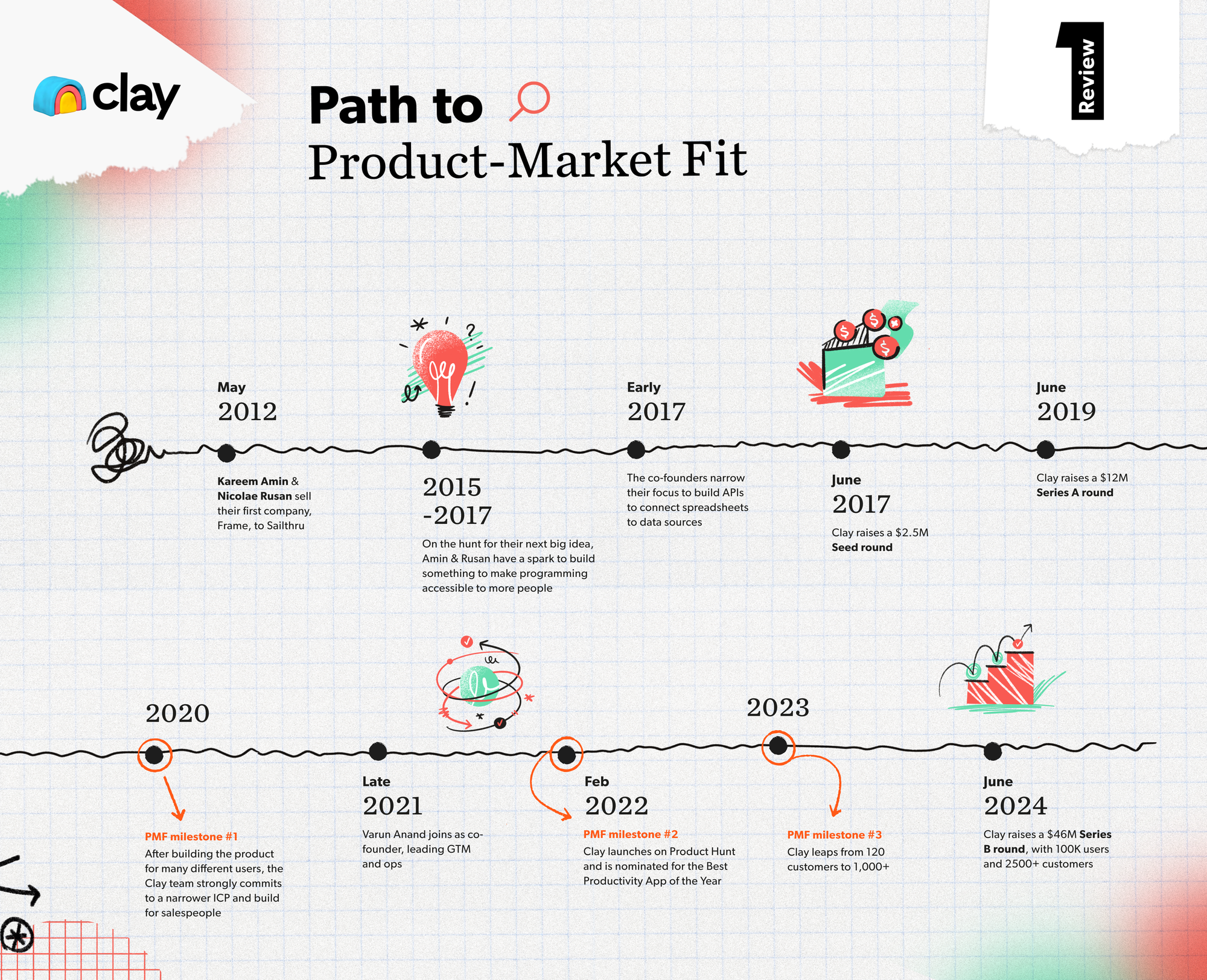
Founded in 2017, the Clay team spent six years quietly plugging away before experiencing an explosion of customer and revenue growth. (To underscore just how meteoric the rise has been, the startup was still close to $0 in revenue as recently as spring 2022.) If you fast forward over the years of wandering, the past 18 months look like a classic "overnight success" story. Today, the company shared it has passed 100K users, nabbed 2500+ customers (including Anthropic, Intercom, Notion, Vanta, and Verkada), and raised a $46M Series B round.
Основанная в 2017 году, команда Clay шесть лет тихо трудилась, прежде чем пережить взрыв в росте клиентов и выручки. (Чтобы подчеркнуть, насколько стремителен был взлёт: ещё весной 2022-го у стартапа была почти нулевая выручка.) Если перемотать через годы блужданий, последние 18 месяцев выглядят как классическая история «успеха за одну ночь». Сегодня компания сообщила, что преодолела отметку в 100K пользователей, привлекла 2500+ клиентов (включая Anthropic, Intercom, Notion, Vanta и Verkada) и подняла раунд Series B на $46M.
In this exclusive interview, Amin unpacks the thinking that has powered Clay's tremendous progress, from narrowing in on an ICP, to cultivating a strong community and developing the muscle of product discipline. But perhaps most uniquely, he also candidly shares how his own psychology ebbed and flowed with the peaks and valleys of the business, offering up helpful pointers to fellow founders who are interested in examining their own growth paths more closely.Let’s rewind to 2017.
В этом эксклюзивном интервью Amin разбирает мышление, которое стояло за огромным прогрессом Clay: от сужения ICP до выращивания сильного комьюнити и развития мышцы продуктовой дисциплины. Но, пожалуй, самое необычное — он откровенно рассказывает, как его собственная психология приливалась и отливалась вместе с пиками и спадами бизнеса, давая полезные ориентиры тем основателям, которым интересно ближе изучить собственные пути роста. Давайте отмотаем к 2017 году.
FINDING AN IDEA:
ПОИСК ИДЕИ:
The idea for Clay stemmed from an abstract desire: to make the power of programming accessible to more people. At the time, collaborative software tooling like Figma, InVision and Miro were capturing attention, but Amin and his co-founder, Nicolae Rusan, wanted to leap one step ahead.
Идея Clay выросла из абстрактного желания: сделать силу программирования доступной большему числу людей. На тот момент в фокусе внимания были инструменты для совместной работы вроде Figma, InVision и Miro, но Amin и его сооснователь Nicolae Rusan хотели прыгнуть на шаг дальше.
“We were thinking about what the next stage might look like. Specifically, we wanted to see how these APIs and SaaS tools on the internet could help people work better. So that’s where we started exploring,” says Amin.
«Мы думали о том, как может выглядеть следующий этап. В частности, мы хотели увидеть, как эти API и SaaS-инструменты в интернете могут помочь людям работать лучше. С этого мы и начали», — говорит Amin.
The first idea was to rebuild the terminal — the 1970s emulator of a computer — which would let companies pipe data from one software tool to another. But they quickly realized that a modern terminal would just help developers move faster, not addressing their desire to give the power of programming to more people.
Первой идеей было переизобрести терминал — эмулятор компьютера из 1970-х, — который позволял бы компаниям перекачивать данные из одного инструмента в другой. Но они быстро поняли, что современный терминал лишь поможет разработчикам двигаться быстрее, а не даст силу программирования большему числу людей.
Then the co-founders started thinking about the world’s most popular programming environment: the spreadsheet. “You’re working with data, except it's not connected to any of the data sources on the internet. What would it look like if we built APIs into a spreadsheet?” he says. “The same way you have higher order programming languages like Python that look more like English, what if a database understood more categories than just text or number? Like a LinkedIn profile, or a Linear ticket, or a HubSpot URL? What if the database knew what you were putting into it and then could get you more information?”
Тогда сооснователи задумались о самой популярной среде программирования в мире — электронной таблице. «Вы работаете с данными, только они не подключены ни к одному источнику данных в интернете. Как бы это выглядело, если бы мы встроили API прямо в таблицу?» — говорит он. «Подобно тому, как есть языки программирования высокого уровня вроде Python, которые выглядят почти как английский, — что если бы база данных понимала больше категорий, чем просто текст или число? Например, профиль LinkedIn, или тикет Linear, или URL HubSpot? Что если бы база знала, что вы в неё кладёте, и могла предоставить больше информации?»
In practice, the early product scraped dozens of databases to pull information directly into a spreadsheet. “Even in the earliest version, we felt this sense of magic. It's a spreadsheet where, suddenly, data pops up in a cell from somewhere else on the internet,” says Amin. With an initial version built, his co-founder took point on prospecting. “I was skeptical and resistant at first to narrowing it down to prospecting. We didn’t know much about outbound outreach, but Nicolae decided to try it out. It ended up resonating with early customers — but also showed us just how difficult doing our own outbound was.”
На практике ранний продукт парсил десятки баз данных, чтобы подтягивать информацию прямо в таблицу. «Даже в самой первой версии было ощущение магии. Это таблица, в которой данные внезапно появляются в ячейке откуда-то из интернета», — говорит Amin. Когда первая версия была готова, его сооснователь взялся за prospecting. «Сначала я скептически относился к идее сузить применение до prospecting и сопротивлялся. Мы мало что знали об outbound, но Nicolae решил попробовать. В итоге это срезонировало с первыми клиентами — но одновременно показало, насколько сложен наш собственный outbound».
IDENTIFYING THE ICP: DIGGING DEEP INTO THE DEBATE BETWEEN HORIZONTAL VS. VERTICAL
ОПРЕДЕЛЕНИЕ ICP: ГЛУБОКОЕ ПОГРУЖЕНИЕ В ДЕБАТЫ HORIZONTAL VS. VERTICAL
But Clay’s co-founders ran into a bit of a conundrum. The problem wasn’t that they didn’t have a market to target — it was that they had too many potential ICPs to pursue.
Но сооснователи Clay столкнулись с дилеммой. Проблема была не в том, что у них не было рынка, на который целиться, а в том, что потенциальных ICP было слишком много.
Recruiters told Amin how useful their product was for finding candidates. Salespeople wanted to use the platform for their inbound and outbound efforts. Front-end engineers could use the spreadsheet as a low-code backend. They even had a customer who was using Clay to transform and send data to their accounting software.
Рекрутеры рассказывали Amin, насколько полезен их продукт для поиска кандидатов. Сейлзы хотели использовать платформу для inbound и outbound. Фронтенд-инженеры могли применять таблицу как low-code бэкенд. У них даже был клиент, который использовал Clay, чтобы трансформировать и отправлять данные в свою бухгалтерскую программу.
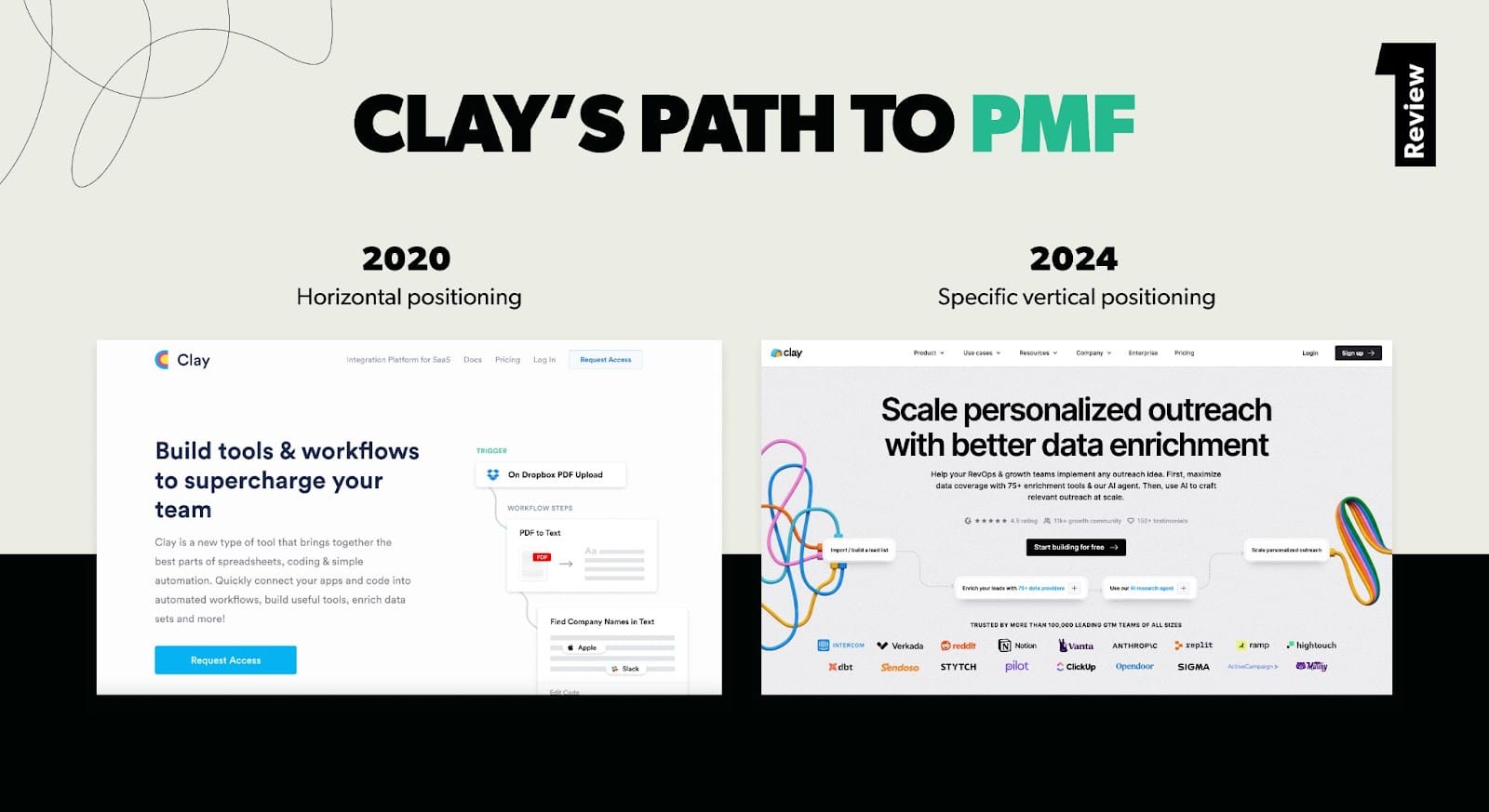
This may sound like a PMF goldmine. But the wide footprint of the product ended up working against the business in the early years. While some horizontal products (like Airtable or Notion) are able to carve out a path where they can be picked up by all sorts of different users, Clay waffled between staying horizontal and going vertical by picking a specific customer.
Это может звучать как золотая жила PMF. Но широкий охват продукта в первые годы работал против бизнеса. Тогда как некоторые горизонтальные продукты (как Airtable или Notion) умеют пробивать путь, в котором их подхватывают самые разные пользователи, Clay колебался между горизонтальным подходом и вертикальным — с выбором конкретного клиента.
This experience taught Amin that when it comes to finding product-market fit, getting to the right positioning is often more challenging than getting to the product itself. “This is a common path — a founder starts by thinking a product is cool and then they have to narrow down the customer and the use case, start to tell the story in a cohesive, coherent way, and then the market gets it. The flow isn’t always linear; often it’s very iterative and messy and that’s entirely normal,” he says.
Этот опыт научил Amin, что когда речь идёт о поиске product-market fit, дойти до правильного позиционирования зачастую сложнее, чем дойти до самого продукта. «Это распространённый путь — основатель сначала думает, что продукт классный, а затем должен сузить клиента и кейс использования, начать рассказывать историю связно и понятно, и тогда рынок её схватывает. Это движение не всегда линейное; часто оно очень итеративное и сумбурное, и это абсолютно нормально», — говорит он.
To dig deeper into Clay’s messy flow, Amin shares four more specific flavors of the ICP challenges the team faced early on.
Чтобы глубже разобраться в сумбурном пути Clay, Amin делится четырьмя более конкретными разновидностями ICP-сложностей, с которыми команда столкнулась на старте.
The dangers of not picking when you go wide:
Опасности отсутствия выбора, когда вы идёте широко:
One signal that their approach wasn’t working? The initial spark often died off quickly. “People would feel excited by the possibilities the product opened. But they weren’t always going back and using it the next day,” says Amin. “So actually we had a lot of, ‘Wow, this is so powerful!’ and then no usage, or inconsistent usage.”
Один из сигналов того, что подход не работает? Первоначальная искра часто быстро угасала. «Люди ощущали восторг от возможностей, которые открывал продукт. Но они не всегда возвращались и пользовались им на следующий день», — говорит Amin. «Так что у нас на самом деле было много „Вау, это так мощно!“ — и затем никакого использования или непостоянное использование».
Another issue was the wide range of use cases. “We had a bunch of initial customers, but they were all doing very wildly different things. One company actually sent me their code base because they wanted to send all of their data to NetSuite, but they didn’t have time to do it, so they asked us to reverse engineer it,” says Amin.
Другой проблемой был широкий разброс сценариев. «У нас была куча первых клиентов, но они все занимались совершенно разными вещами. Одна компания прислала мне свой кодовую базу, потому что они хотели отправлять все свои данные в NetSuite, но не было времени, и они попросили нас реверс-инжинирить это», — говорит Amin.
“It was in the same general sphere of doing some data transformation in a no-code way, but it had nothing to do with sales or recruiting. We just had this running in the background for a long time. They were paying us. But suddenly our servers would go down and we were like, ‘What's going on?’ And it was just this one company sending a bunch of data to us that needed to get transformed and sent to NetSuite. We had a customer, but it was the wrong customer.”
«Это было в той же общей сфере — какие-то трансформации данных в no-code, — но никак не связано с продажами или рекрутингом. У нас это просто работало на фоне очень долго. Они нам платили. Но внезапно наши серверы падали, и мы такие: „Что происходит?“ А это просто одна компания отправляла нам кучу данных, которые нужно было трансформировать и отправить в NetSuite. У нас был клиент, но это был не тот клиент».
Often it’s not that you don’t know who the customer is, it’s that you’re not picking — you haven’t committed to one hypothesis over the other. That’s what creates the confusion about what the product is, what the feature set looks like, and what the language that you use in the product even is.
Часто дело не в том, что вы не знаете, кто клиент, — а в том, что вы не выбираете, не закоммитились на одну гипотезу в ущерб другой. Именно это и создаёт путаницу в том, что такое продукт, как выглядит набор фич и даже какой язык вы используете в продукте.
The costs of malleability:
Цена пластичности:
“When you're an early startup team, one of your strengths is that you're malleable. A prospect can say, 'Oh, could you guys do this?', or 'Are you guys this?' And then you can become that, quite easily. What I’ve learned is that you have to know when to be malleable,” says Amin.
«Когда вы — ранняя стартап-команда, одна из ваших сильных сторон в том, что вы пластичны. Потенциальный клиент может сказать: „О, а вы можете вот так?“ или „А вы вот это?“ — и вы легко становитесь этим. Чему я научился, так это понимать, когда нужно быть пластичным», — говорит Amin.
“It’s almost like there are two distinct phases. You can be malleable when you're defining what the product is, but once you’ve taken a pass at that, you need to harden it when you try to go out to market. You can’t be changing the value prop or even the product itself from meeting to meeting. We were being too malleable when we were trying to sell Clay early on, which made it even harder to separate the signal from the noise.”
«Это почти как две разные фазы. Вы можете быть пластичны, когда определяете, что такое продукт, но как только вы прошли этот этап, вам нужно затвердить его, когда выходите на рынок. Нельзя менять value prop или даже сам продукт от встречи к встрече. Мы были слишком пластичны, когда пытались продавать Clay в начале, и из-за этого было ещё сложнее отделить сигнал от шума».
Malleability is a startup’s greatest weapon — but like all strengths, it’s a double-edged sword.
Пластичность — главное оружие стартапа, но, как и все сильные стороны, это палка о двух концах.
The claustrophobia of commitment:
Клаустрофобия обязательств:
It wasn’t that the Clay team set out to have such a wide breadth of users. The problem was the inherent tension between flexibility and focus.
Дело было не в том, что команда Clay сама стремилась иметь такой широкий охват пользователей. Проблема — во внутреннем напряжении между гибкостью и фокусом.
“Maybe three and a half years into building Clay, we were pretty focused on salespeople. But we hadn’t committed to that ICP in a way that showed in the product — like how we prioritized new features, or changed the language on the website,” he says.
«Примерно через три с половиной года строительства Clay мы довольно сильно сфокусировались на сейлзах. Но мы не закоммитились на этот ICP так, чтобы это отразилось в продукте — например, как мы приоритизировали новые фичи или как меняли язык на сайте», — говорит он.
This fear of commitment, Amin notes, isn’t uncommon for founders. “When you narrow the scope, it feels claustrophobic. Why are we doing something that’s smaller when we could be doing something bigger? Eventually, we realized that by narrowing down our scope, we were actually increasing our value,” he says.
Этот страх обязательств, отмечает Amin, нередок среди основателей. «Когда вы сужаете охват, появляется чувство клаустрофобии. Почему мы делаем что-то меньшее, когда могли бы делать большее? В итоге мы поняли, что сужая охват, мы на самом деле увеличиваем свою ценность», — говорит он.
This was an area for personal introspection, Amin realized in hindsight. "There was something in my psychology that made me feel like, 'Oh, we could do anything.' That was the lure of the horizontal product. And that wasn't an obvious thing until I really dug in. That’s when I realized, 'Oh, I feel constrained.’ And that now we can't do these other things because we're doing this,” he says.
Это была зона для личной интроспекции, понял Amin задним числом. «В моей психологии было что-то, что заставляло меня чувствовать: „О, мы можем заниматься чем угодно“. Это была приманка горизонтального продукта. И это не было очевидно, пока я не начал глубоко в этом копаться. Тогда я понял: „Ой, я чувствую себя в тисках“. А теперь мы не можем заниматься другими вещами, потому что заняты этим», — говорит он.
I had to teach myself that just because we're closing other avenues for now doesn't mean that we won't get back to them later. It was also helpful to give myself the reward of recognizing that people were loving the product and using it — even if it was more narrowly. That was worth more than the constraint.
Мне пришлось научить себя тому, что закрытие других направлений сейчас не означает, что мы не вернёмся к ним позже. Ещё помогло вознаграждать себя признанием того, что люди любят продукт и пользуются им — пусть и более узко. Это стоило больше, чем ограничение.
For Amin, this work all starts with self-awareness: “You have to kind of understand how you work in order to navigate the subtleties of all the decisions that you have to make every day,” he says.
Для Amin эта работа начинается с самосознания: «Вам нужно понимать, как вы работаете, чтобы ориентироваться во всех тонкостях решений, которые приходится принимать каждый день», — говорит он.
There are many ways to cultivate self-awareness, and Amin says founders have to choose the tools that feel right for them. His preferred tools are meditation and a type of therapy called Internal Family Systems (IFS), which involves interacting with yourself from the perspective of your multiple sub-personalities. “So, for instance, if you’re feeling frustrated about something, you may have one part of yourself that wants instant gratification. And another part that wants to wait and be patient. How do you hear each part of yourself clearly and then integrate them? This type of therapy is a way to introspect deeply and understand your motivations,” he says.
Существует множество способов развивать самосознание, и Amin говорит, что основатели должны выбирать инструменты, которые им подходят. Его излюбленные — медитация и тип терапии под названием Internal Family Systems (IFS), который предполагает взаимодействие с собой с позиции своих субличностей. «Например, если вы чем-то расстроены, у вас может быть одна часть, которая хочет мгновенного удовлетворения. И другая, которая хочет подождать и быть терпеливой. Как услышать каждую часть отчётливо и затем их интегрировать? Этот вид терапии — способ глубокой интроспекции и понимания своих мотивов», — говорит он.
“It's different from coaching because it is a way to introspect deeply and to really understand your motivations. Then you come back up to see how that affects how you go to work and what you’re trying to do. And once I was able to get more insight into that, I had more clarity into how to operationalize that — to make decisions that are more focused, for example,” says Amin.
«Это отличается от коучинга, потому что это способ глубоко заглянуть в себя и действительно понять свои мотивы. А затем вы возвращаетесь наверх и смотрите, как это влияет на то, как вы идёте на работу и чем хотите заниматься. И как только мне удалось это лучше понять, у меня появилась ясность в том, как это операционализировать — например, принимать более сфокусированные решения», — говорит Amin.
“You hear a lot of advice to stay focused, but what is focus? Some people think you work on one task in the morning and then flip over to something else in the afternoon. For me, I learned that focus has to mean I don't even think about anything else. If I start to imagine this other world of possibility, I’m not focused. If I let myself think, ‘I’ll work on this new idea on nights and weekends,’ I’m lying to myself about how focused I am.”
«Часто слышишь совет „оставайся сфокусированным“, но что такое фокус? Кто-то считает, что утром работаешь над одной задачей, а после обеда — над другой. Для меня фокус оказался тем, что я не думаю ни о чём другом. Если я начинаю представлять этот другой мир возможностей, я не сфокусирован. Если я разрешаю себе думать: „Я займусь этой новой идеей по ночам и выходным“, я лгу себе о том, насколько я сфокусирован».
The “spiral”:
«Спираль»:
Part of what made it difficult to commit and stay focused was a startup phenomenon Amin refers to as “the spiral.” “We would make a decision to target salespeople. Then we would get sidetracked, pursue another type of user, and then we’d come back to the same spot. And we’d realize, ‘Oh, this is why we made that decision in the first place,’ and then we’d commit to it again. It took a couple of turns,” says Amin.
Частью того, что мешало закоммититься и оставаться сфокусированным, был стартап-феномен, который Amin называет «спиралью». «Мы принимали решение целиться в сейлзов. Потом отвлекались, шли за другим типом пользователей и возвращались в ту же точку. И понимали: „О, вот почему мы изначально приняли это решение“, — и снова коммитились. Это заняло несколько витков», — говорит Amin.
This is a state that probably feels familiar to most early-stage founders. “One of our customers would say something that would seem really exciting and doable — just slightly off from what we were doing. But we would attempt to go for it to get that customer,” he says.
Это состояние, вероятно, знакомо большинству ранних основателей. «Один из наших клиентов мог сказать что-то, что казалось очень захватывающим и реализуемым — слегка в стороне от того, чем мы занимались. Но мы пытались за этим погнаться ради этого клиента», — говорит он.
“Even though we were focused on sales, all these different possibilities continued to emerge within that. We’d commit to talking to salespeople about outbound, but then they would tell us, ‘Well, we're also doing this inbound thing where a lot of customers are coming to us and they need enrichment.’ At the time, we were focused on just the aggregation of data, but we thought, ‘Oh, maybe we should do that,’” says Amin.
«Хотя мы были сфокусированы на продажах, внутри этого продолжали возникать самые разные возможности. Мы коммитились говорить с сейлзами про outbound, а они нам говорили: „Ну, мы ещё занимаемся inbound — к нам приходит много клиентов, и им нужно обогащение“. На тот момент мы фокусировались только на агрегации данных, но думали: „О, может, и этим заняться“», — говорит Amin.
“But then folks would be like, ‘Well, do you have an API? We don't need the spreadsheet interface for that.’ So we thought, ‘Maybe we should change the product, maybe it needs to look like a graph.’ But when we eventually built an auto-enrichment feature, then people started saying, ‘Well, actually we like this. What if I used this as my CRM?’ And so there was a moment where we considered that path, too.”
«А потом кто-то говорил: „Слушайте, а у вас есть API? Нам не нужен интерфейс таблицы“. И мы думали: „Может, надо менять продукт, может, он должен выглядеть как граф“. Но когда мы в итоге сделали авто-обогащение, люди начали говорить: „Слушайте, нам это нравится. А что если использовать это как мой CRM?“ И был момент, когда мы рассматривали и этот путь».
How you position — or fail to position — the product shapes all the product features that you build, in addition to shaping people's view of you.
То, как вы позиционируете продукт — или не позиционируете, — формирует все фичи, которые вы строите, помимо того, как вас воспринимают люди.
All of this would send the team into an even deeper spiral over whether outbound was the right wedge. “We would go back and forth between inbound and outbound. One reason to do outbound is that every B2B company needs outbound, but another reason not to do outbound is that it's quite complex. It’s a fat long tail, and it's also seemingly a saturated market,” he says.
Всё это уводило команду в ещё более глубокую спираль вопроса, является ли outbound правильным клином. «Мы метались между inbound и outbound. Одна причина делать outbound в том, что он нужен каждой B2B-компании; другая причина не делать его в том, что он довольно сложен. Это длинный жирный хвост, и при этом рынок кажется насыщенным», — говорит он.
Sometimes a spiral would leave the realm of sales entirely. “Every once in a while, someone would say something like, ‘Well, I'm a recruiter but I could use this.’ And then we'd rationalize to ourselves that, ‘Well, recruiting is very much just sales. So it’s not really losing focus if we target recruiters, is it?’” says Amin.
Иногда спираль вообще уводила нас из сферы продаж. «Время от времени кто-то говорил: „Ну, я рекрутер, но я мог бы этим пользоваться“. И мы рационализировали: „Ну, рекрутинг — это в общем-то те же продажи. Так что фокус мы вроде и не теряем, если целимся в рекрутеров, правда?“» — говорит Amin.
The way out of the spiral? Fully committing to the ICP of outbound sales and only selling the same product each time — for real. “It wasn't so much that I was 100% sure that outbound was the right call, although it was a faster starting point because all companies need it, versus typically only bigger companies needing inbound support, ” says Amin. “It was more that I realized we need to pick one thing at a time, test it out clearly, and then make sure that it aligned with our larger goals — to get a lot of customers that can come in, self-serve and give us feedback that we can react to quickly. That’s when we’d earn the right to execute on the more expansive parts of our mission.”
Выход из спирали? Полностью закоммититься на ICP outbound-сейлзов и продавать только один и тот же продукт каждый раз — по-настоящему. «Дело было не в том, что я был на 100% уверен, что outbound — правильный выбор, хотя это была более быстрая отправная точка, потому что outbound нужен всем компаниям, тогда как inbound-поддержка обычно нужна только большим, — говорит Amin. — Дело скорее в том, что я понял: нам нужно брать одно за раз, чётко это тестировать и убеждаться, что это согласуется с нашими более крупными целями — заполучить много клиентов, которые могут зайти, обслужить себя сами и дать обратную связь, на которую мы можем быстро реагировать. Только тогда мы заработаем право выполнять более масштабные части нашей миссии».
This is the line of reasoning that helped us climb our way out of the use case spiral: How do we get customers as quickly as possible, so that we can learn as fast as possible, so that we can improve as quickly as possible?
Вот линия рассуждений, которая помогла нам выкарабкаться из спирали кейсов использования: как нам как можно быстрее получить клиентов, чтобы как можно быстрее учиться, чтобы как можно быстрее улучшаться?
While this period may seem like a never ending loop from the outside, Amin emphasizes the learning was still valuable. “It wasn't a complete circle. We would arrive at the same place, but we had more information. Obviously we could have done that faster,” he says.
Хотя со стороны этот период может казаться бесконечной петлёй, Amin подчёркивает, что обучение было ценным. «Это был не полный круг. Мы возвращались в ту же точку, но с большим количеством информации. Очевидно, мы могли сделать это быстрее», — говорит он.
But it can be difficult to recognize the need to extricate yourself once you’re deep into the spiral. Amin returns to examining founder psychology again. “It took hitting the wall a couple of times before I finally recognized that we were not moving as fast as we could be and we were not achieving the milestones as quickly as I wanted to. I was frustrated with myself and felt that I can and should do better,” he says.
Но осознать необходимость выбраться, когда вы уже глубоко в спирали, бывает трудно. Amin снова возвращается к разбору психологии основателя. «Понадобилось несколько раз удариться о стену, прежде чем я наконец признал, что мы не движемся так быстро, как могли бы, и не достигаем майлстоунов так быстро, как мне хотелось. Я был расстроен на себя и чувствовал, что могу и должен лучше», — говорит он.
Everything in life is a spiral, really. You come back to the same place, but with a new perspective that enables you to see it differently.
Всё в жизни — это спираль, по сути. Вы возвращаетесь в ту же точку, но с новым ракурсом, который позволяет увидеть её иначе.
“These feelings can manifest in other ways too, such as avoidance. Whenever I identify these patterns in emotions, the first step is to forgive myself and just be kind to myself. Then I try to dig deeper into the root cause,” says Amin.
«Эти чувства могут проявляться и иначе, например как избегание. Когда я улавливаю такие эмоциональные паттерны, первый шаг — простить себя и быть к себе добрым. Затем я пытаюсь докопаться до корневой причины», — говорит Amin.
He suggests founders also apply a wider team lens here. “It was actually less specifically my personality and more a combination of our personalities. Me, my co-founder and the team, we like building things. And so we would see the opportunities, we’d get sidetracked, and we’d overestimate how much we could do,” says Amin.
Он предлагает основателям применять и более широкую командную линзу. «На самом деле это было не столько именно про мою личность, сколько про сочетание наших личностей. Я, мой сооснователь и команда — мы любим строить. Поэтому мы видели возможности, отвлекались и переоценивали, сколько мы способны сделать», — говорит Amin.
“In truth, we were a very productive team and we thought that we could build more than we could. Eventually we realized that we needed to understand the total cost of ownership. Yes, we could build something quickly, but then who was going to sell it? Who was going to educate customers about it? Who's going to iterate on that feature multiple times until it gets really great? That’s what it takes to get to product-market fit.”
«По правде, мы были очень продуктивной командой и думали, что можем построить больше, чем могли. В итоге мы поняли, что нужно учитывать полную стоимость владения. Да, мы могли быстро что-то построить, но кто потом будет это продавать? Кто будет учить клиентов этим пользоваться? Кто будет итерировать эту фичу много раз, пока она не станет действительно отличной? Вот что нужно для достижения product-market fit».
Getting there required a personal shift. “It took me a lot of work to shift my attention and perspective to say, ‘Okay, the vision part is not the problem. Our ambition is large. What we're missing is what are we doing today? And tomorrow?’"
Чтобы туда добраться, потребовался личный сдвиг. «Мне пришлось проделать большую работу, чтобы перевести внимание и сместить ракурс: „Окей, проблема не в видении. Наши амбиции огромны. Чего нам не хватает, так это понимания: что мы делаем сегодня? И завтра?“»
Like many startups, we eventually realized that we were ahead of the market in terms of what we thought the future should look like. But where we were weaker was in being able to say, “What do we need right now to move the needle tomorrow?” The lofty vision was overtaking what we needed in the present.
Как и многие стартапы, мы в итоге поняли, что мы опережаем рынок в представлениях о том, каким должно быть будущее. Но мы были слабее в том, чтобы ответить: «Что нам нужно прямо сейчас, чтобы сдвинуть метрики завтра?» Большое видение перевешивало то, что нам было нужно в настоящем.

BUILDING OUT THE PRODUCT:
СБОРКА ПРОДУКТА:
So the Clay team decided to focus on outbound salespeople as their ICP. To ensure this wasn’t just another false start, they found ways to hold themselves accountable to this narrower purview. According to Amin, this meant:
Итак, команда Clay решила сфокусироваться на outbound-сейлзах как своём ICP. Чтобы это не оказалось очередным фальстартом, они нашли способы держать себя в ответе перед этим узким периметром. По словам Amin, это означало:
Вырезать фичи, нерелевантные ICP Clay. Убрать любые маркетинговые формулировки, не заточенные под сейлзов. Обновить всю внутреннюю документацию по организации. Просветить команду об этом изменении и убедиться, что все движутся в одном направлении (что на практике оказалось сложным и спорным).
It took time, but the team eventually saw the payoff of narrowing their focus. “We just needed to internalize what momentum felt like. For instance, we would get a customer who wanted a feature. Then the next customer would want the exact same feature. Then we would build that feature, and the customers would be happy,” he says.
Это заняло время, но в итоге команда увидела отдачу от сужения фокуса. «Нам просто нужно было прочувствовать, что такое импульс. Например, приходил клиент и хотел фичу. Потом следующий клиент хотел ровно ту же фичу. Мы её строили, и клиенты были довольны», — говорит он.
“And then we would hire another engineer because we would get more customers. It was about thinking in these loops instead of thinking in terms of what the product should look like or what features we should build.”
«А потом мы нанимали ещё одного инженера, потому что приходило больше клиентов. Это было про мышление циклами вместо мышления о том, как должен выглядеть продукт или какие фичи строить».
We had to figure out how to feed the process rather than feed the product.
Нам пришлось разобраться, как кормить процесс, а не кормить продукт.
Here were two techniques Amin leaned on to help the Clay team do just that:
Вот две техники, на которые Amin опирался, чтобы помочь команде Clay делать именно это:
Lean into counterintuitive product principles
Опирайтесь на контринтуитивные продуктовые принципы
Many founders say that they start their companies with a thesis in mind, but for Amin, it’s more of an intuition. “Thesis implies more information than I think most people have when they start,” he says.
Многие основатели говорят, что начинают компании с тезисом в голове, но для Amin это скорее интуиция. «Тезис подразумевает больше информации, чем у большинства людей есть на старте», — говорит он.
To ensure you can operationalize your intuition, Amin recommends trying to codify it into a set of product principles in the early days. Establishing these principles, Amin says, gave them a clear direction for their strategy, product features, and other important company-related decisions. He shares the two that power Clay:
Чтобы операционализировать интуицию, Amin рекомендует пытаться кодифицировать её в набор продуктовых принципов в ранние дни. Установление этих принципов, говорит Amin, дало им чёткое направление для стратегии, фич продукта и других важных решений на уровне компании. Он делится двумя, которые питают Clay:
1). Мы собираемся агрегировать каждый источник данных в мире. 2). Мы собираемся быть самым гибким инструментом в мире.
The move to integrate with every single data source instead of creating their own exclusive data source wasn’t exactly intuitive. “It's almost an a priori way to think about the world. We thought it made sense to use as many data sources as possible to get the information you want,” he says. “For example, maybe there's a data point of if a company has an office in South Asia. Maybe that's not relevant to every company so it's not worth creating it for some data providers, but it's relevant to this person who's doing prospecting, so including more streams is helpful.”
Решение интегрироваться с каждым источником данных, а не создавать собственный эксклюзивный источник, не было особенно интуитивным. «Это почти априорный взгляд на мир. Мы считали логичным использовать как можно больше источников данных, чтобы получить нужную информацию», — говорит он. «Например, может быть атрибут — есть ли у компании офис в Южной Азии. Возможно, это нерелевантно для каждой компании, и потому не имеет смысла создавать его для одних провайдеров данных, но это релевантно для конкретного человека, занимающегося prospecting, так что больше потоков — это полезно».
Flexibility may seem like a simplistic product principle, but it was also a counterintuitive approach. “It’s at odds with the way the world works right now,” says Amin. “Most tools choose to build by trying to be as easy to use as possible — you aim to shorten the time to value. You come in, you press one button, you’ve got all your leads and you can start sending outbound messages.”
Гибкость может показаться упрощённым продуктовым принципом, но это тоже контринтуитивный подход. «Это идёт вразрез с тем, как сейчас устроен мир», — говорит Amin. «Большинство инструментов выбирают строить так, чтобы их было максимально просто использовать — стремятся сократить time to value. Вы заходите, нажимаете одну кнопку, получаете все лиды и можете начать отправлять outbound-сообщения».
But for the Clay team, flexibility came first — even if that meant the product wasn’t quite so approachable for folks outside of the power user. “When flexibility conflicts with ease of use, we prioritize flexibility first. Once we make something flexible, we then start to think, okay, what is the easiest way to use this?”
Но для команды Clay гибкость стояла на первом месте — даже если это означало, что продукт был не таким доступным для тех, кто не power user. «Когда гибкость конфликтует с простотой использования, мы ставим гибкость на первое место. А уже сделав что-то гибким, мы затем начинаем думать: окей, какой самый простой способ этим пользоваться?»
Don’t mask PMF with new features
Не маскируйте PMF новыми фичами
“Once you can clearly articulate your strategy in terms of a couple of principles, the next task is to apply this methodically. Take an idea that you have to market and really push it to the maximum to see if you've actually built something worthwhile,” says Amin.
«Как только вы можете чётко сформулировать стратегию через пару принципов, следующая задача — применять её методично. Возьмите идею выхода на рынок и реально доведите её до предела, чтобы увидеть, построили ли вы что-то стоящее», — говорит Amin.
“That means pick the actual customer that you're talking to, make sure that they have the same title or at least the same jobs to be done, and then really try to sell it to them — without manufacturing new features.”
«Это значит выбрать конкретного клиента, с которым вы разговариваете, убедиться, что у них одинаковый тайтл или хотя бы одни и те же jobs to be done, и реально попытаться им это продать — без выдумывания новых фич».
There’s a tendency when you’re early to be like, “We’re just missing this one thing…” That actually masks the signs of PMF. When the need is large enough, people will buy your product and wait for you to build the rest of the features. That’s actually the main indicator that you have a product that’s worthwhile.
Есть склонность на ранней стадии говорить: «Нам не хватает только вот этой одной штуки…». На самом деле это маскирует признаки PMF. Когда потребность достаточно велика, люди купят ваш продукт и подождут, пока вы достроите остальные фичи. Вот это и есть главный индикатор того, что у вас стоящий продукт.
Amin found it helpful to instill serious discipline here. “I told the team that once we agree to something and it's in our sprint planning, nothing will shift it. If you're walking to work and you happen to have a new idea, throw it away. We think of ideas during our planning, and then we commit to it unless the data changes. And often the data doesn't change actually,” says Amin.
Amin счёл полезным внедрить здесь серьёзную дисциплину. «Я сказал команде: как только мы на что-то согласились, и это попало в планирование спринта, ничто это не сдвинет. Если по пути на работу вам пришла новая идея — выбрасывайте её. Идеи мы придумываем на планировании и затем коммитимся, пока не изменятся данные. И часто данные не меняются», — говорит Amin.
“Your mood is usually what changes. The information hasn't changed. You just feel differently about it. You get excited about something else in the middle of the sprint and start doing that, saying, ‘Well, a customer told us that this feature is going to be great, so it must be important,” Amin says. “Shifting to a more disciplined approach where we committed, executed, and then committed again was critical for Clay. We left space, obviously, for ad hoc things that happened during the week. But we always made sure that the thing we committed to got done.”
«Обычно меняется ваше настроение. Информация не изменилась. Вы просто чувствуете иначе. Вы загораетесь чем-то другим посреди спринта и начинаете заниматься этим, говоря: „Ну, клиент сказал, что эта фича будет крутой, значит, она важна“», — говорит Amin. «Переход к более дисциплинированному подходу, в котором мы коммитились, исполняли и снова коммитились, был критическим для Clay. Мы, конечно, оставляли место для ad hoc задач в течение недели. Но всегда следили, чтобы то, на что мы закоммитились, было сделано».
BUILDING COMMUNITY:
ПОСТРОЕНИЕ СООБЩЕСТВА:
This decision to commit is ultimately what led to Clay’s success. “It was actually by cutting off all of the different ways that we supported customers that we saw huge growth,” says Amin.
Это решение закоммититься в итоге и привело Clay к успеху. «На самом деле именно отрезав все разные способы, которыми мы поддерживали клиентов, мы увидели огромный рост», — говорит Amin.
This focus also allowed the Clay team to build a robust community. Since they were focusing on one narrower ICP, rather than a huge swath of different folks with vastly different needs, Amin had a hunch that their customers might benefit from being put in the same place to share ideas, best practices, and questions with each other.
Этот фокус также позволил команде Clay построить мощное сообщество. Поскольку они сфокусировались на одном узком ICP, а не на огромном спектре разношёрстных людей с совсем разными потребностями, у Amin было предчувствие, что их клиентам будет полезно оказаться в одном месте, где они могут делиться идеями, лучшими практиками и вопросами друг с другом.
So they started a Slack group and put all their customers in one channel. It was a bit of an unconventional call — Slack would be the only place where customers could get support from the Clay team. “Before that, you would email us or chat like most startups. But we pushed all of our customers into the same channel.” His hunch turned out to be correct. The community, which started with around 200 people, has grown to 11K+ people today.
Так что они завели Slack-группу и собрали всех клиентов в одном канале. Это был довольно нестандартный шаг — Slack стал единственным местом, где клиенты могли получить поддержку от команды Clay. «До этого вы писали нам по email или в чате, как у большинства стартапов. Но мы загнали всех клиентов в один канал». Его предчувствие оказалось верным. Сообщество, начавшееся примерно с 200 человек, сегодня выросло до 11K+ участников.
The momentum created in this channel shouldn’t be underestimated. “It’s like arriving early to a concert. No one else is there. But then five or 10 people trickle in, and then it escalates,” says Amin. “We quickly built some momentum by bringing the same type of people into the venue and letting them see that, when they come in, they're seen. They're like, ‘Oh yeah, I recognize myself in the group that's here.’”
Импульс, созданный в этом канале, нельзя недооценивать. «Это как прийти рано на концерт. Никого больше нет. Но затем заходят пять или десять человек, и дальше идёт по нарастающей», — говорит Amin. «Мы быстро набрали импульс, приведя в одно пространство людей одного типа и дав им увидеть, что когда они приходят, их замечают. Они такие: „О да, я узнаю себя в этой группе“».
As an added bonus, the Slack channel turned into a channel for quick hits of feedback for the Clay team. “It was exciting when the team shipped something and you immediately saw instant feedback. You can only do so much to motivate your team without them seeing results,” says Amin.
Дополнительным бонусом стало то, что Slack-канал превратился в канал быстрых обратных связей для команды Clay. «Было захватывающе, когда команда что-то выкатывала и ты сразу же видел мгновенную обратную связь. Можно сколько угодно мотивировать команду, но без того, чтобы они видели результаты, далеко не уедешь», — говорит Amin.
Reading this, it might be tempting to copy-paste this growth idea for your own company. But Amin warns that there’s no one right approach and that these decisions require thoughtfulness. “There are many, many different approaches and you need to carefully consider whether your strategy is aligned with your execution,” he says.
Читая это, может быть соблазн скопировать эту идею роста для своей компании. Но Amin предупреждает: единственно правильного подхода нет, и такие решения требуют вдумчивости. «Существует множество разных подходов, и нужно внимательно проверить, выровнена ли ваша стратегия с исполнением», — говорит он.
“For us, the strategy was to target growth people, operations folks and really clever SDRs who are trying all these different techniques and want to share and talk about them. Putting them all in the same place provided value for them above and beyond what the tool does itself. And that's why it made sense for us to pursue a community strategy,” he says.
«Для нас стратегия состояла в том, чтобы целиться в growth-людей, ops-специалистов и действительно умных SDR, которые пробуют разные техники и хотят ими делиться и обсуждать. Собрать их всех в одном месте дало им ценность сверх того, что давал сам инструмент. Вот почему нам было осмысленно идти в стратегию сообщества», — говорит он.
“For other B2B founders, the question is how to align your execution to what’s unique about your business? If real-time information and instant responses are important to your product, web chat support probably makes more sense.”
«Для других B2B-основателей вопрос в том, как выровнять исполнение с тем, что уникально в вашем бизнесе? Если для вашего продукта важна информация в реальном времени и мгновенные ответы, веб-чат-поддержка, вероятно, имеет больше смысла».
Designing the experience of your customer and making sure it aligns with your product is actually the path to product-market fit — rather than some generalized thinking like, “Here's how X company did it and this will unlock PMF for me too.”
Дизайн опыта вашего клиента и обеспечение того, чтобы он соответствовал вашему продукту, — вот и есть путь к product-market fit, а не какие-то общие рассуждения вроде: «Вот как X компания это сделала, и это разблокирует PMF и для меня тоже».
GAINING TRACTION:
НАБОР ОБОРОТОВ:
When Clay eventually found product-market fit, Amin says that there were three signals that told him the company had struck gold:
Когда Clay в итоге нашёл product-market fit, Amin говорит, что было три сигнала, давших ему понять, что компания напала на золотую жилу:
1). У нас появились евангелисты Clay. «Мы стали замечать, что люди называют себя экспертами Clay и помогают другим настроиться на Clay. Есть десятки „Claygencies“ — агентств, специализирующихся на внедрении Clay у клиентов, — у некоторых ARR превышает $2M в год, что безумие», — говорит Amin. 2). Люди забирали Clay с собой на новую работу. «Мы также увидели, что люди уходят со своих работ и приносят Clay в новые компании». Это создавало органический импульс, открывая продукт новым командам и организациям. 3). Нас завалили запросами на фичи. «Иногда мы выкатывали баг, и клиент тут же его флагал», — говорит Amin. Это может показаться промахом, но на самом деле это был положительный индикатор. «Это во многом хорошо, потому что значит, что им не всё равно и они пользуются Clay. Так что когда такие вещи начали происходить, стало ясно, что нас тащат вперёд и многие наши тезисы были верны».
“A lot of finding product-market fit is about whether you understand not just is it working? But do we understand why it’s working?” Getting to this point though, says Amin, wasn’t the result of a tightly controlled process. Instead, he recommends approaching it more organically.
«Многое в поиске product-market fit — это про то, понимаете ли вы не только работает ли это, но и почему это работает.» Дойти до этой точки, говорит Amin, не было результатом жёстко контролируемого процесса. Вместо этого он советует подходить к этому более органично.
I tell my team that we're not engineers, we’re more like gardeners. We plant something in the soil, but we don’t control which direction it grows in. If it grows to the left, we also grow to the left and try to nurture it and feed it the best that we can. And then we see what it becomes.
Я говорю команде: мы не инженеры, мы скорее садовники. Мы сажаем что-то в почву, но мы не контролируем, в какую сторону оно растёт. Если оно растёт влево — мы тоже растём влево и стараемся это пестовать и кормить как можем. А потом смотрим, во что оно превратится.
LOOKING FORWARD (AND INWARD)
ВЗГЛЯД ВПЕРЁД (И ВНУТРЬ)
As for Amin’s longer term vision? “We are a creative tool for growth. So with Clay, you should be able to translate any idea that you have for growing your company to reality instantly. I want to be able to turn outbound into a data-driven experimentation platform where you can ask questions like: Who exactly is my ICP? How do I know that they're my ICP? Who are the people that we should message and what should we say and when? With Clay, I want people to be able to run these GTM experiments almost like a scientist.”
А что насчёт более долгосрочного видения Amin? «Мы — креативный инструмент для роста. С Clay вы должны мочь перевести любую идею роста для вашей компании в реальность мгновенно. Я хочу, чтобы outbound можно было превратить в платформу экспериментов на основе данных, где можно задавать вопросы вроде: кто именно мой ICP? Откуда я знаю, что это мой ICP? Кому стоит написать сообщение, что именно сказать и когда? С Clay я хочу, чтобы люди могли запускать GTM-эксперименты почти как учёные».
It’s not just Clay that Amin has big plans for though. He doesn’t intend to stop growing as a founder, and a human. Which brings us to Amin’s final founder psychology tip — decouple the wells of personal and professional fulfillment:
При этом Amin строит большие планы не только для Clay. Он не собирается прекращать расти как основатель — и как человек. Это подводит нас к финальному совету Amin по психологии основателя: разделить колодцы личной и профессиональной самореализации:
“In the beginning, I put a lot of pressure on myself with Clay because I wanted it to be both successful and personally fulfilling. As a founder, your company can become your art project, the thing that you want to be actualized through,” he says. “But this actually decreased the quality of my decision-making because I would get caught in that same spiral of trying to figure out the biggest, most high-impact thing we could possibly do long-term, instead of what is actually useful right now,” he says.
«В начале я очень много давил на себя с Clay, потому что хотел, чтобы это было одновременно успешным и личностно наполняющим. Как основатель, ваша компания может стать вашим арт-проектом, тем, через что вы хотите реализоваться», — говорит он. «Но это на самом деле снижало качество моих решений, потому что я попадал в ту же спираль попыток придумать самую крупную, самую высокоимпактную вещь, какую только можно сделать в долгую, вместо того чтобы делать то, что реально полезно прямо сейчас», — говорит он.
“Now I’ve shifted my mindset. I’ve removed the psychological pressure — it doesn’t have to be the biggest thing, it just has to be what other people think is useful. That enables me to find meaning in the micro-moments — like when a customer is excited and tells me they were able to do something that they couldn't have done before Clay — and that has actually helped me make better decisions as a founder.”
«Теперь я сместил мышление. Я снял с себя психологическое давление — это не обязано быть самым крупным, это просто должно быть тем, что другие люди считают полезным. Это позволяет мне находить смысл в микро-моментах — например, когда клиент в восторге и говорит мне, что смог сделать то, чего не мог сделать до Clay, — и это на самом деле помогло мне принимать лучшие решения как основателю».
Read more details on Clay's next chapter of growth here.
Подробнее о следующей главе роста Clay читайте здесь.
This article is a lightly edited version of our podcast interview with Amin on In Depth. For more tactics on how to build vertical, narrow down your ICP and insights on founder psychology, listen here.
Эта статья — слегка отредактированная версия нашего подкаст-интервью с Amin на In Depth. Больше тактик о том, как строить вертикально, сужать ICP, и инсайтов о психологии основателя слушайте здесь.