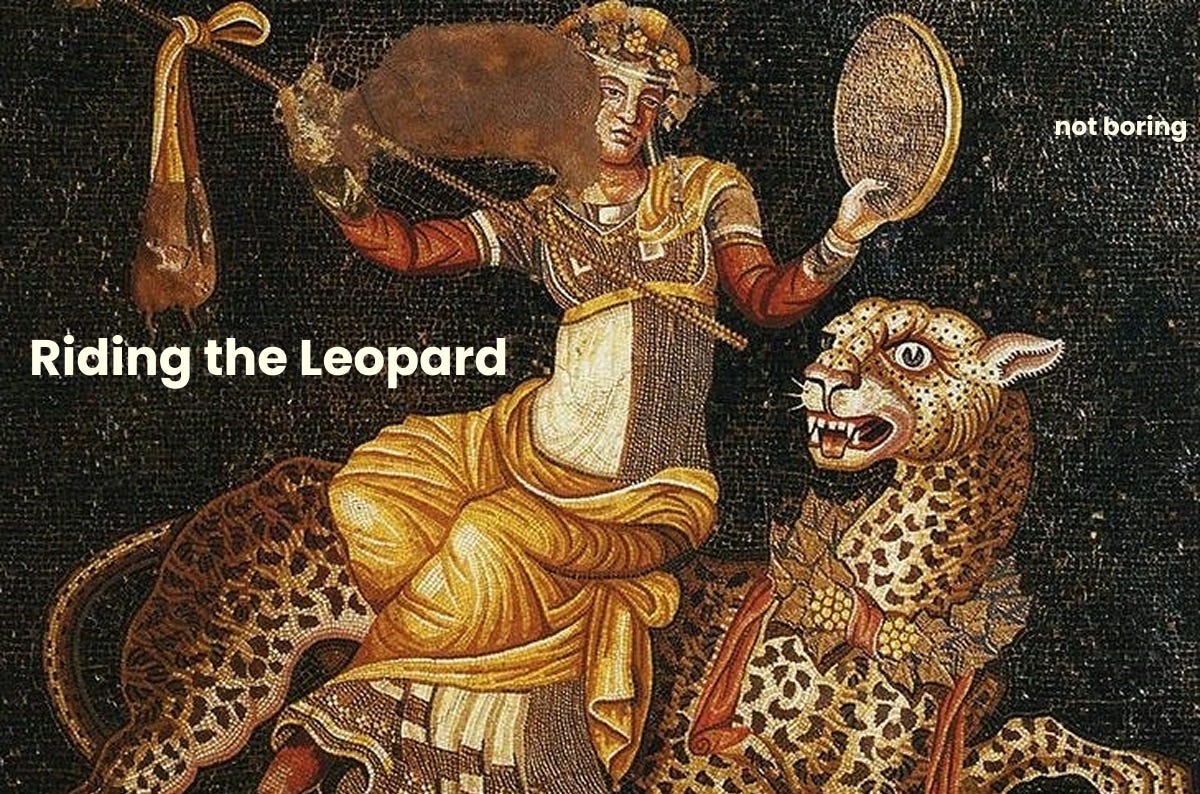
Riding the Leopard
Это транскрипт выступления Packy McCormick на мероприятии The Mountain (6 мая 2026), переработанный в эссе для Not Boring. На фоне новостей вроде раунда Sierra на $15 млрд, выхода Anthropic на годовой темп выручки $44 млрд и фондов Anthropic ($1,5 млрд) и OpenAI ($4 млрд) для внедрения ИИ в крупные компании, автор задаётся вопросом: в чём смысл человеческой жизни, когда машины делают всё больше. Опираясь на Упанишады, Виктора Франкла, Алана Уоттса, Руми, Тейяра де Шардена, исследователя ЛСД Криса Баче, Уайтхеда, подкаст The Telepathy Tapes и других, он предлагает рамку: смысл жизни — расширять диапазон и глубину опыта во вселенной. Из идеи «ты есть то» («Атман есть Брахман») следует, что каждый уникальный опыт — это способ вселенной познать саму себя, а значит дифференциация становится моральной обязанностью. Автор подкрепляет это математикой: по теореме Шеннона информация есть удивление, а John Wheeler с его «It from Bit» утверждал, что люди — со-творцы вселенной; вторая половина эссе доступна только подписчикам not boring world.
Riding the Leopard
Верхом на леопарде
You are here to experience, or: why differentiation is a moral obligation.
Ты здесь, чтобы переживать опыт, или: почему дифференциация — это моральная обязанность.
Welcome to the 1,481 newly Not Boring people who have joined us since our last essay! Join 265,556 smart, curious folks by subscribing here:
Добро пожаловать 1481 новому читателю Not Boring, присоединившемуся к нам со времени прошлого эссе! Присоединяйтесь к 265 556 умным и любопытным людям, подписавшись здесь:
Hi friends 👋 ,
Привет, друзья 👋 ,
Happy Wednesday! Last week, I went out to LA to give a talk at my friend Grant Gittlin’s event, The Mountain. He asked me to do something different and weird, and I took the opportunity to pull a bunch of the ideas I’ve written in essays like Means and Meaning, The Company as a Machine for Doing Stuff, The Return of Magic, Most Human Wins, and others into one cohesive ~philosophy. It was a good excuse to think about the meaning of life.
С хорошей средой! На прошлой неделе я ездил в Лос-Анджелес, чтобы выступить на мероприятии моего друга Grant Gittlin под названием The Mountain. Он попросил меня сделать что-то необычное и странное, и я воспользовался возможностью собрать кучу идей, о которых писал в эссе вроде Means and Meaning, The Company as a Machine for Doing Stuff, The Return of Magic, Most Human Wins и других, в одну цельную ~философию. Это был хороший повод поразмышлять о смысле жизни.
This is the talk. It was written to be spoken, so it may seem an oddly-written essay, but I hope it’s useful nonetheless, if for no other reason than that it makes you pause and wonder at the insane gift and responsibility we’ve all been given to experience and create in the world from our own unique points-of-view.
Это и есть та речь. Она писалась, чтобы её произносить вслух, так что может показаться странно написанным эссе, но я надеюсь, что она всё равно будет полезна — хотя бы потому, что заставит вас остановиться и подивиться безумному дару и ответственности, которые всем нам даны: переживать и создавать в этом мире со своей собственной уникальной точки зрения.
I was very nervous giving this talk to a room full of 80 people, but once I got through that, and a bunch of people told me that I should share it more broadly, I decided why not send it to 265,556 of my closest friends. I do think a lot of people are wondering what it is we’re here to do when machines can do more and more.
Я очень нервничал, выступая перед залом из 80 человек, но как только я прошёл через это, и куча людей сказала мне, что стоит поделиться этим шире, я решил: почему бы не отправить это 265 556 моим ближайшим друзьям. Я и правда думаю, что многие задаются вопросом, что же нам остаётся делать, когда машины умеют всё больше и больше.
This is my best attempt yet, in what will be a lifetime full of attempts, to answer that question and then try to live the answer.
Это моя пока лучшая попытка — в череде попыток длиною в жизнь — ответить на этот вопрос, а затем постараться прожить этот ответ.
Let’s get to it.
Приступим.
Note: I’m sharing the first half with everyone and the whole thing with not boring world subscribers. Join us.
Примечание: первую половину я делюсь со всеми, а целиком — с подписчиками not boring world. Присоединяйтесь к нам.
Riding the Leopard
Верхом на леопарде
Transcript of a Talk Given at The Mountain on May 6, 2026
Транскрипт выступления на The Mountain, 6 мая 2026
Thanks for inviting me, Grant, and to all of you for letting me fill your experience and attention for a little while.
Спасибо, что пригласил, Grant, и вам всем — за то, что позволили мне ненадолго наполнить ваш опыт и завладеть вашим вниманием.
What a week to get to talk to a room of technology people. Sierra just raised at $15 billion. Anthropic crossed a $44 billion run rate, and launched a new company with some huge funds that has $1.5 billion to deploy AI in big companies. OpenAI did the same thing but with $4 billion. Long Lake bought AmEx global travel for $6.3 billion.
Какая неделя для того, чтобы выступать перед залом технологичных людей. Sierra только что привлекла раунд при оценке в $15 млрд. Anthropic перешагнула годовой темп выручки в $44 млрд и запустила новую компанию с огромными фондами, у которой есть $1,5 млрд на внедрение ИИ в крупные компании. OpenAI сделала то же самое, но с $4 млрд. Long Lake купила AmEx global travel за $6,3 млрд.
All of which raises an important question: who gives a shit?
Всё это поднимает важный вопрос: кому какое дело?
I mean that: why do we care?
Я серьёзно: почему нас это волнует?
Things are moving so fast that it’s worth thinking about what it is that we’re doing here.
Всё движется так быстро, что стоит задуматься о том, что же мы здесь вообще делаем.
Last night, a woman who reads my newsletter reached out over Substack DM. She said she had been diagnosed with Stage IV cancer (she’s in remission now!), so she had been confronted with a question we’d all be facing: what happens to human purpose when AI removes scarcity (or in her case, the need to care about being productive at all)? To answer it, she analyzed more than 200 sci-fi books. Across all of those books, by far the most common thing left to solve for post-scarcity is meaning. 59% of books were about the search for meaning. Identity was next, at just 17%.
Вчера вечером женщина, читающая мою рассылку, написала мне в личку в Substack. Она рассказала, что ей поставили диагноз — рак IV стадии (сейчас она в ремиссии!), так что она столкнулась с вопросом, который встанет перед всеми нами: что происходит с человеческим предназначением, когда ИИ устраняет дефицит (а в её случае — необходимость вообще заботиться о том, чтобы быть продуктивной)? Чтобы ответить на него, она проанализировала более 200 научно-фантастических книг. Во всех этих книгах самое распространённое, что остаётся решать в мире после дефицита, — это смысл. 59% книг были о поиске смысла. Следующей шла идентичность — всего 17%.
Assume that companies will keep getting bigger and bigger, and growing faster and faster, and who cares… the thing we’ll be left solving for is meaning.
Предположим, что компании будут становиться всё больше и больше, расти всё быстрее и быстрее, и кому какое дело… то, что нам останется решать, — это смысл.
Luckily, that’s what I’d been planning to talk to you about.
К счастью, именно об этом я и собирался с вами поговорить.
When Grant asked me to talk and I asked Grant what he wanted me to talk about, he said, basically, “Whatever you want, the weirder the better. The line I really love from your recent essays is ‘You have the right to the work only but never to its fruits. Let not the fruits of action be your motive, nor let your attachment be to inaction.’”
Когда Grant попросил меня выступить, и я спросил Grant, о чём он хочет, чтобы я говорил, он сказал, по сути: «О чём угодно, чем страннее, тем лучше. Строчка, которую я по-настоящему обожаю из твоих недавних эссе, — это „У тебя есть право только на действие, но никогда — на его плоды. Пусть плоды действия не будут твоим мотивом, и пусть привязанность твоя не будет к бездействию“».
The funny thing about that line, which comes from the Bhagavad Gita, is that when I wrote about it, Venkatesh Rao, who is smarter, better read, and more Indian than me, replied, “This interpretation of the Gita verse is a bit of a stretch.”
Забавно в этой строчке, взятой из Бхагавад-гиты, то, что когда я о ней написал, Venkatesh Rao — который умнее, начитаннее и индийнее меня — ответил: «Эта трактовка стиха из Гиты — некоторая натяжка».
After going back and forth in the comments, I think Venkatesh and I actually agree, but I am warning you that I am going to do a little bit more Indian-text-stretching and leaping in this talk to build a framework that I think is potentially useful and give it some ancient gravitas.
После того как мы обменялись репликами в комментариях, я думаю, что Venkatesh и я на самом деле согласны друг с другом, но предупреждаю вас: в этой речи я ещё немного понатягиваю индийские тексты и понапрыгаю по ним, чтобы выстроить рамку, которая, как мне кажется, может оказаться полезной, и придать ей немного древней весомости.
There is this category of questions I’ve been wrestling with, which I think a lot of people have been wrestling with recently, which is something along the lines of:
Есть такая категория вопросов, с которыми я борюсь и с которыми, как мне кажется, многие в последнее время борются, — что-то вроде:
If new technology is so great, why are so many people unhappy?
Если новые технологии так прекрасны, почему столько людей несчастны?
If we have means our ancestors couldn’t have dreamed of, why is there a meaning crisis?
Если у нас есть средства, о которых наши предки не могли и мечтать, почему существует кризис смысла?
What is technology for, anyway? What are we doing here?
Для чего вообще нужны технологии? Что мы здесь делаем?
In his 1978 essay collection, The Unheard Cry for Meaning, Holocaust survivor Viktor Frankl wrote, “The truth is that as the struggle for survival has subsided, the question has emerged: survival for what? Ever more people today have the means to live but no meaning to live for.”
В своём сборнике эссе 1978 года The Unheard Cry for Meaning, переживший Холокост Viktor Frankl писал: «Истина в том, что по мере того как стихала борьба за выживание, возник вопрос: выживание ради чего? Всё больше людей сегодня имеют средства, чтобы жить, но не имеют смысла, ради которого жить».
Frankl, who wrote Man’s Search for Meaning about his experience finding meaning in the concentration camp, in the worst situation imaginable, writes three decades later about the lack of meaning in what could historically be described as the best situation imaginable.
Frankl, написавший Man’s Search for Meaning о своём опыте обретения смысла в концлагере, в наихудшей вообразимой ситуации, три десятилетия спустя пишет об отсутствии смысла в том, что исторически можно было бы описать как наилучшую вообразимую ситуацию.
This weird inverse relationship between material and spiritual wealth shows up over and over again.
Эта странная обратная зависимость между материальным и духовным богатством проявляется снова и снова.
“Again I tell you,” preached Jesus, “it is easier for a camel to go through the eye of a needle than for a rich person to enter the kingdom of God.”
«И ещё говорю вам», — проповедовал Иисус, — «удобнее верблюду пройти сквозь игольное ушко, нежели богатому войти в Царство Божие».
The greater our means, the harder it might be to find meaning. The more we accomplish, the sooner we ask, “Cool, now what?”
Чем больше наши средства, тем труднее, возможно, найти смысл. Чем больше мы достигаем, тем раньше спрашиваем: «Круто, и что теперь?»
It seems that we are in the middle of creating more technological, financial, and material wealth than we have at any other point in human history, thanks in part to some of the people in this room.
Похоже, что мы находимся в разгаре создания большего технологического, финансового и материального богатства, чем в любой другой момент в истории человечества — отчасти благодаря некоторым из присутствующих в этом зале.
In order to avoid being the proverbial car-catching dogs, we’d better get prepared for what lies on the other side of all of those means. The world’s spiritual traditions were formed in times of scarcity. How are we supposed to handle all of this abundance? Is abundance bad, actually?
Чтобы не оказаться той самой собакой из пословицы, что гонится за машиной, нам лучше подготовиться к тому, что ждёт нас по ту сторону всех этих средств. Духовные традиции мира формировались во времена дефицита. Как нам справляться со всем этим изобилием? А может, изобилие — это вообще плохо?
I’m going to propose a framework, drawing loosely on a broad set of sources including, but not limited to, the world’s major religions and a guy who took a lot of acid.
Я предложу рамку, опираясь свободно на широкий набор источников, включая, но не ограничиваясь, главные мировые религии и одного парня, который принял много кислоты.
Here’s what I propose:
Вот что я предлагаю:
The meaning of life is to increase the range and depth of experience in the universe.
Смысл жизни — увеличивать диапазон и глубину опыта во вселенной.
OK, so for the first stretch.
Итак, для первой натяжки.
In the Upanishads, there is this concept of “Neti, neti,” or “Not this, not this.” It is a process of understanding what we are not so we can better understand what we are.
В Упанишадах есть понятие «Neti, neti», или «Не это, не это». Это процесс понимания того, чем мы не являемся, чтобы лучше понять, что мы есть.
When you sit in silence and make yourself observe yourself, you notice things like:
Когда вы сидите в тишине и заставляете себя наблюдать за собой, вы замечаете такие вещи, как:
“I am not my thoughts, because I can observe them come and go.”
«Я не мои мысли, потому что я могу наблюдать, как они приходят и уходят».
“I am not my emotions, because I can watch them rise and fall.”
«Я не мои эмоции, потому что я могу видеть, как они поднимаются и спадают».
“I am not my bodily sensations, because I can feel them changing.”
«Я не мои телесные ощущения, потому что я могу чувствовать, как они меняются».
The idea is to strip all of that away so that you know, gnostically, in your bones, that “you” are a process, an undefinable part of an incomprehensible whole. Which doesn’t mean that you are nothing.
Идея в том, чтобы снять всё это, чтобы знать — гностически, нутром, — что «ты» есть процесс, неопределимая часть непостижимого целого. Что не означает, что ты — ничто.
What’s left is awareness, and at any moment, awareness is aware of something, experiencing something. You are awareness itself, and if you’ll allow me to stretch one step further, you are what you experience.
Что остаётся — это осознавание, и в любой момент осознавание осознаёт что-то, переживает что-то. Ты есть само осознавание, и, если позволите мне натянуть ещё на шаг дальше, ты есть то, что ты переживаешь.
This probably isn’t a coincidence. Experiencing things might be the whole reason we’re here.
Вероятно, это не совпадение. Переживание вещей, возможно, и есть вся причина, по которой мы здесь.
A few years ago, I started going down this rabbit hole that sounds insane when you list it out, from Dan Simmons’ sci-fi series Hyperion Cantos to Jesuit scholar Pierre Teilhard de Chardin’s The Phenomenon of Man to The Telepathy Tapes to The Perennial Philosophy, Aldous Huxley’s book arguing that mystics in every tradition – Christian, Hindu, Buddhist, Sufi, Taoist – have peered deeply into the nature of reality and come back saying basically the same thing.
Несколько лет назад я начал спускаться в эту кроличью нору, которая звучит безумно, когда перечисляешь всё подряд: от научно-фантастической серии Dan Simmons Hyperion Cantos до книги иезуитского учёного Pierre Teilhard de Chardin The Phenomenon of Man до The Telepathy Tapes и до The Perennial Philosophy — книги Aldous Huxley, в которой он доказывает, что мистики во всех традициях — христианской, индуистской, буддийской, суфийской, даосской — глубоко заглядывали в природу реальности и возвращались, говоря, по сути, одно и то же.
The same thing is: thou art that.
Это одно и то же: ты есть то.
This is a phrase that comes from the Upanishads, too. The idea is that the innermost self in you (Atman) and the ultimate reality of the universe (Brahman) are not separate things but the same thing.
Эта фраза тоже происходит из Упанишад. Идея в том, что сокровеннейшее «я» в тебе (Атман) и предельная реальность вселенной (Брахман) — не разные вещи, а одно и то же.
If I am not my thoughts, not my emotions, not my body, what am I? Thou art that.
Если я не мои мысли, не мои эмоции, не моё тело, то что я? Ты есть то.
You are god, the universe, whatever, looking at itself through a particular set of eyes, experiencing itself through a particular consciousness.
Ты — бог, вселенная, что угодно, смотрящее на самоё себя сквозь определённую пару глаз, переживающее самоё себя сквозь определённое сознание.
If this is true, and it’s at least weird that so many of the world’s religions came to the same conclusion!, it means that every unique experience a human has is the universe experiencing itself in a way it couldn’t have otherwise.
Если это правда — а это по меньшей мере странно, что столько мировых религий пришли к одному и тому же выводу! — это означает, что каждый уникальный опыт, который проживает человек, есть переживание вселенной самой себя так, как иначе она не смогла бы.
This idea is both woo-sounding and load-bearing for the rest of the talk, so I’m going to reinforce it a little bit through some good ol’ fashioned appeal to authority.
Эта идея звучит и эзотерично, и несёт на себе вес всей остальной речи, так что я немного подкреплю её старой доброй апелляцией к авторитету.
Alan Watts said that “‘You’ is the universe looking at itself from billions of points of view, points that come and go so that the vision is forever new.”
Alan Watts говорил, что «„Ты“ — это вселенная, смотрящая на самоё себя с миллиардов точек зрения, точек, которые приходят и уходят, так что видение вечно ново».
The 13th Century Sufi Poet Rumi said, “You are not a drop in the ocean, you are the entire ocean in a drop.”
Суфийский поэт XIII века Rumi сказал: «Ты не капля в океане, ты — весь океан в капле».
The Jesuit de Chardin said something similar. He held the heretical belief that evolution had a direction, towards more complexity, consciousness, and interiority. He asked, “What is the worth of human works if not to establish, in and by means of each one of us, an absolutely original center in which the universe reflects itself in a unique and inimitable way?”
Иезуит de Chardin сказал нечто похожее. Он придерживался еретического убеждения, что у эволюции есть направление — к большей сложности, сознанию и внутреннему миру. Он спрашивал: «В чём ценность человеческих трудов, если не в том, чтобы установить, в каждом из нас и через каждого из нас, абсолютно оригинальный центр, в котором вселенная отражает себя уникальным и неповторимым образом?»
I can see that you want to get weirder. Let’s get weirder.
Я вижу, вы хотите ещё страннее. Давайте ещё страннее.
Chris Bache, a Professor Emeritus in Philosophy and Religion at Youngstown State University, conducted 73 high-dose LSD sessions on himself over the course of twenty years, going deeper and deeper, often painfully, to the point of tears and vomit, each time. From his later sessions, when he was getting really deep, he came back with the knowledge that “the essence of the individual is the essence of Totality, that Atman is Brahman.”
Chris Bache, заслуженный профессор философии и религии в Youngstown State University, провёл на себе 73 высокодозовых сеанса ЛСД на протяжении двадцати лет, уходя всё глубже и глубже, часто мучительно, до слёз и рвоты каждый раз. Из своих более поздних сеансов, когда он уходил совсем глубоко, он возвращался со знанием того, что «сущность индивидуума есть сущность Тотальности, что Атман есть Брахман».
He portrays humans as incarnated aspects of a Creative Intelligence whose purpose is to awaken within physical existence, exercise controlled creativity, and thereby participate in the universe’s self-emergence.
Он изображает людей как воплощённые аспекты Творческого Разума, чья цель — пробудиться внутри физического существования, упражнять контролируемую креативность и тем самым участвовать в самопроявлении вселенной.
Too weird? Let’s re-anchor on someone more traditionally credible.
Слишком странно? Давайте снова заякоримся на ком-то более традиционно убедительном.
Alfred North Whitehead, the mathematician who wrote Principia Mathematica with Bertrand Russell, spent his 60s building a metaphysics from scratch. “With the becoming and perishing of each actual occasion,” he wrote of moments, “a perspective on the universe is achieved that has never existed before.” In Whitehead’s metaphysics, the universe is not made of things, but of, and I quote, “drops of experience.”
Alfred North Whitehead, математик, написавший Principia Mathematica вместе с Bertrand Russell, провёл свои 60 с лишним лет, выстраивая метафизику с нуля. «С возникновением и исчезновением каждого актуального события», — писал он о мгновениях, — «достигается перспектива на вселенную, которой никогда прежде не существовало». В метафизике Whitehead вселенная состоит не из вещей, а из, цитирую, «капель опыта».
So far, we have religious mystics of all traditions, a philosophical entertainer, a psychonaut, and a mathematician staring deep into the universe and reporting back essentially the same thing.
Итак, на данный момент у нас есть религиозные мистики всех традиций, философ-эстрадник, психонавт и математик, заглянувшие глубоко во вселенную и доложившие, по сути, одно и то же.
Why, though? If we are slivers of the universe experiencing itself, to what end?
Но почему? Если мы — осколки вселенной, переживающей самоё себя, то ради чего?
Because through our imperfect experience, an infinite and perfect universe can know itself and create itself.
Потому что через наш несовершенный опыт бесконечная и совершенная вселенная может познать себя и сотворить себя.
A couple of years ago, a podcast called The Telepathy Tapes rocketed to #1 on the podcast charts. The host, Ky Dickens, had heard stories of non-verbal autistic kids who were able to communicate telepathically, and on the podcast, she interviewed a lot of them and their parents and ran experiments to test their abilities.
Пару лет назад подкаст под названием The Telepathy Tapes взлетел на 1-е место в чартах подкастов. Ведущая, Ky Dickens, слышала истории о невербальных детях с аутизмом, которые могли общаться телепатически, и в подкасте она взяла интервью у многих из них и их родителей и проводила эксперименты, чтобы проверить их способности.
The thing that got me was a conversation with one of the kids, named Asher, who said, through a verbal woman named Jess, that he visits a place called the Realms to access information on any topic, which sounds crazy except for the fact that the kids know things about people they’ve never met that they couldn’t possibly know, and understand languages they were never taught and which their parents don’t speak.
Что меня зацепило, так это разговор с одним из детей по имени Asher, который сказал — через говорящую женщину по имени Jess, — что он посещает место под названием Сферы (the Realms), чтобы получить доступ к информации по любой теме, что звучит безумно, если не считать того факта, что эти дети знают о людях, которых никогда не встречали, то, что они никак не могли бы знать, и понимают языки, которым их никогда не учили и на которых их родители не говорят.
Explaining the Realms, Asher said:
Объясняя Сферы, Asher сказал:
It’s all parts of our soul exploring consciousness in different ways, and we’re basically building up huge amounts of information.
Every new thought we have, every new idea we have is new information. And that way, we’re expanding the cosmos because each new piece of information that we come up with then goes into this library of his and becomes available for everybody else. But we have to get this knowledge through direct experience in 3D life.
Это всё части нашей души, исследующие сознание разными способами, и мы, по сути, накапливаем огромные объёмы информации.Каждая новая мысль, которая у нас появляется, каждая новая идея — это новая информация. И таким образом мы расширяем космос, потому что каждый новый кусочек информации, который мы придумываем, затем попадает в эту его библиотеку и становится доступным для всех остальных. Но мы должны получать это знание через прямой опыт в трёхмерной жизни.
This is something that comes up again and again, too: that God or the universe, omniscient and omnipotent as it is, needs imperfect beings to experience things to sample the full range. There are no stakes if you know how things will play out, no sacrifice if you can just fix it.
Это тоже всплывает снова и снова: что Бог или вселенная, при всём своём всеведении и всемогуществе, нуждается в несовершенных существах, чтобы те переживали разные вещи и тем самым охватывали весь диапазон. Нет ставок, если ты знаешь, чем всё обернётся, нет жертвы, если ты можешь просто всё исправить.
There’s this great book by William Egginton called The Rigor of Angels: Borges, Heisenberg, Kant, and the Ultimate Nature of Reality, in which the author examines the ultimate nature of reality from the perspective of the author, the quantum physicists, and the philosopher. All three came to the same conclusion:
Есть отличная книга William Egginton под названием The Rigor of Angels: Borges, Heisenberg, Kant, and the Ultimate Nature of Reality, в которой автор исследует предельную природу реальности с точки зрения писателя, физиков-квантовиков и философа. Все трое пришли к одному и тому же выводу:
To observe anything, you need distinctions — between here and there, before and after, this and that. Without those gaps, there’s nothing to observe. A timeless, spaceless, perfect unity would be unobservable. Perfection can’t know itself. Only finite, imperfect conditions make experience possible.
Чтобы наблюдать что-либо, нужны различия — между здесь и там, до и после, этим и тем. Без этих зазоров наблюдать нечего. Вневременное, внепространственное, совершенное единство было бы ненаблюдаемым. Совершенство не может познать себя. Только конечные, несовершенные условия делают опыт возможным.
Our job, then, cosmically, is to be limited, imperfect things having experiences on behalf of something too perfect and limitless to be able to.
Наша задача, стало быть, в космическом смысле — быть ограниченными, несовершенными существами, переживающими опыт от имени чего-то слишком совершенного и безграничного, чтобы быть на это способным.
Which was kind of the point of Jesus, right? Christianity’s deepest claim - that God became man, the infinite became finite - is the same claim the other traditions are making, from a different angle.
Что, по сути, и было смыслом Иисуса, верно? Глубочайшее утверждение христианства — что Бог стал человеком, бесконечное стало конечным — это то же самое утверждение, которое делают другие традиции, только под другим углом.
Jesus even had his own version of thou art that: “The Kingdom of God is within you.”
У Иисуса даже была своя версия «ты есть то»: «Царствие Божие внутри вас есть».
In the Gospel of Thomas, discovered at Nag Hammadi in 1945, Jesus says, “If you bring forth what is within you, what you have will save you. If you have nothing within you, what you do not have within you will kill you.” Interpretations range from the gnostic - if you recognize and bring forth the divine light within, you will return to source - to the psychological.
В Евангелии от Фомы, обнаруженном в Наг-Хаммади в 1945 году, Иисус говорит: «Если вы явите то, что внутри вас, то, что есть у вас, спасёт вас. Если у вас нет того внутри вас, то, чего нет у вас внутри, убьёт вас». Трактовки варьируются от гностической — если ты распознаешь и явишь божественный свет внутри, ты вернёшься к источнику — до психологической.
This quote is famous today because Jung’s followers use it to explain the concepts of Shadow and Individuation. “If you bring forth what is within you…” refers to Individuation, or the process of taking the hidden parts of your personality, your talents, your repressed emotions, your Shadow, and bringing them into the light of consciousness. By becoming fully and uniquely you, you are saved from living a fake life.
Эта цитата сегодня знаменита потому, что последователи Юнга используют её для объяснения понятий Тени и Индивидуации. «Если вы явите то, что внутри вас…» относится к Индивидуации, или процессу принятия скрытых частей твоей личности, твоих талантов, твоих подавленных эмоций, твоей Тени, и выведения их на свет сознания. Становясь полностью и неповторимо собой, ты спасаешься от жизни фальшивой жизнью.
“The privilege of a lifetime,” Joseph Campbell said, “is being who you are.” You’ve probably heard that one before. It comes from In the Field, the opening of Reflections on the Art of Living: A Joseph Campbell Companion, something that I highly recommend everyone read. What I forgot until I looked it up while writing this talk was what he said later in that essay.
«Привилегия целой жизни», — сказал Joseph Campbell, — «это быть тем, кто ты есть». Вы, наверное, уже слышали эту фразу. Она взята из In the Field, вступления к Reflections on the Art of Living: A Joseph Campbell Companion — книги, которую я всем настоятельно рекомендую прочитать. Что я забыл, пока не посмотрел, готовя эту речь, — это то, что он сказал дальше в том эссе.
Where there is a way or path,
it is someone else’s path.
You are not on your own path.
If you follow someone else’s way,
you are not going to realize
your potential.
Eternity
is a dimension
of here and now.
The divine lives within you.
Где есть дорога или путь,это чей-то чужой путь.Ты не на своём собственном пути.Если ты идёшь чужой дорогой,ты не реализуешьсвой потенциал.Вечностьесть измерениездесь и сейчас.Божественное живёт внутри тебя.
And later still:
И ещё позже:
The goal of the hero trip
down to the jewel point
is to find those levels in the psyche
that open, open, open,
and finally open to the mystery
of your Self
being Buddha consciousness
or the Christ.
That’s the journey.
It’s all about finding
that still point in your mind
where commitment drops away.
The separateness
apparent in the world
is secondary.
Beyond that world of opposites
is an unseen (but experienced)
unity and identity in us all.
Цель путешествия героявниз, к точке-самоцвету,в том, чтобы найти в психике те уровни,что открываются, открываются, открываютсяи наконец открываются тайнетвоего Я,являющегося сознанием Буддыили Христа.Вот это и есть путешествие.Всё дело в том, чтобы найтиту неподвижную точку в твоём уме,где отпадает привязанность.Разделённость,видимая в мире,вторична.За пределами этого мира противоположностейлежит незримое (но переживаемое)единство и тождество во всех нас.
And then:
А затем:
You must return
with the bliss
and integrate it.
The return is seeing
the radiance everywhere.
The goal is to live
with godlike composure
on the full rush of energy,
like Dionysus riding the leopard,
without being torn to pieces.
Ты должен вернутьсяс блаженствоми интегрировать его.Возвращение — это видетьсияние повсюду.Цель — житьс богоподобным самообладаниемна полном напоре энергии,как Дионис верхом на леопарде,не будучи разорванным на части.
Which is one of the coolest lines I’ve ever read, and if you take just one thing from that talk, I hope it is that: to live with godlike composure on the full rush of energy, like Dionysus riding the leopard, without being torn to pieces.
И это одна из самых крутых строк, что я когда-либо читал, и если вы вынесете из этой речи всего одну вещь, я надеюсь, что это будет именно она: жить с богоподобным самообладанием на полном напоре энергии, как Дионис верхом на леопарде, не будучи разорванным на части.
This is a man who spent his entire life studying the stories and myths that humans across space and time have told ourselves to understand ourselves, and he came back reporting the same thing.
Это человек, который провёл всю свою жизнь, изучая истории и мифы, которые люди во все времена и во всех уголках рассказывали себе, чтобы понять самих себя, и он вернулся, докладывая всё то же самое.
Thou art that. Thou must be the specific version of that you were put here to be.
Ты есть то. Ты должен быть той конкретной версией «того», которой тебя сюда поставили быть.
Every one of these people is saying the same thing: you are a piece of the universe experiencing itself. And every one of them is saying, in different words, that this imposes an obligation on you: to be the fullest, strangest, most irreducible version of yourself. All of this so that each of us might create and experience the world differently than anyone else could.
Каждый из этих людей говорит одно и то же: ты — частица вселенной, переживающей самоё себя. И каждый из них говорит, разными словами, что это налагает на тебя обязательство: быть самой полной, самой странной, самой несводимой версией себя. И всё это для того, чтобы каждый из нас мог творить и переживать мир иначе, чем смог бы кто угодно другой.
In other words, differentiation is a moral obligation.
Иными словами, дифференциация — это моральная обязанность.
It is also a mathematical one, and here I will bring this room full of technologists back to familiar ground.
Она также и математическая, и здесь я верну этот зал, полный технологов, на знакомую почву.
In his 1948 “A Mathematical Theory of Communication,” Claude Shannon, the founder of information theory and the originator of the word ‘bit,’ proved mathematically that information is surprise.
В своей работе 1948 года «A Mathematical Theory of Communication» Claude Shannon, основатель теории информации и автор слова «бит», математически доказал, что информация есть удивление.
The more predictable a message is, the less information it contains. A universe full of identical people producing identical experiences would contain no information at all.
Чем предсказуемее сообщение, тем меньше информации оно содержит. Вселенная, полная одинаковых людей, производящих одинаковый опыт, не содержала бы вообще никакой информации.
An omniscient god cannot be surprised.
Всеведущего бога невозможно удивить.
It’s only through the surprising, the differentiated, the irreducibly specific, that any new information enters the system. Shannon was in no way intentionally writing about the meaning of life, but if you take his math seriously, and mix it in with the mystics and philosophers’ message, the universe learns something through you only to the extent that you are the unexpected thing only you could be.
Только через удивляющее, дифференцированное, несводимо специфическое в систему входит хоть какая-то новая информация. Shannon никоим образом не писал намеренно о смысле жизни, но если воспринять его математику всерьёз и смешать её с посланием мистиков и философов, то вселенная узнаёт что-то через тебя ровно в той мере, в какой ты являешься той неожиданной вещью, которой можешь быть только ты.
Forty years later, John Wheeler, the physicist, re-enchanted Shannon’s concept of the bit when he proposed the now-famous “It from Bit” at a conference in Tokyo. In Wheeler’s Participatory Universe, the universe doesn’t exist until it’s observed by a conscious mind. Matter (It) emerges from information (bit).
Сорок лет спустя John Wheeler, физик, заново наделил волшебством понятие бита Shannon, когда предложил знаменитое теперь «It from Bit» на конференции в Токио. Во вселенной-участнице Wheeler вселенная не существует, пока её не наблюдает сознательный ум. Материя (It) возникает из информации (bit).
Wheeler wasn’t a kook. He was a giant. Richard Feynman, his most famous student, said “Some people think Wheeler’s gone crazy in his later years, but he’s always been crazy.” Feynman credited Wheeler’s insights as the foundation of the Quantum Electrodynamics that won him the Nobel Prize.
Wheeler не был чудаком. Он был гигантом. Richard Feynman, его самый знаменитый ученик, сказал: «Некоторые думают, что Wheeler сошёл с ума на склоне лет, но он всегда был сумасшедшим». Feynman называл прозрения Wheeler фундаментом квантовой электродинамики, принёсшей ему Нобелевскую премию.
CalTech’s Kip Thorne, another Nobel Laureate Wheeler protege and the physics consultant on Interstellar, said that “Wheeler was the greatest master of metaphors and names I have ever known.” He came up with Black Hole and Wormhole and Quantum Foam. Thorne called him “the last of the giants.”
Kip Thorne из CalTech, ещё один нобелевский лауреат, протеже Wheeler и научный консультант по физике фильма Interstellar, сказал, что «Wheeler был величайшим мастером метафор и названий, которого я когда-либо знал». Он придумал «чёрную дыру», «червоточину» и «квантовую пену». Thorne называл его «последним из гигантов».
And Wheeler argued that humans are co-creators of the universe, through the surprising actions we take and the things we experience.
И Wheeler утверждал, что люди — со-творцы вселенной, через удивляющие действия, которые мы совершаем, и вещи, которые мы переживаем.
OK, so having stretched and mixed a bit, where are we?
Итак, понатягивав и понамешав, где же мы оказались?
You are not your job, your outfit, your emotions, your body. You are awareness. You are a little slice of the universe experiencing itself.
Christians, Buddhists, Hindus, psychonauts, non-verbal autistic children, and myths from around the world that the meaning of life is to expand the range and depth of experience in the universe in order to expand and co-create it.
You are here to experience and create in a way that only you can, and for many of you in this room, that means experiencing and creating in a way that expands humanity’s capacity for experience and creation. Differentiation is a moral obligation.
Ты — не твоя работа, не твой наряд, не твои эмоции, не твоё тело. Ты — осознавание. Ты — маленький ломтик вселенной, переживающей самоё себя.Христиане, буддисты, индуисты, психонавты, невербальные дети с аутизмом и мифы со всего света говорят, что смысл жизни — расширять диапазон и глубину опыта во вселенной, чтобы расширять и со-творить её.Ты здесь, чтобы переживать и творить так, как можешь только ты, а для многих из вас в этом зале это означает переживать и творить так, чтобы расширять способность человечества к опыту и творению. Дифференциация — это моральная обязанность.
If some of this sounds familiar, it might be because it sounds very similar to how we train AI models. Humans take actions and create information, from which the model learns and grows. Labs are willing to pay a ton of money for new information; feeding it the same old stuff actually degrades performance.
Если что-то из этого звучит знакомо, то, возможно, потому, что это очень похоже на то, как мы обучаем ИИ-модели. Люди совершают действия и создают информацию, из которой модель учится и растёт. Лаборатории готовы платить кучу денег за новую информацию; скармливание ей того же самого старья на самом деле ухудшает работу модели.
So where does that leave us, the humans in the room?
Так что же это оставляет нам — людям в этом зале?
Keep reading with a 7-day free trial
Продолжайте читать с 7-дневной бесплатной пробной подпиской
Subscribe to Not Boring by Packy McCormick to keep reading this post and get 7 days of free access to the full post archives.
Подпишитесь на Not Boring от Packy McCormick, чтобы продолжить чтение этого поста и получить 7 дней бесплатного доступа к полному архиву постов.