
Why Anthropic Thinks AI Should Have Its Own Computer — Felix Rieseberg of Claude Cowork & Claude Code Desktop
Феликс Ризеберг (Felix Rieseberg), технический сотрудник Anthropic, рассказывает о Claude Cowork — более дружелюбной к пользователю версии Claude Code, которая появилась почти случайно, когда команда заметила, что многие используют Claude Code для разной нетехнической knowledge work, а не для кодинга. Cowork запускает Claude Code внутри лёгкой виртуальной машины, которая служит одновременно границей безопасности и разблокировкой возможностей: Claude получает «собственный компьютер», может ставить инструменты и запускать скрипты без постоянных подтверждений. Продукт был собран примерно за 10 дней из множества уже существовавших внутренних прототипов — Anthropic исповедует культуру «сначала прототип», где исполнение стало настолько дешёвым, что проще «построить всех кандидатов» и выбрать лучшего на практике. Феликс утверждает, что Кремниевая долина недооценивает локальный компьютер, и делает ставку на local-first агентов рядом с тем, где вы работаете, на skills (простые markdown-инструкции) как лёгкий слой абстракции вместо жёстких схем MCP, и на портируемость навыков между агентами. Обсуждаются эволюция computer use за год, сила vision и доступа к DOM через Chrome, тревога Anthropic за рынок труда для джуниоров, модель университета Waterloo с долгими стажировками, дизайн песочниц и компромиссы VM, а также прошлое Феликса: десктоп-приложение Slack, поддержка Electron и Windows 95 на JavaScript. Главный тезис эндшпиля — не просто больше возможностей, а больше независимости: научить пользователей доверять ИИ всё большие объёмы работы на всё более долгие сроки с меньшим числом вмешательств.
Why Anthropic Thinks AI Should Have Its Own Computer — Felix Rieseberg of Claude Cowork & Claude Code Desktop
Почему Anthropic считает, что у ИИ должен быть собственный компьютер — Felix Rieseberg из Claude Cowork и Claude Code Desktop
Claude Cowork came out of an accident.
Claude Cowork появился случайно.
Felix and the Anthropic team noticed something interesting with Claude Code: many users were using it primarily for all kinds of messy knowledge work instead of coding. Even technical builders would use it for lots of non-technical work.
Felix и команда Anthropic заметили кое-что интересное в Claude Code: многие пользователи применяли его прежде всего для самой разной хаотичной knowledge work, а не для кодинга. Даже технические разработчики использовали его для массы нетехнической работы.
Even more shocking, Claude cowork wrote itself. With a team of humans simply orchestrating multiple claude code instances, the tool was ready after a brief week and a half.
Ещё более поразительно, что Claude Cowork написал сам себя. С командой людей, которая просто оркестрировала несколько инстансов Claude Code, инструмент был готов всего за полторы недели.
This isn’t Felix’s first rodeo with impactful and playful desktop apps. He’s helped ship the Slack desktop app and is a core maintainer of Electron the open-source software framework used for building cross-platform desktop applications, even putting Windows 95 into an Electron app that runs on macOS, Windows, and Linux.
Для Felix это не первый опыт работы с влиятельными и при этом игривыми десктоп-приложениями. Он помогал выпустить десктоп-приложение Slack и является ключевым мейнтейнером Electron — open-source фреймворка для создания кросс-платформенных десктоп-приложений, и даже запихнул Windows 95 в Electron-приложение, которое работает на macOS, Windows и Linux.
In this episode, Felix joins us to unpack why execution has suddenly become cheap enough that teams can “just build all the candidates” and why the real frontier in AI products is no longer better chat, but trusted task execution.
В этом выпуске Felix присоединяется к нам, чтобы разобрать, почему исполнение вдруг стало настолько дешёвым, что команды могут «просто построить всех кандидатов», и почему настоящий фронтир в AI-продуктах — это уже не более качественный чат, а доверенное исполнение задач.
He also shares why Anthropic is betting on local-first agent workflows, why skills may matter more than most people realize, and how the hardest questions ahead are about autonomy, safety, portability, and the changing shape of knowledge work itself.
Он также рассказывает, почему Anthropic делает ставку на local-first рабочие процессы агентов, почему skills могут значить больше, чем думают, и почему самые сложные вопросы впереди касаются автономности, безопасности, портируемости и меняющейся природы самой knowledge work.
We discuss
Мы обсуждаем
Felix’s path: Slack desktop app, Electron, Windows 95 in JavaScript, and now building Claude Cowork at Anthropic
What Claude Cowork actually is: a more user-friendly, VM-based version of Claude Code designed to bring agentic workflows to non-terminal-native users
Путь Felix: десктоп-приложение Slack, Electron, Windows 95 на JavaScript, а теперь создание Claude Cowork в AnthropicЧто такое Claude Cowork на самом деле: более дружелюбная к пользователю версия Claude Code на базе VM, призванная принести агентные рабочие процессы тем, кто не привык к терминалу
Why “user-friendly” does not mean “less powerful”: Cowork as a superset product, much like how VS Code initially looked simpler than Visual Studio but became more hackable and extensible
Anthropic’s prototype-first culture: why Cowork was built in 10 days using many pre-existing internal pieces, and how internal prototypes shaped the final product
Why execution is getting cheap: the shift from long memos, specs, and debate toward rapidly building multiple candidates and choosing based on reality instead of theory
The local debate: why Felix thinks Silicon Valley is undervaluing the local computer, and why putting Claude “where you work” is often more powerful
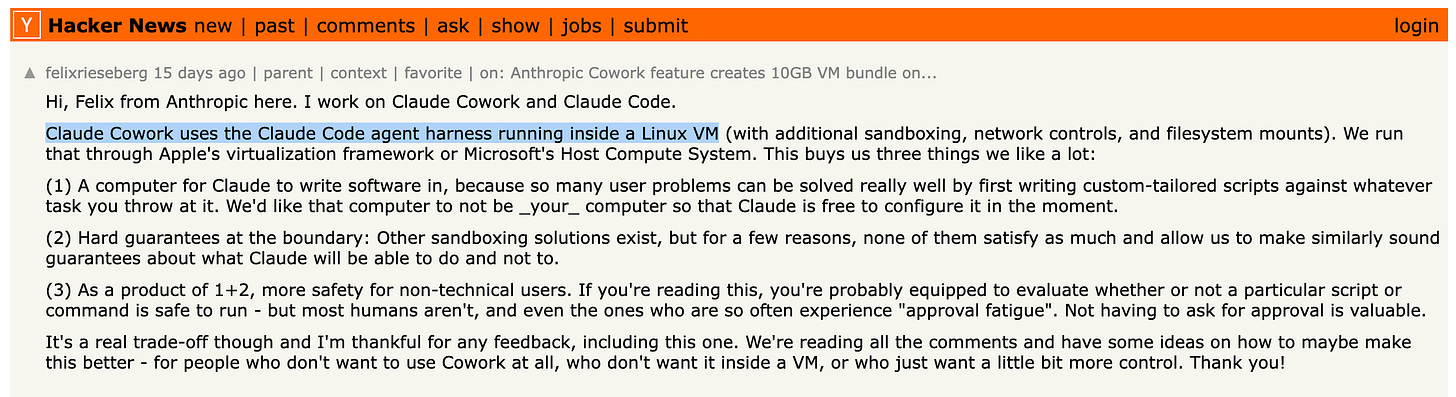
Why Claude gets its own computer: the VM as both a safety boundary and a capability unlock, letting Claude install tools, run scripts, and work more independently without constant approval
Safety through sandboxing: why “approve every command” is not a real long-term UX, and how virtual machines create a middle ground between uselessly safe and dangerously autonomous
How Cowork differs from Claude Code: coding evals vs. knowledge-work evals, different system-prompt tradeoffs, longer planning horizons, and heavier use of planning and clarification tools
Why skills matter: simple markdown-based instructions as a lightweight abstraction layer for reusable workflows, personalized automation, and portable agent behavior
Skills vs. MCPs: why Felix is increasingly interested in file-based, text-native interfaces that tell the model what to do, rather than forcing everything through rigid tool schemas
The portability problem: why personal skills should move across agent products, and the unresolved tension between public reusable workflows and private user-specific context
Real use cases already happening today: uploading videos, organizing files, handling taxes, managing calendars, debugging internal crashes, analyzing finances, and automating repetitive browser workflows
Почему «дружелюбный к пользователю» не значит «менее мощный»: Cowork как продукт-надмножество, во многом так же, как VS Code поначалу выглядел проще, чем Visual Studio, но стал более хакабельным и расширяемымКультура «сначала прототип» в Anthropic: почему Cowork был построен за 10 дней из множества уже существовавших внутренних компонентов и как внутренние прототипы сформировали финальный продуктПочему исполнение дешевеет: сдвиг от длинных меморандумов, спецификаций и споров к быстрому созданию нескольких кандидатов и выбору на основе реальности, а не теорииСпор о локальном: почему Felix считает, что Кремниевая долина недооценивает локальный компьютер, и почему размещать Claude «там, где вы работаете» часто мощнееПочему у Claude свой компьютер: VM как одновременно граница безопасности и разблокировка возможностей, позволяющая Claude ставить инструменты, запускать скрипты и работать более самостоятельно без постоянных подтвержденийБезопасность через песочницы: почему «подтверждай каждую команду» — не настоящий долгосрочный UX, и как виртуальные машины создают золотую середину между бесполезно безопасным и опасно автономнымЧем Cowork отличается от Claude Code: evals для кодинга против evals для knowledge work, разные компромиссы в системном промпте, более длинные горизонты планирования и более активное использование инструментов планирования и уточненияПочему skills важны: простые инструкции на основе markdown как лёгкий слой абстракции для переиспользуемых рабочих процессов, персонализированной автоматизации и портируемого поведения агентовSkills против MCP: почему Felix всё больше интересуется файловыми, текстово-нативными интерфейсами, которые говорят модели, что делать, вместо того чтобы прогонять всё через жёсткие схемы инструментовПроблема портируемости: почему персональные skills должны переноситься между агентными продуктами, и неразрешённое противоречие между публичными переиспользуемыми рабочими процессами и приватным контекстом конкретного пользователяРеальные сценарии использования уже сегодня: загрузка видео, организация файлов, оформление налогов, управление календарями, отладка внутренних крэшей, анализ финансов и автоматизация повторяющихся браузерных процессов
Why AI products should work with your existing stack: Anthropic’s bias toward integrating with Chrome, Office, and existing workflows instead of rebuilding every app from scratch
Почему AI-продукты должны работать с вашим существующим стеком: склонность Anthropic интегрироваться с Chrome, Office и уже имеющимися рабочими процессами, а не пересоздавать каждое приложение с нуля
Computer use one year later: how much better it has gotten, why vision plus browser context is such a superpower, and why letting Claude see the thing it is working on changes everything
Why many “AI verticals” may get compressed: specialized wrappers may matter in the short term, but better general models and stronger primitives could absorb a lot of narrow use cases
The future of junior work: Felix’s concerns about entry-level roles, labor-market disruption, and whether AI can compress early-career learning into denser simulated experience
Why Waterloo grads stand out: internships, shipping experience, and learning how real teams build products versus purely theoretical academic preparation
The agentic future of the desktop: what it means for Claude to have its own computer, whether AI should act on your machine or a remote one, and how intimacy with personal data changes the product design space
Why Electron still mattered: shipping Chromium as a controlled rendering stack, the limits of OS-native webviews, and why browser engines remain one of the great software abstractions
Anthropic’s Labs mentality: wild internal experiments, half-broken future-looking prototypes, and the broader effort to move users from asking questions to delegating increasingly long and valuable tasks
Why the endgame is not just more capability, but more independence: teaching users to trust AI with bigger scopes of work, for longer durations, with fewer interventions
Computer use спустя год: насколько он стал лучше, почему vision вместе с контекстом браузера — такая суперсила, и почему возможность дать Claude видеть то, над чем он работает, меняет всёПочему многие «AI-вертикали» могут схлопнуться: специализированные обёртки могут иметь значение в краткосрочной перспективе, но более качественные общие модели и более сильные примитивы способны поглотить множество узких сценариевБудущее работы джуниоров: опасения Felix насчёт начальных позиций, потрясений на рынке труда и того, сможет ли ИИ ужать ранний карьерный опыт в более плотный симулированный опытПочему выпускники Waterloo выделяются: стажировки, опыт выпуска продуктов и понимание того, как реальные команды строят продукты, в отличие от чисто теоретической академической подготовкиАгентное будущее десктопа: что значит для Claude иметь собственный компьютер, должен ли ИИ действовать на вашей машине или на удалённой, и как близость к личным данным меняет пространство дизайна продуктаПочему Electron всё ещё был важен: поставка Chromium как контролируемого стека рендеринга, ограничения нативных webview ОС и почему движки браузеров остаются одной из великих программных абстракцийFelix Rieseberg@felixrieseberg✨ 📚 Я написал небольшую книгу! Я неделями выжимал самые важные знания «для начинающих» о создании десктоп-приложений с @electronjs всего в 55 страниц. Спасибо замечательной @allymacdonald из @OReillyMedia — теперь это вполне солидное чтение! safaribooksonline.com/library/view/i… 18:34 · 11 дек. 20173 ответа · 28 репостов · 107 лайковМенталитет Labs в Anthropic: дикие внутренние эксперименты, наполовину сломанные прототипы, заглядывающие в будущее, и более широкое стремление перевести пользователей от задавания вопросов к делегированию всё более длинных и ценных задачПочему эндшпиль — это не просто больше возможностей, а больше независимости: приучить пользователей доверять ИИ более крупные объёмы работы, на более длительные сроки, с меньшим числом вмешательств
Felix Rieseberg
Felix Rieseberg
Website: https://felixrieseberg.com/
X: https://x.com/felixriesebergLinkedIn: https://www.linkedin.com/in/felixriesebergСайт: https://felixrieseberg.com/
Anthropic
Anthropic
Website: http://anthropic.com
Сайт: http://anthropic.com
Full Video Pod
Полное видео подкаста
Timestamps
Тайм-коды
00:00 — Cheap execution and building all the candidates
00:44 — Intro in the new Kernel studio
02:47 — What Claude Cowork is
04:18 — Why user-friendly can be more powerful
05:33 — How Anthropic built Cowork
07:09 — Prototype-first product development
08:00 — Why local computers still matter
09:20 — Skills, primitives, and platform leverage
12:13 — Cowork’s architecture: VM + Chrome + system prompt
15:38 — Felix’s own bug-fixing Cowork workflows
17:38 — Local-first agents
20:16 — Evals, planning, and knowledge-work optimization
23:14 — What Anthropic means by evals
24:21 — Scaffolding, tools, and why skills matter
27:44 — Demo: YouTube uploads and self-generated skills
31:03 — Calendar automation and cleaning your desktop
34:47 — Browser context and why DOM access matters
37:47 — Skills portability and plugins
44:36 — Which AI categories survive?
46:19 — Junior jobs, simulated work, and labor disruption
52:00 — Gradual takeoff vs big-bang takeoff
53:42 — Finance, taxes, and enterprise verticals
56:24 — Vision and the improvement in computer use
57:31 — Why Claude writes its own scripts
58:06 — Should Claude have its own computer?
1:01:26 — Windows 95 in JavaScript
1:03:19 — VM tradeoffs and sandbox design
1:07:23 — Approval fatigue and safe delegation
1:11:18 — The future of Cowork
1:12:27 — What comes next for agentic knowledge work
1:15:13 — Electron, Chromium, and desktop software lessons
1:22:16 — Multiplayer agents and coworker-to-coworker workflows
1:26:05 — Anthropic Labs and closing thoughts
00:00 — Дешёвое исполнение и построение всех кандидатов00:44 — Вступление в новой студии Kernel02:47 — Что такое Claude Cowork04:18 — Почему дружелюбное к пользователю может быть мощнее05:33 — Как Anthropic построил Cowork07:09 — Разработка продукта по принципу «сначала прототип»08:00 — Почему локальные компьютеры всё ещё важны09:20 — Skills, примитивы и рычаг платформы12:13 — Архитектура Cowork: VM + Chrome + системный промпт15:38 — Собственные рабочие процессы Felix по исправлению багов в Cowork17:38 — Local-first агенты20:16 — Evals, планирование и оптимизация под knowledge work23:14 — Что Anthropic понимает под evals24:21 — Скаффолдинг, инструменты и почему skills важны27:44 — Демо: загрузки на YouTube и самосозданные skills31:03 — Автоматизация календаря и уборка рабочего стола34:47 — Контекст браузера и почему важен доступ к DOM37:47 — Портируемость skills и плагины44:36 — Какие AI-категории выживут?46:19 — Работа джуниоров, симулированная работа и потрясения на рынке труда52:00 — Постепенный взлёт против взрывного взлёта53:42 — Финансы, налоги и корпоративные вертикали56:24 — Vision и прогресс в computer use57:31 — Почему Claude пишет собственные скрипты58:06 — Должен ли у Claude быть собственный компьютер?1:01:26 — Windows 95 на JavaScript1:03:19 — Компромиссы VM и дизайн песочницы1:07:23 — Усталость от подтверждений и безопасное делегирование1:11:18 — Будущее Cowork1:12:27 — Что дальше для агентной knowledge work1:15:13 — Electron, Chromium и уроки десктоп-софта1:22:16 — Мультиплеерные агенты и рабочие процессы «коллега-коллеге»1:26:05 — Anthropic Labs и заключительные мысли
Transcript
Транскрипт
Alessio: Hey everyone. Welcome to the Latent Space Podcast, our first one in the new studio. This is Alessio, founder of Kernel Labs, and I’m joined by swyx, editor of Latent Space.
Alessio: Привет всем. Добро пожаловать в подкаст Latent Space, наш первый в новой студии. Это Alessio, основатель Kernel Labs, и со мной swyx, редактор Latent Space.
swyx: Yeah, so nice to be here. Thanks to, uh, TJ, Alessio, Allen helping to set everything up. It looks beautiful. We even have the logo outside.
swyx: Да, очень приятно быть здесь. Спасибо TJ, Alessio, Allen, которые помогли всё настроить. Выглядит прекрасно. У нас даже логотип снаружи.
Yeah, kind.
Да, мило.
Felix: It’s like really nice, right? When you walk in here as a guest, you’re like, ah, this is a serious production. You’re like, feel it immediately.
Felix: Это реально круто, правда? Когда заходишь сюда гостем, думаешь: ага, это серьёзное производство. Сразу это чувствуешь.
swyx: Yeah. Felix, you’ve been, you’re, you’re currently a product manager of Cowork or,
swyx: Да. Felix, ты сейчас, ты, ты сейчас продакт-менеджер Cowork или…
Felix: uh, really Technic
Felix: эм, на самом деле, технический…
swyx: Eng. Yeah. The, the identities are kind of vague member technical staff.
swyx: инженер. Да. Эти роли довольно расплывчатые — member of technical staff.
Felix: I know member staff is like, the official title will carry around forever.
Felix: Знаю, member of staff вроде как… официальное звание, которое будешь носить вечно.
swyx: Yeah. I basically kind of wanted, like we’ve been. Kinda obsessed. I, I’ve been using it a lot, even for managing latent space. Like, uh, cowork helps me upload videos and like title things and like edit and everything. It’s, it’s like really amazing.
swyx: Да. Я, в общем, как бы хотел, мы прям зациклились. Я очень много им пользуюсь, даже для управления Latent Space. Cowork помогает мне загружать видео, придумывать заголовки, редактировать и всё такое. Это реально потрясающе.
Alessio: Cool. He said multiple times Cowork has said gi in the group track.
Alessio: Круто. Он несколько раз говорил, что Cowork сказал «gi» в групповом чате.
swyx: Yeah, yeah, yeah. So, so we have a second, uh, we have a second channel, uh, for latent space tv. Uh, and I, uh, and uh, we basically, this is our Discord meetup. Um, and I I, we have like Claude Coworks, it might be a GI, I don’t know if we, we have, uh, uploaded it yet, but one of the sessions was like a, like a Claude cowork thing.
swyx: Да, да, да. Так вот, у нас есть второй канал для latent space tv. И мы, по сути, это наша встреча в Discord. У нас как бы есть Claude Cowork, это, может, было GI, не знаю, загрузили ли мы это уже, но одна из сессий была про штуку с Claude Cowork.
Felix: I, you have to see, I would love to see it. Like, I’m so curious, like one of the most fun parts of my job is like constantly see the weird things people use Cowork for because it’s obviously like very hard for us to actually design for specific use cases we do. But like every single person who’s like most amazed is usually amazed about a thing that I didn’t even expect cowork would be good at.
Felix: Я, должен признаться, очень хотел бы это увидеть. Мне так любопытно — одна из самых интересных частей моей работы это постоянно видеть странные вещи, для которых люди используют Cowork, потому что нам, очевидно, очень трудно проектировать под конкретные сценарии. Но почти каждый, кто больше всего поражён, обычно поражён тем, для чего я даже не ожидал, что Cowork будет хорош.
Um, we have a new designer and it’s one of the first small tasks. I was like, Hey, we need like a new emoji for cowork for our internal stock. It’s like a pretty small thing. I like, can you please do it? And he drew an SVG and just gave it to coworker was like, can you animate this emoji? And now it has like this beautiful loopy animation.
У нас есть новый дизайнер, и одна из первых небольших задач… Я говорю: эй, нам нужен новый эмодзи для Cowork для нашего внутреннего стока. Это довольно мелкая штука. Я такой: пожалуйста, сделай. Он нарисовал SVG и просто отдал его Cowork со словами: можешь анимировать этот эмодзи? И теперь у него такая красивая зацикленная анимация.
Um, and I mean, I think obviously this goes down to like, it turns out you can do more things with code than you expected, but it, it’s like that kind of stuff that is really fun to me. So, long story short, I would love to see like, the kind of things you’re doing.
И, в общем, я думаю, это, очевидно, сводится к тому, что оказывается, кодом можно сделать больше, чем ты ожидал, но именно такие штуки мне реально в кайф. Короче говоря, очень хотел бы увидеть, что вы там делаете.
swyx: I’ll pull it up. I’ll pull it up.
swyx: Я открою. Я открою.
Felix: Yeah. Yeah.
Felix: Да. Да.
swyx: Uh, but before we get into it, I, I think always wanna start with like a top level. What is Claude Cowork for people who haven’t heard of it? Haven’t tried it out.
swyx: Но прежде чем перейти к этому, мне кажется, всегда хочется начать с верхнего уровня. Что такое Claude Cowork для тех, кто о нём не слышал, не пробовал?
Felix: Okay. Uh, real quick, Claude Cowork is a user friendly version of Claude Code. So the way it basically works is we have Claude Code and for us, fairly impressive agent harness that over December we noticed more and more people are using either, even though they’re not technical, they, they’re not at home in the terminal or they are at home in the terminal, but they started using Claude Code for non-coding workloads, right?
Felix: Окей. Если коротко — Claude Cowork это дружелюбная к пользователю версия Claude Code. Работает это примерно так: у нас есть Claude Code, для нас довольно впечатляющий агентный харнесс, и в декабре мы заметили, что всё больше людей используют его, даже не будучи техническими — они не как дома в терминале, или они как дома в терминале, но начали использовать Claude Code для не-кодинговых задач, да?
Like managing expenses or like filling out receipts or organizing a knowledge base. Like there was a big obsidian moment that a lot of people liked and we wanted to capitalize on that, but also bring, bring this capability to people who are not terminal native and who might not know how to like brew and store something.
Вроде управления расходами, или заполнения чеков, или организации базы знаний. Был большой «obsidian-момент», который многим понравился, и мы хотели на этом сыграть, но ещё и принести эту возможность людям, которые не нативны в терминале и могут не знать, как сделать brew и установить что-то.
So cowork is Claude Code running in original machine with a little bit of padding, a little bit more guardrails, making it a little safer and a little bit more convenient for people who don’t wanna first open up the terminal when they go to work.
Так что Cowork это Claude Code, запущенный на исходной машине, с небольшой прокладкой, чуть большим количеством ограждений, делающий его немного безопаснее и удобнее для людей, которые не хотят первым делом открывать терминал, когда садятся за работу.
swyx: It’s interesting, uh, that is kind of. Pitch that way as a more user friendly thing because I always feel like it, it, to me, I I treat it as like why I’m familiar with Claude Code.
swyx: Интересно, что это позиционируется как нечто более дружелюбное к пользователю, потому что мне всегда кажется, что для меня, ну, поскольку я знаком с Claude Code…
Like we, we did a Claude Code episode Yeah. A year ago. But this one is like even more power user tools ‘cause it, uh, it kind of integrates much better with like clotting Chrome and, uh, in all the, all the other tooling. But like, maybe, maybe that’s like a perception thing, right? Like
Мы же делали выпуск про Claude Code, да, год назад. Но эта штука как будто даже больше для power-юзеров, потому что она гораздо лучше интегрируется с Claude и Chrome и со всем остальным инструментарием. Но, может, это вопрос восприятия, да? Типа…
Felix: No, honestly, I don’t think you’re wrong.
Felix: Нет, честно, я не думаю, что ты неправ.
This is like a, a thing I’ve been thinking a lot about for like the last two weeks. So,
Это как раз то, о чём я много думал последние пару недель. Так что…
swyx: but when they say user friendly, it’s like, oh, it’s the dumb down version. But no, actually this is the superset.
swyx: но когда говорят «дружелюбный к пользователю», это звучит как «упрощённая версия». Но нет, на самом деле это надмножество.
Felix: Yeah. Like, I think a similar thing happened, A similar thing happened to me about 10 years ago, like maybe 12 years ago when I was at Microsoft and we started working on, on Electron and like browser-based technologies and cross-platform stuff.
Felix: Да. Похожая штука случилась, похожая штука случилась со мной лет 10 назад, может, лет 12 назад, когда я был в Microsoft и мы начали работать над Electron и браузерными технологиями и кросс-платформенными вещами.
And one of the first use cases was Visual Studio Code, which used to be a website. And the initial narrative was, or Visual Studio Code is, is like a more user-friendly version of Visual Studio. But in a similar vein, I think there was some voices saying, oh, this is. For serious developers, like, we’re not gonna use this.
И одним из первых сценариев был Visual Studio Code, который раньше был сайтом. Изначальный нарратив был: Visual Studio Code это более дружелюбная к пользователю версия Visual Studio. Но в том же духе были голоса, которые говорили: о, это для… Для серьёзных разработчиков мы это использовать не будем.
Right? For like anything. And I think in the end what happened is people have different stories about why Visual Studio Code became such a big thing. But my personal, my personal belief is that the Hackability and the extendability has like played a pretty big role, right? You can hook in Visual Studio Code that like almost any workload, it’s so easy to hack on, so easy to put extensions for it.
Да? Для чего угодно. И, мне кажется, в итоге произошло следующее: у людей разные истории о том, почему Visual Studio Code стал такой большой штукой. Но моё личное убеждение — что хакабельность и расширяемость сыграли довольно большую роль, да? Ты можешь подключить к Visual Studio Code почти любую задачу, на нём так легко хакать, так легко писать расширения.
And I think cowork might be hitting a similar thing where it’s very easy to extend and it’s very easy to bring into your workflows. Uh, so the convenience I think is a bit of a, it’s obviously the thing we strive for as developers, but I think the way people find value in it then is by probably mapping it onto whatever they actually have to do in their job.
И, мне кажется, Cowork может попадать в похожую штуку, где его очень легко расширять и очень легко встраивать в свои рабочие процессы. Так что удобство, я думаю, это… это, очевидно, то, к чему мы как разработчики стремимся, но способ, которым люди находят в этом ценность, — это, вероятно, наложение его на то, что им реально нужно делать на работе.
Alessio: So end of last year, you see the spike of like non-technical usage and clock code. What’s the design process to say we should make clock code work? Because I mean, you built it in only 10 days. Um, I’m sure there was some discussion before on whether it’s easier to use mean. You know, like making, making like a desktop GUI is obviously one way to do it, but like there’s a lot of nuance in the product.
Alessio: Итак, в конце прошлого года вы видите всплеск нетехнического использования Claude Code. Какой был процесс проектирования, чтобы сказать «нам стоит сделать Claude Code…»? Ведь, я имею в виду, вы построили его всего за 10 дней. Уверен, до этого были какие-то обсуждения, проще ли это использовать… Ну знаешь, сделать десктопный GUI — очевидно, один из способов, но в продукте много нюансов.
Like maybe talk people through what was like the trigger of like, we should build a separate thing. We should not build like a different plot code thing. And then maybe some of the more interesting design decisions that maybe you didn’t take.
Может, расскажешь людям, что было триггером — «нам надо построить отдельную штуку, нам не надо строить какую-то другую версию Claude Code». А потом, может, о некоторых более интересных дизайнерских решениях, которые ты, возможно, не принял.
Felix: Yeah, I think philanthropic, we’ve been thinking about ways to move people who are comfortable with using Claude to answer questions and bring more of the power of like this thing to now like, execute tasks for you.
Felix: Да, я думаю, в Anthropic мы давно размышляем о способах перевести людей, которым комфортно использовать Claude для ответов на вопросы, к тому, чтобы привнести больше мощи этой штуки и теперь, ну, выполнять задачи за тебя.
I can like solve problems for you can like build things for you. How do we bring that capability to people who are currently mostly comfortable with like a like question answer paradigm within the chat. And we’ve had a lot of prototypes around that. Just going back as far as like easily a year and a half.
Я могу как бы решать проблемы за тебя, могу строить вещи за тебя. Как нам принести эту возможность людям, которым сейчас в основном комфортна парадигма «вопрос-ответ» внутри чата? И у нас было много прототипов на эту тему. Если оглянуться назад, легко на полтора года.
Like we had a lot of people working on that. Um, and internally philanthropic is a very prototype demo, first culture. We have a lot of like internal prototypes that don’t reach the public. What Cowork actually became is like we sort of picked the right pieces out of the many prototypes that we had.
У нас много людей над этим работало. И внутренне Anthropic это очень прототип-демо-ориентированная культура. У нас много внутренних прототипов, которые не доходят до публики. То, чем Cowork в итоге стал, — это что-то вроде того, что мы выбрали правильные кусочки из множества прототипов, которые у нас были.
Right. And that’s, that’s maybe also like, I think an important qualifier whenever people mention this like 10 day number. I do think it’s important to me to mention that within Double Scratch there was like a lot of stuff already happening, right? Like, and I think it’s important for people to remember that when you build a website, you use React, you use like a bunch of other things.
Да. И это, наверное, тоже важная оговорка всякий раз, когда люди упоминают это число «10 дней». Мне кажется важным упомянуть, что внутри уже происходило очень много всего, да? И, думаю, людям важно помнить, что когда ты строишь сайт, ты используешь React, ты используешь кучу других вещей.
And this is like a similar scenario with like a lot of pieces we already had. Um, and in terms of decision path, I think we live in like an interesting new world where execution is actually quite cheap.
И это похожий сценарий — с кучей кусочков, которые у нас уже были. И в плане пути принятия решений, я думаю, мы живём в интересном новом мире, где исполнение на самом деле довольно дёшево.
swyx: Mm-hmm.
swyx: Угу.
Felix: So maybe, maybe what you would do That’s so crazy. The year. I know it’s wild.
Felix: Так что, может, то, что ты бы сделал… Это так безумно. Год. Знаю, это дико.
swyx: You should be, ideas are cheap.
swyx: Так и есть — идеи дёшевы.
Execution is the hard part. I
Исполнение — вот сложная часть. Я…
Felix: know. And like the, we, we used to live in this world maybe where you would take a product manager and the product manager would go to a number of potential customers and in this like very low bandwidth way, would try to. Try to like tease out what are the problems they’re having, what are they willing to buy?
Felix: знаю. И мы раньше жили в этом мире, может быть, где ты берёшь продакт-менеджера, и продакт-менеджер идёт к ряду потенциальных клиентов и таким очень низкочастотным способом пытается вытянуть, какие у них проблемы, что они готовы купить.
Um, and then maybe what can you build to like drive out that need and then you go back and you like draft a spec and you think about it and then like you make a design and you execute it. We internally philanthropic app, not pretty much closer to the point where we’re like, don’t even write a memo, just like build, like let’s build all the candidates very quickly.
А потом, может, что ты можешь построить, чтобы закрыть эту потребность, и тогда ты возвращаешься и пишешь спецификацию, и обдумываешь её, а потом делаешь дизайн и реализуешь его. Внутренне в Anthropic мы практически близки к точке, где мы говорим: даже не пиши меморандум, просто строй — давай построим всех кандидатов очень быстро.
Let’s just build all of them and then pick the best ones. I think the, the decision that is most impactful both for the product as well for the users right now is like the way we put value on your local computer. I think that’s a big decision point a lot of people have thought about. Should this thing, whatever it is, should it ultimately run into computer or should it run in the cloud?
Давай просто построим всех, а потом выберем лучших. Я думаю, решение, которое сейчас наиболее значимо и для продукта, и для пользователей, — это то, как мы оцениваем ценность твоего локального компьютера. Я думаю, это большая развилка, о которой многие задумывались. Должна ли эта штука, чем бы она ни была, в конечном счёте работать на компьютере или работать в облаке?
‘cause they’re big trade offs, right?
Потому что тут большие компромиссы, да?
Alessio: I guess like if we solve auth, it would be easy to do in the cloud. But I think like the fact that I can just download any file from anywhere and then put it and cowork there, it’s like a big unlock. Um, I mean it’s interesting you mentioned reusing certain pieces. I think this is something I’ve been thinking about even with Claude Code, right?
Alessio: Думаю, если бы мы решили вопрос с авторизацией, в облаке это было бы легко сделать. Но мне кажется, тот факт, что я могу просто скачать любой файл откуда угодно и положить его в Cowork прямо там, это большая разблокировка. И, интересно, ты упомянул переиспользование определённых кусочков. Это то, о чём я думал даже применительно к Claude Code, да?
The price of like writing code is going to zero, blah, blah, blah. But it actually seems like the value of having some sort of platform substrate is like increasing because as you build these new things, you can kind of plug them together.
Цена написания кода стремится к нулю, бла-бла-бла. Но на деле похоже, что ценность наличия некой платформенной основы наоборот растёт, потому что по мере того, как ты строишь эти новые штуки, ты можешь соединять их вместе.
Felix: Yeah.
Felix: Да.
Alessio: So I almost feel like when people are saying, oh, the value of a lot of software is gonna zero because you can recreate it, to me it’s almost like the opposite.
Alessio: Так что я почти чувствую, что когда люди говорят «о, ценность кучи софта пойдёт к нулю, потому что его можно пересоздать», — для меня это почти наоборот.
It’s like having an existing platform to build on top of. It’s like even more valuable because you can kind of bolt things on.
Это как… наличие существующей платформы, поверх которой строить, становится даже более ценным, потому что ты можешь как бы прикручивать к ней разные штуки.
Felix: Yeah.
Felix: Да.
Alessio: You have obviously mcps, you have skills, you have like obviously the models, which is a big part. All these things kind of come together. Do you feel like that’s a valid way to think about it, where people should invest even more in kind of like primitives.
Alessio: У тебя, очевидно, есть MCP, есть skills, есть, очевидно, модели — это большая часть. Всё это как бы сходится вместе. Чувствуешь ли ты, что это правильный способ думать об этом, где людям стоит ещё больше инвестировать в примитивы…
To rebuild on or are you like recreating a lot of it each time because like things change and it’s easier to rewrite than reuse?
…чтобы перестраивать поверх, или вы скорее каждый раз пересоздаёте многое, потому что вещи меняются и проще переписать, чем переиспользовать?
Felix: You know, I think, I think you’re right. I think you’re right that the holistic platform is really useful. And this is maybe a whole like a somewhat contrarian view to a lot of people in ai.
Felix: Знаешь, я думаю, я думаю, ты прав. Думаю, ты прав, что целостная платформа реально полезна. И это, может быть, несколько контрарианский взгляд по сравнению с многими людьми в AI.
I actually don’t think that the future is going to be hyper personalized software down to the point where everyone is running their own version. Like, I actually think it’s going to be quite hard for all of us to have our own internal chat tool and like, if I wanna talk to you, like
Я на самом деле не думаю, что будущее будет в гиперперсонализированном софте вплоть до того, что каждый запускает свою собственную версию. Я, наоборот, думаю, что всем нам будет довольно трудно иметь свой собственный внутренний чат-инструмент, и, ну, если я захочу поговорить с тобой, то…
swyx: how
swyx: как
Felix: is that gonna work, right?
Felix: это будет работать, да?
In the, in the context of cowork and how we build it, I think it’s a bit of a combination. Like what the, the execution that gets cheap is not necessarily rebuilding all the primitives. I think our priori, there’s also not a lot of value in it. So for instance, my team did not think about rebuilding clock code.
В контексте Cowork и того, как мы его строим, я думаю, это что-то вроде комбинации. Дешевеет именно то исполнение, которое не обязательно про пересборку всех примитивов. Я думаю, в этом и ценности-то особой нет. Например, моя команда не думала о пересоздании Claude Code.
We’re like very much started with the. The core thesis of this should be Claude Code.
Мы прямо начали с основного тезиса: это должен быть Claude Code.
Mm-hmm.
Угу.
Felix: And then we’ll like build things on top of it. The part of the execution that gets a little cheaper is like, how do you take all of these Lego pieces and put them together in a way that makes sense for users?
Felix: А потом мы строим вещи поверх него. Та часть исполнения, которая немного дешевеет, — это то, как ты берёшь все эти кусочки Lego и складываешь их вместе так, чтобы это имело смысл для пользователей.
It’s like actually valuable. You have so many different approaches now in terms of what kind of, what kind of things do you actually elevate to a primitive, do you strongly believe that all your products should be built by just combining primitive that the public also has available? Do you keep some things internal?
Это реально ценно. У тебя теперь столько разных подходов к тому, что именно ты выводишь на уровень примитива. Веришь ли ты твёрдо, что все твои продукты должны строиться просто из комбинирования примитивов, которые доступны и публике? Оставляешь ли ты что-то внутренним?
Um, and I think that’s still evolving, but I think what’s probably gonna go away is like, I’m not sure if it’s gonna fully go away, but I’m gonna say, I think for me personally, I will probably no longer try to come up with a really good product without testing up with people. This is not a new concept, but wherever you used to have to make costly decisions around, do we pick technology A or technology B, or do we like, um, build it this way, build it the other way.
И, думаю, это всё ещё эволюционирует, но, мне кажется, что, вероятно, уйдёт… не уверен, уйдёт ли полностью, но скажу: я думаю, что лично я, вероятно, больше не стану пытаться придумать действительно хороший продукт, не протестировав его с людьми. Это не новая концепция, но раньше там, где приходилось принимать дорогие решения — берём ли мы технологию A или технологию B, или строим так, или строим иначе…
I really strongly believe now you just build all of them and try them out with a small focus group and then whatever, whatever is better is what you go with. Right. And that, that is probably quite different even from how we maybe worked a year ago. Right. Like, I think, I think this happened very recently.
Я теперь действительно твёрдо верю, что ты просто строишь их все и пробуешь с небольшой фокус-группой, а потом то, что лучше, — это то, с чем ты идёшь дальше. И это, наверное, довольно сильно отличается даже от того, как мы, может быть, работали год назад, да? Думаю, это произошло совсем недавно.
Alessio: Yeah. I started building something in on Electron since you’re here. Coincidence. Uh, but then Electron and like SQL Light are like, there’s like some issues that like between development and like, uh, building anyway. And I was like, let’s just rebuild the whole thing in Swift and just recreated the whole thing in Swift.
Alessio: Да. Я начал строить кое-что на Electron, раз уж ты здесь. Совпадение. Но потом Electron и SQLite — там есть какие-то проблемы между разработкой и сборкой, в общем. И я такой: давай просто перестроим всё на Swift, и просто пересоздал всё на Swift.
And it’s like, I. It’s done.
И вот, оно… готово.
swyx: You know, I didn’t take any effort. I, I, I don’t even know Swift.
swyx: Знаешь, мне это не стоило никаких усилий. Я, я даже не знаю Swift.
Alessio: Yeah, exactly. I was like, I’m the, I’m not reviewing it anyway, whatever. You can write in whatever language you pick, but the important stuff that I did was not write the electron bindings. Yeah. It was like the logic of what happens in the app, you know, and then the model is like, yeah, I can just recreate the same thing as with
Alessio: Да, именно. Я такой: я всё равно это не ревьюю, неважно. Можешь писать на каком хочешь языке, но важное, что я делал, — это не писать electron-биндинги. Да. Это была логика того, что происходит в приложении, понимаешь, а потом модель такая: да, я могу просто пересоздать то же самое на…
swyx: Yeah.
swyx: Да.
I, I think you still want, especially for people who are doing like high performance software or like very complex software, uh, you still want like, some view of the architecture. Uh, but you can use markdown for that,
Думаю, всё же хочется, особенно для тех, кто делает высокопроизводительный софт или очень сложный софт, всё же хочется некоторого взгляда на архитектуру. Но для этого можно использовать markdown, да?
Felix: right? Yeah.
Felix: Да.
swyx: Uh, you don’t actually have to read the code again. I, I’m still like on a sort of like a definitional thing.
swyx: Тебе на самом деле не нужно снова читать код. Я всё ещё как бы зависаю на одной формулировочной штуке.
Um, can we build a good mental model of Claude Cowork? Um, this is what I have, right? Like you you said it’s like fundamentally cloud co. We don’t wanna touch it. There’s the cloud app, there’s clouding Chrome. I think you guys do something different in planning, but, uh, I’ve been talking with Tariq who is on the cloud co team, and you guys are, he’s like, no, we just exposed planning.
Можем ли мы построить хорошую ментальную модель Claude Cowork? Вот что у меня есть, да? Ты сказал, что это фундаментально Claude Code, мы не хотим его трогать. Есть приложение Claude, есть Claude в Chrome. Думаю, в планировании вы делаете что-то иначе, но я общался с Tariq, который в команде Cowork, и вы… он такой: нет, мы просто вывели планирование наружу.
Maybe we can clarify like, what are the major pieces. That people should be aware. It goes into cowork, like,
Может, мы можем прояснить, какие основные части, о которых людям стоит знать, входят в Cowork, типа…
Felix: okay, I think you basically have them. So really, um, you can, you can take planning more or less out. I think there’s a few things that are really valuable in cowork. Um, the virtual machine is probably the most powerful thing.
Felix: окей, я думаю, ты в целом их назвал. Так что планирование можно более-менее убрать. Думаю, в Cowork есть несколько действительно ценных вещей. Виртуальная машина — пожалуй, самая мощная штука.
So we currently run like a, we currently run like a lightweight VM and we put clocked out into the vm and we do that for, for, um, a number of reasons. Safety and security is a big one, but even if you, even if you ignore for a second safety and security and you’re just like, okay, Yolo, I want this thing to do whatever.
Сейчас мы запускаем такую лёгкую VM и помещаем Claude Code в эту VM, и делаем это по ряду причин. Безопасность и защита — одна из больших. Но даже если на секунду проигнорировать безопасность и защиту, и ты такой: окей, yolo, я хочу, чтобы эта штука делала что угодно…
It is quite powerful to give Claus on computer that is like generally a good idea. And in terms of architecture and UX and everything else that we’ve been working on, philanthropic, it often is quite useful for you to like anthropomorphize, um, clot aggressively and just be like, this is a person. What will you do if you give a, if you had a person, right?
Дать Claude собственный компьютер довольно мощно, это в целом хорошая идея. И в плане архитектуры, UX и всего остального, над чем мы работали в Anthropic, часто довольно полезно агрессивно антропоморфизировать Claude и просто говорить: это человек. Что ты сделаешь, если дашь… если бы у тебя был человек, да?
Yeah. And the analogy I’ve given my dad this morning who is still like quite insistent on using chat even for like coding things, is if you were a developer and your employer told you that you don’t need a computer, they’re just gonna like, send you emails with a code and you send emails with code back like that, maybe work for Patrick Miles in the back, but that it’s not very effective.
Да. И аналогия, которую я привёл сегодня утром своему папе, который всё ещё настойчиво использует чат даже для кодинга: если бы ты был разработчиком и твой работодатель сказал бы, что компьютер тебе не нужен, они просто будут слать тебе письма с кодом, а ты будешь слать письма с кодом в ответ — это, может, и сработает для кого-то на задворках, но это не очень эффективно.
Um, so what we can do with the VM is because it’s a, it’s a Linux system, Claude Code has more or less free reign to install whatever needs to install. It can install Python, it can install no js. We do have strict network ingress and egress controls. So you can still, as, as a user in like plain human language, make it clear to, to the entire system what you’re okay with and what you’re not okay with.
Так что то, что мы можем сделать с VM: поскольку это Linux-система, у Claude Code более-менее свобода ставить всё, что нужно поставить. Он может поставить Python, может поставить Node.js. У нас есть строгий контроль входящего и исходящего сетевого трафика. Так что ты по-прежнему можешь как пользователь обычным человеческим языком дать понять всей системе, с чем ты согласен, а с чем нет.
But at no point do we have to ask a real person, like a, like a person who might be in marketing or a lawyer. I’d have to go to a lawyer and be like, are you okay with me installing Homebrew?
Но ни в какой момент нам не нужно спрашивать живого человека, например, человека из маркетинга или юриста. Мне пришлось бы идти к юристу и спрашивать: ты не против, если я поставлю Homebrew?
Alessio: Yeah, yeah.
Alessio: Да, да.
Felix: Right. Because the implications of the question and the answer are complex and nuanced and like, not, not easy to reason about.
Felix: Да. Потому что последствия вопроса и ответа сложны, нюансированы и непросты для осмысления.
This gives us a lot of distraction that makes Cloud very powerful. Now then around it, we, we do probably have a number of things that also keeps growing almost every single week that you’re probably noticing that make cowork maybe better for certain tasks than just cloud. Cloud on its own. Yeah. But most of those actually live in the system prompt.
Это даёт нам много изоляции, которая делает Claude очень мощным. Дальше вокруг этого у нас есть ряд вещей, которые тоже почти каждую неделю растут, ты, наверное, замечаешь, которые делают Cowork, может, лучше для определённых задач, чем просто Claude сам по себе. Но большинство из них на самом деле живёт в системном промпте.
They’re about like, what can we infer about the work that you do? What can we, what can we intru in the system prompt to make that more effective? It’s of course the like very tight integration with Cloud and Chrome. You’re noticing that a lot of people, especially as the models get better, a lot of people throw up their hands when it comes to MCP connectors in this area.
Они про то, что мы можем заключить о работе, которую ты делаешь. Что мы можем заложить в системный промпт, чтобы сделать это эффективнее. Это, конечно, и очень тесная интеграция с Claude и Chrome. Ты замечаешь, что многие люди, особенно по мере того как модели становятся лучше, многие просто опускают руки, когда дело доходит до MCP-коннекторов в этой области.
I’m not gonna, I’m not gonna go through like 25 M CCP connectors, click off everywhere and then like half of them don’t let me do the things anyway. So Cloud and Chrome is quite powerful because we can just talk to the cloud and Chrome sub agent and that will just do things for you.
Я не буду проходить через 25 MCP-коннекторов, кликать везде, а потом половина из них всё равно не даёт мне делать что нужно. Так что Claude и Chrome довольно мощны, потому что мы можем просто поговорить с саб-агентом Claude и Chrome, и он просто сделает за тебя дела.
swyx: Yeah, so, so one example right in MCPI, honestly, I think that the state of MCP is kind of, kind of.
swyx: Да, так вот один пример, честно говоря, с MCP. Я думаю, что состояние MCP сейчас довольно…
Really hard to integrate. Um, I need to, I needed to add, uh, Figma MCP to the coding agent that I use.
Реально трудно интегрировать. Мне нужно было добавить Figma MCP к кодинг-агенту, которым я пользуюсь.
Felix: Yeah.
Felix: Да.
swyx: Uh, and, but I didn’t wanna read the docs, so I just had caught to it. And it’s, it’s great at reading docs and the same, same way I had to set up like a Google Cloud, um, account for some project I was working on and get some API keys somewhere.
swyx: Но я не хотел читать доки, так что я просто отдал это Claude. И он отлично читает доки, и точно так же мне надо было настроить аккаунт Google Cloud для какого-то проекта, над которым я работал, и получить где-то API-ключи.
And Google Cloud is famously super hard to navigate, so I just didn’t wanna deal with any of it. I just used Claude Cowork
А Google Cloud, как известно, ужасно неудобен в навигации, так что я просто не хотел со всем этим возиться. Я просто использовал Claude Cowork.
Felix: within the first week of developing on Core. This happened very, very quickly. Um, I caught myself by starting to use cowork for coding tasks, which is not ostensibly what we built it for, right?
Felix: В первую же неделю разработки на Cowork это произошло очень-очень быстро. Я поймал себя на том, что начал использовать Cowork для кодинг-задач, для чего мы его, по идее, не строили, да?
We don’t need to. But I found myself, um, I found myself like on our internal, internal tool that we have for, to collect crashes and just like debugging information and I found myself sort like picking out the ones that I think we can easily fix versus the ones that might be like kernel corruption or something else on the operating system.
Нам не нужно. Но я ловил себя на том, что во внутреннем инструменте, который у нас есть для сбора крэшей и отладочной информации, я как бы выбирал те, которые, как мне кажется, мы можем легко починить, против тех, которые могут быть, например, повреждением ядра или чем-то ещё в операционной системе.
And I found myself sort of picking these out and then just telling Clark, go fix this bug. I was like, what am I doing here? Go one level up, tell a cowork, I want you to go to all these crash tools. I want you to find all the bugs that you think are fixable and not like an operating system crash. And then I want you to tell another cloud to like fix all of that.
И я ловил себя на том, что как бы выбираю их, а потом просто говорю Claude: иди почини этот баг. И я такой: что я тут делаю? Поднимись на уровень выше, скажи Cowork: я хочу, чтобы ты пошёл во все эти инструменты для крэшей, нашёл все баги, которые ты считаешь чинимыми и которые не падения операционной системы. А потом я хочу, чтобы ты сказал другому Claude всё это починить.
Um, and that’s, that’s, that’s sort of another cloud,
И это, это как бы другой Claude…
swyx: just so it can spin up another instance or,
swyx: то есть он может поднять ещё один инстанс или…
Felix: uh, it, currently what I do is, um, and this is a bit of a hack, but I tell it to use clockwork remote to which website itself? Yeah, that’s interesting. So you basically take, if you, if you imagine like a dashboard with like 20 bucks, you, this is remote control or clock or remote, or, sorry, I just wanted to confirm what, the way I’m using it is.
Felix: сейчас я делаю вот что — и это немного хак, но я говорю ему использовать Claude Code remote, который сам по себе сайт? Да, это интересно. Так что ты по сути берёшь, если представить себе дашборд с, скажем, 20 багами, ты — это remote control или Claude remote, или, прости, я просто хотел уточнить — способ, которым я его использую, такой.
I have cowork running and I’m telling cowork, here’s where I normally go every morning to find the latest bugs. Go read the entire bug list, separate out which ones are fixable, which ones are, are fixable, and then for the fixable ones, four is this almost loop. For each bug, write a markdown file with a prompt.
У меня запущен Cowork, и я говорю Cowork: вот куда я обычно хожу каждое утро, чтобы найти последние баги. Прочитай весь список багов, отдели те, что чинимы, от тех, что нечинимы, а потом для чинимых — почти цикл. Для каждого бага напиши markdown-файл с промптом.
And then for each markdown v, that is a prompt. Start of a cloud set. So natively Claude Code has
А потом для каждого markdown, который является промптом, запусти Claude. Так что нативно у Claude Code есть…
swyx: this concept of subagents. Mm-hmm. And this is basically a subagent, but you’re not using the subagent functionality.
swyx: эта концепция саб-агентов. Угу. И это по сути саб-агент, но ты не используешь функциональность саб-агентов.
Felix: I’m not using the subagent functionality. And the reason I’m not is because I’m firing that off as a Claude Code remote
Felix: Я не использую функциональность саб-агентов. И причина, почему не использую, в том, что я запускаю это как Claude Code remote…
swyx: task.
swyx: задачу.
Felix: Yes. That’s kind of nice. ‘cause then I can just fire it off. I can go to my next meeting and in Claude Code remote. Now the work is happening.
Felix: Да. Это довольно приятно. Потому что тогда я могу просто запустить это. Я могу уйти на следующую встречу, и в Claude Code remote работа уже идёт.
swyx: Mm-hmm. Yeah. You, you see like you’re already starting to use the cloud over your local machine. And I think this is one of those things where like. Shouldn’t just everything just be cloud first, right?
swyx: Угу. Да. Видишь, ты уже начинаешь использовать облако вместо своей локальной машины. И мне кажется, это одна из тех штук, где, типа… разве не должно всё просто быть cloud-first, да?
Felix: Ah, this is such a good group. I’m like solely bad about this. I have so many thoughts about that. Okay. So I generally believe that Silicon Valley overall is undervaluing the local computer. And my default argument for that is always how come we’re all using MacBooks and not like an iPad or a Chromebook?
Felix: А, это такой хороший вопрос. Мне прям очень неловко по этому поводу. У меня столько мыслей на этот счёт. Окей. В общем, я в целом считаю, что Кремниевая долина недооценивает локальный компьютер. И мой дефолтный аргумент в пользу этого всегда такой: как так получается, что мы все используем MacBook, а не iPad или Chromebook?
Um, that there is like still value in, in having a local machine. And now when I think about Clot, it’s this entity that is supposed to be very useful to you, like it tremendously useful to you. I think that entity needs to have access to all the same tools you have access to. Otherwise it’s gonna be hamstrung in like all these complex ways.
То есть в наличии локальной машины всё же есть ценность. И теперь, когда я думаю о Claude, это сущность, которая должна быть очень полезна тебе, прямо колоссально полезна. Я думаю, этой сущности нужен доступ ко всем тем же инструментам, к которым есть доступ у тебя. Иначе она будет связана по рукам всеми этими сложными способами.
And there’s, there’s sort of two approaches we could take. We could say, okay, we’re gonna like one by one chip away at everything that is at your computer and move it into the cloud. That’s, that’s one way to do it. Um, and I think other products have taken that path. I personally, this is a very personal opinion, but I personally, for the amount of tools that I use.
И есть как бы два подхода, которые мы можем выбрать. Мы можем сказать: окей, мы будем один за другим откалывать всё, что есть на твоём компьютере, и переносить это в облако. Это один способ. И, думаю, другие продукты пошли по этому пути. Лично я, это очень личное мнение, но лично я при том количестве инструментов, которые я использую…
Just don’t have the patience to give another tool like permissions to every single thing and keep those permissions up to date. The second thing that I’m still grappling with, and I don’t have a good answer for anyone just yet, but the second thing I’m still grappling with is what does it look like for someone to slurp up your entire work and put that in the cloud?
…просто не имею терпения давать ещё одному инструменту разрешения на каждую отдельную штуку и поддерживать эти разрешения в актуальном состоянии. Вторая вещь, с которой я всё ещё борюсь и на которую пока ни у кого нет хорошего ответа, но вторая вещь, с которой я всё ещё борюсь: как это выглядит, когда кто-то засасывает всю твою работу и помещает её в облако?
Like if I, just as an example, like if you could click a button and it just clone your entire computer into the cloud, is that something that you would want? I’m not totally convinced yet that all everyone will. Mm-hmm. And that is sort of like upstream of all the technical issues we’re gonna have. ‘cause like in general, I think the world is not ready for this kind of stuff.
Например, если бы ты мог нажать кнопку, и она бы просто склонировала весь твой компьютер в облако — это то, чего ты бы хотел? Я пока не вполне убеждён, что все захотят. Угу. И это как бы выше по течению, чем все технические проблемы, которые у нас будут. Потому что в целом, мне кажется, мир ещё не готов к таким вещам.
Like, I’ll give you one quick example that would probably be very easy for us. So as a desktop app, we in theory with your permission, can do a lot of things on your computer, including reading your Chrome cookies. If we really want to do right, we could take your Chrome cookies, you would have to decrypt them for us.
Приведу один быстрый пример, который для нас, наверное, был бы очень простым. Как десктоп-приложение мы в теории, с твоего разрешения, можем делать многое на твоём компьютере, включая чтение твоих cookie из Chrome. Если бы мы реально захотели, мы могли бы взять твои cookie из Chrome — тебе пришлось бы их для нас расшифровать.
We could put those on the cloud if we really felt like it. Pretty easy solution. That would be super cool. We could just be like, oh, we can do all your tasks in the cloud now. Um, a lot of websites, thanks, include it. If, if they see the same authentication from like two different locations, we’ll just lock down your account and now you have to go to the branch and be like, okay, I, I’m here with my passport.
Мы могли бы положить их в облако, если бы реально захотели. Довольно простое решение. Это было бы суперкруто. Мы могли бы сказать: о, теперь мы можем делать все твои задачи в облаке. Но многие сайты, если они видят одну и ту же аутентификацию из двух разных мест, просто заблокируют твой аккаунт, и тебе придётся идти в отделение и говорить: окей, я здесь со своим паспортом.
You actually know that. Wow. Yeah. As tired as well are of the term agent for the age agent future, I think there’s a lot of stuff that sort of slowly needs to catch up and until that’s the case, the way I, as someone’s working on clock and make Cloud most effective is to like put it where you are working.
Ты на самом деле это знаешь. Ого. Да. Как бы все мы ни устали от термина «агент» для агентного будущего, я думаю, есть много вещей, которым нужно медленно догонять, и пока этого не произошло, способ, которым я, как человек, работающий над Claude, делаю Claude наиболее эффективным, — это разместить его там, где ты работаешь.
swyx: Anything else? I thought with our mental model, so like, basically like, uh, part of me also just want, like the more I understand how it works, the more I can use it to its full potential. Right?
swyx: Что-нибудь ещё? Я подумал про нашу ментальную модель — типа, часть меня тоже хочет, ну, чем больше я понимаю, как это работает, тем больше я могу использовать его на полную, да?
Felix: Yeah.
Felix: Да.
swyx: And so what I’m get hearing from you is you told me to delete the planning thing. You’re not doing anything special on, on the, that’s only exclusive to Qua cowork.
swyx: И вот что я слышу от тебя: ты сказал мне убрать штуку с планированием. Вы не делаете ничего особенного, что было бы эксклюзивом только для Claude Cowork.
Felix: We have some tricks for this sort of like change week over week. We eval cowork maybe against different use cases than he would evil clock code, right? If you think about it this way. Okay, so like clock code is our eval clock cowork. Yeah. So clock code is like quite optimized for coding tasks and we mostly value it whether or not we’re getting better or worse depending on how good it is at like a typical suite job.
Felix: У нас есть кое-какие трюки на этот счёт, которые как бы меняются от недели к неделе. Мы прогоняем evals для Cowork, может быть, против других сценариев, чем для Claude Code, да? Если так подумать. Окей, Claude Code — наш eval Claude Cowork. Да. Так что Claude Code довольно оптимизирован под кодинг-задачи, и мы в основном оцениваем, становится ли он лучше или хуже, по тому, насколько он хорош в типичной работе вроде SWE.
And Clark Cowork on the other hand, we evaluate more against typical knowledge work, the kind of stuff he would find in finance or in like maybe a, like in like a legal office. Um, my personal use case is always like managing my things, like managing my personal mortgage or something like that, right? Or like wealth planning for me and my family.
А Claude Cowork, с другой стороны, мы оцениваем больше против типичной knowledge work, той, что встречается в финансах или, может, в каком-нибудь юридическом офисе. Мой личный сценарий всегда что-то вроде управления моими делами, типа управления моей ипотекой или чем-то таким, да? Или планирование благосостояния для меня и моей семьи.
Those are the kinds of use cases we eval, clock cowork on. And what you might be picking up on is like the subtle changes we make to the system. Prompt what we put in the system, prompt how we steer, clot with the tools we give it. Um, like either it’d be better in one or the other direction and whether there’s a trade off, try us exist a lot.
Вот те сценарии, на которых мы оцениваем Claude Cowork. И то, что ты, возможно, улавливаешь, — это тонкие изменения, которые мы вносим в систему. Промпт, что мы кладём в системный промпт, как мы направляем Claude с помощью инструментов, которые ему даём. Либо это лучше в одном, либо в другом направлении, и есть ли тут компромисс — компромиссы есть, их много.
CLO code will be better of a code and Claude Cowork will be better. For non-coding tasks, will those gaps still exist in the next three generations of models? It’s like a little unclear to me though.
Claude Code будет лучше в коде, а Claude Cowork будет лучше в не-кодинговых задачах. Сохранятся ли эти разрывы в следующих трёх поколениях моделей? Мне это пока немного неясно.
swyx: Yeah,
swyx: Да,
Felix: because right now these like hyper optimizations we make, I’m not sure for how long they’re still be relevant.
Felix: потому что прямо сейчас эти гипероптимизации, которые мы делаем, — я не уверен, насколько долго они ещё будут актуальны.
swyx: I think what I was referring to was also, it, it just, uh, it qualitatively felt different when I probably, it’s just all prompting and I’m reading too much into it, but like the, the fact that it comes out with like a nine step plan, I can edit the plan and give feedback and, and, and see it execute the plan.
swyx: Думаю, то, на что я ссылался, тоже, оно просто… качественно ощущалось иначе, когда я, наверное, это всё просто промптинг и я слишком много в это вчитываюсь, но тот факт, что оно выдаёт план из девяти шагов, я могу отредактировать план и дать обратную связь, и увидеть, как оно выполняет план.
Yeah. It felt more long range than in Claude Code, but maybe that already existed in Claude Code and you just build a nicer UI for it.
Да. Это ощущалось более долгосрочным, чем в Claude Code, но, может, это уже было в Claude Code, а вы просто сделали для этого более приятный UI.
Felix: It’s kind of both. Um, like if the Clark Code people who build the planning functionalities would city, they probably say yes, we have all of those things in Clark code and they do.
Felix: Это как бы и то, и другое. Если бы люди из Claude Code, которые строят функциональность планирования, были здесь, они, наверное, сказали бы: да, всё это есть в Claude Code, и так оно и есть.
Um, I think people tend to give cowork. Tasks that are maybe of longer time horizon, I thought is
Думаю, люди склонны давать Cowork задачи, возможно, с более длинным временным горизонтом, по-моему…
swyx: so long. Yeah.
swyx: настолько длинным. Да.
Felix: That’s like one thing, right? It’s just like that the, the chunk of work tends to be maybe a little bigger. And then the second thing is that because the work, when it gets longer, it gets a little bit more ambiguous.
Felix: Это как бы одна штука, да? Просто… кусок работы обычно немного больше. А вторая штука в том, что поскольку работа, когда она становится длиннее, становится немного более неоднозначной…
We do tell co-work to make heavy use of the planning tool or to make heavy use of the ask user question tool, right? We do want it to come up with like. Different scenarios of, okay, tease out what the user actually wants. Don’t go off to work for like four hours and then come back with the wrong thing.
Мы говорим Cowork активно использовать инструмент планирования или активно использовать инструмент ask user question, да? Мы хотим, чтобы он придумывал, ну… Разные сценарии того, окей, вытяни, чего пользователь на самом деле хочет. Не уходи работать на четыре часа, а потом возвращайся с не той штукой.
And you’re probably picking up on that.
И ты, наверное, это улавливаешь.
swyx: Yeah.
swyx: Да.
Felix: Um, I wish I could tell you I like built this magical thing and it’s like, there’s some secret sauce,
Felix: Хотел бы я сказать тебе, что я построил какую-то волшебную штуку, и там есть некий секретный соус,
swyx: but No, no, no. I mean, it’s, it’s just clarity is good that, you know, engineers just want to know. Yeah. They can, they can plan around it. And then I think also for me, um, I am realizing I have to switch to my, my other machine because this is a new machine that doesn’t have my session.
swyx: но нет, нет, нет. Я имею в виду, это просто ясность — это хорошо, понимаешь. Да. Инженеры просто хотят знать. Да. Они могут вокруг этого планировать. И ещё, думаю, для меня — я осознаю, что мне надо переключиться на мою другую машину, потому что это новая машина, на которой нет моей сессии.
But, uh, yeah, the, the, the planning is really important for, for me to like approve or like to see whether it’s like, it’s right. The ask is, the question is so beautifully presented. I mean, it also, it also available in like cursor and, and in Claude Code. But like, I, I think like it’s so nice to see that it, like it’s kind of for me like to understand that it gets me, it gets what I want to do.
Но, да, планирование реально важно для меня, чтобы как бы одобрить или увидеть, правильно ли оно. Ask user question так красиво представлен. Это, кстати, доступно и в Cursor, и в Claude Code. Но мне кажется, так приятно видеть, что оно как бы — для меня это про понимание, что оно меня понимает, понимает, что я хочу сделать.
Felix: Yeah.
Felix: Да.
swyx: Yeah.
swyx: Да.
Felix: It probably very hard
Felix: Это, наверное, очень трудно…
swyx: just on the topical evals. Mm-hmm. When you say eval, I think people are very vague about what it means. Is it just like vibe testing or do you have like automated programmatic evals of Claude Cowork?
swyx: просто по теме evals. Угу. Когда ты говоришь eval, мне кажется, люди очень расплывчато понимают, что это значит. Это просто вайб-тестирование или у вас есть автоматизированные программные evals для Claude Cowork?
Felix: When we say eval, uh, what we really mean is that we essentially take the entire transcript, including all the tools that clot has available ultimately to it, and we then measure what are the outputs, depending on what we tweak, right?
Felix: Когда мы говорим eval, мы на самом деле имеем в виду, что мы по сути берём весь транскрипт, включая все инструменты, которые в итоге доступны Claude, и затем измеряем, какими получаются выходы в зависимости от того, что мы крутим, да?
So we do run that a lot. We use that in training. Um, we use that in, in like, if you sort of separate out post training from like the scaffolding around it. Cowork sort of exists in the scaffolding space, but obviously we also train on it a little bit. Um, so when we say eval, we mean given the certain transcript, what do the outputs look like?
Так что мы делаем это очень часто. Мы используем это в обучении. Мы используем это в… если как бы отделить пост-тренинг от скаффолдинга вокруг него — Cowork как бы существует в пространстве скаффолдинга, но, очевидно, мы и обучаем на нём немного. Так что когда мы говорим eval, мы имеем в виду: для данного транскрипта, как выглядят выходы?
Including the file outputs as well as like the actual token outputs, like the ones that you see in the chat window.
Включая файловые выходы, а также собственно токеновые выходы, те, что ты видишь в окне чата.
Alessio: I’m curious, um, how much of the failure modes are the model intelligence versus like the usage of the end tool to put the intelligence in? Like the well planning is like a good example, right?
Alessio: Мне любопытно, какая доля провалов — это интеллект модели, против использования конечного инструмента, чтобы вложить интеллект? Планирование — хороший пример, да?
It’s like one thing is to come up with a plan. The other thing is like make a nice spreadsheet. Yeah. That kind of runs you through the plan. Like how have you seen that? Well,
Одно дело — придумать план. Другое дело — сделать красивую таблицу. Да. Которая как бы проводит тебя через план. Как ты это видел? Ну…
Felix: the thing that I grapple with a lot is that whatever scaffolding you come up with, I think we still have a bit of sort of like model overhang where the model is dramatically more capable than right.
Felix: вот с чем я много борюсь: какой бы скаффолдинг ты ни придумал, я думаю, у нас всё ещё есть некий model overhang, где модель драматически способнее, чем…
Users end up using it for. And I think part of that is that we’re just not getting the model all the tools to do all the things that’s theory capable of, right? There’s like one thing, um, however, whenever you do build the scaffolding, I’m sort of wondering at what point, at what point will that scaffolding go away and like how much you invest in figuring out what the right scaffolding is.
Чем пользователи в итоге её используют. И, думаю, отчасти это потому, что мы просто не даём модели все инструменты, чтобы делать всё, на что она в теории способна, да? Это одна штука. Однако всякий раз, когда ты строишь скаффолдинг, я как бы задумываюсь: в какой момент этот скаффолдинг уйдёт и сколько ты вкладываешь в выяснение того, какой скаффолдинг правильный?
It’s kind of up to, it’s a little bit of a bet. And one thing that I as an NJ quite enjoy is that like working in philanthropic and working at a frontier lab, I maybe have a little bit more insight into what’s coming, coming down the chute in terms of like, what’s the next model, what is the model capable of?
Это как бы зависит… это немного ставка. И одно, что мне как инженеру очень нравится, — работая в Anthropic и работая в frontier-лаборатории, я, может, имею чуть больше понимания того, что грядёт, в плане того, какая следующая модель, на что модель способна?
What is good at, what is it bad at? And I’m, I’m increasingly wondering, is the right thing for us to like really invest too much in sort of these like scaffolding corrections where the model might otherwise not misbehave, but just not do the thing that you want?
В чём она хороша, в чём плоха? И я всё больше задумываюсь: правильно ли для нас так много вкладывать в эти скаффолдинговые поправки, где модель в остальном, может, и не ведёт себя плохо, а просто не делает того, чего ты хочешь?
Alessio: Yeah.
Alessio: Да.
Felix: Or is it to just like give it as many capabilities as possible, try to make those safe so there’s the worst case scenarios, likeno status might be otherwise.
Felix: Или правильнее просто дать ей как можно больше возможностей, постараться сделать их безопасными, чтобы худшие сценарии были, ну, чем-то, чего иначе могло бы и не быть.
And then just simply wait a second for the next model drop. I’m personally, currently more leaning into the ladder. I think we’re gonna see a lot of like applications and companies that do very impressive things with ai that in the short term might seem very effective ‘cause they’re very specialized to individual use cases.
А потом просто подождать секунду до выхода следующей модели. Лично я сейчас больше склоняюсь ко второму. Думаю, мы увидим много приложений и компаний, которые делают очень впечатляющие вещи с ИИ, что в краткосрочной перспективе может казаться очень эффективным, потому что они очень специализированы под отдельные сценарии.
But I think once models get better generalization and get better at like those specific use cases without being super guided on those, I’m not sure how long that’s gonna stick around. And you can kind of, kind of already see this in like skills and NCP servers, right? Mm-hmm. We’ve, we’ve already seen sort of this like slow shift from MCP service to skills.
Но я думаю, как только модели станут лучше обобщать и лучше справляться с этими конкретными сценариями без того, чтобы их супер-направляли, я не уверен, насколько долго это продержится. И это уже как бы видно на skills и MCP-серверах, да? Угу. Мы уже видим этот медленный сдвиг от MCP-сервисов к skills.
And like, maybe a good example is Barry who made skills. He was initially hacking on something that honestly looked a lot, looked, looked a lot like what Cowork does today. It was sort of thinking about what if cowork, but for like people who don’t wanna build code. Mm-hmm. And, um, he too did that as a prototype inside the desktop app.
И, может, хороший пример — Barry, который сделал skills. Изначально он хакал над чем-то, что, честно, очень напоминало то, что Cowork делает сегодня. Он как бы размышлял: а что если Cowork, но для людей, которые не хотят писать код? Угу. И он тоже сделал это как прототип внутри десктоп-приложения.
One of the first use cases we thought of were, okay, what, what are like coding like use cases that could really benefit from graphical interfaces and like from being a little separated from the actual underlying code. And everyone comes with the same answers. Data analysis,
Одним из первых сценариев, о которых мы подумали, был: окей, какие кодинг-сценарии могли бы реально выиграть от графических интерфейсов и от того, чтобы быть немного отделёнными от собственно лежащего в основе кода? И все приходят к одному и тому же ответу. Анализ данных,
Alessio: right?
Alessio: да?
Felix: Yeah. Or saying how many users do we have today?
Felix: Да. Или вопрос — сколько у нас сегодня пользователей?
How many, like, it’s always data analysis. And I think the thing that ultimately led to skills is that we wanted to connect this little prototype to our data warehouse and. The team very quickly discovered that like instead of building a custom tool for the thing to talk our data warehouse, they just like meet and embarked on follow like mm-hmm.
Сколько… это всегда анализ данных. И, думаю, к skills в итоге привело то, что мы хотели подключить этот маленький прототип к нашему хранилищу данных. И команда очень быстро обнаружила, что вместо того чтобы строить кастомный инструмент для общения с хранилищем данных, они просто как бы встретились и пошли по пути типа угу.
Dear Claude, if you want to get data, here’s the end point. Here’s what the API looks like. You’ll figure it out.
Дорогой Claude, если хочешь получить данные, вот эндпоинт. Вот как выглядит API. Разберёшься.
swyx: Ah.
swyx: А.
Felix: And then it be hand over control. Yeah, yeah. Also just like maybe go one step up in the layer of abstractions, right. Just, yeah. Instead of, instead of telling the thing, here’s ACL I, please call the CLI, or here’s an MCP.
Felix: И потом передаёшь управление. Да, да. Просто как бы поднимаешься на один уровень абстракции выше, да. Просто — вместо того чтобы говорить штуке «вот CLI, пожалуйста, вызови CLI» или «вот MCP, пожалуйста, вызови вот в такой форме», — просто «вот эндпоинт. Если хочешь что-то узнать, если запостишь сюда, может, сделаешь POST SQL. Всё будет ок».
Please call this ECT shape. Just like this is the end point. If you wanna know something, if you post here, maybe you can do post sql. It’s gonna be okay. And that ended up being so effective that they started trying the same pattern of like just giving the model a markdown file that describes whatever it needs to do.
И это оказалось настолько эффективно, что они начали пробовать тот же паттерн — просто давать модели markdown-файл, который описывает всё, что ей нужно сделать.
That the whole thing eventually became skills and we’re like. We should package this up. This is a good idea.
Вся эта штука в итоге стала skills, и мы такие… Надо это упаковать. Это хорошая идея.
swyx: Yeah. Um, we’ve had Barry Mahesh, uh, on, on our conference and uh, he’s uh, definitely got a good idea there.
swyx: Да. У нас был Barry Mahesh на нашей конференции, и у него там определённо хорошая идея.
Felix: Yeah.
Felix: Да.
swyx: I wanted to show you the, how I’ve been using Claude Cowork.
swyx: Я хотел показать тебе, как я использовал Claude Cowork.
Felix: Uh, this is was my favorite part.
Felix: О, это была моя любимая часть.
swyx: This is this. So this is like me, uh, this is how we run the Discord. Uh, we literally, uh, at first I didn’t trust Cloud Core. This was my very first usage.
swyx: Это вот. Так вот это как бы я — вот так мы ведём Discord. Мы буквально… сначала я не доверял Claude Cowork. Это было моё самое первое использование.
Felix: Okay.
Felix: Окей.
swyx: Right. So then I was like, okay, I will just try to manually download from Zoom all my recordings and upload it to YouTube. Yeah. Because this is a very laborious process.
swyx: Да. Так вот я подумал: окей, я просто попробую вручную скачать из Zoom все мои записи и загрузить их на YouTube. Да. Потому что это очень трудоёмкий процесс.
I got a click, click, click YouTube, um, isn’t super user friendly. Uh, and it just did it. And then I was like, actually, you know, even the download from Zoom part, I should also. Put into Claude Cowork, and then I did it right. Here’s a bunch of, and it starts compacting here, and it, and it, it starts to even be able to do things like look through the individual frames of the video to name the video so I can upload it auto automatically.
Я кликаю клик-клик-клик, YouTube не очень удобен. И оно просто это сделало. А потом я подумал: на самом деле даже часть со скачиванием из Zoom мне тоже стоит. Засунуть в Claude Cowork, и я так и сделал, да. Вот куча всего, и оно начинает тут компактировать, и оно даже начинает уметь делать такие вещи, как просматривать отдельные кадры видео, чтобы назвать видео, чтобы я мог загрузить его автоматически.
Oh, that is, and this replaces my job as a YouTuber. We will forever appreciate your creative Yes. You know, and so that’s great. Uh, but then by the way, it compacts and makes, makes like a new thing, right? So I, I don’t, I don’t have the initial, initial thing, but then I asked it to make its own skills so that it, so that something that’s repetitive and one-off and human guided becomes more automated and I can use the skills independently and reuse them.
О, это… и это заменяет мою работу как ютубера. Мы всегда будем ценить твою креативность. Да. Понимаешь, и это здорово. Но потом, кстати, оно компактирует и делает как бы новую штуку, да? Так что у меня нет изначальной штуки, но потом я попросил его сделать собственные skills, чтобы то, что повторяемо, разово и направляется человеком, стало более автоматизированным, и я мог использовать skills независимо и переиспользовать их.
Uh, and it obviously you can write skills and that goes into context and skills at the bottom here, which is, which is so nice. Um, so I have all these skills that, that I now sort of do on a weekly basis. Uh, I know you’ve released scheduled Coworks, which I haven’t done yet, but
И, очевидно, ты можешь писать skills, и это уходит в контекст, и skills внизу здесь, что так приятно. Так что у меня есть все эти skills, которые я теперь как бы делаю на еженедельной основе. Я знаю, вы выпустили запланированные Cowork, которые я ещё не пробовал, но…
Felix: course I should try them. I, I think this is like so wonderful and fun for me to see because.
Felix: конечно, мне стоит их попробовать. Думаю, это так замечательно и весело для меня видеть, потому что…
One thing that is very fun for me about skills in particular is that they’re so easy to make. Like anyone can make a skill, like a text message, could be a skill, and they can be so hyper personalized to you. And this is like sort of the subtraction layer, right? Like, um, I, I’m just guessing, but I assume, heck, you are very good at your job.
Одна вещь, которая для меня особенно классная в skills, — это то, что их так легко создавать. Любой может создать skill, как текстовое сообщение, и они могут быть так гиперперсонализированы под тебя. И это как бы слой абстракции, да? Я просто гадаю, но предполагаю, чёрт, ты очень хорош в своей работе.
You’re probably given this thing some guidance about how to do it, right? I,
Ты, наверное, дал этой штуке какое-то руководство, как это делать, да? Я…
swyx: I just said, wrap everything up into, into a skill, right?
swyx: Я просто сказал — заверни всё в skill, да?
Felix: Yeah.
Felix: Да.
swyx: And then, uh, and then I was like, actually, sometimes I might need to break, uh, things apart because some parts fail or some parts might be needed in individually. So I told it to split one skill into three skills.
swyx: А потом я подумал: на самом деле иногда мне может понадобиться разбить вещи, потому что некоторые части ломаются или некоторые части могут понадобиться по отдельности. Так что я сказал ему разбить один skill на три skills.
So it’s like a skill splitting thing, and then there’s like a parent skill that just orchestrates all of them if I want to use that. You know, like, um, I think that’s, that’s like really good. Uh, and, and, uh, there’s, there’s one more part, which is the, uh, Google Chrome thing that I told you about.
Так что это как бы штука, разбивающая skills, а потом есть как бы родительский skill, который просто оркестрирует их все, если я хочу это использовать. Понимаешь, я думаю, это реально хорошо. И есть ещё одна часть — это штука с Google Chrome, о которой я тебе говорил.
Felix: Yeah.
Felix: Да.
swyx: Where I’m like, okay, you know, what’s better than uploading, using Claude Coworks to YouTube?
swyx: Где я такой: окей, знаешь, что лучше, чем загрузка с помощью Claude Cowork на YouTube?
Like actually. Looking at the docs to like programmatically upload to YouTube and then putting that in a skill. And I’ve never done that before. I don’t want to deal with Google Cloud. Yeah. So Claude Cowork does it for me.
Типа, на самом деле смотреть в доках, как программно загружать на YouTube, а потом положить это в skill. И я раньше никогда этого не делал. Я не хочу возиться с Google Cloud. Да. Так что Claude Cowork делает это за меня.
Felix: That is really cool.
Felix: Это реально круто.
swyx: So, so I, I just, I don’t care. I just, like, I do a thing. I don’t, it doesn’t really matter.
swyx: Так что я просто, мне всё равно. Я просто делаю штуку. Это не так важно.
Felix: That is really cool. And then you’ve, I assume paired the skill just with the script that it’s built.
Felix: Это реально круто. И ты, полагаю, спарил skill со скриптом, который он построил.
swyx: Yeah, no, I just update, update the skills.
swyx: Да, нет, я просто обновляю skills.
Felix: Oh, that is beautiful. Yeah. That’s wonderful.
Felix: О, это прекрасно. Да. Это замечательно.
swyx: It’s kind of like a skill, like, uh, uh, basically I think like the way that people ease into Claude Cowork is like take a knowledge work task that you would normally be clicking around for and then, uh, try to turn, turn that, and then you do the, okay, well what if you went further?
swyx: Это как бы skill, типа… по сути, я думаю, способ, которым люди втягиваются в Claude Cowork, — это взять задачу knowledge work, в которой ты обычно кликаешь туда-сюда, а потом попробовать превратить, превратить это, и тогда ты делаешь — окей, а что если пойти дальше?
Okay. And then when, if you went further, when, if you, and it sort of expand the scope of cowork as you gain trust with it and, and also teach it how to replace you.
Окей. А потом, если пошёл дальше, и оно как бы расширяет область применения Cowork по мере того, как ты завоёвываешь к нему доверие, и заодно учишь его, как тебя заменить.
Felix: Yeah. It’s like a little bit like playing factorial, but for your own life. Uh, like you say, you start really small.
Felix: Да. Это немного похоже на игру в Factorio, но для твоей собственной жизни. Типа, ты начинаешь с реально малого.
swyx: Yeah.
swyx: Да.
Felix: You start automating something really tiny and like.
Felix: Ты начинаешь автоматизировать что-то реально крошечное и…
Once it clicks, you keep adding onto this like automation empire. Just like make your life easier and easier. My favorite skill has been, um, every single morning Kohlberg starts looking at my calendar and make sure that there’s conflicts because people tend to schedule a lot of meetings, sometimes last minute, sometimes miss it soft and painful.
Как только щёлкает, ты продолжаешь достраивать эту автоматизационную империю. Просто делаешь свою жизнь всё легче и легче. Мой любимый skill — каждое утро Cowork начинает смотреть в мой календарь и убеждаться, что там есть конфликты, потому что люди склонны назначать много встреч, иногда в последнюю минуту, иногда пропускают — мягко и болезненно.
And a lot of products have existed like that A lot. I’ve written in the custom prompt there. I haven’t made it a skill, um, honestly should.
И много продуктов существовало в таком духе. Многое из этого я прописал в кастомном промпте. Я не сделал из этого skill, честно, стоило бы.
swyx: Yeah.
swyx: Да.
Felix: But I’ve given it like pretty clear instructions about okay, here are some people, if they book over other meetings, I’m probably gonna go to their meeting. Like if Dario schedules a meeting.
Felix: Но я дал ему довольно чёткие инструкции про то, окей, вот некоторые люди — если они бронируют поверх других встреч, я, наверное, пойду на их встречу. Например, если Dario назначает встречу…
swyx: Right.
swyx: Точно.
Felix: Not try to reschedule down. Right. Um, and I think there’s some other rules in there about like what kind of meetings I care more about what kind of meetings I care less about. What is okay to like, maybe pun like when I want to be, when I want to be working, when I don’t want to be working. And it’s those really small things that I can think kind of click with people.
Felix: Не пытайся её перенести. Да. И, думаю, там есть ещё какие-то правила про то, какие встречи меня волнуют больше, какие меньше. Что нормально, может, перенести, когда я хочу работать, когда не хочу работать. И именно эти маленькие штуки, как мне кажется, как бы щёлкают у людей.
Right. When we launch co-work, I think one of the US races that went most viral on Twitter. X was clean up your desktop, which is stuff, because silly, that’s such a smart thing, right? Like you don’t need to model to clean up your desktop. Not really. Um,
Да. Когда мы запускали Cowork, думаю, один из сценариев, который больше всего завирусился в Twitter… X — это «убери свой рабочий стол», что… кажется глупым, но это такая умная штука, да? Тебе не нужна модель, чтобы убрать рабочий стол. Не особо. Эм,
swyx: like this, like clean up my desktop.
swyx: типа вот это, типа «убери мой рабочий стол».
Felix: Yeah, exactly. Yeah.
Felix: Да, именно. Да.
swyx: I need to, I need to choose my desktop, right? I guess give it access to my desktop.
swyx: Мне нужно навести порядок на рабочем столе, да? Полагаю, дать ему доступ к моему рабочему столу.
Felix: Yeah.
Felix: Да.
swyx: Okay. Uh, okay. This is very scary. Oh, we’ll do it.
swyx: Окей. Эм, окей. Это очень страшно. О, давай сделаем это.
Alessio: I did, I did it with my downloads folder. It was like, you have so many term sheets and there’s like eight copies of your rental lease for your office. I was like, all right.
Alessio: Я сделал это со своей папкой загрузок. Оно такое: у тебя столько term sheet'ов и тут восемь копий договора аренды твоего офиса. Я такой: ладно.
Like, don’t yell at me.
Типа, не ругай меня.
Felix: It’s like, it’s not such a small task. And then like, I, I would never go out there and normally otherwise and tell people I’ve pulled a product. It can organize your folder. Right. Um, because it feels small. But I think to your point like,
Felix: Это такая… это не такая уж маленькая задача. И, типа, я бы никогда не вышел и не стал бы при других обстоятельствах рассказывать людям, что я выпустил продукт. Он может организовать твою папку. Да. Потому что это ощущается мелким. Но, думаю, к твоему вопросу, типа,
swyx: oh, here’s, here’s the, here’s the ask user questions.
swyx: о, вот, вот ask user questions.
Felix: Yeah.
Felix: Да.
swyx: Uh,
swyx: Эм,
Felix: beautiful. Right. Elite obvious junk. You probably shouldn’t click that.
Felix: прекрасно. Да. Очевидный мусор. Это, наверное, не стоит трогать.
Alessio: No.
Alessio: Нет.
Felix: If he’s not done right.
Felix: Если он не сделан как надо.
swyx: As long as it’s reversible, I don’t
swyx: Пока это обратимо, мне всё равно.
Alessio: make up blend to,
Alessio: не выдумывай…
swyx: yeah. Uh, yeah. No, I, I have a, I have a typical, everything is super messy folder. So, yes. I think this, this is super helpful. So this is a pretty simple task.
swyx: да. Да. Нет, у меня есть типичная папка «всё суперхаотично». Так что да. Думаю, это, это супер полезно. Так что это довольно простая задача.
Mm-hmm. But I’ve, okay, here it is. Right. Here’s the progress. I don’t see this in, that’s why I’m like, this gotta be something different than, uh, than Claude Code, because I’m like, we
Угу. Но я… окей, вот оно. Да. Вот прогресс. Я не вижу этого в… вот почему я такой: это должно быть что-то отличное от Claude Code, потому что я такой, мы…
Felix: do. Yeah. That’s, we do system prompt that. We’re like, all right. We want you to think about like, this task Yeah. Methodology.
Felix: делаем. Да. Это мы прописываем в системном промпте. Мы такие: ладно. Мы хотим, чтобы ты подумал про, типа, эту задачу. Да. Методологически.
Yeah.
Да.
swyx: And then I can, I can, I can do like little suggestions for, for, for these things. It’s beautiful. Look at this. I, I can, I can like say like, oh, don’t do that. Don’t do this. It’s amazing.
swyx: И тогда я могу делать маленькие подсказки для этих штук. Это прекрасно. Посмотри на это. Я могу, я могу как бы сказать, типа, о, не делай этого. Не делай того. Это потрясающе.
Felix: I’m so happy. You like it. Um, I mean, the other way around, like we’re part of the Clark core team, if you would like this in Clark COVID.
Felix: Я так рад. Тебе нравится. Эм, я имею в виду, и наоборот, типа, мы часть команды Claude Code, если бы ты хотел это в Claude Code.
swyx: Yeah. Yeah. Yeah. Uh, so, so yeah, I mean, uh, this is really good. Obviously I, I’m like kind of raving about it. Uh, you know, I have other things like sign up for pg e so if you can do phone calls for me, that’d be great. Um, I, I do, people
swyx: Да. Да. Да. Эм, так что да, это реально хорошо. Очевидно, я как бы восхваляю это. Понимаешь, у меня есть и другие штуки, типа «зарегистрируй меня на PG&E», так что если бы ты мог делать телефонные звонки за меня, было бы здорово. Эм, я… люди…
Felix: have done that. Obviously you can’t do that natively, but people have done that with like, various other providers.
Felix: это делали. Очевидно, нативно ты это сделать не можешь, но люди делали это с помощью разных других провайдеров.
swyx: Yeah. Uh, and then this is like signing up for the Figma MCP. Um, I, I really am trying to do like everything, um, data analysis as well. I do think, um, oh, design to code, uh, very, very good. Right? So like, here’s a Figma file, take it. And then this is where like a lot of other tasks is like knowledge work, like replace my manual clicking, but this is no, I would normally use Claude Code or uh, Claude Code for this, but because I perceive that you have better Chrome integration
swyx: Да. И вот это как бы регистрация на Figma MCP. Эм, я реально пытаюсь делать прям всё, анализ данных тоже. Я думаю, эм, о, design-to-code, очень-очень хорошо, да? Типа, вот файл Figma, возьми его. И вот тут уже куча других задач — это knowledge work, типа «замени мои ручные клики», но это нет, я бы обычно использовал Claude Code для этого, но поскольку я воспринимаю, что у тебя лучше интеграция с Chrome…
Felix: mm-hmm.
Felix: угу.
swyx: I, I think you can actually do a better job of this. And I, this, this is one shot at my, uh, conference website.
swyx: я думаю, ты на самом деле можешь справиться с этим лучше. И это, это сделано с одного раза на сайте моей конференции.
Felix: That’s pretty cool. Like at some point I would love to like, hear how you feel about code. In the desktop apps, which is like I never use, which is the, the same team. Same team.
Felix: Это довольно круто. Типа, в какой-то момент я хотел бы услышать, как ты относишься к коду. В десктоп-приложениях, которыми я никогда не пользуюсь, — это та же команда. Та же команда.
swyx: So I use the call code in terminal, which I, I perceive to be the default way of cloud coding.
swyx: Так что я использую Claude Code в терминале, который я воспринимаю как дефолтный способ кодинга с Claude.
Felix: So one thing this has,
Felix: Так что одна штука, которая тут есть,
swyx: sorry, I’m just like, I’m not
swyx: прости, я просто как бы, я не…
Felix: here, I’m not here. All products. Can I talk about other stuff? Like I, I’m not sure if people out there wanna like hear me advertise my stuff for like an hour. Please do that. Um, this thing is like a builtin browser, which is a thing a lot of products have said.
Felix: здесь, я не здесь. Все продукты. Можно мне поговорить о других вещах? Типа, я не уверен, хотят ли там люди слушать, как я рекламирую свои штуки в течение часа. Пожалуйста, делай это. Эм, эта штука как бы встроенный браузер, о чём говорили многие продукты.
Yeah, it’s a builtin browser. And I think giving cloud eyes into like what you’re actually working on makes it so much more effective. And that’s probably what you’ve seen in cohort because it can see Chrome, it can like debug the dom, it can like see things. Um, that does make it more powerful.
Да, это встроенный браузер. И, думаю, дать Claude глаза в то, над чем ты реально работаешь, делает его настолько эффективнее. И это, наверное, то, что ты видел в Cowork, потому что он может видеть Chrome, может отлаживать DOM, может видеть вещи. Эм, это действительно делает его мощнее.
swyx: Yeah. So, so I think, uh, my mental model was kind broken.
swyx: Да. Так что, думаю, моя ментальная модель была как бы сломана.
‘cause I only use this cowork because I thought it had a, a browser thing in it. But I understand that the Claude Code app. The app version of Claude Code does have a built-in browser. I’ve seen, I’ve seen this preview thing.
Потому что я использую Cowork только потому, что думал, что в нём есть штука с браузером. Но я понимаю, что приложение Claude Code. Версия Claude Code в виде приложения действительно имеет встроенный браузер. Я видел, видел эту штуку с превью.
Felix: Yeah.
Felix: Да.
swyx: I just, I’ve never used it.
swyx: Я просто, я никогда им не пользовался.
Felix: But in the end, in the end, you sort of have it by hard.
Felix: Но в итоге, в итоге, ты как бы получаешь это по умолчанию.
Yeah. You basically get the same thing. Right? Like the, the, the additional skill that you’re describing is chart is better if we can see what it’s working on. Right. That’s, that’s sort of like the summary here and like whether it’s using your Chrome
Да. Ты по сути получаешь то же самое, да? Типа, дополнительный навык, который ты описываешь, — Claude лучше, если мы можем видеть, над чем он работает, да. Это как бы краткое резюме здесь, и используется ли при этом твой Chrome…
swyx: Yeah.
swyx: Да.
Felix: Or it’s just like making up its own little like browser.
Felix: или он просто как бы создаёт свой собственный маленький браузер.
It doesn’t really make a big difference because either way it’s gonna see what it’s working on and that just makes it much better. And then you don’t have to run QA for your cloud.
Это не делает большой разницы, потому что в любом случае он будет видеть, над чем работает, и это просто делает его намного лучше. И тогда тебе не надо делать QA для своего Claude.
swyx: Why doesn’t it pick up my existing Claude Code sessions? ‘cause I, I mean, obviously I’ve used Claude Code, but Excellent question.
swyx: Да. Почему он не подхватывает мои существующие сессии Claude Code? Потому что я, ну, очевидно, я использовал Claude Code, но… Отличный вопрос.
Um, don’t have a good answer other than like, we’re honest. Just haven’t Yeah. This is what the Open AI team does. Okay. Uh, cool. I I I don’t have other, like, I, I just, I, I do wanna expand people’s minds and also maybe show people if they haven’t really done it, but like, I, I think it’s very interesting how I sometimes use this more than I use, I mean, I use dia, right?
Эм, нет хорошего ответа, кроме как, типа, мы честно просто пока не. Да. Это то, что делает команда OpenAI. Окей. Круто. У меня нет других, типа, я просто, я хочу расширить людям сознание и, может, показать людям, если они реально этого не делали, но, типа, мне кажется очень интересным, как я иногда использую это больше, чем я использую, ну, я использую Dia, да?
Yeah. Um, I, and I use, uh, I’ve used like all the other agentic browsers and philanthropic didn’t have to build an agentic browser because you just had Claude Cowork and that’s enough.
Да. Эм, я и использую, эм, я использовал все остальные агентные браузеры, и Anthropic не пришлось строить агентный браузер, потому что у тебя просто был Claude Cowork, и этого достаточно.
Felix: Yeah. I also think like maybe integrating with number of excellent browsers out there, it’s like currently on my personal priority list, a little higher than like trying to rebuild a browser from scratch.
Felix: Да. Я тоже думаю, что, может, интеграция с рядом отличных браузеров, которые существуют, сейчас в моём личном списке приоритетов чуть выше, чем попытка построить браузер с нуля.
Yeah. You know, never say never, but I think going back to this idea of like, we wanna plug this into an entire existing workflow, I think our goal is actually to not replace any of the applications we have in your computer. But instead of like, work really well within a new workflow,
Да. Понимаешь, никогда не говори никогда, но, думаю, возвращаясь к этой идее, что мы хотим встроить это в целый существующий рабочий процесс, я думаю, наша цель на самом деле — не заменять ни одно из приложений, которые есть на твоём компьютере. А вместо этого хорошо работать внутри нового рабочего процесса,
Alessio: make the new one. Yeah.
Alessio: сделать новый. Да.
Are, it seems that nowadays, especially on the browser, most of the innovation is like user ergonomics. It’s not really like the underlying browser engine. So I feel like to call it, it doesn’t really matter if it’s like the, uh, or Chrome or Alice, whatever.
Похоже, что в наши дни, особенно в браузере, большинство инноваций — это пользовательская эргономика. Это не про сам движок браузера. Так что я чувствую, что для Claude не особо важно, Chrome это или Arc, или что угодно.
Felix: Yeah. We wanna, we wanna meet you wherever you are.
Felix: Да. Мы хотим, мы хотим встретить тебя там, где ты есть.
Which is like, like obviously I would say that, but it’s also just generally true because I don’t wanna shrink my potential user base artificially by saying, okay, like, I’m gonna start building for the people who are willing to switch browsers.
Что, типа, очевидно, я бы так сказал, но это ещё и просто в целом правда, потому что я не хочу искусственно сжимать свою потенциальную пользовательскую базу, говоря: окей, я буду строить для людей, которые готовы сменить браузер.
Alessio: Right.
Alessio: Точно.
Felix: That’s such a, like, you know, like many lawsuits have been filed over who gets to review the browser and like a lot of money has switched hands over the question of like, which browser is default and which search engine is default within the browser.
Felix: Это такая… знаешь, типа, много исков было подано по поводу того, кто получает право пересматривать браузер, и куча денег перешла из рук в руки по вопросу о том, какой браузер по умолчанию и какой поисковик по умолчанию внутри браузера.
Um, I just wanna build for, yeah, I wanna build for swyx essentially. Like, I wanna, I wanna, I wanna build for people who have a number of annoying tasks that they feel like. Maybe clock could do it. Could do it for them.
Эм, я просто хочу строить для, да, я хочу строить для swyx, по сути. Типа, я хочу, я хочу, я хочу строить для людей, у которых есть ряд раздражающих задач, по которым они чувствуют, что, может, Claude мог бы это сделать. Мог бы сделать это за них.
Alessio: Yeah. What do you think about skills portability? I think there’s been one thing, I use another thing called zo, which is kinda like a cloud computer plus agent.
Alessio: Да. Что ты думаешь про портируемость skills? Думаю, была одна штука — я использую другую вещь под названием zo, которая что-то вроде облачного компьютера плюс агент.
And I have a skill to add visitors to the office. Yeah. So whenever somebody has to come in after hours, they need to check in downstairs. Um, but I wanna like text the thing, so it doesn’t really work in, in cowork, but now that skill is in the zone harness and it’s not in my cowork thing. And then if I make a change, it’s gotta, I gotta sync them.
И у меня есть skill, чтобы добавлять посетителей в офис. Да. Так что когда кому-то надо прийти после рабочих часов, им надо отметиться внизу. Но я хочу написать этой штуке текстом, так что в Cowork это не особо работает, но теперь этот skill в харнессе zo, а не в моём Cowork. И если я вношу изменение, мне приходится их синхронизировать.
How do you see that going? Like I see memory as like. Cloud personal, kinda like, I don’t necessarily want my memories to be cross thing.
Как ты это видишь? Например, я вижу память как… Личную для Claude, типа, я не обязательно хочу, чтобы мои воспоминания были кросс-платформенными.
Felix: Yeah.
Felix: Да.
Alessio: But I do want my skills to be cross agent that I use. I think with MTPs, people do the same thing. It’s like, oh, Mt. P Gateway. Mt P registry. I don’t really know if that’s like a business.
Alessio: Но я хочу, чтобы мои skills были кросс-агентными, между агентами, которые я использую. Думаю, с MCP люди делают то же самое. Типа, о, MCP Gateway, MCP Registry. Я не особо знаю, бизнес ли это.
So I’m curious like if you’ve had any thoughts in the area.
Так что мне любопытно, были ли у тебя какие-то мысли в этой области.
Felix: I think for me, this is sort of where I go back to the really basic primitives for our skills are file-based instead of like this complicated thing that exists inside a place somewhere that is like super proprietary. I’m really leaning into the idea of like, it’s all just files and vultures, and that makes it very portable on its own.
Felix: Думаю, для меня это как бы возвращает к самым базовым примитивам, поскольку наши skills файловые, вместо какой-то сложной штуки, которая существует где-то в супер-проприетарном месте. Я реально склоняюсь к идее, что это всё просто файлы и папки, и это само по себе делает их очень портируемыми.
Right. We do have skills as part of this container format, which was just called plugins.
Да. У нас есть skills как часть этого контейнерного формата, который мы назвали plugins.
Alessio: Mm-hmm.
Alessio: Угу.
Felix: And plugins are available both for Claude Code and Claude Code work the same format, and you can install plugins. This works in cowork today. You can basically say, I’m gonna add a whole, like just a GitHub repo as a.
Felix: И plugins доступны и для Claude Code, и для Claude Cowork в одном и том же формате, и ты можешь устанавливать plugins. Это работает в Cowork уже сегодня. Ты по сути можешь сказать: я добавлю целый, ну, просто GitHub-репозиторий как…
Skills marketplace or like a plugin marketplace. And that’s how we’re doing portability. I think we have a lot of room left to grow in. How do we make it easy for people to know that they can write skills? How do we make it easy for them to just like, share a skill with you? Because obviously all the words I just said, right?
Маркетплейс skills или маркетплейс plugins. И вот так мы делаем портируемость. Думаю, у нас ещё много пространства для роста в том, как сделать так, чтобы людям было легко узнать, что они могут писать skills. Как сделать так, чтобы им было легко просто поделиться skill с тобой? Потому что, очевидно, все слова, которые я только что сказал, да?
Like I’m losing most of the knowledge worker base out there, right. And start by saying, oh, you can connect to GitHub repo. It’s not exactly how most people will end up working in like a general knowledge worker space. Um, but I think there’s something there. And another thing that’s there that I think has not really been properly explored is the, the, the combination of which part of the skill is very portable and then which part of the skill is like very personal to you.
Типа, я теряю большую часть базы knowledge-работников, да. И начинать со слов «о, ты можешь подключиться к GitHub-репозиторию» — это не совсем то, как большинство людей в итоге будут работать в пространстве knowledge work в целом. Эм, но я думаю, там что-то есть. И ещё одна вещь, которая там есть и которая, как мне кажется, не была толком исследована, — это комбинация того, какая часть skill очень портируема, а какая часть skill очень личная для тебя.
Right. And I think that’s something we haven’t really solved as an industry. Hmm.
Да. И, думаю, это то, что мы как индустрия толком не решили. Хм.
swyx: It’s like, which, how you wanna introduce more structure to the skill or have always have like. Public skill, private skill, you know, pair. Yeah, yeah. Kind of. I think there’s
swyx: Это типа, как ты хочешь привнести больше структуры в skill, или всегда иметь, типа… Публичный skill, приватный skill, понимаешь, пару. Да, да. Как бы. Думаю, там есть…
Felix: like a, like the easiest way to do this, which is we do like use string interpolation or something.
Felix: типа, самый простой способ это сделать — мы как бы используем строковую интерполяцию или что-то такое.
Right, right. Yeah, yeah. Insert username here, insert like phone number, insert, like known folder, locations, that kind of stuff. Um, that’s probably clunky. That’s why we haven’t built it. Um, but I do think someone is going to come up with like an interesting way to keep everything we like about skills. The portability is just a file, it’s just marked down.
Точно, точно. Да, да. Вставь имя пользователя сюда, вставь, типа, номер телефона, вставь, типа, известные расположения папок, такого рода штуки. Эм, это, наверное, неуклюже. Вот почему мы это не построили. Эм, но я думаю, кто-то придумает интересный способ сохранить всё, что нам нравится в skills. Портируемость — это просто файл, это просто markdown.
It’s just text, honestly. Right. Like a text file words. The complete lack of structure, which means you don’t need any kind of tutorial to write a skill. Just like explain it to Claude the way he would explain it to me and Claude will probably get it before I work. Mm-hmm. Right? You’re just like, for booking a flight, tell Claude how to book a flight the same way we tell him somewhere.
Это просто текст, честно, да. Типа, текстовый файл со словами. Полное отсутствие структуры, что означает, что тебе не нужен никакой туториал, чтобы написать skill. Просто объясни это Claude так, как объяснил бы мне, и Claude, наверное, поймёт это раньше, чем я. Угу. Да? Ты просто, типа, для бронирования рейса расскажи Claude, как бронировать рейс, так же, как ты рассказал бы кому-то…
I just started working here today. But combine that with a very like, personal thing. Um, maybe we’ll stick with a booking a flight example. I don’t actually think. AI should be booking flights. I think the tools we have is yes.
Я только сегодня начал тут работать. Но скомбинируй это с очень личной штукой. Эм, может, останемся на примере с бронированием рейса. Я на самом деле не думаю. Что ИИ должен бронировать рейсы. Думаю, инструменты, которые у нас есть, — да.
swyx: Yeah. Finally, somebody says it. It’s the default demo that everyone’s making.
swyx: Да. Наконец-то кто-то это говорит. Это дефолтная демка, которую все делают.
Felix: I’m
Felix: Я…
swyx: like, I even against like booking demos, it is not a good showcase.
swyx: типа, я даже против демок с бронированием, это не лучшая витрина.
Felix: Yeah. I’m like, I just wanna book my flight myself. But, um, I think there’s a lot of things that have a personal and a non-personal component and that’s maybe why people reach for flight booking because some things are very universal. Yeah. Super flight is usually better, right? Like few people try to book the most expensive flight.
Felix: Да. Я такой: я просто хочу забронировать свой рейс сам. Но, эм, думаю, есть много вещей, у которых есть личный и неличный компонент, и, может, поэтому люди тянутся к бронированию рейсов, потому что некоторые вещи очень универсальны. Да. Дешёвый рейс обычно лучше, да? Типа, мало кто пытается забронировать самый дорогой рейс.
And then some things are quite personal about like what times you prefer, which seat you prefer, which airports you prefer. Combining that and like a skill format that is actually portable, compatible, easy to understand for people. I think that would be very exciting. We just haven’t figured it out yet.
А потом некоторые вещи довольно личные — типа, какое время ты предпочитаешь, какое место предпочитаешь, какие аэропорты предпочитаешь. Скомбинировать это в формате skill, который реально портируем, совместим, легко понятен для людей — думаю, это было бы очень захватывающе. Мы просто пока этого не выяснили.
Alessio: Yeah, I think the text part every, I think everybody by now has some sort of like cloud file thing. Either Dropbox, Google Drive, whatever. So it feels like in a way it should basically like sim link. My skills into all my agent harnesses. Yeah. Just keep those ing like we have internally this like valuable tokens repo, which is like all the commands sub agents.
Alessio: Да, думаю, текстовая часть, каждый, думаю, у каждого сейчас есть какая-то облачная штука с файлами. Либо Dropbox, либо Google Drive, что угодно. Так что кажется, что в каком-то смысле оно должно по сути просто симлинкнуть мои skills во все мои агентные харнессы. Да. Просто держать их там, как у нас внутри есть этот, типа, репозиторий valuable tokens, в котором лежат все команды, саб-агенты.
It’s good. Uh, and then I build like a TUI where you can start it and be like, you know, install this command and this three sub agents into this agent in this folder and just copy paste this. It doesn’t do anything. It literally cp the file into that. But I feel like there should be something similar where like whenever I go into a new thing, it’s like, hey, here’s like the link to exactly the cloud folder and just bring down these skills into this.
Хорошо. И потом я строю TUI, где можно его запустить и сказать, типа, знаешь, установи эту команду и эти три саб-агента в этого агента в эту папку, и просто копипастишь это. Оно ничего не делает. Оно буквально делает cp файла в ту папку. Но я чувствую, что должно быть что-то похожее, где, типа, всякий раз, когда я захожу в новую штуку, оно такое: эй, вот ссылка ровно на облачную папку, просто стяни эти skills сюда.
Yeah. Like today it doesn’t quite work like that. Like if I install a new agent, I cannot, I have to like copy paste all the skills and I don’t even know where they are.
Да. Типа, сегодня это не совсем так работает. Типа, если я устанавливаю нового агента, я не могу, мне приходится копипастить все skills, и я даже не знаю, где они.
Felix: Yeah.
Felix: Да.
Alessio: That’s like the big problem. It’s like where do I find them?
Alessio: Это как бы большая проблема. Типа, где мне их найти?
Felix: Yeah.
Felix: Да.
Alessio: Um, so I’m curious like in the future like that, that almost feels like my personal productivity thing will be my skills.
Alessio: Эм, так что мне любопытно, типа, в будущем — это почти ощущается так, что моя личная продуктивность будет моими skills.
Felix: Yeah.
Felix: Да.
Alessio: Is not really the product that I use. Everybody has access to the same product. But today there’s, that just looks like copy pasting ME files, I
Alessio: А не собственно продукт, который я использую. У всех есть доступ к одному и тому же продукту. Но сегодня это просто выглядит как копипаст MD-файлов, я…
Felix: think so many things I, I really like thinking about agents and LLMs just as like another coworker. So many attempts have made to build documentation companies that are like, oh, we’re gonna solve oil documentation problems.
Felix: думаю, столько вещей, я реально люблю думать об агентах и LLM просто как о ещё одном коллеге. Столько попыток было сделано построить документационные компании, типа: о, мы решим все проблемы с документацией.
Um, I myself, like spend a little bit of time working in notion, right? I’m like deeply familiar with the concept of let’s get everyone on the same page. Mm-hmm. Right? And what you’re basically saying here is you want all your agents to be on the same page about your preferences, about the skills, about the way they ought to work and like how they ought to execute.
Эм, я сам, типа, провёл немного времени, работая в Notion, да? Я как бы глубоко знаком с концепцией «давайте все будем на одной странице». Угу. Да? И ты по сути говоришь здесь, что хочешь, чтобы все твои агенты были на одной странице насчёт твоих предпочтений, насчёт skills, насчёт того, как они должны работать и как должны исполнять.
And I’m not sure what the right thing is going to be if it’s going to be some, some company that can say, all right, we’re as an independent body, we’re not trying to like, push into any particular product. It’s our job to be like the skill authority, and we provide, I don’t know, we’re gonna be the Dropbox of skills and we can just sim link us into all the products we want to use.
И я не уверен, что окажется правильной штукой — будет ли это какая-то компания, которая может сказать: ладно, мы как независимый орган, мы не пытаемся проталкивать какой-то конкретный продукт. Наша работа — быть как бы авторитетом по skills, и мы предоставляем, не знаю, мы будем Dropbox для skills, и мы можем просто симлинкнуть себя во все продукты, которые мы хотим использовать.
I’m not sure that’s gonna be viable business, but as, as an idea, it would be cool.
Я не уверен, что это будет жизнеспособный бизнес, но как идея это было бы круто.
Alessio: Yeah. Yeah. I think so many things are just going away as businesses. It’s like, how am I supposed to do it? I’m not even asking somebody to make a product about it. Like yeah. I wanna personally know. And there’s things like you said, it’s like you almost wanna skill and then interpolate it between personal and work.
Alessio: Да. Да. Думаю, столько вещей просто исчезают как бизнесы. Типа, как мне это делать? Я даже не прошу кого-то сделать продукт об этом. Типа, да. Я хочу лично знать. И есть штуки, как ты сказал, типа, ты почти хочешь skill, а потом интерполировать его между личным и рабочим.
So if I’m booking a fly for work, it’s different than I’m booking a flight personally.
Так что если я бронирую рейс по работе, это отличается от того, если я бронирую рейс лично.
Felix: Yeah.
Felix: Да.
Alessio: In some ways, yeah. But like a lot of the scaffolding is the same, you know? Cool.
Alessio: В каком-то смысле, да. Но, типа, большая часть скаффолдинга та же, понимаешь? Круто.
Felix: I mean, as an engineer I will tell you like, you know, technic a person to technic a person. I will just be like siblings.
Felix: Я имею в виду, как инженер я тебе скажу, типа, знаешь, технарь технарю. Я бы просто сделал симлинки.
Alessio: Well that’s what, that’s what I do.
Alessio: Ну, это то, что я и делаю.
We call that MD and agents that MD’s just the same how sim length. And so it is like, that works, but it feels like, yeah, I don’t know. Maybe
Мы называем это MD, и agents.md — это то же самое, как симлинк. И вот это как бы работает, но ощущается, типа, да, не знаю. Может…
Felix: you can always go one, you can always tell cowork problem and then cowork will solve it for you. Just make the siblings. That’s like one way to do it.
Felix: ты всегда можешь, типа, ты всегда можешь сказать Cowork про проблему, и тогда Cowork решит её за тебя. Просто сделай симлинки. Это как бы один способ это сделать.
Alessio: That’s true.
Alessio: Это правда.
That’s true. All right. Everything is called cowork.
Это правда. Ладно. Всё называется Cowork.
Felix: Uh, potentially spicy. Question for both of you.
Felix: Эм, потенциально острый вопрос вам обоим.
swyx: Uh, which of these industries will go away?
swyx: Эм, какие из этих индустрий исчезнут?
Alessio: Okay, so what Felix was saying before is interesting. There’s busy like. The short term pressure of like, we need to turn these tokens into valuable things, which is I should build the last mile product that harness the model.
Alessio: Окей, так вот то, что Felix говорил раньше, интересно. Есть как бы… Краткосрочное давление, типа, нам нужно превращать эти токены в ценные вещи, то есть мне надо строить продукт «последней мили», который оседлает модель.
And then there’s the question of like, long term, which ones are gonna still be valuable? And I think you’re kind of seeing this today with like, uh, you know, the coding space in a way is kind of like everybody’s moving up and up in stack because you need more than just turning tokens into code. I think search, like enterprise search is kind of saying the same thing.
А потом есть вопрос, типа, в долгосрочной перспективе какие из них всё ещё будут ценны? И я думаю, ты как бы видишь это уже сегодня, типа, знаешь, кодинг-пространство в каком-то смысле — все движутся всё выше и выше по стеку, потому что нужно больше, чем просто превращать токены в код. Думаю, поиск, типа, корпоративный поиск как бы говорит то же самое.
Like with G Clean and like all these different companies is like, at the end of the day, if Cowork is the one doing all the work, the search itself is like such a small part that like, I don’t know if I’m really gonna pay that much money just to do search. It’s almost like everything is like a cowork vertical.
Типа, с Glean и всеми этими разными компаниями — в конце концов, если Cowork это тот, кто делает всю работу, сам поиск это такая маленькая часть, что я не знаю, буду ли я реально платить столько денег просто за поиск. Это почти как будто всё — это как бы вертикаль Cowork.
So like how much can cowork first party support?
Так что, типа, сколько Cowork может поддержать «первой стороной»?
swyx: Mm-hmm.
swyx: Угу.
Alessio: And how much can it not? I think for a lot of these things, the planning thing that you were showing do Which one? The planning. The planning.
Alessio: И сколько не может? Думаю, для многих из этих вещей — та штука с планированием, которую ты показывал… Которая? Планирование. Планирование.
swyx: Okay. Yeah. Yeah.
swyx: Окей. Да. Да.
Alessio: That’s one thing where like most of the value that these agents provide is like they’re better at planning for specific tasks.
Alessio: Это одна штука, где, типа, большая часть ценности, которую дают эти агенты, в том, что они лучше планируют под конкретные задачи.
Yeah. And have better tools for it.
Да. И имеют под это лучшие инструменты.
swyx: Yeah.
swyx: Да.
Alessio: But I think the models are now moving in that direction and they have the right harnesses and they’re on your computer. So for me it’s almost like if for the end customer trusts your startup to be the provider of that task result, then I think that works. This is, uh, something that, this is a short
Alessio: Но я думаю, модели теперь движутся в этом направлении, и у них есть правильные харнессы, и они на твоём компьютере. Так что для меня это почти как — если конечный клиент доверяет твоему стартапу быть провайдером результата этой задачи, то, думаю, это работает. Это, эм, что-то, над чем, это короткий…
swyx: spike that we’re, we’re working on.
swyx: всплеск, над которым мы работаем.
Uh, yeah.
Эм, да.
Felix: I think, look, I’ll, I’ll, I’ll tell you this, like I don’t think I’m the best person to like actually estimate which industry is going to be hit the hardest. But I do think that at philanthropic as a group of people, we’re deeply worried about the impact. That the tools are going to have on the labor market, especially for like junior employees that, because I think, I think it’s only honest to say that when we talk about automating a lot away, a lot of the work that we personally find annoying that we maybe think’s not the best use of our time.
Felix: Думаю, смотри, я тебе скажу так, типа, я не думаю, что я лучший человек, чтобы реально оценить, какая индустрия пострадает сильнее всего. Но я думаю, что в Anthropic как группа людей мы глубоко обеспокоены влиянием, которое эти инструменты окажут на рынок труда, особенно для джуниоров. Потому что, думаю, будет честно сказать, что когда мы говорим об автоматизации множества вещей, большой части той работы, которую мы лично находим раздражающей, которая, может, не лучшее использование нашего времени…
In a lot of industries, that kind of work would’ve been given to a junior entry level employee. Yeah. Right. And I think it’s, it’s only, it’s only right to be really worried about that and like worry what that’s going to do in particular to people like enter the shop market.
Во многих индустриях такая работа отдавалась бы джуниору, сотруднику начального уровня. Да. Точно. И, думаю, это, это просто честно — реально беспокоиться об этом и беспокоиться о том, что это сделает, в частности, с людьми, входящими на рынок труда.
Alessio: Mm-hmm. I have a solution for that.
Alessio: Угу. У меня есть решение для этого.
Which you make them, you create simulative jobs for them.
Которое — ты создаёшь для них симуляционные рабочие места.
Felix: Okay.
Felix: Окей.
Alessio: So this is, this is like half joke, half true. So if you think about software engineering, when you’re like a junior engineer, you work like 1, 2, 3 years. And in those three years there’s like maybe like a handful of moments where like you really learn something.
Alessio: Так что это, это как бы наполовину шутка, наполовину правда. Так что если подумать о разработке софта, когда ты джуниор-инженер, ты работаешь, типа, 1, 2, 3 года. И за эти три года, может, есть, типа, горстка моментов, где ты реально чему-то учишься.
And then a bunch of other days where like you’re not really progressing.
А потом куча других дней, где ты, типа, не особо продвигаешься.
Felix: Yeah.
Felix: Да.
Alessio: I think now we can use AI and these models to actually like shortcut these careers and almost like simulate the early years of your work and like just make them like super dense and like these learnings, it’s like, hey, we’re working on this feature, which is like a distributed system and you need to learn this thing that might take three months at a company.
Alessio: Думаю, теперь мы можем использовать ИИ и эти модели, чтобы реально как бы срезать путь в этих карьерах и почти симулировать ранние годы твоей работы и просто сделать их супер-плотными, и эти знания, типа, эй, мы работаем над этой фичей, которая, типа, распределённая система, и тебе надо выучить эту штуку, которая, может, заняла бы три месяца в компании.
And so you take three months here, it’s like we’re just simulating the whole thing. It’s actually not a real thing. And in one week we kind of speed run through the whole thing and you kind of learn your lesson from there. And we kind of repeat that in like one year. You basically get like three years worth of like projects and experience.
И вот ты тратишь три месяца здесь, типа, мы просто симулируем всё это. На самом деле это не настоящая штука. И за одну неделю мы как бы спидранем через всё это, и ты как бы извлекаешь свой урок отсюда. И мы как бы повторяем это, типа, за один год. Ты по сути получаешь, типа, трёхлетний объём проектов и опыта.
Yeah. I think it’s harder for like things like sales or for things like, you know, marketing because you don’t really have a way to get the feedback loop. But I think a lot of it, it sounds kind of silly, it’s like you’re making the new effect job, but it’s almost like you go to college, right? People pay to learn how to do it, and this might feel similar where it’s like, hey, we have the.
Да. Думаю, это сложнее для таких вещей, как продажи или, типа, знаешь, маркетинг, потому что там у тебя нет особо способа получить петлю обратной связи. Но думаю, многое из этого, звучит немного глупо, типа, ты создаёшь новую работу начального уровня, но это почти как ты идёшь в колледж, да? Люди платят, чтобы научиться это делать, и это может ощущаться похоже, типа, эй, у нас есть…
Jane Street Simulator is like, you wanna come work at Jane Street? We’ll just put you in the simulator for like three months.
Симулятор Jane Street, типа, хочешь прийти работать в Jane Street? Мы просто посадим тебя в симулятор, типа, на три месяца.
Felix: Wow.
Felix: Ого.
Alessio: And you’ll come out of it. It’s like, you know, I’m ready.
Alessio: И ты выйдешь из этого. Типа, знаешь, я готов.
Felix: So there, there is an aspect here. I’m not an expert enough to like actually know what, what is going to happen to marketing or legal or finance, right?
Felix: Так что тут есть аспект. Я не настолько эксперт, чтобы реально знать, что произойдёт с маркетингом, или юриспруденцией, или финансами, да?
Like, I don’t work in those jobs and I, I don’t think I should talk about them, but I am an engineer and I think I have a pretty good idea of what engineering is like. And I think one thing we’re sort of seeing is that as a company and also as, as the public, we’re like deeply worried about entry level, but we’re also seeing more senior engineers accelerate it.
Типа, я не работаю в этих профессиях и, не думаю, что мне стоит о них говорить, но я инженер, и, думаю, у меня довольно хорошее представление о том, что такое инженерия. И, думаю, одна вещь, которую мы как бы видим, — это что как компания, а также как общество, мы глубоко обеспокоены начальным уровнем, но мы также видим, как более сеньорные инженеры ускоряются.
If like they’re more productive. They, they actually increase the value they provide. And the thing that I’m thinking about a lot is the fact that even before all of this happened, um, I’ve always had a lot of respect for the University of Waterloo and the, the new grads that have joined my teams as from coming from the University of Waterloo always felt like.
Если они продуктивнее. Они, они на самом деле увеличивают ценность, которую дают. И штука, о которой я много думаю, — тот факт, что даже до того, как всё это случилось, эм, я всегда питал большое уважение к Университету Ватерлоо, и новые выпускники, которые приходили в мои команды из Университета Ватерлоо, всегда казались…
More ready than new grads will like literally spend their entire time at the university regardless of how good, but never actually had to work inside an environment where you have to ship things that eventually will be used by users. And I’m, I’m, I’m German. I like initially went to German University and I think the, the, the like information systems programs, there tend to be very theoretical, right?
Более готовыми, чем выпускники, которые буквально провели всё своё время в университете, независимо от того, насколько хороши, но которым никогда реально не приходилось работать в среде, где надо выпускать вещи, которыми в итоге будут пользоваться пользователи. И я, я немец. Я изначально учился в немецком университете, и, думаю, программы по информационным системам там обычно очень теоретические, да?
Like I often give people the example of like trying to become a doctor, but you first have to do four years of biology and as a result when you get a new grad, you sort of have to teach them what it’s like to actually build products and to work in a company and like work with other people. And like some people will have different opinion and like, how do you do all of those things?
Типа, я часто привожу людям пример, типа, попытаться стать врачом, но сначала тебе надо четыре года заниматься биологией, и в результате когда ты получаешь нового выпускника, тебе как бы приходится учить его, каково это — реально строить продукты, работать в компании и работать с другими людьми. И, типа, у некоторых людей будет другое мнение, типа, как ты делаешь все эти вещи?
And the University of Ulu, it seems like they just. Spend half of their time. I dunno if it’s true, but I think it’s, it’s a year, right? They spend so much time,
А в Университете Ватерлоо, кажется, они просто. Тратят половину своего времени. Не знаю, правда ли это, но, думаю, это год, да? Они тратят так много времени,
swyx: part of your job, uh, a cu a curriculum to do spend a year in internships.
swyx: часть твоей работы, эм, учебной программы — провести год на стажировках.
Felix: Yeah. They just like go from company to company. They show up on your team as like a junior engineer who spend like 20 companies.
Felix: Да. Они просто как бы переходят из компании в компанию. Они появляются в твоей команде как джуниор-инженер, который провёл, типа, в 20 компаниях.
Not really, but like, it seems like a lot of my new grads have also briefly worked at Apple, Google, Tesla. Yes. And uh, there’s a common meme where they like collect all these logos, like infinity stones, but, and they always put it on LinkedIn and it is very unclear that they’re an intern. Like Yeah, yeah, exactly.
Не совсем, но, типа, кажется, что многие мои новые выпускники также ненадолго работали в Apple, Google, Tesla. Да. И, эм, есть распространённый мем, где они как бы собирают все эти логотипы, как камни бесконечности, и они всегда выкладывают это в LinkedIn, и совершенно неясно, что они стажёры. Типа, да, да, именно.
But it does actually make them so much better compared to other new grads. And I wonder if that’s a useful model maybe for the future when we also have to like, crunch down the amount of time you have as a junior employee. ‘cause the value you have as a junior employee is going to like, be impacted.
Но это на самом деле делает их настолько лучше по сравнению с другими новыми выпускниками. И я задаюсь вопросом, может ли это быть полезной моделью для будущего, когда нам тоже придётся как бы сжать количество времени, которое у тебя есть как у джуниора. Потому что ценность, которую ты имеешь как джуниор, будет как бы под ударом.
swyx: My sort of pro young people take is that they’re, you’re more, uh, you have higher neuroplasticity, you can learn more, you have less preexisting biases.
swyx: Моя как бы про-молодёжная позиция в том, что они, у тебя выше нейропластичность, ты можешь больше учиться, у тебя меньше предсуществующих предубеждений.
And, uh, what I is assuming is true for you, what OpenAI often says is that. Actually it’s the, the younger, like fresh grad engineers that use Codex or their coding stuff, uh, more innovatively than the, uh, experienced engineers who have a set and preferred way of doing things.
И, эм, что, как я предполагаю, верно для тебя, что часто говорит OpenAI, — это что. На самом деле именно молодые, типа свежие выпускники-инженеры используют Codex или их кодинг-штуки более инновационно, чем опытные инженеры, у которых есть устоявшийся и предпочитаемый способ делать вещи.
Felix: Yeah. As I talk to people, I, I someone experience.
Felix: Да. Когда я говорю с людьми, я, кто-то опытный.
swyx: Yeah. So maybe you’re more AI native. Yeah. And therefore you’re, you, you get cut. But like, I think the problem is you don’t need that many of them.
swyx: Да. Так что, может, ты более AI-нативен. Да. И поэтому ты, тебя берут. Но, типа, думаю, проблема в том, что тебе не нужно так много их.
Felix: I mean, philanthropic is on the record as saying we do believe that the impact on the market is going to be sizable and we do not think that people overall are ready.
Felix: Я имею в виду, Anthropic официально заявляет, что мы считаем, что влияние на рынок будет значительным, и мы не думаем, что люди в целом готовы.
Right. And we do actually think we should probably talk about it as a society much more. Yeah. I’m not sure that I’m like the individual that can add like anything useful there. But I think as societies with economists and, and governments that need to wrestle those questions in a way that is probably more meaningful than me wrestling with them, we’re probably not doing good enough.
Да. И мы реально считаем, что нам, наверное, стоит говорить об этом как обществу гораздо больше. Да. Я не уверен, что я тот индивид, который может добавить тут что-то полезное. Но я думаю, что как общества, с экономистами, и, и правительствами, которым нужно бороться с этими вопросами способом, который, наверное, более значим, чем моя борьба с ними, — мы, наверное, делаем недостаточно хорошо.
swyx: Well, we, we’ll try to educate and then I think also just releasing frequently as, as, as you guys do, or probably maybe too frequently
swyx: Ну, мы, мы постараемся просвещать, и потом, думаю, ещё просто выпуская часто, как вы, ребята, делаете, или, наверное, может, слишком часто…
Felix: Yeah.
Felix: Да.
swyx: Uh, is helping people to adjust over time. Right. Rather than one big bang thing. There’s like sort of this gradual takeoff that people are living through that we
swyx: эм, помогает людям приспосабливаться со временем. Да. А не одна большая взрывная штука. Есть как бы этот постепенный взлёт, который люди проживают, который мы…
Felix: Yeah.
Felix: Да.
swyx: Waking people up. Right.
swyx: пробуждая людей. Да.
Felix: Yeah. And I, but I think a lot of us like wondering at what point do we actually have full takeoff, right? Like at what point is there, we’re all sort of expecting this like big bang moment where things will accelerate so quickly that it becomes a self-reinforcing loop.
Felix: Да. И, но, думаю, многие из нас как бы задаются вопросом, в какой момент у нас на самом деле будет полный взлёт, да? Типа, в какой момент произойдёт — мы все как бы ожидаем этого, типа, момента большого взрыва, где вещи ускорятся так быстро, что это станет самоусиливающейся петлёй.
swyx: Mm-hmm.
swyx: Угу.
Felix: And at that point, it’s sort of like off to the races and there will be no more like slowly catching up.
Felix: И в этот момент это как бы понеслось, и больше не будет, типа, медленного догоняния.
You notice just have cloud being so good at everything.
Ты просто замечаешь, что Claude так хорош во всём.
swyx: Yeah. It’s when cowork is training models, it’s when it’s looking at tensor board and Exactly. Weight and biases and training things.
swyx: Да. Это когда Cowork обучает модели, это когда оно смотрит на TensorBoard и, именно, Weights & Biases и обучает вещи.
Felix: I like we can all debate like how many years it’s away, right? Like some people make a better route, like maybe it’s 10 years away, maybe it’s a year away.
Felix: Типа, мы все можем спорить, типа, насколько это далеко, да? Типа, кто-то делает ставку получше, типа, может, это в 10 годах, может, в одном.
Um, I’m not entirely sure where, where I come on this time, but I’m not totally sure that ultimately it matters all that much, whether or not it happens in four or five years. If we have a decent one, certainly that’s going to happen. It’s probably something we should wrestle with.
Эм, я не вполне уверен, где я тут стою, но я не вполне уверен, что в конечном счёте это так уж сильно важно, произойдёт ли это через четыре или пять лет. Если у нас есть приличный шанс, что это точно произойдёт, это, наверное, то, с чем нам стоит бороться.
swyx: I wanted to talk, so by the way, the, the scheduled task complete, uh, the, the, there’s the clean my desktop task complete and it did it organized by file type, which, okay.
swyx: Я хотел поговорить, кстати, эта запланированная задача завершена, эта задача «убери мой рабочий стол» завершена, и оно сделало это, организовав по типу файла, что, окей.
But, you know, I was trying to get it to do more sort of thematic, like read the file, understand what it’s about, group by, uh, the, the topic rather than the file type. But
Но, знаешь, я пытался заставить его делать более тематически, типа, прочитай файл, пойми, о чём он, сгруппируй по теме, а не по типу файла. Но…
Felix: I mean, you can just follow up and have it do that. Oh yeah. Here, like it did, it is proposing That’s right.
Felix: Я имею в виду, ты можешь просто дать follow-up и заставить его это сделать. О да. Вот, типа, оно сделало, оно предлагает. Точно.
swyx: Yeah. So it’s, it’s got some like topical things, but uh, yeah, I could probably do better.
swyx: Да. Так что оно, оно как бы получило какие-то тематические штуки, но, эм, да, я, наверное, мог бы сделать лучше.
Like, yeah, so like I probably need to give it a skill to read video files so that it understands here’s how I like to,
Типа, да, типа, мне, наверное, надо дать ему skill для чтения видеофайлов, чтобы он понимал, вот как мне нравится…
Felix: honestly though, like, um, I see that you’re using Opus 4.6, right? Like my recommendation for people is increasingly don’t worry about it anymore. Just like tell it what you want it to do.
Felix: честно говоря, эм, я вижу, что ты используешь Opus 4.6, да? Типа, моя рекомендация людям всё больше: не заморачивайся об этом больше. Просто скажи ему, что ты хочешь, чтобы он сделал.
swyx: Yeah.
swyx: Да.
Felix: And it’s probably gonna figure out a way to do it. It might not be the way that you like necessarily or the way that you’ve gone about it.
Felix: И оно, наверное, найдёт способ это сделать. Это может быть не тот способ, который тебе обязательно нравится, или способ, которым ты это делал.
swyx: Videos, deeper,
swyx: Видео, глубже,
Alessio: lower outsourcing, organizing all of this. So let’s fight. Yeah. Yeah.
Alessio: ниже, аутсорсинг, организация всего этого. Так что давай сразимся. Да. Да.
Felix: I’m honestly like, so curious what cloud is gonna come up with.
Felix: Честно говоря, мне так любопытно, что Claude придумает.
swyx: I’ll kick that off.
swyx: Я это запущу.
I wanted to also just talk about the, the overall, uh, you know, you talk about data analysis, you talk about like, uh, your, your personal finances. You also said, uh, which by the way for us is very timely tax season, right? Like Yeah. Use cloud core for tax season. It is not responsible for any mistakes, but might as well, right?
Я хотел также просто поговорить про общее, эм, знаешь, ты говоришь про анализ данных, ты говоришь про, эм, свои, свои личные финансы. Ты также сказал, эм, что, кстати, для нас очень своевременно — налоговый сезон, да? Типа, да. Используй Claude Cowork для налогового сезона. Оно не несёт ответственности за ошибки, но почему бы и нет, да?
Like it’s, it’s free knowledge work for you. Yeah. Uh, so I just like, I think cloud for finance is a big deal. Um, and this is definitely like in that mix. I wonder, is it like, do you, is it a separate team? Do you talk to them? How important is it? Right. Like, because you can also natively output Excel files now.
Типа, это, это бесплатная knowledge work для тебя. Да. Эм, так что я просто, типа, думаю, Claude для финансов — это большое дело. Эм, и это определённо как бы в этом миксе. Мне интересно, это типа, ты, это отдельная команда? Ты с ними говоришь? Насколько это важно? Да. Типа, потому что ты теперь можешь нативно выдавать файлы Excel.
Felix: Yeah.
Felix: Да.
swyx: Just
swyx: Просто
Felix: talk about the
Felix: расскажи про…
swyx: finance effort
swyx: финансовое направление…
Felix: grow. Yeah. We care about the verticals quite a bit. So we do have a dedicated verticals team. We have a dedicated enterprise team,
Felix: рост. Да. Нас довольно сильно волнуют вертикали. Так что у нас есть выделенная команда по вертикалям. У нас есть выделенная корпоративная команда,
swyx: and those is business engineering, not sales.
swyx: и это business engineering, не продажи.
Felix: It’s engineering. Yeah, yeah, yeah. It’s engineering. So we do have people who sort of come to work every single day and they, they ask themselves, how do we make co-work extremely effective for people in those specific industries?
Felix: Это инженерия. Да, да, да. Это инженерия. Так что у нас есть люди, которые как бы приходят на работу каждый день, и они спрашивают себя: как нам сделать Cowork предельно эффективным для людей в этих конкретных индустриях?
How do we make it easier for them to understand, how do we make it easier for them to plug into this and like sort of get the same value out of it that software engineers get? I think it’s no real surprise that software engineers ended up being sort of at the forefront of the entire AI moment because so much of it is this like Rub Goldberg machine nest where like we’re already used to automating things, right?
Как нам сделать так, чтобы им было легче понять, как нам сделать так, чтобы им было легче подключиться к этому и как бы получить ту же ценность, которую получают софтверные инженеры? Думаю, неудивительно, что софтверные инженеры в итоге оказались как бы на острие всего AI-момента, потому что так много в этом — это, типа, машина Руба Голдберга, где мы уже привыкли автоматизировать вещи, да?
Like it’s part of our job. Yeah. So we care about it quite a bit. I think it also like really matches what we see. Cloud being very good and as a model, I think it provides tremendous amount of value to those customers in particular because. We can do so much with the amount of data they have. Those are like data heavy industries.
Типа, это часть нашей работы. Да. Так что нас это довольно сильно волнует. Думаю, это ещё и реально совпадает с тем, что мы видим. Claude как модель очень хорош, и, думаю, он даёт огромное количество ценности этим клиентам в частности, потому что. Мы можем сделать так много с тем объёмом данных, который у них есть. Это как бы насыщенные данными индустрии.
Their industries for correctness matters quite a bit.
Их индустрии, где корректность довольно сильно важна.
swyx: So for us of, I’ve used it to analyze my business, I just can’t show it. So
swyx: Так что для нас — я использовал это, чтобы анализировать мой бизнес, я просто не могу это показать. Так что…
Felix: it’s two sense. I had a similar question about, about taxes. Like, I did tweet, I did tweet about the fact, I did tweet about, oh, COVID is doing my taxes. This is honestly incredible.
Felix: это два цента. У меня был похожий вопрос про, про налоги. Типа, я твитнул, я твитнул про тот факт, я твитнул про, о, Cowork делает мои налоги. Это честно невероятно.
And, um, it’s like annoying. He is like, this is so cool, but I’m not gonna, Twitter is maybe not the audience that needs to like see my tax return.
И, эм, это как бы раздражает, он такой: это так круто, но я не собираюсь, Twitter, может, не та аудитория, которой надо видеть мою налоговую декларацию.
swyx: Yeah. That way. Here, here it is. It’s it’s reading on the videos, so it’s like Yeah, it’s getting more, yeah.
swyx: Да. Вот так. Вот, вот оно. Оно читает по видео, так что, типа, да, оно становится больше, да.
Felix: How did it actually do it? I’m actually curious.
Felix: Как оно на самом деле это сделало? Мне реально любопытно.
swyx: Oh, usually it just like, takes a screenshot and then it reads the screenshot vi by vision.
swyx: О, обычно оно просто, типа, делает скриншот, а потом читает скриншот через vision.
So this is what I do for my, my Zoom upload thing, right? Because I, I have paper club sessions that I need to upload to Zoom and I want it to automatically. Uh, title them and do show notes and everything. So it just take screenshots and try to try its best. Yeah. It wouldn’t probably benefit from transcribing, which it’s doing by, it’s operating by Pure Vision now, but it’s good enough.
Так что это то, что я делаю для моей загрузки в Zoom, да? Потому что у меня есть сессии paper club, которые мне надо загрузить в Zoom, и я хочу, чтобы оно автоматически. Эм, давало им заголовки и делало show notes и всё такое. Так что оно просто делает скриншоты и старается изо всех сил. Да. Оно, наверное, выиграло бы от транскрибирования, которое оно делает — оно сейчас работает на чистом Pure Vision, но этого достаточно.
Felix: Yeah.
Felix: Да.
swyx: And then I, uh, I do have to call, uh, out to Nano Banana to do images. So unless you guys do images for me, uh, I have to call other people your images.
swyx: А потом я, эм, мне приходится обращаться к Nano Banana для картинок. Так что если только вы, ребята, не делаете картинки за меня, эм, мне приходится обращаться к другим людям за картинками.
Felix: We’re aware. We’re aware. It’s, it’s just like so fun for me because like, this is the thing that I’m increasingly doing, like increasingly curious about cloud’s, creativity and like figuring out what is great Claude’s approach is like some problem.
Felix: Мы в курсе. Мы в курсе. Это, это просто так весело для меня, потому что, типа, это та штука, которую я всё больше делаю, типа, всё больше любопытствую насчёт креативности Claude и, типа, выясняю, каков отличный подход Claude к какой-то проблеме.
swyx: Yeah. Vision for everything is, is like the, the superpower, right? Like, you know, and computer use, you guys were the first to do computer use, right. And when it was launched, I was very unimpressed. I was like, it’s slow, it’s unreliable, it’s wild. How much better? ‘cause it is one year ago.
swyx: Да. Vision для всего — это как бы, эта суперсила, да? Типа, знаешь, и computer use, вы, ребята, были первыми, кто сделал computer use, да? И когда его запустили, я был очень не впечатлён. Я такой: оно медленное, ненадёжное, это дико. Насколько лучше? Потому что это год назад.
Felix: Yeah, I know. Like it was barely usable.
Felix: Да, знаю. Типа, оно было едва юзабельным.
Yeah. I, I remember it was very usable, but is it wild how much better things have gotten? Yeah.
Да. Я, я помню, оно было очень юзабельным, но дико ли, насколько лучше стали вещи? Да.
swyx: Yeah.
swyx: Да.
Felix: Over that one year
Felix: За тот один год…
swyx: we went to the anthropic office because you, uh, for the launch event for computer use. Like there was like this hackathon. Yeah. And like nobody hack on computer use.
swyx: мы ходили в офис Anthropic, потому что ты, эм, на ивент запуска computer use. Типа, там был как бы этот хакатон. Да. И, типа, никто не хакал на computer use.
Felix: But I did see, I, I I don’t know if you’re okay with me saying that, but I did see briefly that you do have like a, like an automate Mac, SMCB server installed.
Felix: Но я видел, я, я не знаю, окей ли тебе, что я это говорю, но я ненадолго видел, что у тебя есть, типа, установленный automate Mac MCP-сервер.
Right. Uhhuh, you use that ever.
Да. Угу, ты вообще им пользуешься?
swyx: What? Sorry? Which one? Where?
swyx: Что? Прости? Который? Где?
Felix: Um, if you go to your settings.
Felix: Эм, если зайти в настройки.
swyx: Oh, settings. Okay. Uh, where, sorry, this one?
swyx: О, настройки. Окей. Эм, где, прости, вот этот?
Felix: Yeah.
Felix: Да.
swyx: Yeah.
swyx: Да.
Felix: Um, I noticed that in your connectors,
Felix: Эм, я заметил это в твоих коннекторах,
swyx: Uhhuh. Uh, I probably said it at one time, but I don’t use it actively.
swyx: угу. Эм, я, наверное, поставил это однажды, но активно им не пользуюсь.
Felix: Oh, okay. The
Felix: О, окей. Этот…
swyx: a max automated. Yeah. Yeah. So, so I, yeah, this one I really wanted to like, just automate everything in my thing.
swyx: automate Mac. Да. Да. Так что я, да, вот этот я реально хотел, типа, просто автоматизировать всё в моей штуке.
I didn’t find, I didn’t find it super reliable.
Я не нашёл, я не нашёл его супер-надёжным.
Felix: Okay.
Felix: Окей.
swyx: Why?
swyx: Почему?
Felix: No, no, no question at all.
Felix: Нет, нет, нет, вообще без вопросов.
swyx: Cloud is much better writing Apple Script and executing its own Apple Script than relying on these, uh, third party tools.
swyx: Claude гораздо лучше пишет AppleScript и исполняет свой собственный AppleScript, чем полагается на эти сторонние инструменты.
Felix: Yeah.
Felix: Да.
swyx: Uh, so I’ve increased, I, I initially installed Im CP and like all these other fcps that people built, and, but now I don’t use any of them anymore.
swyx: Эм, так что я всё больше, я изначально поставил MCP и, типа, все эти другие MCP, которые люди построили, но теперь я не использую ни один из них больше.
Like just, just let cloud write its own thing.
Типа, просто, просто пусть Claude пишет свою собственную штуку.
Felix: Yeah. It’s
Felix: Да. Это…
swyx: gonna be more custom made. We keep going up the stack,
swyx: будет более кастомным. Мы продолжаем подниматься по стеку,
Felix: but if using computer uses like a fairly interesting area to me, and it’s like also interesting in the sense that I don’t think we’re far away from, I don’t think we’re far away from clapping, very effective, but like using your computer and not just it’s theoretical computer.
Felix: но, типа, использование computer use — это, типа, довольно интересная область для меня, и это, типа, ещё интересно в том смысле, что я не думаю, что мы далеко от — я не думаю, что мы далеко от того, чтобы Claude был очень эффективным, но, типа, используя твой компьютер, а не просто свой теоретический компьютер.
Alessio: Mm-hmm. What’s the relationship between the user and the computer? Like, uh, there, there were some tweets about how huge some of the VMs, the Claude Cowork creates ours, like 12, 15 gigabytes and people complain. Yeah. But at some point it’s like, if you’re using the computer, you’re taking action on, it’s, it’s just your computer.
Alessio: Угу. Какие отношения между пользователем и компьютером? Типа, эм, было несколько твитов о том, какие огромные некоторые VM, которые создаёт Claude Cowork, типа, 12, 15 гигабайт, и люди жалуются. Да. Но в какой-то момент это, типа, если ты используешь компьютер, ты совершаешь на нём действия, это просто твой компьютер.
And I’m just looking at it, you know, it’s like, I, I think that’s why people like the idea of like the Mac mini and the open claw or whatever on it because it’s like, it got its own home. You know? It is doing its thing, I’m doing my thing. I think there’s some kind of like, not like risk condition, but it’s like, okay, if I kickstart this task now I can’t really use the computer.
И я просто смотрю на него, понимаешь, типа, я, думаю, вот почему людям нравится идея, типа, Mac mini и open Claude или что угодно на нём, потому что это, типа, у него есть свой собственный дом. Понимаешь? Он делает свою штуку, я делаю свою штуку. Думаю, есть какое-то, типа, не то чтобы race condition, но это, типа, окей, если я запущу эту задачу сейчас, я не могу реально пользоваться компьютером.
Felix: Yeah.
Felix: Да.
Alessio: You know, because car coworkers doing things on it and it’s kind of awkward, like, yeah. I’m not sure.
Alessio: Понимаешь, потому что Cowork делает на нём вещи, и это как бы неловко, типа, да. Я не уверен.
Felix: I, I do think it’s a super interesting area because I, I can maybe tell you like some of the things I thought about that I think are actually a bad idea. So when, when we initially started working on cowork, I, I did have some dreams about, well, would it look like for cloud of its own cursor?
Felix: Я, я действительно думаю, что это супер-интересная область, потому что я, я, может, могу рассказать тебе некоторые вещи, о которых я думал и которые, как мне кажется, на самом деле плохая идея. Так что когда, когда мы изначально начали работать над Cowork, я, у меня были некоторые мечты про, ну, как бы выглядел для Claude его собственный курсор?
Could be cool, right? Like it’s a computer, we can write code, we can touch everything. Like who says that computers need to have one cursor? We could do a second cursor, but that actually breaks down quite a bit. Even if you go and like present cool dreams to both Apple and Microsoft, you’re like, wouldn’t it be cool if, um, it breaks down quite a bit?
Могло бы быть круто, да? Типа, это компьютер, мы можем писать код, мы можем трогать всё. Типа, кто сказал, что у компьютеров должен быть один курсор? Мы могли бы сделать второй курсор, но это на самом деле довольно сильно ломается. Даже если ты пойдёшь и, типа, представишь крутые мечты и Apple, и Microsoft, ты такой: разве не было бы круто, если, эм, это довольно сильно ломается.
‘cause so many of our models on a computer are built around this idea of like, there’s only one thing working on it. Yeah, there’s like a foreground app, a background app, cloud and Chrome can work in the background, but that’s like within one application. But the operating system layer, that is a lot harder to implement.
Потому что так много наших моделей на компьютере построено вокруг этой идеи, типа, есть только одна штука, работающая на нём. Да, есть, типа, приложение на переднем плане, приложение на заднем плане, Claude и Chrome могут работать в фоне, но это, типа, в пределах одного приложения. А слой операционной системы — это гораздо труднее реализовать.
So I’m, I’m still grappling with what, what does it mean for cloud to actually act on your computer. It’s the right format for cloud to have its own computer that you set up. And maybe every now and then you like zoom in and you play with it. Or is the right format for Claude to just like, wait until you are.
Так что я, я всё ещё борюсь с тем, что, что значит для Claude реально действовать на твоём компьютере. Правильный ли это формат — чтобы у Claude был собственный компьютер, который ты настраиваешь? И, может, время от времени ты как бы заглядываешь в него и играешь с ним. Или правильный формат — чтобы Claude просто, типа, ждал, пока ты…
Stepping away for a little bit and take over while you’re gone. Or it’s the right move for cloud. Just like if it’s on computer in the cloud, and like whatever you want cloud to do, you have to set up yourself. Right. There’s like a, there’s like a number of different options. Um, this is the thing I think about a lot, like what is the relationship between you and your computer and you and your data on their computer?
Отошёл ненадолго, и брал управление, пока тебя нет. Или правильный ход для Claude — просто, если он на компьютере в облаке, и, типа, что бы ты ни хотел, чтобы Claude делал, тебе надо настроить это самому, да? Есть как бы, есть как бы ряд разных вариантов. Эм, это штука, о которой я много думаю, типа, какие отношения между тобой и твоим компьютером, и тобой и твоими данными на их компьютере?
Because how intimate that relationship is kind of depends on the tool and Right. The thing that you’re current looking at, right? Like we’re quite comfortable sharing some things, very uncomfortable, sharing other things. And I think whatever product is gonna be successful, we’ll have to deal with those, like, with those different things.
Потому что насколько близкие эти отношения, как бы зависит от инструмента и, точно, штуки, на которую ты сейчас смотришь, да? Типа, нам вполне комфортно делиться какими-то вещами, очень некомфортно делиться другими вещами. И, думаю, какой бы продукт ни оказался успешным, ему придётся иметь дело с этими, типа, с этими разными вещами.
But you probably, even if Claude was capable of making a determination, would you want Claude to make that determination in the first place? It’s tricky, Barry, because it’s like, it’s more than just privacy. It’s like almost intimacy and it’s like tricky to reason about in a way that will make everyone comfortable.
Но ты, наверное, даже если бы Claude был способен сделать определение, захотел бы ты, чтобы Claude вообще делал это определение в первую очередь? Это хитро, Barry, потому что это, типа, это больше, чем просто приватность. Это, типа, почти близость, и это, типа, хитро рассуждать способом, который сделает всех комфортными.
Alessio: Yeah, I could see. You know, a virtual box, like actual virtual box app where like you run the VM and then you have like a screen within the screen, you know, you can put it in the background, but then you can like jump in the screen and like you,
Alessio: Да, я мог бы представить. Знаешь, виртуальный бокс, типа, реальное приложение VirtualBox, где, типа, ты запускаешь VM, а потом у тебя есть, типа, экран внутри экрана, понимаешь, ты можешь поместить его на задний план, но потом можешь, типа, запрыгнуть в экран и, типа, ты,
Felix: that’s not a bad idea. Yeah.
Felix: это неплохая идея. Да.
Alessio: You know, like, I mean I used it, you know, people used to do it virtualizing like C Linux in a Windows machine.
Alessio: Понимаешь, типа, я имею в виду, я использовал это, знаешь, люди раньше делали это, виртуализируя, типа, Linux в Windows-машине.
Felix: Yeah.
Felix: Да.
Alessio: And like you would just jump in and then you would jump out. But it’s like, it’s not like a dual boot. It’s like within the thing. The problem is that you need twice the amount of ram, twice the amount of, you know, it’s like, it’s kind of taxing on the machine. But I think that would be cool. Kinda like see, you know, the little quad window.
Alessio: И, типа, ты бы просто запрыгивал, а потом выпрыгивал. Но это, типа, это не как dual boot. Это, типа, внутри штуки. Проблема в том, что тебе нужно в два раза больше оперативки, в два раза больше, знаешь, это, типа, это довольно нагружает машину. Но, думаю, это было бы круто. Типа, видеть, знаешь, это маленькое окошко Claude.
I can see desktop look cute. It is clicking around things
Я вижу, рабочий стол выглядит мило. Оно кликает по вещам…
swyx: I was gonna bring up. He’s the original machine and the machine guy, because he has the uh, windows. Windows 95 project. Where’s, where’s the Windows 85 project at?
swyx: Я собирался поднять это. Он тот самый «человек с машинами», потому что у него есть, эм, штука с Windows. Проект Windows 95. Где, где проект Windows 95?
Felix: It’s probably somewhere in my GI guitar,
Felix: Он, наверное, где-то в моём GitHub,
swyx: right? No, no, no, no, no. It is like the first thing you see is this one.
swyx: нет, нет, нет, нет, нет. Это, типа, первое, что ты видишь, — вот это.
Nice. Yeah,
Хорошо. Да,
Felix: yeah,
Felix: да,
swyx: exactly.
swyx: именно.
Felix: That was honestly a very fun project though. Like, obviously I didn’t, I, I should say this, just so that No, it’s the wrong impression. I did not write the actual, the actual, obviously I didn’t build Windows only five because I was a child, but also I did not build the actual engine that is capable of like simulating an X 86 processor and JavaScript and m um, that’s a tool called V 86, which is very cool and everyone should try.
Felix: Это был, честно говоря, очень весёлый проект, хотя. Типа, очевидно, я не, я должен сказать, просто чтобы не создавать неправильного впечатления. Я не написал собственно, очевидно, я не построил Windows 95, потому что я был ребёнком, но также я не построил собственно движок, который способен, типа, симулировать процессор x86 в JavaScript, эм, это инструмент под названием V86, который очень крут, и всем стоит попробовать.
But this came out of a, this came out of like a debate we had at work where people were like, they often are in the into debating the merits of electron and whether or not we should be building software in JavaScript, yes or no. And I still am very upset that I can run all of Windows 95 in JavaScript.
Но это вышло из, это вышло из, типа, спора, который у нас был на работе, где люди, типа, они часто спорят о достоинствах Electron и о том, стоит ли нам строить софт на JavaScript, да или нет. И я всё ещё очень расстроен тем, что я могу запустить весь Windows 95 в JavaScript.
And launch Microsoft Excel inside the virtualized JavaScript Windows only five machine, and do things that pro, I can do that entire chain faster than I can do a lot of other things in like traditional SaaS applications. Mm-hmm. Uh, this is sort of like a, like a performance rampage that I went on. So I’m mostly built this as a joke for some of my colleagues at Slack.
И запустить Microsoft Excel внутри виртуализированной JavaScript-машины Windows 95, и делать вещи, которые я могу сделать всю эту цепочку быстрее, чем я могу сделать многое другое в, типа, традиционных SaaS-приложениях. Угу. Эм, это как бы, типа, такой перформанс-беспредел, в который я пустился. Так что я в основном построил это как шутку для некоторых моих коллег в Slack.
This took, took like one night. Um, what, but then that I, it was, it was not hard to do. It was all the hard work is in V 86. Yeah. Like if, go to the repo, it’s gonna say like, 99% of his work is done by, by um, a guy who goes after the, by the name. Copy. His name is Fabian.
Это заняло, заняло, типа, одну ночь. Эм, что, но это, это было нетрудно сделать. Вся тяжёлая работа в V86. Да. Типа, если зайти в репозиторий, там будет сказано, типа, 99% его работы сделано, эм, парнем, который проходит под именем... Его зовут Fabian.
swyx: Yeah.
swyx: Да.
Felix: Um,
Felix: Эм,
swyx: cool. I think you’re, you’re kind of back on the Windows grind ‘cause you’re building out the Windows support.
swyx: круто. Думаю, ты как бы вернулся к гринду Windows, потому что ты строишь поддержку Windows.
Uh, I thought there was some really cool technical stories to tell. Uh, and it gives people an appreciation of like, well here’s how hard it is and here’s how important here, how, how you invested the sandbox. So maybe this is like a good opportunity to talk about something in the details.
Эм, я думал, там есть какие-то реально классные технические истории. Эм, и это даёт людям понимание того, типа, вот насколько это трудно и вот насколько важно, как ты вложился в песочницу. Так что, может, это хорошая возможность поговорить о чём-то в деталях.
Felix: Oh yeah, the, the VM honestly is like so cool.
Felix: О да, VM честно говоря, типа, очень крута.
There’s a lot of things we dislike about the vm, right? Like there, there’s a lot of things that are real trade offs and you want to know why you making those trade offs. Um, and you’re right, like a lot of people write me like, Hey, how, how come cloud is taking up 10 gigabytes? I could say on the point, it’s not actually taking up 10 gigabytes.
Есть много вещей, которые нам не нравятся в VM, да? Типа, есть, есть много вещей, которые являются реальными компромиссами, и тебе хочется знать, почему ты делаешь эти компромиссы. Эм, и ты прав, типа, многие люди пишут мне, типа, эй, как, как так получается, что Claude занимает 10 гигабайт? Я могу сказать по существу, на самом деле он не занимает 10 гигабайт.
It’s just like a way that macros displays bites is like wrong, but the way we actually ride it to disc is by we collapse the empty space and the image, so it’s not actually taking up 10 gigs. But that’s a technical differentiation. That’s probably not gonna matter to, like,
Это просто, типа, способ, которым macOS отображает байты, как бы неправильный, но способ, которым мы на самом деле записываем это на диск, — мы сворачиваем пустое пространство в образе, так что он на самом деле не занимает 10 гигов. Но это техническое различие. Это, наверное, не будет иметь значения для, типа,
swyx: to me, the the, the outcome is it takes too long to start.
swyx: для меня результат в том, что он слишком долго стартует.
Yeah. It’s like 30 seconds sometimes. So I don’t know. Oh, it should be faster than that. Whatever it be te about this feels like 30.
Да. Это, типа, иногда 30 секунд. Так что я не знаю. О, должно быть быстрее. Что бы там ни было про это, ощущается как 30.
Felix: Yeah. Like even either way, like whatever it is, it’s going to be, it’s going to be slower than just running Log Ultra on your computer. Right. So the trade offs are real, but what we’re doing on Windows, we’re using the Windows, windows, uh, host compute system.
Felix: Да. Типа, в любом случае, типа, что бы это ни было, это будет, это будет медленнее, чем просто запуск Claude Code на твоём компьютере. Да. Так что компромиссы реальны, но то, что мы делаем на Windows, — мы используем Windows, Windows, эм, host compute system.
It’s the same thing that WSL two runs on, like the Windows subsystem for Linux that I think a lot of developers appreciate quite a bit. Yeah. Um, and it’s, it’s pretty cool because we sort of like have to separate out which system space the virtual machine runs in, in who gets to talk the virtual machine because obviously you give this virtual machine a decent amount of power.
Это та же штука, на которой работает WSL 2, типа, Windows Subsystem for Linux, который, думаю, многие разработчики довольно ценят. Да. Эм, и это, это довольно круто, потому что нам как бы приходится отделять, в каком системном пространстве работает виртуальная машина, и кто получает право говорить с виртуальной машиной, потому что, очевидно, ты даёшь этой виртуальной машине приличный объём мощности.
How do we optimize not just the connection between the two systems, but also how do we make sure that random other application doesn’t get to talk to Clot inside the vm?
Как нам оптимизировать не только соединение между двумя системами, но и как нам убедиться, что случайное другое приложение не получит права говорить с Claude внутри VM?
swyx: Hmm.
swyx: Хм.
Felix: We do some pretty interesting things. Um, last week we started writing a new networking service. A networking driver. That optimizes how Claw talks to the internet.
Felix: Мы делаем некоторые довольно интересные вещи. Эм, на прошлой неделе мы начали писать новый сетевой сервис. Сетевой драйвер. Который оптимизирует, как Claude говорит с интернетом.
If your company’s doing like weird internet things like pack inspection and like, like, you know, taking your part as a cell and inside your company, I think there was probably like a very small, easy version to build of cowork that is much simpler but also breaks on most com most users, computers. And this one is quite nice because it works on most users computers.
Если твоя компания делает, типа, странные интернет-штуки, типа инспекции пакетов и, типа, знаешь, разбора твоего трафика и внутри твоей компании, думаю, там, наверное, была, типа, очень маленькая, простая версия Cowork, которую можно было построить, которая гораздо проще, но также ломается на компьютерах большинства пользователей. А эта довольно приятна, потому что она работает на компьютерах большинства пользователей.
Um, and the default example I always go for is I, I really want this to be highly effective on like a, on like a machine that most people pick up. And that machine will probably not have Python, it will not have no j And even if I just take away those two things, cloud is going to be so much less effective from
Эм, и дефолтный пример, к которому я всегда обращаюсь, — я, я реально хочу, чтобы это было высокоэффективным на, типа, на машине, которую большинство людей берёт. И на этой машине, наверное, не будет Python, на ней не будет Node.js. И даже если я просто уберу эти две вещи, Claude станет настолько менее эффективным с…
swyx: your computer.
swyx: твоего компьютера.
So what do you do? You don’t even, I mean, may maybe require people to install Node in Python.
Так что что ты делаешь? Ты даже не, я имею в виду, может, требуешь от людей установить Node и Python.
Felix: Oh, like, you mean for like a, what does the feature look like without a vm?
Felix: О, типа, ты имеешь в виду, типа, как выглядит фича без VM?
swyx: No, no, no. So, so like, like you said, right? Let’s say a target machine is whatever’s a default spec, windows laptop.
swyx: Нет, нет, нет. Так что, типа, как ты сказал, да? Допустим, целевая машина — это что-то вроде дефолтной спецификации, Windows-ноутбук.
Felix: We do this, which is quite cool.
Felix: Мы делаем это, что довольно круто.
So on, on, uh, mes, we use the, um, apple virtualization framework, which is pretty solid, optimized, like it’s good stuff, and instead simple a p call, right?
Так что на, на, эм, Mac мы используем, эм, Apple Virtualization Framework, который довольно солидный, оптимизированный, типа, это хорошая штука, и вместо этого простой вызов API, да?
swyx: It’s
swyx: Это
Felix: like super simple.
Felix: типа, супер просто.
swyx: I, I saw the code recently and I’m like, that’s it. What the fuck
swyx: Я, я недавно видел код, и я такой: и это всё? Какого чёрта.
Felix: would you, once you start like shipping production code on it, you start adding like all of these edge cases, your new
Felix: Ну, как только ты начинаешь, типа, выпускать продакшн-код на нём, ты начинаешь добавлять, типа, все эти граничные случаи, твои новые…
swyx: Oh
swyx: О
Felix: yeah, it ends up being a little longer, but, um, I think Apple really cooked with a virtualization framework and it’s very, very good.
Felix: да, в итоге становится немного длиннее, но, эм, думаю, Apple реально круто сделали с virtualization framework, и он очень-очень хорош.
It is very fast, it’s very reliable. And same on Windows. The, the host compute system. I think WSL two as well is maybe one of the diamonds within Windows. It’s like one of the few things that developers universally rave about is very, very cool. And like hooking into the same subsystem makes a lot easier for us to say We don’t really care how locked down your computer is.
Он очень быстрый, очень надёжный. И то же на Windows. host compute system. Думаю, WSL 2 тоже, может, один из бриллиантов внутри Windows. Это, типа, одна из немногих вещей, которые разработчики универсально восхваляют, очень-очень круто. И, типа, подключение к той же подсистеме делает нам гораздо легче говорить: нам не особо важно, насколько заблокирован твой компьютер.
Maybe it’s like your employer’s computer and your employer has decided that you get to install nothing.
Может, это компьютер твоего работодателя, и твой работодатель решил, что ты ничего не можешь установить.
Alessio: Mm-hmm.
Alessio: Угу.
Felix: Not trusted, but it’s true in a lot of environments, right? Like even at Anthropic, um, our IT department controls what kinda stuff you install, just like a pretty common experience for many companies.
Felix: Недоверенный, но это правда во многих средах, да? Типа, даже в Anthropic, эм, наш IT-отдел контролирует, какие штуки ты устанавливаешь, типа, довольно распространённый опыт для многих компаний.
Um, and this gives it departments a decent amount of, like, it makes their job so much easier because we can say you can separate out cloud’s computer from the user’s computer. And then for cloud’s computer, where you probably care about its data loss, you care about like a potentially hostile actor, you care about maybe data being exfiltrated.
Эм, и это даёт IT-отделам приличный объём, типа, это делает их работу настолько легче, потому что мы можем сказать: ты можешь отделить компьютер Claude от компьютера пользователя. И тогда для компьютера Claude, где ты, наверное, заботишься о потере данных, ты заботишься о, типа, потенциально враждебном акторе, ты заботишься, может, об эксфильтрации данных.
And once you control the network and the file system layer, you don’t really care necessarily anymore. That cloud might be writing super useful Python scripts. What worries you about the fact is that like once you install Python, now anyone can do anything on a computer. Once you put that in the vm, that risk really goes down.
И как только ты контролируешь сеть и слой файловой системы, тебе уже не особо важно, что Claude может писать супер-полезные Python-скрипты. Что тебя беспокоит в том факте, что, типа, как только ты ставишь Python, теперь любой может сделать что угодно на компьютере. Как только ты помещаешь это в VM, этот риск реально снижается.
swyx: Yeah.
swyx: Да.
Felix: So that’s why we jumped through all of these hoops.
Felix: Так что вот почему мы прошли через все эти обручи.
swyx: Yeah. I think you, you had a different, uh, tweet about this. Um, but it, it’s, it’s almost like people have also approved exhaustion. Like, it’s like you can’t approve every single commands. Like sometimes by, by default, some of the theis, I think even early called code, uh, we have to approve every single command.
swyx: Да. Думаю, у тебя был другой, эм, твит про это. Эм, но это, это почти как у людей ещё и approval exhaustion — усталость от подтверждений. Типа, это, типа, ты не можешь подтверждать каждую отдельную команду. Типа, иногда по умолчанию, типа, некоторые из тезисов, думаю, даже ранний Claude Code, эм, нам приходилось подтверждать каждую отдельную команду.
Yeah. And, and like it’s so, so there’s this sort of dichotomy between either approve every step or dangerously get permissions.
Да. И, и, типа, это так, так что есть как бы эта дихотомия между либо подтверждай каждый шаг, либо опасно давай разрешения.
Felix: Yeah.
Felix: Да.
swyx: And actually sandboxing is like, kind of like the middle ground.
swyx: И на самом деле песочница — это как бы золотая середина.
Felix: Yeah. I do think, I do think it, it’s maybe on us as like the AI industry to come up something better than, oh, this is super safe as long as it doesn’t do anything right.
Felix: Да. Я, я думаю, я думаю, это, может, на нас как на AI-индустрии — придумать что-то получше, чем «о, это супер-безопасно, пока оно ничего не делает», да.
Right. But if you want this to be useful, then you have to like approve every single step of the way. And like, computer use is a good example. The only way to make computer use on your host, like super safe, like really super safe is probably if you approve every single action, right. Like models, like, I would like to type the word.
Да. Но если ты хочешь, чтобы это было полезным, то тебе приходится как бы подтверждать каждый отдельный шаг на пути. И, типа, computer use — хороший пример. Единственный способ сделать computer use на твоём хосте, типа, супер-безопасным, типа, реально супер-безопасным, — это, наверное, если ты подтверждаешь каждое отдельное действие, да? Типа, модель, типа, я хотел бы напечатать слово.
You’re like, okay, that seems fine. I know, I know. Which, like cursor is focused. Yeah. It’s not
Ты такой: окей, кажется, нормально. Я знаю, я знаю, типа, курсор сфокусирован. Да. Это не…
swyx: automation if you don’t delegate.
swyx: автоматизация, если ты не делегируешь.
Felix: Yeah, exactly. You need to like properly delegate. You need to be able to like delegate and walk away and trust that this thing is not gonna like mess dramatically. And I don’t even think we need to build perfect systems.
Felix: Да, именно. Тебе надо, типа, правильно делегировать. Тебе надо мочь, типа, делегировать и уйти, и доверять, что эта штука не, типа, сильно накосячит. И я даже не думаю, что нам надо строить идеальные системы.
I don’t think we need to wait for like a hundred percent model alignment. We can rely on the same Swiss cheese model we’ve used in the industry for a long time. But I do think we need to like universally maybe eventually invest more. And that’s what we’re doing. We need to invest more in systems where we can say, you do not need to approve everything.
Я не думаю, что нам надо ждать, типа, стопроцентного выравнивания модели. Мы можем полагаться на ту же модель швейцарского сыра, которую мы используем в индустрии долгое время. Но я действительно думаю, что нам надо, типа, универсально, может, в итоге больше инвестировать. И это то, что мы делаем. Нам надо больше инвестировать в системы, где мы можем сказать: тебе не надо подтверждать всё.
swyx: Speaking of Swiss cheese model, he just wrote a thing about this.
swyx: Кстати о модели швейцарского сыра, он только что написал об этом штуку.
Felix: Oh cool.
Felix: О, круто.
swyx: Yeah. Uh, yeah. Um, yeah. Super cool. I mean, yeah, it’s, it’s weird how like, I guess usually I think safety and security is kind of like a boring word to, to engineers. They’re like, just gimme be unsafe, gimme unsecure. But, um, I think.
swyx: Да. Эм, да. Эм, да. Супер-круто. Я имею в виду, да, это, это странно, как, типа, обычно, думаю, безопасность и защита — это как бы скучное слово для инженеров. Они такие: просто дай мне быть небезопасным, дай мне быть незащищённым. Но, эм, думаю.
Achieving the right thing. Like you are going after a consumer slash prosumer.
Достижение правильной штуки. Типа, ты идёшь за consumer'ом слэш prosumer'ом.
Felix: Yeah. Yeah. Talking both kind of like both. I think I, I also want to capture people who would’ve no trouble using clock code like yourself, right?
Felix: Да. Да. И тем, и другим как бы. Думаю, я тоже хочу захватить людей, которым было бы несложно использовать Claude Code, как ты сам, да?
swyx: Yeah. Yeah.
swyx: Да. Да.
Felix: But still find it maybe just convenient, easier. You’re like, oh cool.
Felix: Но всё же находят это, может, просто удобным, легче. Ты такой: о, круто.
That’s like the list on the right. I can edit it. Those things are just easier to do if you have
Это как бы список справа. Я могу его редактировать. Эти вещи просто легче делать, если у тебя есть…
swyx: to. But this is like clearly the knowledge work side. Yeah. Claude Code will clearly capture the development workflow. But like I, I, I do think like you have to sweat this like safety and security details in order for people to trust it.
swyx: Но это, типа, явно сторона knowledge work. Да. Claude Code явно захватит девелоперский рабочий процесс. Но, типа, я, я действительно думаю, типа, тебе приходится попотеть над этими, типа, деталями безопасности и защиты, чтобы люди этому доверяли.
And like the even Claude and Chrome, like having the whatever API uses to do the background thing.
И, типа, даже Claude и Chrome, типа, имея какой бы API ни использовался для фоновой штуки.
Felix: Yeah.
Felix: Да.
swyx: Um, that’s the only reason I use it is because otherwise I would have to just get a separate machine.
swyx: Эм, это единственная причина, почему я им пользуюсь, потому что иначе мне пришлось бы просто заводить отдельную машину.
Felix: Yeah.
Felix: Да.
swyx: And just run it, run to the, and that sounds like
swyx: И просто запускать её, запускать в, и это звучит как…
Felix: super annoying.
Felix: супер-раздражающе.
swyx: Yeah. I mean, like currently doing it, but,
swyx: Да. Я имею в виду, типа, сейчас я так и делаю, но,
Felix: and I think, I think also as developers, um, maybe we’re, we are more risk tolerant, but we’re also just like accepting we are more risk tolerant, but I think we also just have.
Felix: и думаю, думаю, ещё как разработчики, эм, может, мы более толерантны к риску, но мы также просто как бы принимаем, что мы более толерантны к риску, но, думаю, у нас также просто есть.
I don’t wanna say arrogance, but like sort of the trust that if like the really bad thing happens, we can probably fix it.
Не хочу сказать высокомерие, но, типа, как бы доверие к тому, что если, типа, реально плохая штука случится, мы, наверное, сможем это починить.
swyx: I just tell Claude to like, check with me before doing any irreversible action. Like sending an email or doing permanently. Yeah, it’s good enough.
swyx: Я просто говорю Claude, типа, проверь со мной перед тем, как делать любое необратимое действие. Типа, отправка письма или совершение чего-то навсегда. Да, этого достаточно.
Felix: But like, not even Claude, I mean like simple things such as NPM install, right?
Felix: Но, типа, даже не Claude, я имею в виду, типа, простые вещи, такие как npm install, да?
Like we’re all running NPM install with full user permissions and if it wants to like read SSH, it well crazy that that is the default kind of why. Yeah, I know. I agree. I agree. Fine. Like I’m obviously doing it every single day. No, right. Like, uh, and I think obviously NPM and GitHub too have like done a pretty good job maybe over the last couple months to like clean house and come up with like more specific tokens.
Типа, мы все запускаем npm install с полными пользовательскими разрешениями, и если оно захочет, типа, прочитать SSH, то — безумие, что это дефолт, как бы почему. Да, знаю. Согласен. Согласен. Хорошо. Типа, я, очевидно, делаю это каждый отдельный день. Нет, да. Типа, эм, и, думаю, очевидно, npm и GitHub тоже как бы сделали довольно хорошую работу, может, за последние пару месяцев, чтобы, типа, навести порядок и придумать, типа, более специфичные токены.
But generally speaking, I think as engineers we’ve always been a little bit more risk tolerant. And if you do a little bit of introspection and you ask yourself, is that how we should be doing things, you might not always come up with the right answer. And I think for models too, like my approach, like I’m not gonna, the the safest thing is to do nothing.
Но в целом, думаю, как инженеры мы всегда были немного более толерантны к риску. И если ты сделаешь немного интроспекции и спросишь себя, так ли нам надо делать вещи, ты, может, не всегда придёшь к правильному ответу. И думаю, для моделей тоже, типа, мой подход, типа, я не собираюсь, самая безопасная штука — ничего не делать.
We do want products that are quite capable, but to the extent possible, I don’t wanna ask you, are you okay with the script? Because I kind of believe that once it starts becoming a part of your workflow, you’re probably not either, either you don’t have the skill to understand whether or not the python, the script is safe or you’re not gonna read it anyway.
Мы действительно хотим продукты, которые довольно способны, но насколько возможно, я не хочу спрашивать тебя, окей ли тебе со скриптом. Потому что я как бы считаю, что как только это начинает становиться частью твоего рабочего процесса, тебе, наверное, тоже всё равно — либо у тебя нет навыка понять, безопасен ли Python-скрипт, либо ты всё равно не будешь его читать.
swyx: Cool. I guess a, a couple partying questions. Uh, what’s the future of clockwork?
swyx: Круто. Полагаю, пара прощальных вопросов. Эм, каково будущее Cowork?
Felix: I think we’re still, we’re still such early days. We’re gonna keep shipping things that we’re gonna keep shipping, things that, um, we’re gonna keep iterating on this thing like pretty quickly, but, which I mean, you can sort of continue to expect that every single week there’s gonna be like a small new feature, if not a big new feature.
Felix: Думаю, мы всё ещё, мы всё ещё на таком раннем этапе. Мы будем продолжать выпускать вещи, которые мы будем продолжать выпускать, вещи, которые, эм, мы будем продолжать итерировать над этой штукой довольно быстро, что, я имею в виду, ты можешь как бы продолжать ожидать, что каждую отдельную неделю будет, типа, маленькая новая фича, если не большая новая фича.
Um, I’m going to continue probably to double down on your computer and like making you effective in your computer and making cloud effective in your computer. Um, we’re starting to grapple, as we talked about today, grapple more with a question of like, what does it mean? What does your computer mean? Does it have to be the one in front of you or like a VM on your computer or like a computer somewhere else?
Эм, я собираюсь, наверное, продолжать удваивать ставку на твой компьютер и, типа, делать тебя эффективным на твоём компьютере и делать Claude эффективным на твоём компьютере. Эм, мы начинаем бороться, как мы говорили сегодня, бороться больше с вопросом, типа, что это значит? Что значит твой компьютер? Должен ли это быть тот, что перед тобой, или, типа, VM на твоём компьютере, или, типа, компьютер где-то ещё?
And then the third thing that I’m quite excited about is. We’re continuing to go off this hill climbing on slowly taking users who are used to asking questions and getting an answer to slowly teaching them to like step more and more away. And that claw take over like bigger and bigger tasks and work both in time as well as in like scope.
А потом третья вещь, которая меня довольно сильно радует, это. Мы продолжаем как бы карабкаться на этот холм, медленно беря пользователей, которые привыкли задавать вопросы и получать ответ, и медленно уча их как бы отступать всё больше и больше. И чтобы Claude брал всё большие и большие задачи и работал и по времени, и, типа, по охвату.
And I think you can probably see most of the, our investments on our feature releases to like work on both of those things, like the ability to do more on your computer and then the ability to do more independently for longer.
И думаю, ты, наверное, можешь увидеть большинство наших инвестиций в наших релизах фич, направленных на обе эти вещи, типа, способность делать больше на твоём компьютере и потом способность делать больше самостоятельно дольше.
swyx: Does remote control work for Claude Cowork yet? No. Right.
swyx: Работает ли уже remote control для Claude Cowork? Нет. Да?
Felix: Excellent question.
Felix: Отличный вопрос.
swyx: Coming soon. I mean, that’s an obvious thing if you want to keep betting on the, on your computer, but I, to me like. You know, we, we talk about like, people are not ready this year. Like the, there’s, there’s no wall. It’s, it’s accelerating to me like what will be we be doing differently at the end of this year that, you know, we are maybe not even thinking about this, uh, at the start of this year.
swyx: Скоро. Я имею в виду, это очевидная штука, если ты хочешь продолжать делать ставку на твой компьютер, но я, для меня, типа. Знаешь, мы, мы говорим, типа, люди не готовы в этом году. Типа, нет, нет стены. Это, это ускоряется, для меня, типа, что мы будем делать иначе к концу этого года, что, знаешь, мы, может, даже не думаем об этом, эм, в начале этого года.
Right. Like, I’m just trying to look ahead as to like, what, what’s like a good use case that you’re, that we sort of aim towards? So for, for example, for the machine learning scientists, it’s always, okay, well I want AI scientists, I can automate, automate machine learning, but like for, for knowledge work, I mean, I can already, you know, get it to sign up for Google Cloud to mean as a GI.
Да. Типа, я просто пытаюсь заглянуть вперёд, типа, что, что хороший сценарий, к которому ты, к которому мы как бы стремимся? Так что, например, для machine learning учёных это всегда, окей, ну, я хочу AI-учёных, я могу автоматизировать, автоматизировать machine learning, но, типа, для knowledge work, я имею в виду, я уже могу, знаешь, заставить его зарегистрироваться в Google Cloud, что для меня как GI.
Felix: Yeah. ‘
Felix: Да. Потому что
swyx: cause Google cuts are, but like, what, what is, what’s beyond that? I don’t know.
swyx: Google так сложен, но, типа, что, что за пределами этого? Я не знаю.
Felix: I think it’s basically the idea that like you still had to tell her to build your script, right? He was still kind of involved.
Felix: Думаю, это по сути идея, что, типа, тебе всё ещё пришлось сказать ему построить твой скрипт, да? Он всё ещё был как бы вовлечён.
swyx: Yes.
swyx: Да.
Felix: In maybe a way that felt kind of magical to you, but like, maybe to me on the other side is the person building this product still feels kind of heavy handed.
Felix: Способом, который, может, ощущался для тебя как бы волшебно, но, типа, может, для меня на другой стороне, как для человека, строящего этот продукт, всё ещё ощущается как бы тяжеловесно.
I see so much process that I’m like, oh, lemme take that away from you. Okay. But like, how do I just go, I will continues to go or continue to go like further and further up the stack. Make your life easier and easier.
Я вижу так много процесса, что я такой: о, дай-ка я заберу это у тебя. Окей. Но, типа, как мне просто пойти, я продолжу идти или продолжу идти, типа, всё выше и выше по стеку. Делать твою жизнь всё легче и легче.
swyx: Oh, here’s one. Right?
swyx: О, вот одна. Да?
Felix: Yeah.
Felix: Да.
swyx: Watch, uh, I, you know, I don’t care about my own privacy or whatever, or I trust cloud, I trust philanthropic.
swyx: Смотри, эм, я, знаешь, мне всё равно на мою собственную приватность или что угодно, или я доверяю Claude, я доверяю Anthropic.
So just watch everything I do on a normal day-to-day basis. At the end of the day, tell me what you is called co workable.
Так что просто наблюдай за всем, что я делаю в обычный день. В конце дня скажи мне, что, как ты называешь, co-workable — можно ли это автоматизировать через Cowork.
Felix: Yeah. I
Felix: Да. Я
swyx: dunno.
swyx: не знаю.
Felix: I think the funny thing about a lot of these products is that like, for good reason, I don’t enjoy, I, I don’t, throughout my entire career, I’ve never like teased too much what I’m working on because I think you should just like, yeah.
Felix: Думаю, забавная штука про многие из этих продуктов в том, что, типа, по уважительной причине я не люблю, я не, на протяжении всей моей карьеры я никогда особо не тизерил то, над чем работаю, потому что думаю, что тебе стоит просто, типа, да.
Release it. Yeah. Build the base and release it, and then talk about it. Like I’m, I’m not a big fan of the like vague posting my own work ahead of time.
Выпусти это. Да. Построй базу и выпусти это, а потом говори об этом. Типа, я, я не большой фанат, типа, туманных постов про мою собственную работу заранее.
swyx: Yeah.
swyx: Да.
Felix: But the thing that is like always so fascinating to me is like, both of you all multiple times a day, you’ve like mentioned things and I’m like, yeah, that is obviously like very obvious
Felix: Но штука, которая, типа, всегда так увлекательна для меня, в том, что, типа, вы оба несколько раз в день, вы как бы упоминали вещи, и я такой: да, это, очевидно, типа, очень очевидно…
swyx: Okay.
swyx: Окей.
Felix: That someone should be working on those things. Um, and I think we’re still in the space where if you look at cowork. The things that we will be releasing will probably not be a big surprise to either of you. You’re gonna be like, yeah, obviously that’s valuable obviously that we’re working on those things.
Felix: что кто-то должен над этими вещами работать. Эм, и думаю, мы всё ещё в пространстве, где если ты посмотришь на Cowork. Вещи, которые мы будем выпускать, наверное, не будут большим сюрпризом ни для одного из вас. Вы будете такие: да, очевидно, это ценно, очевидно, что мы работаем над этими вещами.
swyx: Yeah.
swyx: Да.
Yeah.
Да.
Felix: And obviously that’s good and useful. And the more I hit those points, the more our features fit into that category, I think the better it is for us because then we don’t end up building things that are too hyper specialized to difficult harness style.
Felix: И очевидно, что это хорошо и полезно. И чем больше я попадаю в эти точки, чем больше наши фичи вписываются в эту категорию, тем, думаю, лучше для нас, потому что тогда мы не заканчиваем тем, что строим вещи, которые слишком гиперспециализированы под сложный стиль харнесса.
swyx: Yeah. I think the hyper specialized thing is very important.
swyx: Да. Думаю, штука с гиперспециализацией очень важна.
It keeps you like general purpose. It, it means you’re not thinking too small. Maybe I don’t, I don’t know what the, the word is.
Она держит тебя, типа, общего назначения. Это, это значит, что ты не мыслишь слишком мелко. Может, я не, я не знаю, какое слово.
Felix: Yeah, yeah, exactly. It’s like the whole concept that like at no point if we release, you know, there’s no Claude Code for no jazz applications that use React and 10 Stack. I know any of those two things.
Felix: Да, да, именно. Это как бы вся концепция, что, типа, ни в какой момент, если мы выпускаем, знаешь, нет Claude Code для Node.js-приложений, которые используют React и TanStack. Я знаю любые две из этих вещей.
And like if it’s anything else, I know several startups like that. I think that’s pretty, like, I’m not a vc, I’m not an investor. It’s like hard for me to predict where the markets go. But in terms of the building box that I’m interested in, the electron is probably by far the most popular thing I ever built.
И, типа, если это что угодно ещё, я знаю несколько стартапов вроде этого. Думаю, это довольно, типа, я не VC, я не инвестор. Мне как бы трудно предсказать, куда пойдут рынки. Но в плане строительных блоков, которые мне интересны, Electron, наверное, на сегодня самая популярная штука, которую я когда-либо построил.
And, um, electron itself is like. Very abstractable and generalizable. Right? Like so many apps run in it. And I think it would’ve been hard for me to predict how many apps actually end up using Electron.
И, эм, сам Electron как бы. Очень абстрагируемый и обобщаемый, да? Типа, столько приложений работает в нём. И думаю, мне было бы трудно предсказать, сколько приложений на самом деле в итоге используют Electron.
swyx: Yeah.
swyx: Да.
Felix: Um, and what would’ve been even less useful for me to predict this in what those apps do. I distinctly remember a bloom coming out of being like, that is cool.
Felix: Эм, и что было бы ещё менее полезно для меня предсказать — что эти приложения делают. Я отчётливо помню, как вышел Loom, и я был такой: это круто.
Like you are a camera in a little circle in the corner. That is pretty smart.
Типа, ты камера в маленьком кружке в углу. Это довольно умно.
swyx: That’s an app. Yeah. Yeah.
swyx: Это приложение. Да. Да.
Felix: Or at least was, I’m not sure if it still is. It was for a while. Or like one password has so many interesting things. Right. It, it’s, it’s, it’s a level of the stack that I’m quite comfortable with. And whenever I give other engineers, advisors actually that layer that I think is most valuable to invest in because the tools of that layer are not that good.
Felix: Или по крайней мере было, я не уверен, так ли это до сих пор. Какое-то время было. Или, типа, у 1Password столько интересных штук, да? Это, это, это уровень стека, с которым мне довольно комфортно. И всякий раз, когда я даю другим инженерам советы — на самом деле это тот слой, в который, думаю, ценнее всего инвестировать, потому что инструменты этого слоя не так уж хороши.
But that’s where you get the most leverage
Но именно там ты получаешь наибольший рычаг, типа,
swyx: for like,
swyx: для, типа,
Felix: the future in general.
Felix: будущего в целом.
swyx: Just quick tangent on Electron. ‘cause I always wonder this, uh, have you looked at Tori?
swyx: Просто быстрое отступление про Electron. Потому что мне всегда любопытно — эм, ты смотрел на Tauri?
Felix: I have, yeah.
Felix: Смотрел, да.
swyx: What’s your take? Uh, you know, look, my, my my, my view is like most things should be Tori by default, unless you really need the full power of electron, but.
swyx: Какое твоё мнение? Эм, знаешь, моё, мой взгляд такой: большинство вещей по умолчанию должно быть на Tauri, если только тебе реально не нужна вся мощь Electron, но.
Felix: Yeah, I can give like my take on, I can give my big take. Why do we ship an entire version of chromium inside the thing, right? Like why do we do that? And, um, people ask me this question a lot because it’s like very counterintuitive. Wouldn’t it be much easier to use the web use that are on the operating system?
Felix: Да, я могу дать как бы моё мнение про, я могу дать моё большое мнение. Почему мы поставляем целую версию Chromium внутри этой штуки, да? Типа, почему мы это делаем? И, эм, люди задают мне этот вопрос часто, потому что это, типа, очень контринтуитивно. Разве не было бы гораздо легче использовать webview, которые есть в операционной системе?
Wouldn’t it be much easier not to have to do that? And the answer is yes. And like obviously I did that once upon a time. I did that there was a version of the Slack app that used just the operating system that use Wait, did you, did you start the Slack app? I would, well, team effort and
Разве не было бы гораздо легче не делать этого? И ответ — да. И, типа, очевидно, я делал это когда-то. Я делал это, была версия приложения Slack, которая использовала просто операционную систему, которая использовала — погоди, ты, ты начал приложение Slack? Я бы, ну, командные усилия и…
swyx: Yeah, but I was, I was there.
swyx: Да, но я, я был там.
We built the Slack app.
Мы построили приложение Slack.
Felix: Yeah. It’s crazy. Um, I mean obviously you get the electron guy to do it, but, well, but this is an interesting point. Like, by the time, by the time I joined Slack, they already had an app that was built with something at the time called Met Gap. It was a little bit like the same app gap thing for mobile.
Felix: Да. Это безумие. Эм, я имею в виду, очевидно, ты берёшь парня из Electron, чтобы это сделать, но, ну, но это интересный момент. Типа, к тому времени, к тому времени, как я присоединился к Slack, у них уже было приложение, которое было построено на чём-то, что в то время называлось MacGap. Это было немного похоже на ту же штуку PhoneGap для мобильных.
It just used the operating systems. Web views. Um, and that didn’t work for like so many reasons. Um, and they were like, all right, maybe we need like bigger guns. We need to like take more control of the rendering stack. And there’s, there’s a few things I always mention here. Um, I think if you’re building a small app, just going with the operating systems web view is perfectly fine.
Оно просто использовало webview операционных систем. Эм, и это не работало по, типа, стольким причинам. Эм, и они такие: ладно, может, нам нужны, типа, пушки побольше. Нам надо как бы взять больше контроля над стеком рендеринга. И есть, есть пара вещей, которые я всегда упоминаю здесь. Эм, думаю, если ты строишь маленькое приложение, просто пойти с webview операционной системы — вполне нормально.
If you’re building an app, maybe that doesn’t have too many users who will like cry bloody murder. If it doesn’t work, that is fine. The reason to go with your own embedded rendering engine is because, and this is still true in 2026, the operating system render engines are not that good. They’re just not that good.
Если ты строишь приложение, может, у которого не слишком много пользователей, которые будут, типа, кричать благим матом, если оно не работает, — это нормально. Причина пойти с собственным встроенным движком рендеринга в том, что, и это всё ещё верно в 2026 году, движки рендеринга операционных систем не так уж хороши. Они просто не так уж хороши.
Both Microsoft and Apple are trying to move away from that. They so far really haven’t, the only way to upgrade those is to upgrade your operating system. So if you are, say Slack and you have critical rendering bug in WK WebU and some of the other WebU options, your only recourse is to tell your customer, oh, sorry, you’re too poor.
И Microsoft, и Apple пытаются уйти от этого. Они пока реально не ушли, единственный способ обновить их — это обновить твою операционную систему. Так что если ты, скажем, Slack и у тебя критический баг рендеринга в WKWebView и некоторых других вариантах WebView, твоё единственное средство — сказать твоему клиенту: о, прости, ты слишком беден.
You didn’t bother the, its MacBook. Unacceptable.
Ты не удосужился, его MacBook. Недопустимо.
swyx: Mm-hmm.
swyx: Угу.
Felix: Unacceptable to user, unacceptable to user developer. So you sort of need to like go down the stack and like find the best rendering engine, then put it in your app. Why chromium, even though it’s very big chromium is by far the best thing. Like I, I often like to remind people the unreal engine, you wanna render some text.
Felix: Недопустимо для пользователя, недопустимо для разработчика. Так что тебе как бы надо спуститься вниз по стеку и, типа, найти лучший движок рендеринга, а потом поместить его в своё приложение. Почему Chromium, хотя он очень большой? Chromium — на сегодня лучшая штука. Типа, я часто люблю напоминать людям про Unreal Engine — хочешь отрендерить какой-то текст?
They use chromium. Like chromium is part of the unreal engine for same purposes. Chromium is very, very good. I think it’s like one of the marvels of engineering. It’s very hard for, we’re in San Francisco right now where we’re recording. Most of the people in the city are web developers. It’s hard for me to like overstate how magical it is.
Они используют Chromium. Типа, Chromium — часть Unreal Engine для тех же целей. Chromium очень-очень хорош. Думаю, это, типа, одно из чудес инженерии. Это очень трудно — мы в Сан-Франциско прямо сейчас, где мы записываем. Большинство людей в городе — веб-разработчики. Мне трудно, типа, переоценить, насколько это волшебно.
They run seat like rendering a YouTube video dynamically. Negotiating a bit rate, figuring out what to do about your extremely broken hardware driver. Actually, this is a fun thing. Um, okay, you can enter Chrome call on Wack Wack GPU. Okay? And if you scroll down a little bit, these are all the enabled workarounds because something is going wrong on your computer.
Они запускают, типа, рендеринг видео с YouTube динамически. Договариваются о битрейте, выясняют, что делать с твоим крайне сломанным аппаратным драйвером. На самом деле, это забавная штука. Эм, окей, можно зайти в Chrome, набрать chrome://gpu. Окей? И если прокрутить немного вниз, это все включённые обходные пути, потому что что-то идёт не так на твоём компьютере.
If you’re doing this on a Windows computer with like A GPU, that is not the most popular GPO, it will be much longer. And all of these are usually just there to make sure that if I say as a developer, I want a red pixel to appear here, that that actually happens. Chrome is such a marvel because of works on all the machines that user might throw you and it’s gonna work fairly reliably.
Если ты делаешь это на Windows-компьютере с, типа, GPU, который не самый популярный GPU, это будет гораздо длиннее. И все эти штуки обычно просто там, чтобы убедиться, что если я как разработчик говорю, что хочу, чтобы красный пиксель появился здесь, что это реально произойдёт. Chrome — такое чудо, потому что работает на всех машинах, которые пользователь может тебе подкинуть, и он будет работать довольно надёжно.
And if it doesn’t, they will probably fix it within 24 hours.
И если нет, они, наверное, починят это в течение 24 часов.
swyx: I see. So this is the super operating system, right? That that works everywhere.
swyx: Понятно. Так что это супер-операционная система, да? Которая работает везде.
Felix: Yeah.
Felix: Да.
swyx: Right. Okay. Yeah.
swyx: Точно. Окей. Да.
Felix: So a lot of the magic of Electron is honestly just that it makes it very easy for you to ch chromium in a way that serves you exactly in your use cases.
Felix: Так что многое из магии Electron, честно говоря, просто в том, что он делает очень лёгким для тебя кастомизировать Chromium способом, который служит тебе ровно в твоих сценариях.
Elect, uh, exactly.
Electron, эм, именно.
swyx: Our next interview is with Morgan Dreesen.
swyx: Наше следующее интервью с Morgan Dreesen.
Felix: Yeah.
Felix: Да.
swyx: Who had the phrase like, desktop OSS are just poorly deep, uh, poor implications of the, the actual os, which is Chrome, which like actually works everywhere. And this is this, this is the platform where you ship apps.
swyx: У которого была фраза вроде «десктопные ОС — это просто плохие, эм, плохие реализации настоящей ОС, которой является Chrome, который, типа, реально работает везде». И это та платформа, на которой ты выпускаешь приложения.
Felix: I, I think the wild thing is that like as engineers, we so often sort of assume that the platform, like the layer below us is like super stable.
Felix: Я, думаю, дикая штука в том, что, типа, как инженеры мы так часто как бы предполагаем, что платформа, типа, слой под нами, типа, супер-стабилен.
Mm-hmm. And then you talk to those people and they’re like, ah, we are also just like guessing. Um, uh, and I had like a distinct moment at Slack where one of our customers at Slack was Nvidia, and for a while I really put GPU developers on this pedestal in my head. And I do think they’re still probably much smarter than I am.
Угу. А потом ты говоришь с теми людьми, и они такие: а, мы тоже просто как бы гадаем. Эм, и у меня был, типа, отчётливый момент в Slack, где одним из наших клиентов в Slack была Nvidia, и какое-то время я реально ставил GPU-разработчиков на пьедестал в своей голове. И я действительно думаю, что они, наверное, всё ещё гораздо умнее меня.
But I was like hardware engineers who built the chips, who then like built the drivers. Their work must be so much harder than mine. They must be very good. And we had like one bug in Slack where like if you had a YouTube video in Slack, it wouldn’t quite render why. Like it would have these weird artifacts.
Но я был такой, аппаратные инженеры, которые построили чипы, которые потом, типа, построили драйверы. Их работа, должно быть, настолько труднее моей. Они, должно быть, очень хороши. И у нас был, типа, один баг в Slack, где, типа, если у тебя было видео с YouTube в Slack, оно не совсем рендерилось — почему. Типа, у него были эти странные артефакты.
And, um, that ended up being a chromium bug. And I ended up on this like giant thread. So I got to see a lot of the source code. And they also are just like common to do. We don’t know why this is weird, but if you flip this bit, things work. You know, this is just like happening with every layer of the stack.
И, эм, это в итоге оказалось багом Chromium. И я оказался в этом, типа, гигантском треде. Так что я смог увидеть много исходного кода. И они тоже просто как бы, обычно делают так — мы не знаем, почему это странно, но если перевернуть этот бит, вещи работают. Знаешь, это просто как бы происходит с каждым слоем стека.
Maybe the, uh, you know, the,
Может, эм, знаешь,
swyx: the end of year a GI prediction is that clock can build chromium. You see, you see you, you laugh now. But yeah, like, you know, someday
swyx: предсказание AGI на конец года в том, что Claude может построить Chromium. Видишь, ты, ты смеёшься сейчас. Но да, типа, знаешь, когда-нибудь…
Felix: it’s, it’s sounding, it could get pretty good. Like it used to be completely useless. Um, mostly just like overwhelmed, both with how hyper specialized tools are inside the chromium repo.
Felix: это, это звучит, оно могло бы стать довольно хорошим. Типа, раньше оно было совершенно бесполезным. Эм, в основном просто как бы перегружено, и тем, насколько гиперспециализированы инструменты внутри репозитория Chromium.
Like for, for a long time. Chrome has like sort of reinvent all the tools because none of them are capable of ending Chrome. I think the EGI moment I am kind of waiting for is at what point are we gonna say Electron is probably no longer necessary because you can just build fully native apps. The Swifty?
Типа, для, для долгого времени. Chrome как бы переизобрёл все инструменты, потому что ни один из них не способен собрать Chrome. Думаю, AGI-момент, которого я как бы жду, — это в какой момент мы скажем, что Electron, наверное, больше не нужен, потому что можно просто строить полностью нативные приложения. На Swift?
Yeah. Like not just in Swift because this is one thing, like it’s pretty easy if you, I think our current models are quite capable of taking an electron app and replicating it Swift, are they gonna be capable of like building an app that is actually more performant, which is less memory? All of that stuff, um, is gonna go into the same hyper optimization that developers have done for like a long time.
Да. Типа, не просто на Swift, потому что это одна штука, типа, это довольно легко, если ты, думаю, наши текущие модели вполне способны взять Electron-приложение и реплицировать его на Swift. Будут ли они способны, типа, построить приложение, которое на самом деле более производительно, которое использует меньше памяти? Всё это, эм, уйдёт в ту же гипероптимизацию, которую разработчики делали, типа, долгое время.
We’re not quite there yet. Work and like point even our best models at a thing and say, just replicate this, a native code. Make no mistakes. Ultra think. Right? We’re not quite there yet. Um, ultra
Мы пока не совсем там. Возьми и, типа, направь даже наши лучшие модели на штуку и скажи: просто реплицируй это, нативный код. Не делай ошибок. Ultra think. Да? Мы пока не совсем там. Эм, ultra…
swyx: think is bad
swyx: think сегодня плох…
Felix: today. Think is back. Yes. Okay.
Felix: think вернулся. Да. Окей.
swyx: Or we’ll get an ultra think for like days,
swyx: Или мы получим ultra think на, типа, дни,
Felix: just a pretty long time before,
Felix: просто довольно долгое время до того,
swyx: but he worked on Ultra think for days.
swyx: но он работал над ultra think дни.
Yeah. Why he just, it’s just. Front,
Да. Почему он просто, это просто. Фронт,
Alessio: I’ll let it, the
Alessio: я дам этому…
Felix: more goes into
Felix: чем больше уходит в…
swyx: it. Yeah. Okay.
swyx: это. Да. Окей.
Alessio: Another question I had is like coworks. So if I have my Claude Cowork, like what’s kinda like the multiplayer mode? I think sub agents is like single player Split up the context.
Alessio: Ещё один вопрос, который у меня был, — это типа Cowork. Так что если у меня есть мой Claude Cowork, типа, что вроде как режим мультиплеера? Думаю, саб-агенты — это как бы одиночная игра, разбить контекст.
Felix: Yeah.
Felix: Да.
Alessio: And the multiplayer cowork is like, my colleague is some file on their machine that I wanna know about or I wanna know how their task is going to then update my thing.
Alessio: А мультиплеер Cowork — это, типа, мой коллега — это какой-то файл на их машине, о котором я хочу узнать, или я хочу знать, как идёт их задача, чтобы потом обновить мою штуку.
Like is that interesting? Is that something that makes sense for you to build or for like
Типа, это интересно? Это что-то, что имеет смысл тебе строить, или, типа…
Felix: It’s like super interesting to me it, it almost goes back to like some of the scaffolding room. Like okay, are we gonna be end up, are we, will we end up building scaffolding that will just go away? And like a question I have here is at what point do we just assign these things, like their own Gmail account?
Felix: Это, типа, супер-интересно мне, это, это почти возвращает к некоторым из вопросов про скаффолдинг. Типа, окей, мы в итоге, мы, в итоге ли мы построим скаффолдинг, который просто уйдёт? И, типа, вопрос, который у меня тут есть: в какой момент мы просто назначим этим штукам, типа, их собственный Gmail-аккаунт?
We just give them their like Slack handle and then they will just like use the same tools we humans use to interact with each other. You mentioned our finance people, they’ve been working pretty hard on very good office integrations. And I think for a while we’ve been like, we built so much tech around cloud, leaving useful comments inside a Google Doc, and now it just does, it just like leaves a comment in your Google Doc and that’s how you interact with it.
Мы просто дадим им, типа, их Slack-хэндл, и тогда они будут просто, типа, использовать те же инструменты, которые мы, люди, используем, чтобы взаимодействовать друг с другом. Ты упомянул наших финансовых людей — они довольно усердно работали над очень хорошими интеграциями с Office. И думаю, какое-то время мы такие: мы построили так много техники вокруг того, чтобы Claude оставлял полезные комментарии внутри Google Doc, а теперь он просто это делает, он просто, типа, оставляет комментарий в твоём Google Doc, и вот так ты с ним взаимодействуешь.
Maybe like the similar thing where I still have open questions around what is the best interaction mode? Is it for us to build something super custom for cowork agents to talk to each other? Or is it okay, let’s just jump straight to the finish line and say, well, we’re just gonna give this thing, if you use Slack at work, we’re just gonna give this thing a Slack handle.
Может, типа похожая штука, где у меня всё ещё есть открытые вопросы про то, какой лучший режим взаимодействия? Это для нас построить что-то супер-кастомное для агентов Cowork, чтобы говорить друг с другом? Или это, окей, давайте просто перепрыгнем сразу к финишной черте и скажем, ну, мы просто дадим этой штуке, если ты используешь Slack на работе, мы просто дадим этой штуке Slack-хэндл.
And that’s going to be the way, it’s like multiplayer capable.
И это будет способ, типа, мультиплеер-способный.
Alessio: They communicate with each other. Yeah. Yeah. Like, you know, as a, as a fun project, I build this thing called piq, which basically takes any repo and the PI agent, uh, coding agent, it puts it in a VPS, and then there’s a public web hook where anybody can submit a coding task.
Alessio: Они общаются друг с другом. Да. Да. Типа, знаешь, как, как забавный проект, я построил эту штуку под названием piq, которая по сути берёт любой репозиторий и pi-агента, эм, кодинг-агента, помещает это в VPS, и потом есть публичный веб-хук, куда любой может отправить кодинг-задачу.
Oh. And then there’s a dashboard in which you review the task and then piq pi, pi, uh, queue.
О. И потом есть дашборд, в котором ты ревьюишь задачу, а потом piq pi, pi, эм, queue.
Yeah. You basically get all these like tasks, anybody can submit a task.
Да. Ты по сути получаешь все эти, типа, задачи, любой может отправить задачу.
Felix: Mm-hmm.
Felix: Угу.
Alessio: And to me it’s almost like in the organization of the future, it’s like the sales people are talking to the engineering team that is talking to the marketing team, to the product team, and all these coworker are going to like queue up decisions for other people to approve in a way.
Alessio: И для меня это почти как в организации будущего, типа, это, типа, продажники говорят с инженерной командой, которая говорит с маркетинговой командой, с продуктовой командой, и все эти Cowork будут, типа, ставить в очередь решения для других людей на одобрение в каком-то смысле.
Felix: Yeah.
Felix: Да.
Alessio: You know, and I’m kind of curious what that looks like and like how do you, how do I give my cowork the ability to build a proof task without asking me
Alessio: Понимаешь, и мне как бы любопытно, как это выглядит, и, типа, как мне дать моему Cowork способность строить proof-задачу, не спрашивая меня…
Felix: Yeah.
Felix: Да.
Alessio: And how to decide which one I need to review. Yeah. You know, because for some of these things it’s like, you know, you wanna change the color of something that’s kinda like a branding decision.
Alessio: И как решить, какую из них мне надо ревьюить. Да. Понимаешь, потому что для некоторых из этих вещей это, типа, знаешь, ты хочешь изменить цвет чего-то, это как бы брендинговое решение.
Or another one is like, hey, your thing is just broken. It’s like, this is like how you fix it. Yeah. And Claude can actually review whether or not that prompt matches what he’s trying to do today. Everything is still very, it’s like multiplayer within the single player, you know? Yeah. I guess spin up many of them, but like, how do I get multiple people to hand off to each other things using their particular context?
Или другое — это, типа, эй, твоя штука просто сломана. Это, типа, вот как ты это чинишь. Да. И Claude может реально отревьюить, соответствует ли тот промпт тому, что он пытается сделать сегодня. Всё всё ещё очень, это, типа, мультиплеер внутри одиночной игры, понимаешь? Да. Полагаю, можно поднять много их, но, типа, как мне заставить нескольких людей передавать друг другу вещи, используя их конкретный контекст?
Felix: Yeah. And for both of your coworkers to like talk to each other. Right,
Felix: Да. И чтобы оба ваших Cowork как бы говорили друг с другом. Точно,
Alessio: right. Yeah. Hey, we got an episode today. Can you like, have you, you know, or
Alessio: точно. Да. Эй, у нас сегодня эпизод. Можешь, типа, ты, знаешь, или…
Felix: Yeah. This is like a, uh, I know we’re like running out of time here, but like we, we previously talked about sharing skills and I did have this question of like, what if your cowork would just like ask the other coworks if they have a skill for this task?
Felix: Да. Это как бы, эм, я знаю, что мы как бы здесь выходим из времени, но, типа, мы, мы раньше говорили про шеринг skills, и у меня был этот вопрос: что если бы твой Cowork просто, типа, спросил другие Cowork, есть ли у них skill для этой задачи?
Doesn’t matter. These could do.
Неважно, эти могли бы сделать.
swyx: Right. Like, okay, so skill transfer.
swyx: Точно. Типа, окей, так что передача skill.
Felix: Yeah, like,
Felix: Да, типа,
swyx: um, and again, that’s, maybe
swyx: эм, и снова, это, может,
Felix: this maybe goes back into the territory of like building something very powerful and building something creepy often goes hand in hand. Um, because I could tell from the reaction that my fellow engineers said that this is probably not what we’re gonna do, but like.
Felix: это, может, возвращает на территорию, типа, построения чего-то очень мощного и построения чего-то жуткого, что часто идёт рука об руку. Эм, потому что я мог сказать по реакции, что мои коллеги-инженеры сказали, что это, наверное, не то, что мы будем делать, но типа.
We have Bluetooth le right? Like I, this computer can figure out that it’s sitting right next to this computer. So you’re probably working on the same thing. Um, well, you see that in cowork, probably not. But, um, there’s like, I think really creative solutions to problems that we really haven’t tried yet.
У нас есть Bluetooth LE, да? Типа, я, этот компьютер может выяснить, что он сидит прямо рядом с этим компьютером. Так что вы, наверное, работаете над одним и тем же. Эм, ну, ты увидишь это в Cowork, наверное, нет. Но, эм, есть, типа, я думаю, реально креативные решения проблем, которые мы реально ещё не пробовали.
Yeah,
Да,
Alessio: yeah, yeah. Yeah.
Alessio: да, да. Да.
swyx: Excellent. I guess the, the last thing is, uh, philanthropic labs. Uh, I always have this mental model of a model lab versus, uh, agent lab. And this is basically Anthropics internal agent lab, which co Claude Code, uh, is now under, right? It’s part of the whole org.
swyx: Превосходно. Полагаю, последняя вещь — это, эм, Anthropic Labs. Эм, у меня всегда есть эта ментальная модель — модельная лаборатория против, эм, агентной лаборатории. И это по сути внутренняя агентная лаборатория Anthropic, под которой теперь Claude Code, да? Это часть всей организации.
Felix: I mean, people are so fungible, right?
Felix: Я имею в виду, люди так взаимозаменяемы, да?
Like,
Типа,
swyx: okay, this is just, I, I don’t know how, I don’t know real. This is, I don’t know.
swyx: окей, это просто, я, я не знаю как, я не знаю, насколько реально. Это, я не знаю.
Felix: No, it’s a real team. It’s a very, um, the, the last team is primarily working though on things that you don’t see in public yet. Um, they’re trying like really wild out there, ideas that seem quite improbable. Um, the mad science
Felix: Нет, это реальная команда. Это очень, эм, команда Labs в основном работает, хотя, над вещами, которые ты пока не видишь публично. Эм, они пробуют, типа, реально дикие идеи, которые кажутся довольно невероятными. Эм, штука с безумной наукой…
swyx: thing.
swyx: вещь.
But you, you’re, are you officially under this thing or
Но ты, ты, ты официально под этой штукой или…
Felix: No? We’re, where is the Claude Code is, but now Claude Code is like a fairly big group where. I actually know many people we are like, like I remember yesterday coming into our weekly COVID meeting. I was like, woo,
Felix: Нет? Мы, где Claude Code, но теперь Claude Code — это как бы довольно большая группа, где. Я на самом деле знаю много людей, мы такие, типа, я помню, вчера придя на наше еженедельное собрание Cowork, я был такой: воу,
Alessio: this is hot.
Alessio: тут жарко.
Felix: There’s a lot of people here.
Felix: Тут много людей.
Um, but we still have a labs team and we actually made the labs team a lot bigger. Mike just joined the labs team as a, as an ic, which I think is very cool and very fun. But they’re, they’re working on things that you have not seen yet that are extremely out there and probably half broken. Right? Like the sort of the idea of a lab team is that it should only work on things that make really no sense for anyone else to work on.
Эм, но у нас всё ещё есть команда Labs, и мы на самом деле сделали команду Labs гораздо больше. Mike только что присоединился к команде Labs как, как IC, что, думаю, очень круто и очень весело. Но они, они работают над вещами, которые ты ещё не видел, которые крайне «не от мира сего» и, наверное, наполовину сломаны, да? Типа, как бы сама идея команды Labs в том, что она должна работать только над вещами, над которыми реально нет смысла работать кому-либо ещё.
swyx: Okay. Well, looking for exciting things from there, but thank you so much. I know we’re out of time, but uh, appreciate your joining us. I appreciate co cowork, everyone go use it. Uh, it is the closest I’ve felt to a I this year. That’s so nice you to say. Thank you very much. Yeah. Thank you for your time. Yeah.
swyx: Окей. Что ж, ждём захватывающих вещей оттуда, но огромное спасибо. Знаю, мы выходим из времени, но, эм, ценим, что ты к нам присоединился. Я ценю Cowork, все идите его использовать. Эм, это самое близкое к ИИ, что я ощущал в этом году. Так приятно, что ты это говоришь. Огромное спасибо. Да. Спасибо за твоё время. Да.
Discussion about this episode
Обсуждение этого выпуска