2026 customer service planning series: Vol. 02
Это вторая из пяти частей серии Intercom о планировании клиентского сервиса на 2026 год. Главный тезис: когда AI Agents решают большинство клиентских обращений, прежняя многоуровневая модель поддержки (управление очередью, передачи, продуктивность по объёму) перестаёт работать, и роль человеческой команды меняется полностью. Авторы выделяют четыре базовые роли для запуска ИИ: AI operations lead, knowledge manager, conversation designer и support automation specialist, а существующие функции (enablement, QA, workforce management) должны сместить фокус с управления очередью на улучшение системы. Появляется новый тип руководителя — «player-coach», который одновременно настраивает систему и развивает людей. В качестве примеров приводятся Dotdigital (роль «Fin Ops»), Clay (GTM-инженер и встроенная функция support engineering) и Lightspeed (команда Digital Engagement и треугольная модель), а сама команда поддержки Intercom теперь построена на трёх опорах: Human Support, AI Support и Support Operations and Optimization.
When AI Agents resolve the majority of customer conversations, the shape of your support team has to change.
This is part two of our five-part series on customer service planning for 2026. We’ll be sharing all five editions on our blog and on LinkedIn.
If you’d rather have them emailed to you directly as they’re published, drop your details here.
The old tiered model built around queue management, handoffs, and volume-based productivity no longer fits. AI now handles the bulk of customer interactions, and that changes the role of your human team entirely.
Responsibilities evolve, and success is measured differently. It goes beyond just adding automation to existing ways of working. You’re building an operating model that’s entirely new.
Where to start: Roles that unlock AI performance
Most teams don’t hire a dedicated AI function from day one. They start by distributing a few critical responsibilities across existing team members, and formalize those responsibilities as AI becomes central to how support works.
Once you have executive support and a clear strategy in place, these are the four foundational roles we believe are key to getting AI off the ground in a meaningful way:
1. AI operations lead
2. Knowledge manager
3. Conversation designer
4. Support automation specialist
What happens to other roles?
Introducing new AI-first roles doesn’t mean your existing functions disappear. But they do need to evolve. For AI to scale effectively, every function in your support organization must shift its focus from managing queue-level activity to improving the system’s performance:
You’ll also need a new kind of leadership to make this model work. The traditional support leader doesn’t map cleanly to an AI-first organization. You need a new layer: leaders who are part strategist, part operator. They roll up their sleeves to analyze the AI Agent’s performance, refine content, and debug handoffs, but they also coach the team through a new way of working.
This is the “player-coach model” – leaders who actively shape both the system and the people within it.
These leaders see the AI Agent as a teammate to manage, not just a tool to monitor. They can’t be purely people leaders or purely systems thinkers. They need to be both, and they’re emerging as a critical hire in support right now.
Some teams are restructuring their organizations around the AI Agent as a core product, not just a support tool.
Here are some real-world examples:
Our support org chart at Intercom
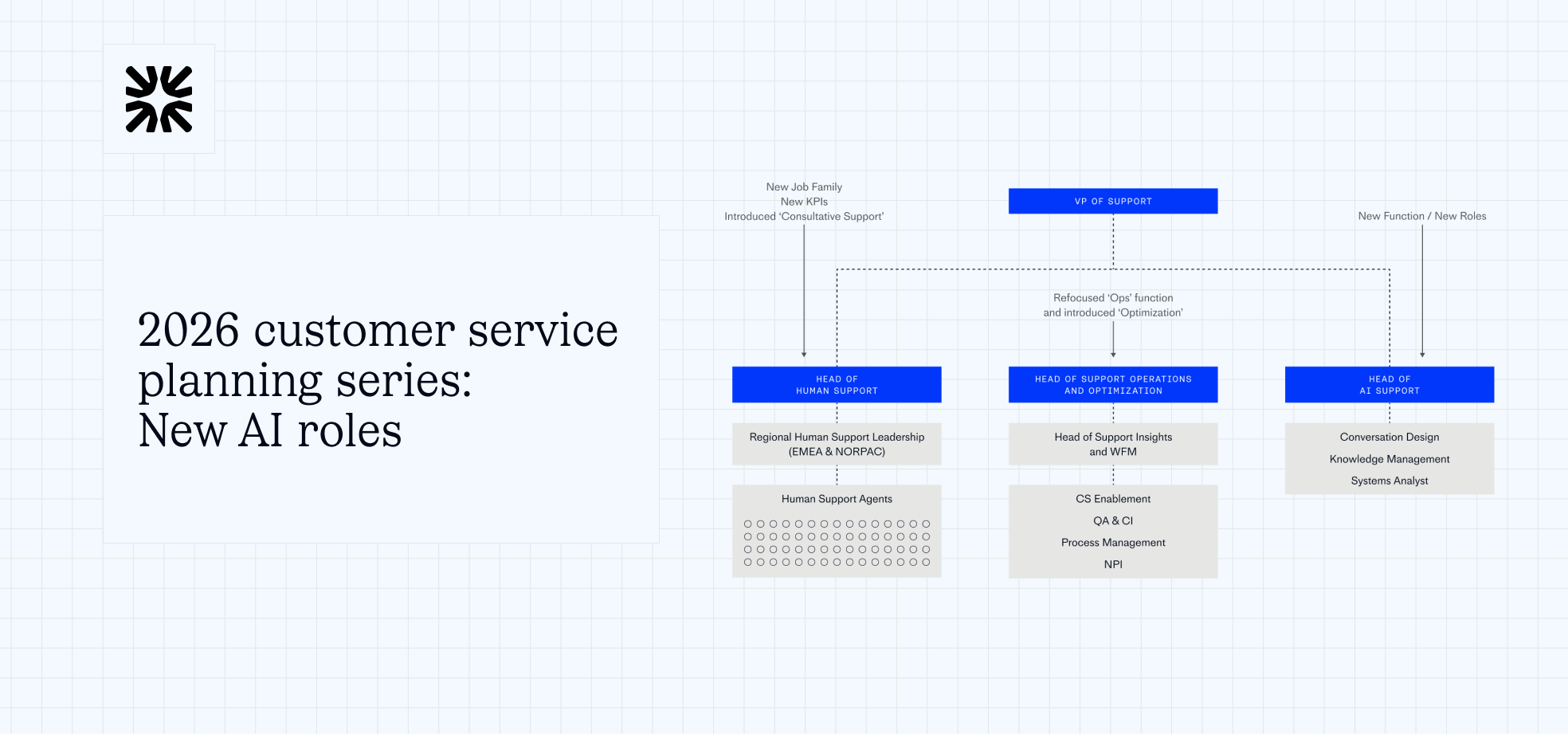
At Intercom, our Support team is now structured around three pillars: Human Support, AI Support, and Support Operations and Optimization.
Each function includes evolving roles and responsibilities, but all of them work together as a system, with clear ownership and shared accountability for AI performance.
Putting it all together
Once AI Agents handle most conversations, your team’s work moves from “answering questions” to “designing and improving the system that answers questions.” They become the force that steers quality, rather than the one that carries the volume.
This is why new roles are important. It’s not because they’re trendy, but because the performance of your support organization now depends on the performance of AI, and no AI Agent succeeds without clear ownership of content, behavior, workflows, and improvement cycles.
That’s the pattern we’ve seen from working with so many teams:
If you take one thing away from this week’s article, let it be this: if AI is going to handle the majority of your customer conversations, your team needs to be designed to help it do that well.
Your roles, responsibilities, and leadership approach are now part of the architecture of AI performance.
Next week, we’ll go deeper into how these roles actually operate day-to-day – the workflows, responsibilities, rhythms, and collaboration patterns that make an AI-first support organization run.
To follow along with the series and have each new edition emailed to you directly, drop your details here.